iTero Lumina Invisalign Compatibility in 2026
The iTero Lumina is the only premium intraoral scanner manufactured by Align Technology, the company behind Invisalign, which makes its compatibility with Invisalign workflows...
Written by Agnes Markovic
Read time: 9 min read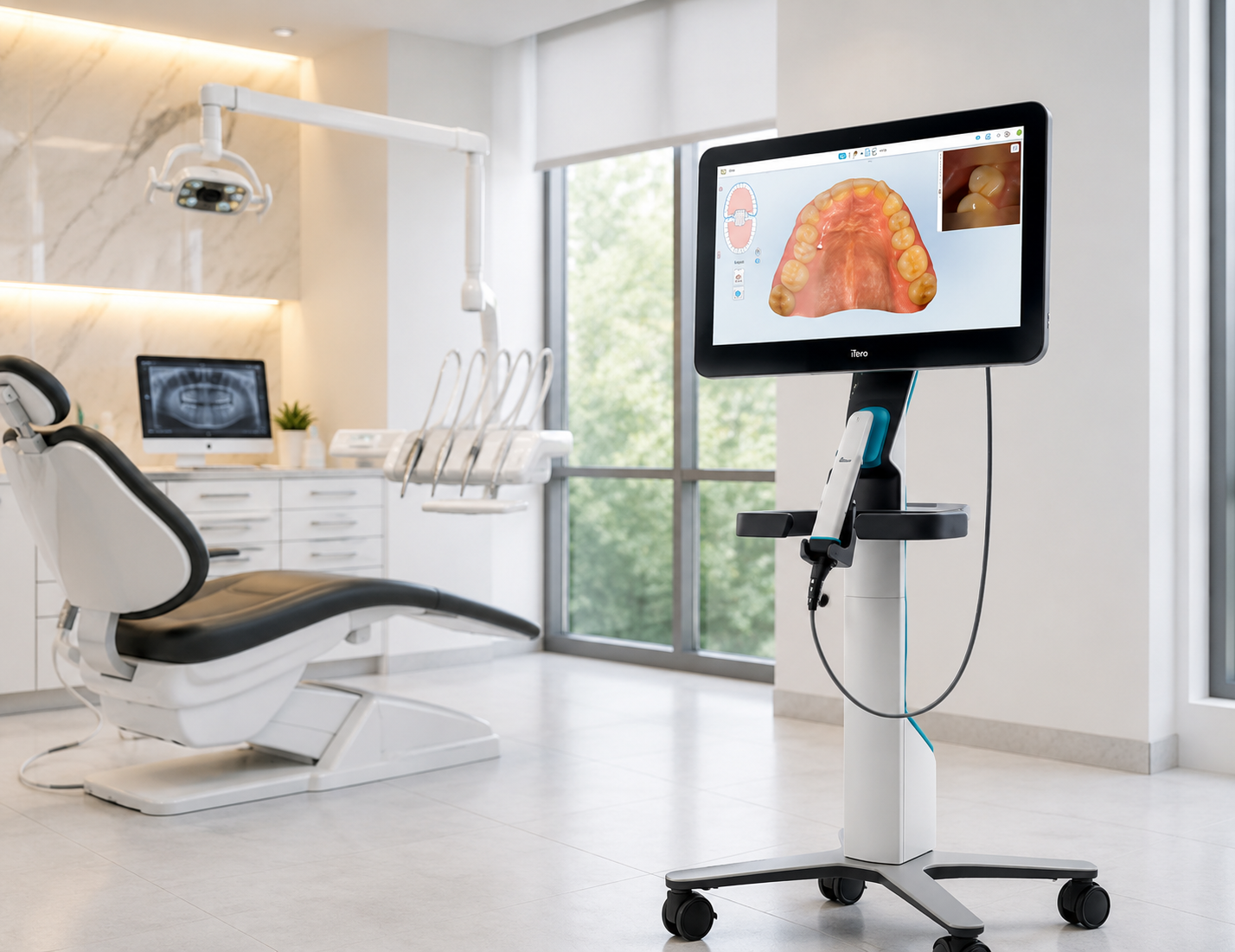
The iTero Lumina is the only premium intraoral scanner manufactured by Align Technology, the company behind Invisalign, which makes its compatibility with Invisalign workflows native rather than mediated through third-party software. For orthodontists and general practitioners evaluating a scanner upgrade in 2026, the question of iTero Lumina Invisalign compatibility extends well beyond simple case submission. It now covers NIRI caries detection on the Lumina Pro, the Align Oral Health Suite, faster full arch scan times, and tighter ClinCheck integration. This article reviews the current Lumina family in 2026, the specifications that matter for clear aligner cases, pricing in USD, and how the scanner stacks up against the TRIOS 5, Primescan, and Medit alternatives.
TL;DR
The headline points before the clinical detail:
The iTero Lumina is fully compatible with Invisalign and provides native case submission, ClinCheck integration, Invisalign Outcome Simulator Pro, and Align Oral Health Suite access out of the box.
The 2026 Lumina family contains two SKUs, the standard iTero Lumina and the iTero Lumina Pro, with NIRI caries detection exclusive to the Pro model released in March 2025.
Full arch scan time is approximately 30 seconds, roughly 2x faster than the iTero Element 5D, with pricing in the 45,000 to 50,000 USD range depending on configuration and Invisalign case volume.
TRIOS 5, Primescan, and Medit scanners are not on Align Technology's qualified third-party list for native Invisalign submission, so practices using those scanners rely on STL export or alternative aligner platforms.
What Is The iTero Lumina in 2026?
The iTero Lumina is a next-generation intraoral scanner from Align Technology that uses Multi-Direct Capture imaging technology in place of the confocal system used in earlier iTero models. The 2026 product line is not the same single device that launched in early 2024, so practices comparing quotes should confirm which SKU is on the table before signing.
Release Date And Current SKUs
Align Technology announced the original iTero Lumina on January 31, 2024, with commercial availability following in February 2024. The next-generation release on March 6, 2025, introduced the iTero Lumina Pro dental imaging system, which added Near Infra-Red Imaging (NIRI) and restorative workflow capabilities to the Lumina platform. Existing standard Lumina owners received a software update beginning in April 2025 that unlocked restorative and diagnostic support, although NIRI remains hardware-restricted to the Pro variant.
The 2026 Lumina family consists of:
iTero Lumina, the standard intraoral scanner, capable of orthodontic and restorative workflows, without NIRI hardware
iTero Lumina Pro, the dental imaging system with NIRI caries detection above the gingiva and full restorative capability
Both run on the iTero Plus Series platform and are available in cart and mobile configurations, with PC versions offered for Align-authorized laptop hardware that meets the company's published specifications.
Does Invisalign Accept iTero Lumina Scans?
Yes. The iTero Lumina is an Align Technology product, which makes Invisalign compatibility native and automated rather than dependent on STL export. According to Align Technology's official product documentation, every scan captured on the Lumina can be submitted directly to Invisalign through MyiTero and the iTero Doctor Site, with no intermediate file conversion or third-party bridge software needed.
Native Invisalign Workflow On The Lumina
The integration spans every stage of an Invisalign case, from records to refinements. Practices upgrading from a non-Align scanner often understate how much chair-side time the native workflow saves, because the comparison sits at the workflow layer rather than the file-export layer.
The Lumina supports:
Invisalign case submission with one-click upload to ClinCheck
Invisalign Outcome Simulator Pro with in-face simulation for chairside patient communication
Invisalign Smile Architect for ortho-restorative case planning
iTero TimeLapse for monitoring tooth movement, wear, and gingival recession across visits
DentalMonitoring and Invisalign Virtual Care compatibility for remote progress assessment
iTero Lumina Specifications That Matter for Invisalign Cases
The specifications most relevant to clear aligner workflows are scan speed, accuracy across the full arch, wand ergonomics, and the supporting AI feature set, since Invisalign cases require a clean full arch capture along with consistent occlusal registration.
Specification | iTero Lumina (2026) |
Full arch scan time | Approximately 30 seconds (2x faster than iTero Element 5D) |
Imaging technology | iTero Multi-Direct Capture with 6 cameras at the wand tip |
Field of view | 3x larger than iTero Element 5D at 12 mm scan distance |
Maximum capture distance | Up to 25 mm |
Wand weight | 260 grams, approximately 50% lighter than previous iTero models |
Detail resolution | Captures features as small as 30 micrometers |
Accuracy benchmark | Outperformed TRIOS 5, CS3800, Medit i700, and Alliedstar in ADA/ANSI 132 bench testing (Align Technology data, July 2024) |
Tip type | Single-use, approximately 2.50 USD per tip |
Configurations | Cart, mobile, and PC |
iTero Lumina Full Arch Scan Time and Scan Speed
A full arch scan on the iTero Lumina takes approximately 30 seconds, with Align Technology's published data placing this at roughly twice the speed of the iTero Element 5D. The speed advantage comes from the wider field of view and the simultaneous multi-angle capture from the six cameras housed at the wand tip, which removes much of the maneuvering required on confocal scanners. For an orthodontic practice scanning 20 Invisalign records per week, the cumulative chair-time saved translates into meaningful capacity gains over a quarter.
iTero Lumina AI Features in 2026
The AI feature set on the Lumina platform has expanded significantly since the 2024 launch, with the most clinically meaningful additions arriving through the March 2025 next-generation release and ongoing software updates from Align Technology. Some features are exclusive to the Lumina Pro hardware, so confirming the SKU on the quote matters.
NIRI Caries Detection On The Lumina Pro
NIRI uses near-infrared light to highlight interproximal caries above the gingiva without radiation. According to Align Technology, the technology was first validated on the iTero Element 5D against bitewing radiographs, and the Lumina Pro is the only Lumina-family device with the NIRI hardware needed to capture these frames. AI overlays in the Align Oral Health Suite then highlight suspect lesions for clinician review. A November 2025 descriptive case series published in DDS News reported that the AI overlay can occasionally miss early enamel lesions that NIRI frames still capture, which reinforces that clinician interpretation remains essential.
Invisalign Outcome Simulator Pro
Invisalign Outcome Simulator Pro generates an in-person simulation of post-treatment results during the new patient consultation. The 2025 update added multi-treatment simulations, with separate flows for Invisalign ortho-only cases and Invisalign Smile Architect ortho-restorative cases. Practices integrating the simulator into a structured dental treatment plan consistently report higher case acceptance, particularly with adult patients weighing clear aligners against fixed orthodontic appliances.
iTero Design Suite and Align Oral Health Suite
The iTero Design Suite supports chairside design for 3D-printed models, bite splints, and restorations, available on all iTero models with a full service plan. The Align Oral Health Suite overlays clinical findings on Lumina scan images during the consultation, which surfaces conditions such as gingival recession, occlusal wear, and tooth movement before the orthodontic plan is finalized. Both tools share patient data with MyiTero and the iTero Doctor Site, which means scans, simulations, and findings travel together rather than in separate exports.
iTero Lumina Price And Cost In 2026 (USD)
The approximate recommended retail price of the iTero Lumina in 2026 sits between 45,000 and 50,000 USD, although the actual quoted price varies based on Invisalign case volume, regional pricing, and any active Align Technology promotions. The Lumina Pro carries a premium above this range because of its NIRI hardware and full restorative imaging capability. Practices opening a new dental practice should budget the scanner as part of overall capital equipment planning, alongside CBCT, dental chairs, and sterilization.
Total cost of ownership includes:
Acquisition cost, between 45,000 and 50,000 USD for the standard Lumina, with Lumina Pro typically priced higher
Single-use scanning tips, approximately 2.50 USD per tip in current pricing
Service plan tier, with some software features such as the iTero Design Suite tied to full service coverage
PC hardware compliance costs for the PC configuration SKU, since Align mandates specific laptop specifications
Replacement and upgrade pricing for existing iTero Element or Element Plus practices, which can lower the net acquisition cost
For practices doing 10 or more Invisalign cases per month, the chair-time savings from a 30-second full arch scan, combined with Invisalign case-volume discounts that Align frequently applies, can shorten the payback period substantially.
iTero Lumina vs. iTero Element 5D For Invisalign
For Invisalign-focused practices already running an iTero Element 5D or Element 5D Plus, the upgrade decision turns on speed, ergonomics, and which NIRI configuration matters. Both scanners submit cases natively to Invisalign, so the comparison sits firmly in the experience and capability category rather than compatibility.
The Element 5D remains a strong scanner for restorative and Invisalign mixed practices, especially where the budget is tight. Practices that rely heavily on NIRI for routine caries screening should specifically compare against the Lumina Pro, since the standard Lumina does not include NIRI hardware. The Lumina advantages over the Element 5D include the faster full arch scan time, the smaller and lighter wand, the larger 25 mm capture distance, and the 3x larger field of view, all of which combine to lower the learning curve and reduce rescan rates.
iTero Lumina vs. TRIOS 5, Primescan, and Medit for Invisalign
The most common comparisons for the iTero Lumina in 2026 are against the 3Shape TRIOS 5, the Dentsply Sirona Primescan, and the Medit i700 and i900. Each scanner is a capable performer in its own ecosystem, although native Invisalign submission is the dividing line for clinicians whose case mix is aligner-heavy.
TRIOS 5 Invisalign Compatibility In 2024 And 2026
The TRIOS 5 and TRIOS 6 do not have native Invisalign case submission. According to 3Shape's own support documentation, TRIOS 3 remains the only TRIOS model that can submit scans directly to Invisalign. Practices using a TRIOS 5 for Invisalign cases typically export STL files and follow a manual upload path, which adds steps and limits access to features such as the Outcome Simulator.
The TRIOS 5 still wins on wireless ergonomics, open ecosystem connectivity, and broad lab compatibility through 3Shape Unite. Practices doing mixed restorative work with light Invisalign volume often prefer it. For aligner-heavy ortho workflows, the workflow tax becomes harder to justify against the Lumina.
Primescan vs. iTero For Invisalign
The Dentsply Sirona Primescan is not on Align Technology's qualified third-party scanner list for Invisalign case submission. The older CEREC Omnicam was qualified, although Primescan and the newer Primescan 2 were not added under the same workflow. Primescan integrates natively with SureSmile, Dentsply Sirona's own clear aligner system, and works through DS Core for CAD/CAM milling and lab communication. Practices considering Primescan should be clear-eyed about the difference between SureSmile and Invisalign workflows before committing capital. For a deeper look at this specific topic, see the dedicated Primescan Invisalign compatibility breakdown.
Does Invisalign Accept Medit Scans In 2024 And 2026?
The Medit i700 and i900 scanners are not on Align Technology's qualified scanner list for Invisalign submission. Medit's strength is open-export economics and a strong feature set without subscription fees, which suits practices doing mixed restorative work where Invisalign is not the dominant aligner system. For clinicians evaluating the broader scanner field, the 3Shape TRIOS scanner lineup and the iTero family represent the two ecosystems with the deepest aligner integration in 2026.
Should Your Practice Upgrade To The iTero Lumina in 2026?
The decision to upgrade depends almost entirely on Invisalign case volume, the role of NIRI caries detection in routine exams, and the configuration of the current scanner fleet. Four practice profiles are worth considering.
High-Volume Invisalign Orthodontic Practices
For practices submitting 10 or more Invisalign cases per month, the iTero Lumina is generally the default choice because workflow efficiencies, native Outcome Simulator access, and Align Technology's accuracy data align with a high-volume Invisalign business model. Adult Invisalign consultations in particular benefit from the in-face simulator at the first visit, where case acceptance hinges on visualization.
General Practitioners Doing Mixed Restorative And Invisalign
GPs combining restorative work with a meaningful Invisalign volume should consider the Lumina Pro specifically, because NIRI caries detection adds chairside diagnostic value to every exam, and the restorative software unlocked in April 2025 makes the Pro a credible single-device solution for crown and bridge work alongside aligner records.
Cost-Sensitive General Practices With Low Invisalign Volume
Practices doing fewer than five Invisalign cases per month often find that the iTero Element 5D Plus, or an open-platform scanner like the Medit i700, offers a better return at the current price point. The Lumina's premium features only deliver clear payback at certain volume thresholds, so volume modeling should precede the purchase order.
DSOs And Multi-Location Groups
For DSO procurement teams evaluating a fleet upgrade, the case for the Lumina rests on standardizing the Invisalign workflow across locations and the data infrastructure that MyiTero provides across multiple offices. A pilot in two to three locations before fleet-rolling is the conventional recommendation, with chair-time, rescan rate, and case acceptance as the primary measurement criteria.
Best Practices for Adopting the iTero Lumina in 2026
Adoption of the Lumina is straightforward compared with first-generation scanners, although the Multi-Direct Capture technique differs from the confocal scanning patterns used on older iTero hardware. Assistants and ortho techs benefit from targeted training on the new workflow, not just product orientation.
Run a two-week trial alongside the existing scanner and compare rescan rate, full arch capture time, and final scan accuracy on the same patient cohort
Validate full arch implant workflows on real cases before standardizing the Lumina across the practice, particularly for All-on-4 and All-on-6 protocols
Confirm laptop and PC configuration compliance if the PC SKU is being considered, since Align Technology mandates specific hardware specifications
Train scanning assistants on the Multi-Direct Capture technique, which uses lifted-wand transitions rather than the rolling motion required by confocal scanners
Audit current Invisalign submission workflows for redundant steps that Lumina's native integration can eliminate, such as STL exports and manual upload routines
Integrate the Outcome Simulator Pro into the new patient consultation script to maximize case acceptance during the first visit
Bottom Line
The iTero Lumina in 2026 offers the deepest native Invisalign compatibility of any scanner on the market, with full ClinCheck submission, Invisalign Outcome Simulator Pro, and the Align Oral Health Suite built into the standard workflow. The March 2025 next-generation release added NIRI caries detection on the Lumina Pro, restorative capabilities on the standard Lumina, and software updates that close the gap with the Element 5D Plus on restorative work. For Invisalign-volume practices, the 30-second full arch scan time and the 45,000 to 50,000 USD price range make the Lumina a credible capital investment in 2026, with the Lumina Pro the right call for GPs who also rely on NIRI for routine caries diagnostics.
Already own the scanner? Our step-by-step guide to the MyITero login covers account setup, doctor versus lab access, and the most common sign-in errors.
Frequently Asked Questions
Does Invisalign accept iTero Lumina scans?
Yes. The iTero Lumina is manufactured by Align Technology, the maker of Invisalign, and offers native Invisalign case submission, ClinCheck integration, and the Invisalign Outcome Simulator Pro. No STL export or third-party workaround is required for clear aligner submissions, and every Lumina configuration routes scans through MyiTero and the iTero Doctor Site.
How much does iTero Lumina cost?
The iTero Lumina is priced at approximately 45,000 to 50,000 USD in 2026, with the iTero Lumina Pro at a premium because of its NIRI hardware and full restorative capability. Align Technology offers volume-linked discounts tied to Invisalign case numbers, and upgrade pricing is typically available for existing iTero Element or Element Plus owners.
How much does iTero Lumina cost in 2026 compared with previous years?
Pricing in 2026 remains in the 45,000 to 50,000 USD range for the standard Lumina, broadly in line with the 2024 launch price. The Lumina Pro, launched in March 2025, sits above this range. Align Technology continues to discount the scanner against Invisalign case volume, so the effective price for high-volume Invisalign practices can be materially lower than the list price.
Does iTero Lumina have NIRI caries detection?
The standard iTero Lumina does not include NIRI. Near Infra-Red Imaging for interproximal caries detection above the gingiva is exclusive to the iTero Lumina Pro dental imaging system, which Align Technology announced in March 2025. Practices that need NIRI on a Lumina-family device should specify the Pro variant on the quote.
What is the iTero Lumina full arch scan time?
A full arch scan on the iTero Lumina takes approximately 30 seconds, which is roughly twice the speed of the iTero Element 5D according to Align Technology's published benchmarks. The scan speed comes from Multi-Direct Capture technology and a 3x larger field of view at 12 mm scan distance, which reduces the wand movement required during the scan.
iTero Lumina vs. iTero Element 5D for Invisalign, which is better?
Both scanners submit natively to Invisalign and integrate with ClinCheck. The Lumina is faster, smaller, lighter, and more accurate based on Align Technology's bench testing. The relevant trade-off is NIRI, where the Element 5D includes the technology, and in the Lumina family, only the Lumina Pro has NIRI hardware. Element 5D users who depend on NIRI for caries diagnostics should compare specifically against the Lumina Pro.
Does Invisalign accept Trios 5 scans in 2024 and 2026?
TRIOS 5 does not have native Invisalign case submission in either 2024 or 2026. According to 3Shape's support documentation, only TRIOS 3 can submit scans directly to Invisalign. TRIOS 5 and TRIOS 6 users typically rely on STL export workflows rather than a native submission path, which limits access to features such as the Outcome Simulator.
Is Primescan compatible with Invisalign?
The Dentsply Sirona Primescan is not on Align Technology's qualified third-party scanner list for Invisalign case submission. The older CEREC Omnicam was qualified, while Primescan integrates natively with SureSmile, Dentsply Sirona's own clear aligner system. Practices considering Primescan should plan their aligner workflow around SureSmile rather than Invisalign.
Does Invisalign accept Medit scans in 2024, 2025, and 2026?
Medit i700 and i900 scanners are not on Align Technology's qualified scanner list for Invisalign submission in 2024 or 2026. Medit suits practices doing mixed restorative work where Invisalign is not the dominant aligner system, since the open-export model and absence of subscription fees offer strong economics outside the Invisalign workflow.