Rating: 3.9/5
TheraCal LC Review: How Well Does This Pulp Liner Perform?
This TheraCal LC review measures BISCO's light-cured liner against its published record. A 2026 randomized trial logged seven pulpotomy failures with TheraCal LC and none with...
Reviewed by Agnes Markovic
Pros
- Sets in 20 seconds per layer and allows restoration at the same visit
- Needs no mixing, which reduces waste and suits small areas
- Bonded better to composite than MTA and Biodentine in 2025 laboratory testing
- Shows high radiopacity on follow-up radiographs
- Showed lower solubility than Dycal and MTA in laboratory work
- Releases more calcium than calcium hydroxide liners in available comparisons
- Reached 96.2% success in a 12-month randomized indirect capping trial
- Contains no HEMA, according to the manufacturer
Cons
- Places methacrylate monomers against pulp tissue in direct capping
- Reduced cell viability in several independent laboratory studies
- Hydrated incompletely in a tooth culture model
- Produced fewer complete dentin bridges than Biodentine and MTA in human histology
- Recorded 75% pulpotomy success against 94.4% for MTA in a 2026 trial
- Requires layers of 1 mm or less with adequate light access
- Cannot be left exposed and carries no pulpotomy or root repair labeling
- Showed no benefit over Dycal or no liner in a 12-month indirect capping trial
This TheraCal LC review measures BISCO's light-cured liner against its published record. A 2026 randomized trial logged seven pulpotomy failures with TheraCal LC and none with MTA, while a 90-tooth indirect capping trial reported 96.2% success. Those two results frame the clinical question: how close to vital pulp this resin-based material should go.
TL;DR
TheraCal LC protects deep dentin well when intact dentin still covers the pulp
A 12-month trial recorded 96.2% indirect capping success, with no benefit over Dycal or no liner
Biodentine and MTA outperform it on exposed pulp in human histology and a 2026 pulpotomy trial
Clinicians should reserve it for liner work and small mechanical exposures when a non-resin cement is impractical
What Is TheraCal LC?
TheraCal LC is a single-paste, light-cured calcium silicate held in a hydrophilic resin matrix, sold as a pulp protectant and liner. It sits between two families of materials, and most arguments about it trace back to that position.
BISCO's 510(k) summary, dated October 25, 2006, describes a resin-based, MTA-filled liner and names Prisma VLC Dycal as its predicate device. The filing cites a side-by-side comparison with that calcium hydroxide liner plus biocompatibility testing. It lists no human pulp-healing data, so most of the clinical evidence reached the literature years after the paste reached operatories.
Conventional MTA sets over hours, which makes same-visit bonding difficult. A light-curable resin removes the wait, and every later debate about this product concerns what that resin costs biologically.
Composition
Published formulations have shifted across patents and safety data sheets, so older papers do not always describe the current paste. A 2018 review in the International Journal of Dentistry traced those versions and reported the following ranges.
Portland cement at 30–50% in a 2012 safety data sheet
Polyethylene glycol dimethacrylate (PEGDMA) at 10–30% in the same sheet
Barium zirconate at 1–10% as the radiopacifier
Bis-GMA listed in a 2011 sheet and undetected in one independent analysis
BISCO states that the paste is free of HEMA, a monomer long linked to pulpal inflammation in resin-modified glass ionomers. PEGDMA and any other residual methacrylates remain in the discussion, since the label warns that the product contains polymerizable methacrylate monomers.
How TheraCal LC Sets
Setting happens in two stages that run on different clocks. Light polymerizes the resin within seconds and gives the clinician a working set. Hydration of the silicate particles comes afterward, and it depends on water reaching them through a matrix that has already cured.
The paste contains no water of its own. In a tooth culture model, Camilleri and colleagues found large unhydrated particles after pulp capping and attributed them to limited moisture, with no calcium hydroxide detected and less calcium leaching than Biodentine.
This finding explains the instruction to leave dentin visibly moist. Air-drying the floor before placement reduces the moisture available to the silicate phase and also works against the seal.
Reported Properties
Manufacturer figures and independent figures diverge on pH duration and calcium release, so the table separates them by source.
Property | Reported result | Source type |
|---|---|---|
pH at 3 hours | 10–11 | Manufacturer |
pH over time | 10–11 to day 3, about 8 from day 7 to day 28 | Independent laboratory |
Calcium release | 234 µg/cm² at 7 days | Manufacturer, data on file |
Calcium release, relative | Above Dycal, below ProRoot MTA and Biodentine | Independent studies |
Radiopacity | 2.6 mm Al | Manufacturer |
Solubility | Lower than calcium hydroxide and calcium silicate comparators | Independent studies |
Cure depth | 1 mm labeled, 1.7 mm reported after 20 s | Manufacturer and independent |
Packaging And Storage
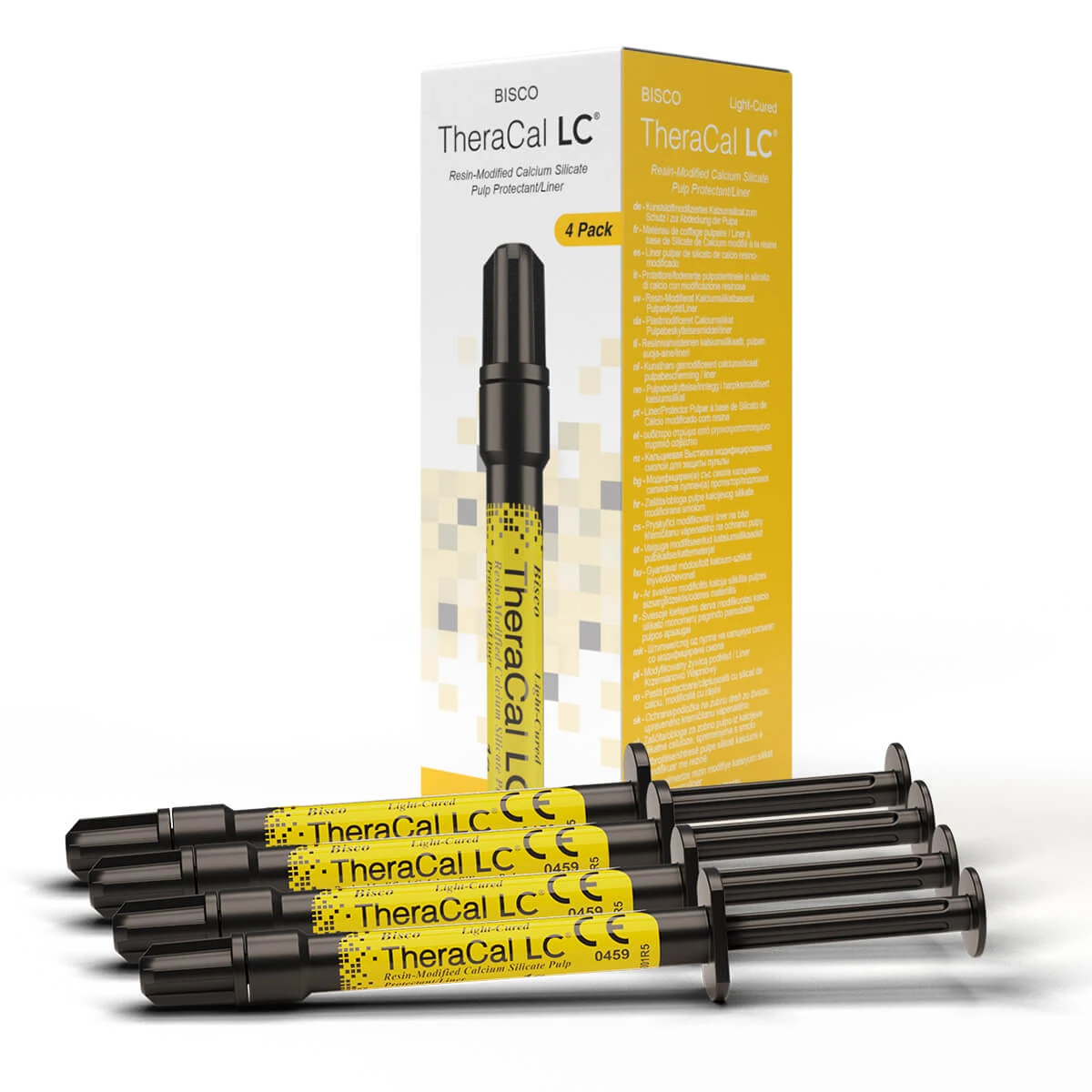
The paste ships in 1 g syringes that fit a chairside restorative setup with no extra equipment.
BISCO sells a four-syringe package (H-33014P) and single-syringe refills (H-3301P), with 22-gauge black disposable tips sold separately in packs of 50. Rev 6-24 calls for storage at 20–25°C (68–77°F) and says contaminated tips and syringes should be discarded, which matters in a practice where one syringe moves between operatories across many patients.
TheraCal LC Indications
The current instructions for use (Rev 6-24) restrict the product to licensed dentists and divide the TheraCal LC indications into pulp exposures and deep preparations.
Direct Pulp Capping
BISCO indicates the paste for any pulpal exposure once hemostasis is achieved, and the label draws no distinction between a carious exposure and a clean bur exposure.
A carious exposure delivers bacteria and already inflamed tissue to the interface, whereas a pinpoint bur exposure through sound dentin in an asymptomatic tooth starts from a far better biological position. Case selection has to separate what the label groups together.
Indirect Capping, Liner, Base, Or Sealer
This group covers deep and large preparations, where the material does its most defensible work.
The label permits placement under amalgam and Class I or II composite restorations, other base materials and cements. BISCO also positions the paste as an alternative to calcium hydroxide, glass ionomer, cavity varnish, zinc phosphate and IRM.
Contraindications And Precautions
One contraindication appears on the label, covering patients with a history of severe allergic reaction to methacrylate resins. The precautions carry more day-to-day weight.
Keep the material off enamel and cavity margins
Never leave it exposed to the oral environment
Use a rubber dam or other adequate isolation
Control pulpal hemorrhage before placement, and consider endodontic treatment if bleeding persists
Isolation failures are hard to detect after the fact, which is why a rubber dam belongs in any exposure protocol regardless of the material chosen.
Uses Outside The Label
Pulpotomy does not appear among the indications in Rev 6-24, which makes it off-label for this product. BISCO sells a separate dual-cured material, TheraCal PT, within its pulp therapy range.
The oral exposure warning also rules out interim restoration. Septodont lists pulpotomy, perforation repair, resorption repair, and apexification alongside temporary enamel restoration in the Biodentine instructions, a far wider scope than a light-cured liner can claim.
TheraCal LC Pulp Capping: Clinical Technique
TheraCal LC pulp capping appears easy because the syringe removes mixing, yet isolation and cure quality still determine what reaches the pulp. The sequence below follows the manufacturer's instructions, and the notes after it draw on endodontic guidance.
Direct Pulp Capping Protocol
The labeled sequence for an exposure runs to six steps and assumes a rubber dam is already in place.
Complete the cavity preparation under rubber dam isolation
Achieve hemostasis with a saline-dampened sterile cotton pellet placed gently on the exposure
Blot the preparation with a sterile pellet and leave the dentin visibly moist
Apply TheraCal LC in layers of 1 mm or less, covering the exposure and extending at least 1 mm onto sound dentin
Light cure each increment for 20 seconds
Place the adhesive or restorative layer according to its own manufacturer's directions
Indirect Pulp Capping And Liner Protocol
The indirect sequence is shorter because no hemostasis step applies when the pulp stays covered.
Isolate the tooth and complete the preparation, leaving dentin visibly moist
Apply the paste to the cavity floor in layers of 1 mm or less, forming a smooth surface over deep dentin
Light cure each increment for 20 seconds
Place the adhesive or restorative layer according to its own manufacturer's directions
Clinical Notes That Change Outcomes
Several decisions sit outside the numbered steps, and guidelines disagree on one of them.
Rev 6-24 speaks of removing all infected carious tissue. The AAE position statement on vital pulp therapy also calls complete caries removal essential, on the grounds that residual caries hides the condition of the pulp. The European Society of Endodontology favors selective one-stage removal or stepwise excavation in deep lesions to avoid exposure. A clinician lining over retained affected dentin under ESE logic should record that decision in the dental treatment plan, so the next operator knows soft dentin was left on purpose.
Hemostasis is another point where the label and specialty guidance part ways. Rev 6-24 names saline, while the AAE describes sodium hypochlorite held against the pulp for 5 to 10 minutes as the typical route, with disinfection of the dentin-pulp interface as an added benefit. The ESE also asks for a disinfectant, along with magnification. Bleeding that continues after that interval gives direct information about pulpal inflammation, and the AAE treats that observation as part of diagnosis.
The 1 mm limit protects polymerization close to the pulp. Unreacted monomer is the main biological objection to this paste, and the 2018 review ties the reported cytotoxicity to it. A syringe tip in a deep proximal box can easily deposit more than 1 mm at the line angle, so thickness deserves a visual check before the light goes on.
Rev 6-24 specifies 20 seconds and leaves irradiance unstated. A UCLA poster recorded higher cytotoxicity in dental pulp stem cells after a 20-second cure than after a 40-second overcure, and its authors questioned whether the labeled time is sufficient. No clinical protocol has validated a longer exposure. Radiometer checks on the curing light address the variable an operator controls today.
Selective-etch and total-etch protocols both remain available after cure. One study on bonding over dentin replacement materials found no microstructural change in set TheraCal LC after acid etching, and total-etch followed by a self-etch primer gave the best bond values. A conference abstract by Wang and Suh reported bond strength climbing from 0.8 MPa without adhesive to 7.7–11.4 MPa with the adhesives tested, while calcium release fell from 284 µg/cm² to 6–80 µg/cm². A universal adhesive should go on only after the liner fully covers any exposure, since BISCO itself says MDP-containing adhesives are not meant for the pulp.
The AAE links immediate permanent restoration to less microleakage and less postoperative sensitivity. Immediate restorability is the practical advantage this paste offers, and a bulk-fill composite or fiber-reinforced dentin replacement can go in at the same visit.
How Well Does TheraCal LC Perform?
TheraCal LC performs most predictably when dentin separates it from the pulp, and its published results scatter as that barrier disappears. Laboratory chemistry, cell culture, histology, and patient trials each answer a different question, so they are treated separately here.
Calcium Release And Alkalinity
The paste releases calcium and raises local pH, and the size of the effect depends on what it is compared against.
Gandolfi and colleagues measured pH 10–11 from 3 hours to 3 days, followed by pH 8 from day 7 to day 28, with apatite precipitating in phosphate-containing solution. BISCO cites pH 10–11 over 90 days, relying on a dissertation, which is a far longer alkaline window than the Bologna data showed.
Comparators change the picture. Against Dycal and other resin liners, TheraCal LC ranks first in the data BISCO publishes. Independent work summarized in the 2018 review places it below Biodentine and ProRoot MTA, and a 2022 study on human dental pulp stem cells also recorded significantly more calcium from MTA.
A 2025 study in Frontiers in Dental Medicine added a surface finding. After 21 days in simulated body fluid, Biodentine showed the most pronounced calcium phosphate formation, and TheraCal LC showed minimal mineralization.
Bonding And Handling
Resin chemistry gives this paste its clearest laboratory advantage. In the same 2025 study, TheraCal LC recorded significantly higher shear bond strength to composite than either MTA or Biodentine (p < 0.003).
Radiopacity also exceeded Biodentine in that study, and BISCO's 2.6 mm Al figure means the layer should read clearly on a bitewing at recall. Handling needs no triturator. For a child whose cooperation is running out, that difference can decide which material gets used.
Cytotoxicity And Residual Monomers
Cell culture work supplies the sharpest criticism of TheraCal LC, and the findings recur across laboratories.
Kunert and colleagues exposed a monocyte/macrophage cell line to eluates of six bioactive materials in 2022. TheraCal LC alone reduced viability significantly at 24 and 48 hours and produced DNA damage in a comet assay. The authors advised against it for vital pulp therapy.
Küden's group used human dental pulp stem cells and found MTA significantly less cytotoxic than TheraCal LC at every time point through day 7. Novotná and colleagues reported high cytotoxicity at extract concentrations of 25% and above, with 68.18% viability at 10%, a level they classed as potentially cytotoxic.
Eluate tests cannot reproduce a tooth. Kunert's team acknowledged that its model omits the dentin barrier and the immune response, and its cell line was not pulp-derived. Those omissions matter most for lining, since remaining dentin can filter leachates, and that reasoning gives little protection to an exposed pulp.
BISCO answers with an unpublished 2025 UCLA report of more than 80% viability in pulp stem cells and with references to ISO evaluations that its page does not detail. Peer-reviewed publication would let clinicians weigh that report against the studies above.
Clinical Trial Outcomes
Patient trials give the most relevant data at the chair, and they remain small and varied.
Study | Procedure | Sample | Comparator | Follow-Up | Result |
|---|---|---|---|---|---|
Ravi 2026 | Full pulpotomy, irreversible pulpitis | 72 children | MTA | 12 months | 75% vs 94.4% MTA (ITT, p < 0.05) |
Mahapatra 2024 | Direct capping, posterior teeth | 42 teeth | MTA, Biodentine | 12 months | 78.57% vs 85.71% MTA and 100% Biodentine (NS) |
Semprum-Clavier 2024 | Indirect capping, permanent teeth | 90 teeth | Dycal, no liner | 12 months | 96.2% vs 100% for each comparator (NS) |
Joshi 2024 | Direct capping, sound premolars | 60 teeth | Biodentine | 6 weeks | Histology favored TheraCal LC |
Hassanpour 2023 | Pulpotomy, primary molars | 90 teeth | MTA | 12 months | No significant difference |
Bakhtiar 2017 | Partial pulpotomy, sound third molars | 27 teeth | Biodentine, MTA | 8 weeks | Complete bridge 11% vs 100% Biodentine and 56% MTA |
The Semprum-Clavier trial at the University of Illinois Chicago is the cleanest test of the liner role. Teeth stayed vital at one year in 96.2% of the TheraCal LC group, and no significant difference separated the three protocols. The no-liner arm reached 100%, which should temper any claim that a calcium-releasing liner improves outcomes under a well-sealed composite.
Direct capping results are harder to read. The Mahapatra trial found no significant difference, but it enrolled 14 teeth per group. A 21-point spread between TheraCal LC and Biodentine cannot establish equivalence at that size, even though the authors described TheraCal LC as a usable alternative.
A 2022 systematic review and meta-analysis found no difference in clinical success between TheraCal LC and comparators, with the certainty of evidence rated low to moderate because of risk of bias. The AAE offers wider context, reporting 85–100% success at 1–2 years for calcium silicate cements in teeth with irreversible pulpitis and 43–92% for an older group that pairs calcium hydroxide and glass ionomers with resin-based products.
Follow-up is the weakest feature of this literature. Every trial in the table stopped at or before 12 months, and a pulp cap that looks healthy at one year can still fail later. A two-year direct capping study summarized in the 2018 review reported 93.3% success with TheraCal LC, against 83.3% for a self-etch bonding agent and 66.6% for Fuji IX. Neither comparator represents current first-line care for an exposed pulp, and BISCO's frequently cited primate work shares that limit, with better bridges reported against glass ionomer and light-cured Dycal.
Inflamed pulps produced the clearest negative result. In the 2026 trial by Ravi and colleagues, children aged 9–14 with symptomatic mature molars received full pulpotomy, and the TheraCal LC group recorded seven failures against none with MTA.
Human histology leans the same way. Bakhtiar's group extracted third molars 8 weeks after partial pulpotomy and found complete dentin bridges in 11% of TheraCal LC teeth. Joshi and colleagues reported the reverse in caries-free premolars at 6 weeks, a short interval in teeth with no inflammatory burden.
What Patients Reported
Pain and sensitivity are the outcomes patients notice, and several trials recorded them directly.
Pain scores in the Ravi trial were significantly lower with MTA at each assessment through day 5. In the Bakhtiar study, two patients in the TheraCal LC group reported significant pain at one week, while the MTA and Biodentine groups had no thermal or palpation sensitivity.
Indirect capping tells a calmer story. Semprum-Clavier's group tracked visual analog pain scores from 24 hours to 12 months and found no significant sensitivity difference among the protocols. BISCO's brochure promises virtually no postoperative sensitivity, and that trial suggests the absence of sensitivity may owe as much to the sealed restoration as to the liner beneath it.
Primary Teeth
Pediatric results are generally more favorable, although follow-up rarely passes 12 months.
Hassanpour and colleagues found no significant difference from MTA in a split-mouth trial of 90 primary molars. A Mansoura University study recorded 88.9% clinical success with TheraCal against 73.3% for formocresol. Direct capping looked less secure in a randomized trial in primary molars, with 12-month clinical success of 70% against 85% for indirect capping, a difference that did not reach significance.
Pulpotomy claims belong in the record with the correct CDT code, and the off-label status of this material should appear in the consent discussion.
TheraCal LC Vs Biodentine
The TheraCal LC vs Biodentine decision comes down to how much chair time a case can spare and how close the material will sit to pulp tissue.
Biodentine's composition is water-based tricalcium silicate with no resin phase. Its instructions call for a 30-second capsule mix, and Septodont advises waiting 12–15 minutes before covering it with the final restoration.
Factor | TheraCal LC | Biodentine |
|---|---|---|
Chemistry | Resin-modified calcium silicate | Water-based tricalcium silicate |
Delivery | Single-paste syringe | Capsule and liquid, triturated |
Set | 20 s light cure per layer | About 12 minutes |
Layering | 1 mm increments | Bulk placement |
Hydration in tooth model | Incomplete | Hydrates and forms calcium hydroxide |
Calcium release | Lower | Higher |
Bond to composite | Significantly higher | Lower |
Radiopacity | Significantly higher | Lower |
Oral exposure | Must be covered | Labeled for temporary enamel restoration |
Pulpotomy | Not labeled | Labeled |
Root and perforation repair | Not labeled | Labeled |
Biological Performance
Biodentine holds the stronger record when placed against pulp tissue, in animals and in humans.
Kayad and colleagues capped 40 rabbit incisors and measured significantly thicker bridges under Biodentine at weeks 1 and 2, averaging 28.16 µm and 33.66 µm. TheraCal LC showed a bridge only at week 2, averaging 15.93 µm, and inflammation scored similarly in both groups.
Bakhtiar's human data point in the same direction, with complete bridging in every Biodentine tooth. Sound teeth extracted within weeks cannot model the bacterial challenge of a carious exposure, so the most useful future trial would enroll cariously exposed permanent teeth and follow them past two years.
Clinical Workflow
Chair time is the real argument for TheraCal LC. Twelve minutes matters during a long restorative appointment, and a syringe avoids the triturator entirely.
Early bond strength has been the usual objection to Biodentine, and the Frontiers data support it. A 2026 study on maturation time concluded that the recommended 12-minute set appeared adequate, as delayed restoration had minimal influence on composite bonding.
Biodentine also allows a staged approach when the operator wants to confirm pulpal response before committing to deep margin elevation or an indirect restoration. TheraCal LC cannot be left as the surface layer between visits.
Which Material Fits Which Case
Exposure status and pulpal diagnosis matter more than brand preference when choosing between these products.
Clinical Situation | Reasonable first choice | Reasoning |
|---|---|---|
Deep dentin, no exposure, composite same visit | TheraCal LC or Biodentine | Dentin barrier remains, and TheraCal LC is faster |
Under amalgam or cement | TheraCal LC | Labeled use with simple placement |
Small, clean mechanical exposure, healthy pulp | Biodentine or MTA, TheraCal LC if impractical | Labeled, though biological evidence favors non-resin cements |
Carious exposure | Biodentine or MTA | Inflamed tissue, consistent with ESE guidance |
Partial or full pulpotomy | Biodentine or MTA | TheraCal LC is off-label with mixed results |
Interim restoration or stepwise excavation | Biodentine | TheraCal LC must not be exposed orally |
Perforation or resorption repair | Biodentine or MTA | TheraCal LC is not labeled for these uses |
Bottom Line
TheraCal LC earned its following on convenience, and that convenience holds up. A clinician working through a deep Class II can line the floor and move to adhesive after a 20-second cure, with a bond to composite that outperformed Biodentine and MTA in laboratory testing.
The 2024 Illinois trial is the result worth remembering when ordering. At 12 months, indirect capping with TheraCal LC performed as well as Dycal and as well as placing no liner, so a practice buying it for lining is paying for handling and radiopacity. Proof of better pulpal survival under a sealed composite has not appeared.
Direct contact with pulp is a separate purchasing decision. Seven failures against none in the 2026 Ravi trial came from symptomatic mature molars treated with an off-label technique, and that population sits far from the pinpoint mechanical exposure BISCO's label also covers. Long-term trials in cariously exposed adult teeth remain scarce, and clinicians choosing TheraCal LC for those cases are working ahead of the evidence.
A sensible cabinet holds both products. TheraCal LC can handle covered deep dentin, while Biodentine or MTA takes the exposures, with the choice documented alongside the pulpal diagnosis and the recall schedule.
Verdict
<p>The verdict weighs each use separately, because the evidence for lining and the evidence for exposed pulp point in different directions.</p><p>TheraCal LC deserves a place in a restorative cabinet for one job above the others: protecting deep dentin when the pulp remains covered. A 20-second cure and a syringe tip suit posterior work where time and access run short. One 12-month trial of 90 teeth reported 96.2% success, although the same trial found no advantage over Dycal or over no liner.</p><p>Exposed pulp calls for a stricter standard, because residual monomer meets tissue with no dentin in between. Human histology from Bakhtiar's group showed complete bridges in 11% of TheraCal LC teeth against 100% with Biodentine, and a 2026 trial in symptomatic molars recorded 75% success against 94.4% with MTA.</p><p>A small, clean mechanical exposure in an asymptomatic tooth remains a labeled use when a non-resin calcium silicate is impractical. Carious exposures and pulpotomies belong with Biodentine or MTA.</p><p>Placement discipline governs how the material behaves in cases where it does fit. Layers need to stay at 1 mm or less on visibly moist dentin, with a verified light and a sealed final restoration. Practices that stock only this product for pulp therapy should add a non-resin calcium silicate before the next exposure occurs.</p>
Frequently Asked Questions
What is TheraCal LC used for?
TheraCal LC is used for pulp capping and as a protective liner or base under restorative materials. Its strongest support is in lining deep dentin where the pulp remains covered.
Can TheraCal LC be placed directly on an exposed pulp?
The manufacturer indicates it for exposures after hemostasis. Direct placement remains the most debated use, since monomers contact tissue with no dentin barrier and human histology generally favors Biodentine and MTA.
Is TheraCal LC better than Biodentine?
TheraCal LC sets faster and bonds more strongly to composite, which suits lining. Biodentine forms more complete dentin bridges and carries broader indications, so it holds the stronger position for exposed pulp.
What are the TheraCal LC indications?
The TheraCal LC indications in Rev 6-24 are direct pulp capping for any exposure after hemostasis, plus indirect pulp capping and lining in deep preparations. Pulpotomy is not listed.
Is TheraCal LC toxic to the pulp?
Independent cell studies have reported reduced viability, and one reported DNA damage. Those models omit the dentin barrier and immune response, so they do not directly predict clinical failure. Trial outcomes range from favorable to significantly worse than MTA.
Does TheraCal LC contain HEMA?
BISCO states the paste is formulated without HEMA. It does contain polymerizable methacrylate monomers, and the label advises against use in patients with a history of severe allergic reaction to methacrylate resins.
How thick should TheraCal LC be placed?
The instructions specify layers of no more than 1 mm, each cured for 20 seconds. In direct capping, the material should cover the exposure and extend at least 1 mm onto sound surrounding dentin.
Do you need to etch or bond over TheraCal LC?
Adhesive use follows the directions of the adhesive manufacturer. Bond strength improved with adhesives in laboratory testing and calcium release fell, so the restoration should seal the liner completely.
Can TheraCal LC be used for pulpotomy?
Pulpotomy is not listed in the current instructions. Primary molar trials have been encouraging, while a 2026 trial in mature molars with irreversible pulpitis found significantly lower success than MTA.
What is the difference between TheraCal LC and TheraCal PT?
TheraCal PT is BISCO's dual-cured, resin-modified calcium silicate, and TheraCal LC cures by light alone. Independent data remain mixed, with one study reporting higher TEGDMA release from TheraCal PT.
Can TheraCal LC be used in children?
The label sets no age restriction, and the paste has been studied in primary molars for capping and pulpotomy. Short application time helps with younger patients, and long-term pediatric data remain limited.
How should TheraCal LC be stored?
Store it at room temperature, between 20 and 25°C (68–77°F). Dispense it promptly because it is light-curing, and discard used syringe tips.