Rating: 3.9/5
GC EQUIA Forte HT Review: A Glass-Hybrid Restorative Alternative?
This EQUIA Forte HT review looks at whether GC's glass hybrid can carry posterior load as a long-term restorative. The answer depends on cavity size and patient age, and the...
Reviewed by Agnes Markovic
Pros
- True bulk fill with no depth-of-cure limit and no layering
- Chemical adhesion after a 10-second conditioner, with no adhesive step
- Finishing at 2 minutes 30 seconds from the start of mixing
- Moisture tolerance that suits cervical lesions and uncooperative patients
- Indicated for stress-bearing Class II restorations in permanent teeth
- No polymerization shrinkage stress in the restorative body
- Fluoride release and ion exchange useful in high-caries-risk patients
- Five-year multicenter data showing parity with a nanohybrid composite
- Lower cost than composite over three years in a published model
Cons
- Lower flexural strength than composite or RMGI
- Not suitable for cusp replacement or wide MOD cavities
- Weak 24-month results in primary molar Class II restorations
- Esthetics adequate for posterior teeth but below composite
- Fewer shades than Fuji II LC in most markets
- Sensitive to contamination and desiccation in the first 2.5 minutes
- Requires a capsule mixer, an applier and a mandatory coat
- Limited long-term data specific to the HT version
This EQUIA Forte HT review looks at whether GC's glass hybrid can carry posterior load as a long-term restorative. The answer depends on cavity size and patient age, and the published trials mark those limits more clearly than the product brochures do.
TL;DR
EQUIA Forte HT restores Class I and moderate Class II cavities in permanent teeth in one bulk increment, with no adhesive step.
A five-year multicenter trial found GC EQUIA Forte performed on par with a nanohybrid composite in two-surface molar restorations.
Fuji II LC beat EQUIA Forte in primary molar Class II restorations, with 90.8% versus 66.7% success at 24 months.
Clinicians should use EQUIA Forte HT for intact-cusp posterior cavities and root caries, and keep Fuji II LC for cervical work, liners and pediatric proximal boxes.
Why Glass Hybrids Are Back on the Posterior Agenda
On 1 January 2025, Regulation (EU) 2024/1849 ended the routine use of dental amalgam across the European Union, leaving an exception only where a dentist judges it strictly necessary for a patient's medical needs. The ban on manufacturing and importing amalgam into the EU followed on 1 July 2026, according to the European Commission guidance notice.
That deadline changed the conversation in operatories well beyond Europe. Practices that once placed amalgam in high-caries-risk adults, older patients with limited mouth opening, and children who would not sit still for a layered composite now need a tooth-colored option that tolerates less-than-perfect conditions.
A bulk-fill composite solves part of the problem. It still depends on an adhesive protocol and a dry field, and it carries polymerization stress. Glass ionomers bond chemically and release fluoride, but conventional formulations have rarely lasted in occlusal load. GC built its glass hybrid category to sit between those two groups, and EQUIA Forte HT is the current version of that idea.
Understanding where it fits starts with the material itself, then the cavity design rules, and finally the trial data, which is more mixed than most product pages admit. For lesions caught early, the decision also ties back to caries progression and how much tooth structure remains.
What Is EQUIA Forte HT
EQUIA Forte HT is a bulk-fill glass hybrid restorative system that GC introduced in 2019. It pairs EQUIA Forte HT Fil, a self-curing encapsulated high-viscosity glass ionomer, with EQUIA Forte Coat, a light-cured, self-adhesive resin coating filled with nanoparticles. The letters HT stand for high translucency.
Product Lineage
The EQUIA family evolved over twelve years, and most of the long-term clinical data comes from the earlier products. Knowing which product a study used matters when reading the evidence.
The original EQUIA system launched in 2007 and combined Fuji IX GP Extra with a resin coat. GC EQUIA Forte followed in 2015 and introduced glass hybrid technology, with smaller, more reactive glass particles and a higher-molecular-weight polyacrylic acid. In 2019, EQUIA Forte HT refined the particle size distribution again and lowered the refractive index of the glass, which improved translucency while keeping the same setting time, as described in the GC comprehensive guide.
A 2021 Compendium article by pediatric dentist Lance Kisby notes that EQUIA Forte was the first glass hybrid indicated for stress-bearing Class II restorations, and that the HT version extended the label to stress-bearing and non-stress-bearing Class I and Class II work plus Class V.
What Comes in the Kit
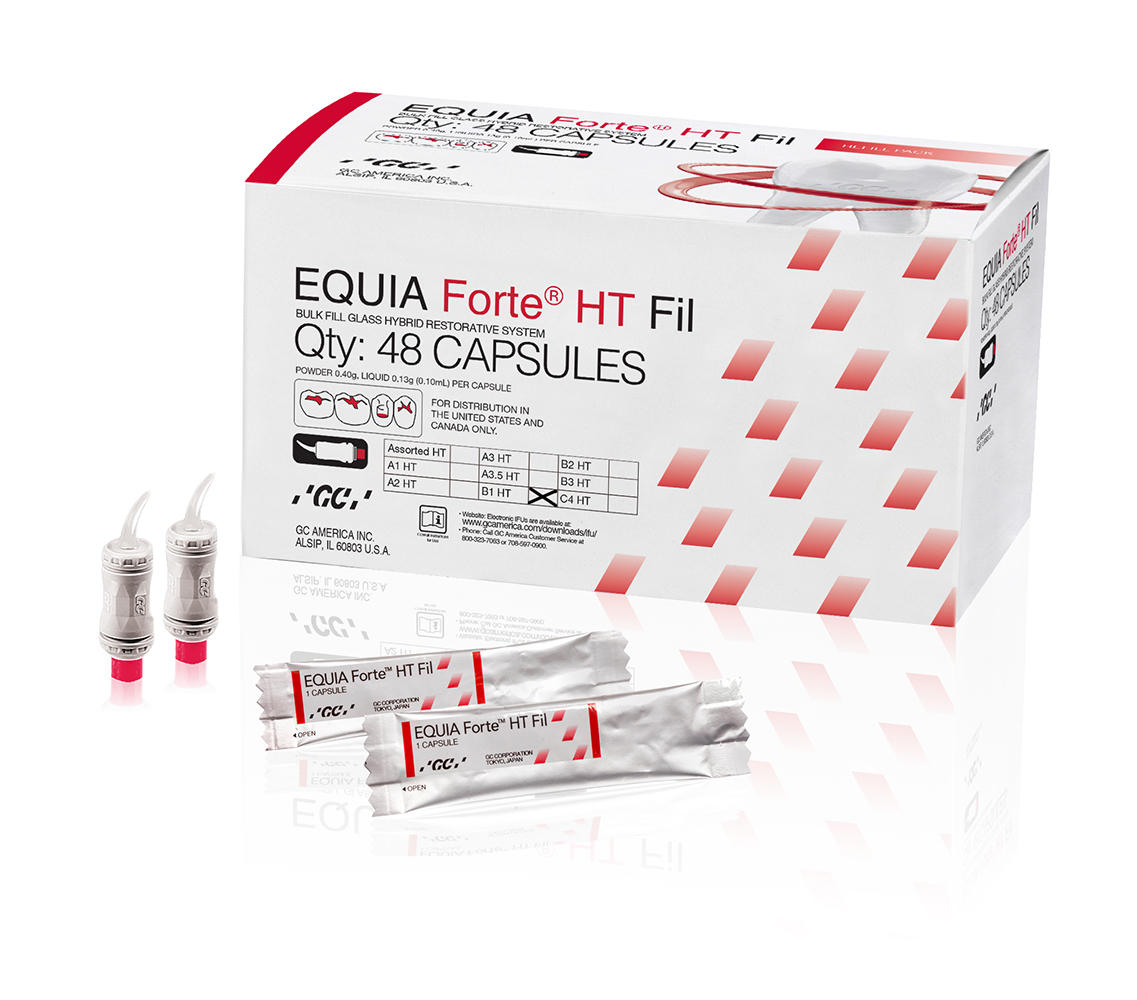
The US intro kit holds 48 capsules, each containing about 0.40 g of powder and 0.13 g (0.10 mL) of liquid, along with a 4 mL bottle of EQUIA Forte Coat and a bottle of GC Cavity Conditioner, according to the GC brochure. The coat also comes as 0.1 mL unit doses, which suit practices that want single-use infection control.
The US instructions for use list eight VITA classic shades, A1, A2, A3, A3.5, B1, B2, B3 and C4, all labeled HT. Some regional distributors stock only A2, A3, and A3.5, so availability should be confirmed before ordering. Placement also requires a capsule mixer running at about 4,000 rpm, a capsule applier, and a curing light delivering more than 500 mW/cm² for the coat.
How Glass Hybrid Chemistry Works
Chemically, EQUIA Forte HT Fil is still a glass ionomer. It sets through an acid-base reaction between fluoroaluminosilicate glass and polyacrylic acid, and its restorative body contains no resin. The differences from older glass ionomers sit in the particle architecture and the acid.
Filler and Acid
GC's technical guide describes conventional fluoroaluminosilicate glass reinforced with a second, smaller population of highly reactive silicate particles. The small particles pack into the spaces between the large ones and release ions early in the reaction, so the set matrix is denser than a conventional glass ionomer.
A higher-molecular-weight polyacrylic acid goes into the powder. Longer polymer chains generally produce a tougher, more crack-resistant matrix, and this is the main reason glass hybrids reach flexural values conventional glass ionomers cannot. The material belongs to the wider family of bioactive materials that pediatric and general dentists view quite differently, according to a recent survey.
Translucency
Older high-viscosity glass ionomers look chalky because light scatters where the glass meets the matrix. GC lowered the refractive index of the HT glass to sit closer to that of the matrix, which reduces scatter and lets the restoration pick up color from the surrounding tooth.
GC in-house testing reports a translucency value of 55.9 and a flexural strength of 45.1 MPa for EQUIA Forte HT. Those figures are manufacturer data and have not been independently replicated in the sources reviewed here. In posterior teeth, the color blend is acceptable for most patients, and in anterior teeth it falls short of a composite.
The Role of EQUIA Forte Coat
EQUIA Forte Coat is a self-adhesive resin with 40 nm silica nanofillers and a multifunctional monomer, applied at a film thickness of about 35–40 µm. It protects the immature glass ionomer from early water uptake and dehydration, and it seals surface porosity and microcracks.
Sealing those flaws raises flexural strength considerably. A 2020 laboratory study in the Journal of Dental Sciences measured uncoated EQUIA Forte Fil at about 15 MPa and coated specimens at about 41 MPa. GC states the newer coat raises surface hardness by roughly 35% and wear resistance by more than 40% compared with the original EQUIA Coat.
Maturation After the Coat Wears
The coat is designed to wear away over roughly 300–500 days in function. During that period, the glass hybrid keeps maturing, taking up calcium and phosphate ions from saliva, and GC in-house data shows surface hardness rising during this phase. This so-called second maturation is the theoretical basis for the restoration holding up after the coat has gone.
Indications and Contraindications
EQUIA Forte HT carries a broader label than most glass ionomers, and that breadth is its main commercial selling point. The label comes with cavity design conditions that matter as much as the indication list.
Manufacturer Indications
The US instructions for use list the following indications for EQUIA Forte HT Fil.
Class I restorations
Stress-bearing Class II restorations
Non-stress-bearing Class II restorations
Intermediate restorations
Class V and root surface restorations
Core build-up
GC's comprehensive guide also names amalgam replacement, molar-incisor hypomineralization, geriatric and pediatric patients, and high-caries-risk patients as clinical situations where the system fits.
Contraindications
The contraindications are short and mostly concern the coat.
Direct pulp capping
Known allergy to glass ionomer cements or to methacrylate monomers or polymers
Use of the coat together with desensitizers or eugenol-containing materials, which can interfere with setting or bonding
Class II Cavity Design Limits
The stress-bearing Class II indication assumes a conservative box. GC's guide advises leaving about 1–1.5 mm of tooth between the cavity outline and the cusp tips, avoiding over-contouring and avoiding cases where the distance to the adjacent tooth is too wide to build a contact. Earlier EQUIA guidance limited the preparation to less than half the intercuspal distance.
In practice, EQUIA Forte HT is a material for moderate two-surface boxes with intact cusps. Teeth with cracked cusps, wide MOD preparations, or cusps needing replacement belong with composite, a short-fiber reinforced composite base, or an indirect restoration.
EQUIA Forte HT Technical Specifications
The handling numbers below come from GC's US instructions for use and the comprehensive guide. The figures that shape the appointment are a 10-second mix, 1 minute 30 seconds of working time, and finishing at 2 minutes 30 seconds.
Parameter | EQUIA Forte HT |
|---|---|
Material class | Bulk-fill glass hybrid (high-viscosity glass ionomer) with resin coat |
Setting of the Fil | Self-cure acid-base reaction |
Setting of the coat | Light cure for 20 s at more than 500 mW/cm² |
Capsule content | 0.40 g powder, 0.13 g (0.10 mL) liquid |
Mixing time | 10 s at about 4,000 rpm |
Working time at 23 °C | 1 min 30 s from start of mixing |
Net setting time at 37 °C | 2 min 30 s |
Placement | Single bulk increment, no layering |
Conditioning | GC Cavity Conditioner for 10 s, rinse, do not desiccate |
Coat film thickness | About 35–40 µm |
Shades (US) | A1, A2, A3, A3.5, B1, B2, B3, C4 (HT) |
Storage | 4–25 °C in original foil, away from light |
Patient instruction | No pressure on the restoration for 1 hour |
Chairside Handling and Placement Protocol
The protocol has no adhesive, no layering, and only one light-cure step for the coat. Most failures traced to technique come from moisture control during the first two and a half minutes, rather than from any single step.
Remove caries and round every internal line angle, since sharp internal edges concentrate stress in glass ionomers.
Keep about 1–1.5 mm of sound tooth between a Class II box and the cusp tips, and skip enamel bevels.
Place a sectional matrix with a ring and wedge firmly before conditioning.
Apply GC Cavity Conditioner for 10 seconds, rinse thoroughly, and blot until the surface looks moist and glistening.
Activate the capsule, mix for 10 seconds, and inject from the deepest point outward with the nozzle kept inside the material.
Overfill slightly and contour within 1 minute 30 seconds of the start of mixing.
Leave the restoration undisturbed until 2 minutes 30 seconds, then remove the matrix and finish with superfine diamonds under water spray.
Rinse, dry gently, apply a thin layer of EQUIA Forte Coat and light cure for 20 seconds straight away.
A published pediatric case shows how fast this runs in a difficult patient. Kisby describes a 6-year-old with poor cooperation and facial caries on a primary canine, where the capsule was mixed for 10 seconds, and the material syringed into the preparation within 10 seconds before condensing and contouring. For a child who tolerates only a few minutes in the chair, that timeline is the reason clinicians reach for the material.
Isolation
GC describes rubber dam as optional because the material tolerates moisture. Saliva or blood contact during the first few minutes still weakens the surface, and an over-dried preparation leads to crazing.
Cotton rolls with high-volume suction work for occlusal cavities. For deep proximal boxes or cervical lesions near the gingiva, a dry-field isolation system or dam makes the outcome more predictable.
Matrix Choice
Glass ionomers cannot be condensed into contact the way a packable composite can, so the matrix builds the contact. A sectional matrix system with a firm ring and an anatomical band gives the most reliable proximal shape.
GC's guide recommends pulling the band out buccally with mosquito forceps rather than lifting it occlusally. Lifting can chip a marginal ridge that is still only minutes old.
Finishing and Occlusion
Finishing starts at 2 minutes 30 seconds, under water spray, with superfine diamonds. Dry finishing dehydrates the surface and causes crazing.
Occlusal adjustment should happen before the coat goes on, since grinding afterward removes the protective layer. A patient who reports a high spot at the next visit needs a light adjustment and a fresh application of coat over the area.
Clinical Evidence: What the Trials Show
In permanent posterior teeth, GC EQUIA Forte matched a nanohybrid composite for five years in moderate-to-large Class II restorations. In primary molars, a 2026 randomized trial found it clearly outperformed by Fuji II LC. Most long-term data predates the HT version and is extrapolated from EQUIA and EQUIA Forte.
Study | Material compared | Setting | Follow-up | Key result |
|---|---|---|---|---|
Papadopoulou et al., 2026 | EQUIA Forte vs Fuji II LC | Class II, primary molars, split-mouth RCT | 24 months | 66.7% vs 90.8% success, favoring Fuji II LC (p < 0.001) |
Zayed et al., 2025 | EQUIA Forte HT vs Fuji II LC | Class V carious lesions, adults, RCT | 12 months | 80% vs 61.5% success, not significant |
Miletić et al., 2023 | EQUIA Forte vs Tetric EvoCeram | 360 Class II molar restorations in 180 patients | 5 years | Similar performance, 2-year survival 93.6% vs 94.5% |
Gurgan et al., 2020 | EQUIA vs microhybrid composite | Class I and II, permanent teeth, RCT | 10 years | Cumulative failure rate 3.17% |
Gurgan et al., 2015 | EQUIA vs Gradia Direct Posterior | 140 Class I and II lesions, mean age 24 | 4 years | Clinically acceptable for both |
Permanent Posterior Teeth
The multicenter study led by Ivana Miletić is the most relevant trial for general practice. It enrolled 180 patients across Croatia, Italy, Serbia, and Turkey, and each received one EQUIA Forte and one Tetric EvoCeram two-surface molar restoration. Estimated two-year survival was 93.6% for the glass hybrid and 94.5% for the composite, according to GC's summary of the interim results, and the five-year results presented at the 2023 CED/NOF-IADR congress again showed similar performance.
For the older EQUIA system, Gurgan's 10-year randomized trial reported a cumulative failure rate of 3.17% across Class I and II restorations. An evidence commentary in Evidence-Based Dentistry rated the strength of that evidence as very low, mainly because of sample size and attrition. The result is encouraging and should be read with that caveat.
A seven-year multicenter evaluation by Basso and colleagues gives a useful counterweight. Class I restorations showed no failures, while Class II success dropped to around 70%. Cavity size and occlusal load drive most of the difference between those two outcomes.
Primary Molars
The 2026 trial by Papadopoulou and colleagues in the European Archives of Paediatric Dentistry is the most important recent paper for pediatric clinicians. In Class II primary molar restorations, EQUIA Forte succeeded in 66.7% of cases at 24 months, compared with 90.8% for Fuji II LC.
Loss of retention caused most failures with both materials, and maxillary first primary molars failed more often regardless of the material used. Secondary caries appeared in 9 glass hybrid restorations and only 1 RMGI restoration. For proximal lesions in primary molars, these numbers support an RMGI, a preformed crown, or the Hall technique over a glass hybrid.
Cervical and Root Lesions
A randomized trial from Egypt and published in 2025 compared EQUIA Forte HT with Fuji II LC in Class V carious lesions in high-caries-risk adults. At one year, overall success was 80% for the glass hybrid and 61.5% for the RMGI, a difference that did not reach statistical significance.
The RMGI group showed significant deterioration in marginal adaptation, discoloration, and surface texture over the year, while the glass hybrid group did not. The sample comprised 32 patients, with follow-up for only 12 months. For older patients with xerostomia and multiple root lesions, the glass hybrid's bulk placement and fluoride release make it a practical choice.
MIH and Special Care Patients
GC's guide summarizes small studies in molar-incisor hypomineralization, where bonding to porous enamel is unreliable. Two of them reported retention of 96.8% and 100% at 12–24 months. Clinicians managing MIH alongside enamel hypoplasia often use the material as a long-term interim restoration until the patient is old enough for definitive work.
In special care patients, an ART-based glass hybrid approach reached 90.2% five-year survival against 82.8% for composite in one study cited by GC. Those patients rarely tolerate long appointments or full isolation, and the shorter chair time works in the material's favor.
Cost-Effectiveness
A cost-effectiveness analysis by Schwendicke and colleagues, cited in GC's guide, found glass hybrid restorations cheaper than composite both initially and over three years, with limited differences in efficacy. Shorter procedure time drives most of the savings, and that saving shrinks if a restoration needs replacing early.
EQUIA Forte HT vs Fuji II LC
EQUIA Forte HT is the stronger choice for bulk-filled Class I and moderate Class II restorations in permanent teeth. Fuji II LC remains the better-documented option for Class III and V work, liners and bases, and on 2026 evidence, for Class II restorations in primary molars. Both come from GC, and they were built for different jobs.
Two Different Chemistries
GC Fuji II LC is a resin-modified glass ionomer. GC describes it as the world's first resin-reinforced glass ionomer and still positions it as the benchmark light-cured glass ionomer, ready for finishing after 20 seconds of light curing. Water-soluble methacrylate monomers, including HEMA, allow the light-activated set.
EQUIA Forte HT has no resin in its body. It sets purely by the acid-base reaction, and only the surface coat contains resin. The practical result is no polymerization shrinkage stress in the bulk and no depth-of-cure limit, along with no HEMA in the restorative itself.
Side-by-Side Comparison
The table below compares the two materials on the points that change daily clinical decisions. Data comes from the EQUIA Forte HT IFU and the Fuji II LC capsule IFU.
Feature | EQUIA Forte HT | Fuji II LC (capsule) |
|---|---|---|
Material class | Glass hybrid with resin coat | Resin-modified glass ionomer |
Setting | Self-cure, coat light-cured 20 s | Light cure 20 s per layer plus chemical set |
Depth of cure | Bulk fill, no limit | 1.8 mm (A2), layer deeper cavities |
Working time at 23 °C | 1 min 30 s | 3 min 15 s |
Finishing | 2 min 30 s after start of mixing | Immediately after light curing |
Main indications | Class I, Class II including stress-bearing, Class V, root, core build-up | Class III, Class V, limited Class I, primary teeth, core build-up, base or liner |
Stress-bearing Class II in adults | Indicated, with cavity design limits | Not indicated |
Shades | 8 VITA shades (US) | 11 VITA shades |
Surface protection | EQUIA Forte Coat, required | Optional varnish or coat |
Resin monomer in body | No | Yes (HEMA) |
Strength and Wear
In flexure, Fuji II LC is the stronger material. The 2020 Journal of Dental Sciences study measured coated EQUIA Forte Fil at about 41 MPa and coated Fuji II LC at about 105 MPa.
Wear resistance favors the glass hybrid. A 2021 laboratory study in the Caspian Journal of Dental Research found EQUIA Forte significantly more wear-resistant than Fuji II across wear cycles, while Fuji II released more fluoride in the first week, with the difference disappearing by day 15. Occlusal surfaces fail through wear and fatigue more than through single loads, which explains why GC indicates the glass hybrid, and not the RMGI, for load-bearing posterior work.
Marginal Seal
In a 2019 dye penetration study on Class V cavities in primary and permanent teeth, EQUIA Forte showed the least microleakage of three materials, and Fuji II LC showed the most. The 2025 clinical trial on cervical lesions pointed the same way, with margins and surface texture deteriorating over 12 months with Fuji II LC and holding steady with EQUIA Forte HT.
Retention in Primary Molars
The clearest result in favor of Fuji II LC comes from the 2026 Papadopoulou trial. At 24 months, Fuji II LC succeeded in 90.8% of Class II primary molar restorations against 66.7% for EQUIA Forte, with annual failure rates of roughly 5% and 18%.
Dentists who restore many proximal lesions in children should give this paper heavy weight. The dentalreviewed.com Fuji II LC review covers the RMGI's own limits, including surface roughening in the first year and its 1.8 mm depth of cure.
Handling Time
Fuji II LC offers more than twice the working time and sets on command, so finishing can start right after light curing. EQUIA Forte HT is faster overall in a deep cavity because it goes in as one increment, but the operator has to wait 2 minutes 30 seconds and protect the field during that wait.
Under a deep restoration, Fuji II LC can still serve as a base, while a resin-modified calcium silicate such as TheraCal LC is the more common choice as a light-cured liner over near-pulp dentin.
Which One to Reach For
The two materials complement each other in a well-stocked operatory. The list below matches each to the cases where the evidence favors it.
Permanent molar, Class I or moderate Class II with intact cusps: EQUIA Forte HT
Cervical or root caries in a high-risk adult: either material, with early clinical data favoring EQUIA Forte HT
Class III restoration, liner, base or sandwich technique: Fuji II LC
Class II lesion in a primary molar: Fuji II LC, based on current evidence
Case Selection and Treatment Planning
Case selection decides most outcomes with EQUIA Forte HT. Recording the material choice and its rationale in the dental treatment plan helps when a restoration needs review at recall, and it gives patients a clear explanation of why a glass hybrid was chosen over composite.
Cases That Suit the Material
These are the situations where the indications, the evidence, and the handling profile line up.
Class I occlusal lesions in adults and adolescents
Two-surface Class II boxes in permanent premolars and molars with sound cusps
Root surface and cervical caries in older or high-caries-risk patients
Patients who cannot tolerate long appointments or full isolation
Hypomineralized molars where enamel bonding is unpredictable
Long-term interim restorations while a definitive plan is finalized
Core build-ups where the remaining tooth structure supports retention
Cases to Avoid
These situations push the material past what its strength and the trial data support.
Cusp replacement or cavities wider than about half the intercuspal distance
Patients with bruxism and heavy wear facets on the tooth being restored
Wide proximal boxes where a tight contact cannot be built
Class II restorations in primary molars, especially maxillary first primary molars
Anterior restorations where esthetics are the priority
Coding and Documentation
In the US, glass ionomers placed as definitive restorations are generally reported with the resin-based composite codes, D2330 to D2394, although individual payer policies vary. Clinicians unsure about the correct entry can check how the CDT codes for direct restorations are structured before submitting claims.
Bottom Line
EQUIA Forte HT has earned a permanent place in posterior restorative dentistry, within boundaries that the evidence draws fairly precisely. For Class I cavities and moderate two-surface Class II boxes in permanent teeth, the GC EQUIA Forte family has shown performance comparable to a nanohybrid composite for five years in a large multicenter trial.
Its value rises when isolation is difficult or chair time is short. Older patients with root caries, children with hypomineralized first molars, and special care patients benefit most from a material that goes in as one increment and tolerates some moisture.
The 2026 primary molar data is the main reason for caution. In proximal restorations in primary teeth, Fuji II LC retained far better, and pediatric practices should plan accordingly. Large cavities, missing cusps, and patients with heavy bruxism remain composite or indirect territory.
For most general practices, the sensible approach is to stock both materials and match each to the cases where the evidence supports it. EQUIA Forte HT covers posterior bulk restorations in adults, and Fuji II LC covers cervical, anterior, and pediatric proximal work.
Verdict
<p>EQUIA Forte HT does what GC claims in the cases it was designed for. In permanent molars and premolars with intact cusps, it delivers a durable, tooth-colored restoration in a single bulk increment, with no adhesive, in a few minutes of chair time. The five-year multicenter data showing parity with a nanohybrid composite in moderate Class II boxes is the strongest argument in its favor.</p><p>It earns its place for root caries, hypomineralized molars, older patients, and anyone who cannot sit through a long, perfectly isolated composite appointment. Its weaknesses are just as clear. It lacks the strength for cusp replacement or wide preparations; its esthetics are good for posterior teeth and limited elsewhere. And the 2026 primary molar trial is a real warning for pediatric Class II work, where Fuji II LC performed far better.</p><p>The practical recommendation is to stock EQUIA Forte HT as the default for posterior Class I, moderate Class II, and cervical lesions in high-risk adults, and to keep Fuji II LC for Class III and V restorations, liners, bases, and proximal restorations in primary teeth.</p>
Frequently Asked Questions
Is EQUIA Forte HT a glass ionomer or a composite?
EQUIA Forte HT is a glass ionomer. GC calls it a glass hybrid because of its modified particle and acid system, but the restorative body sets through an acid-base reaction and contains no resin. Only EQUIA Forte Coat, the surface layer, is a light-cured resin.
Can EQUIA Forte HT be used in stress-bearing Class II restorations?
Yes, within limits. GC advises keeping 1–1.5 mm of tooth between the cavity and the cusp tips, avoiding over-contouring and ensuring a proper contact. The material is not intended for cusp replacement.
What is the difference between GC EQUIA Forte and EQUIA Forte HT?
Both use glass hybrid technology. The HT version has a further refined particle size distribution and glass with a lower refractive index, which gives higher translucency and a slightly longer extrusion window at the same setting time.
Is EQUIA Forte Coat necessary?
Yes. The coat protects the setting material from moisture and drying, seals surface porosity and raises flexural strength and early wear resistance. The instructions for use state that EQUIA Forte HT Fil should be used only with EQUIA Forte Coat.
Does EQUIA Forte HT need rubber dam?
GC lists rubber dam as optional because the material tolerates moisture. The field still has to stay free of saliva and blood without over-drying for the first 2.5 minutes, and deep Class II boxes benefit from dam or a dry-field system.
How long do EQUIA restorations last?
For the original EQUIA system, a 10-year randomized trial reported a cumulative failure rate of 3.17% in Class I and II cavities. GC EQUIA Forte matched a nanohybrid composite over five years in moderate-to-large Class II restorations, and long-term data for the HT version is still building.
Which is better, EQUIA Forte HT or Fuji II LC?
The answer depends on the indication. EQUIA Forte HT is indicated for stress-bearing Class II restorations in permanent teeth and goes in as one bulk increment. Fuji II LC is a light-cured RMGI best suited to Class III and V restorations, liners and bases, and a 2026 trial found it more successful in primary molar Class II restorations, at 90.8% versus 66.7%.
Is EQUIA Forte HT suitable for children?
Pediatric dentists use it for occlusal lesions, hypomineralized molars and uncooperative patients because it is fast and moisture tolerant. For proximal lesions in primary molars, current evidence favors an RMGI such as Fuji II LC.
Does EQUIA Forte HT release fluoride?
Yes. Like other glass ionomers, it releases fluoride and exchanges ions with saliva. One laboratory study found early fluoride release higher for Fuji II than for EQUIA Forte, with the difference disappearing by day 15.
Can EQUIA Forte HT replace amalgam?
For many Class I and moderate Class II cavities, it can, and GC lists amalgam replacement as a clinical application. Large cavities, cusp coverage and heavy occlusal load call for composite or an indirect restoration.
How long does an EQUIA Forte HT restoration take to place?
The material needs a 10-second mix, up to 1 minute 30 seconds of working time, finishing at 2 minutes 30 seconds and a 20-second cure for the coat. GC reports a single-surface amalgam replacement completed in about 3 minutes 25 seconds of placement time.