Rating: 4.1/5
Ultradent Forma S Composite Review
Selecting the right composite resin is one of the most consequential material decisions a clinician makes. The wrong choice leads to wasted chair time, compromised esthetics, and...
Reviewed by Rachel Thompson
Pros
- Non-sticky, sculptable handling adapts to cavity walls and carves into anatomical form without pulling, slumping, or clinging to instruments, making placement faster and more predictable across all cavity classes
- VITA classical shade guide alignment eliminates the guesswork of proprietary shade systems, and the Body shades work convincingly as a single-shade solution for most posterior cases
- High filler loading (74–79% by weight) translates to strong mechanical properties with flexural strength around 186 MPa and hardness of 64 HK, making it suitable for stress-bearing posterior restorations
- Zirconia nano-hybrid filler system provides long-term color stability, excellent radiopacity, and optical properties (translucency, fluorescence, opalescence) that closely mimic natural tooth structure
- Outstanding polishability and gloss retention allow a natural-looking surface finish quickly, and that finish holds up against dietary and hygiene-related abrasion over time
- Complete four-tier shade opacity system (Body, Dentin, Enamel, Effect) within a single product line handles everything from quick posterior fillings to demanding anterior layering
- Ergonomic syringe design with attached cap and one-handed plunger improves chairside workflow, especially during longer restorative sessions
Cons
- As a newer product, Forma S does not yet have the multi-year independent clinical trial data that established competitors such as 3M Filtek or Tokuyama Estelite have accumulated
- Pricing tends to be in the mid-to-premium range, which could be a consideration for budget-conscious practices, though consolidating around a single system may offset the per-syringe cost
- The 4 g syringe format may not suit practices that prefer unit-dose compules or capsules for cross-contamination control
- Some in vitro research on the predecessor FORMA composite has raised questions about chromatic stability after exposure to certain substances, and it remains to be seen whether the reformulated version addresses this fully
- Forma S is a conventional-viscosity composite and does not offer a bulk-fill variant, so a separate flowable or bulk-fill product is still needed for those specific applications
Selecting the right composite resin is one of the most consequential material decisions a clinician makes. The wrong choice leads to wasted chair time, compromised esthetics, and restorations that fail prematurely. Ultradent Products, the Utah-based manufacturer behind the VALO curing light and Opalescence whitening system, has introduced the FORMA S composite to its direct restorative lineup. Positioned as an updated successor to the original FORMA composite, the Forma S brings a refined zirconia nano-hybrid formula, an intuitive VITA-based shade system, and handling properties engineered for both speed and precision.
This Ultradent Forma S review examines the material from every angle that matters to practicing dentists, covering formulation, mechanical properties, shade selection, handling characteristics, clinical indications, and value. Whether the goal is a quick posterior Class II or a demanding anterior layered restoration, this article provides the information needed to determine whether Forma S belongs in the operatory.
What Is the Ultradent Forma S Composite?
Understanding the composition and design philosophy behind a restorative material is the first step toward using it effectively. The Forma S is not a minor reformulation of its predecessor. It represents a meaningful upgrade across multiple performance dimensions.
FORMA S is a light-cured, zirconia nano-hybrid composite resin developed for direct and indirect restorations in both anterior and posterior teeth. Ultradent engineered the material around a proprietary filler system that combines nanoscale zirconia particles with larger glass particles, achieving a filler load of approximately 74–79% by weight (66–71% by volume) with an average particle size of roughly 0.8 μm. This high filler loading is responsible for the mechanical backbone of the material, while the nanoscale zirconia fraction contributes to a smooth surface finish after polishing and long-term color stability.
The inclusion of ytterbium trifluoride (YbF₃) in the filler system provides radiopacity, ensuring the cured composite is readily visible on diagnostic radiographs. This allows clinicians and hygienists to monitor restoration integrity, detect secondary caries, and evaluate marginal adaptation during routine imaging. The material is compatible with standard camphorquinone-based photoinitiator chemistry, meaning it cures reliably with any quality LED curing light emitting in the 400–500 nm wavelength range.
Key Technical Specifications
Hard numbers provide the foundation for any meaningful material comparison. The following specifications give dental professionals a concrete frame of reference when evaluating the Forma S against competing products in the nano-hybrid composite category.
Filler type: zirconia nano-hybrid
Filler load: 74–79% by weight, 66–71% by volume
Average particle size: ~0.8 μm (by weight)
Flexural strength: 185.54 ± 8.99 MPa
Knoop hardness: 64.1 ± 2.9 HK
Curing: light-cured, camphorquinone-based photoinitiator, compatible with 400–500 nm LED curing lights
Shade system: VITA classical shade guide with Body, Dentin, Enamel, and Effect opacities
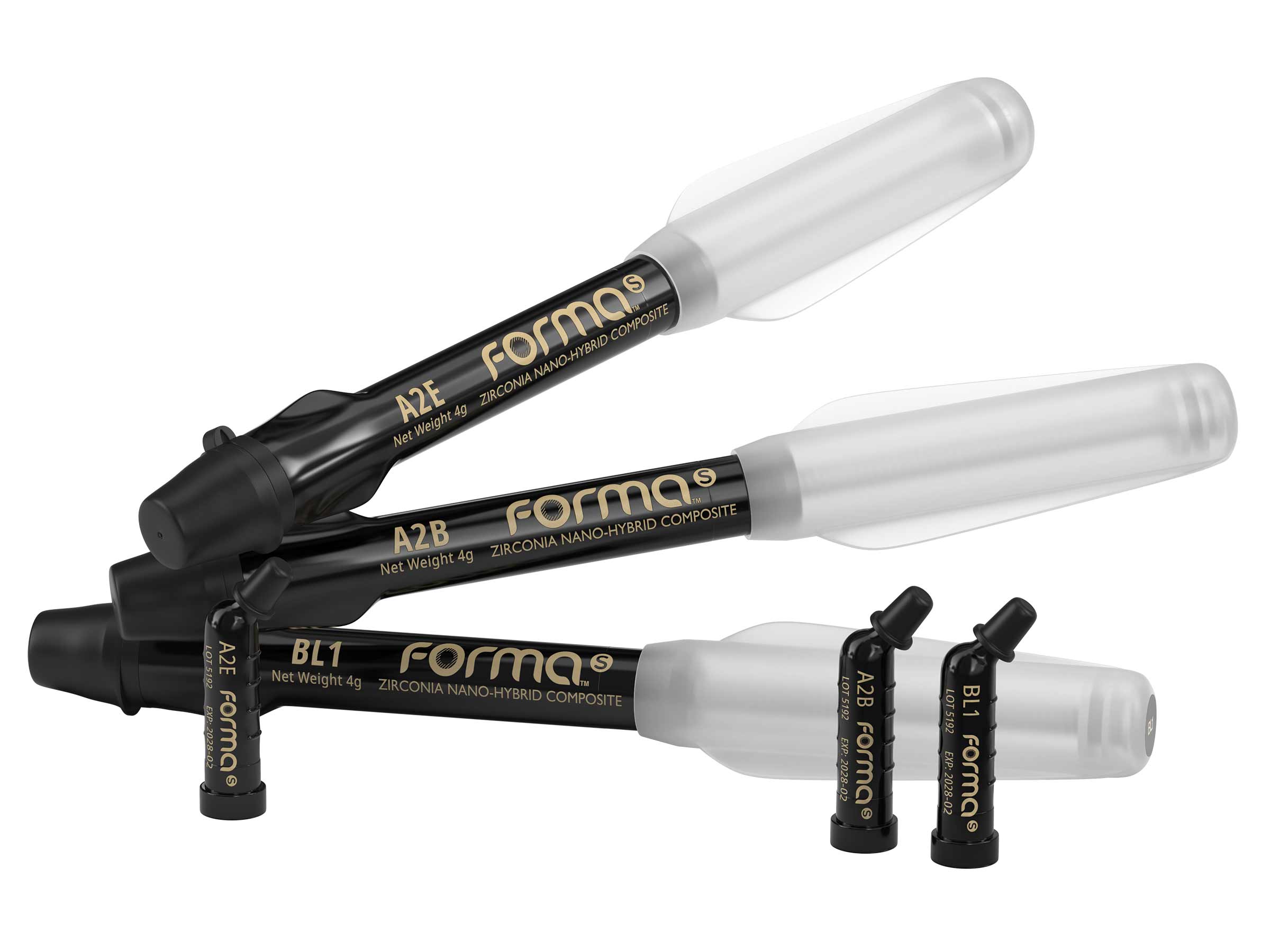
Packaging: 4 g syringes with attached cap and ergonomic one-handed plunger
The flexural strength figure of roughly 186 MPa sits comfortably above the ISO 4049 minimum of 80 MPa for polymer-based filling and restorative materials. Knoop hardness at 64 HK indicates a surface that can withstand occlusal loading in posterior restorations while remaining amenable to finishing and adjustment with standard carbide and diamond instruments.
The Forma S Shade System: Simplifying Shade Selection
Shade matching remains one of the most time-consuming and subjective aspects of restorative dentistry. A composite system that simplifies this process without sacrificing esthetic versatility provides a real clinical advantage.
Unlike some competitors that use proprietary shade designations, Forma S adheres directly to the VITA classical shade guide. For clinicians who have spent years matching teeth with a VITA shade tab, this is immediately intuitive, and there is no need to consult a cross-reference chart or memorize an unfamiliar naming convention.
The shade system is organized into four opacity categories:
Body shades offer an ideal balance of translucency and opacity, allowing many restorations to be completed with a single shade. In the posterior region especially, one Body shade placed over a properly bonded preparation blends convincingly with surrounding tooth structure.
Dentin shades are more opaque, designed to mimic the chroma-rich dentin core of the tooth in multi-shade layering techniques for anterior restorations where depth of color matters.
Enamel shades are more translucent, replicating the light-transmitting properties of natural enamel. They are placed as the outermost layer in a layered buildup.
Effect shades provide specialized optical effects such as higher translucency for incisal edges and opalescent characteristics that elevate anterior esthetics.
This architecture means clinicians can start simple with a single Body shade for routine cases and scale up to a full layering technique when the esthetic demand warrants it, all within one composite system. That kind of versatility is a practical advantage in busy practices where routine posterior fillings and demanding anterior cases arrive on the same schedule.
Handling Properties: Clinical Performance Under the Instrument
Material properties on a datasheet matter, but what a composite feels like during placement ultimately determines whether clinicians reach for it day after day. Handling preferences are personal, but certain qualities are universally appreciated.
The Forma S composite is engineered to be sculptable without being sticky. Ultradent describes the material as "non-sticky," meaning it does not grab onto composite instruments, spatulas, or brushes. In practical terms, the material can be placed in an increment, adapted to cavity walls and margins, sculpted into anatomical form, and adjusted without pulling away or deforming when the instrument is withdrawn.
There is also sufficient body to resist slumping, even in Class II restorations where gravity and the matrix band orientation can work against the clinician. Working time is generous under normal operatory lighting because the camphorquinone-based photoinitiator system will not begin significant polymerization until exposed to an appropriate curing light. However, the material should be shielded from overhead operatory lights during extended sculpting sessions, as prolonged ambient light exposure can initiate surface polymerization.
The syringe design deserves mention as well. Ultradent has engineered the Forma S syringe with an attached cap and an ergonomic plunger that facilitates one-handed dispensing. This is a small but meaningful ergonomic detail in a workflow where the clinician often holds an instrument in one hand and a syringe in the other.
Polishability and Esthetic Outcomes
A composite that cannot be polished to a high luster will look artificial regardless of how accurately the shade matches. Surface roughness also influences plaque accumulation, staining susceptibility, and patient comfort.
The Forma S composite polishes to a high gloss with conventional multi-step polishing systems. Ultradent recommends its own Jiffy composite finishing and polishing system for optimal results, though the material responds well to any quality sequence involving aluminum oxide or diamond-impregnated polishers. The nano-hybrid filler distribution plays a central role here. Because the filler particles are smaller and more uniformly distributed than in traditional hybrid composites, fewer large particles are plucked from the surface during polishing. The result is a smoother, more reflective surface that closely mimics the luster of natural enamel.
The zirconia-based filler system also contributes optical properties beyond surface finish. The material provides translucency, opalescence, and fluorescence characteristics that closely approximate natural tooth structure. Under different lighting conditions, a well-placed Forma S restoration should maintain its natural appearance rather than looking flat or overly opaque.
Clinical Indications and Versatility
One of the most appealing aspects of a universal composite is its ability to cover a broad range of clinical scenarios without requiring the clinician to maintain multiple product lines. Forma S is indicated for a wide variety of applications, as outlined below.
Direct anterior restorations (Class III, Class IV, and Class V cavities)
Direct posterior restorations (Class I and Class II cavities)
Indirect restorations, including composite inlays and onlays
Core buildups for indirect restorations
Splinting of mobile teeth
Diastema closures
Direct veneers
This versatility means a practice can standardize on Forma S as its primary composite system and cover the majority of direct restorative needs without maintaining multiple composite lines. The inventory simplification alone can be a meaningful benefit for practice efficiency and cost control. For clinicians developing a comprehensive dental treatment plan that includes multiple restorative procedures, having a single system that handles both anterior and posterior cases streamlines both ordering and clinical workflows.
Why the Zirconia Nano-Hybrid Filler Chemistry Matters
The choice of filler material in a composite resin is not a marketing detail. It directly impacts clinical longevity, esthetic stability, and diagnostic utility. Understanding why Ultradent chose zirconia helps explain several of the Forma S's performance characteristics.
Zirconia (zirconium dioxide, ZrO₂) is an extremely hard ceramic material. In the context of dental composites, zirconia particles provide several advantages over purely silica-based fillers. First, zirconia is harder than glass, which translates to improved wear resistance. In posterior restorations subjected to repeated occlusal loading and masticatory forces, a harder filler helps the composite maintain its anatomical form over years of service. Second, zirconia contributes to color stability. Unlike some filler systems that can yellow or shift in hue over time, zirconia is inherently color-stable, extending the esthetic service life of the restoration. Third, zirconia offers favorable optical properties with an intrinsic translucency that, when combined with the resin matrix, mimics the way natural tooth structure transmits and scatters light.
The inclusion of ytterbium trifluoride adds radiopacity, making the restoration clearly distinguishable from surrounding tooth structure on bitewing and periapical radiographs. This is essential for detecting secondary caries, evaluating margin gaps, and assessing restoration integrity over time.
How Forma S Compares to Other Popular Composites
No composite exists in isolation. Dental professionals evaluating the Forma S will inevitably weigh it against other widely used products. While a full head-to-head clinical comparison is beyond the scope of any single article, here are some broad comparisons based on available data.
Versus Ultradent Mosaic Composite
Mosaic has been Ultradent's flagship universal composite for years, using a bis-GMA-based resin matrix with zirconia-silica glass ceramic fillers and 20 nm silica. Mosaic achieves a filler load of approximately 68% by volume for dentin shades and 56% for enamel shades. Forma S increases the filler volume to 66–71% across all shades, which should translate to improved mechanical properties and reduced polymerization shrinkage. The Forma S shade system is also redesigned around the VITA guide, whereas Mosaic uses its own 20-shade system. For clinicians loyal to Mosaic's handling, Forma S may feel like a natural upgrade that builds on a familiar Ultradent workflow.
Versus 3M Filtek Supreme/Filtek Universal
The 3M Filtek line uses a true nanocomposite approach with nanoclusters and individual nanoparticles. It has a strong independent evidence base and is widely used globally. The Filtek line's key differentiator is its nanoparticle technology, which produces outstanding polish and esthetics. Forma S counters with its zirconia-enhanced filler system and a potentially simpler shade approach tied to the VITA guide. Clinicians deciding between the two are likely to weigh handling preference and shade system familiarity alongside mechanical performance data.
Versus Tokuyama Estelite Sigma Quick
Estelite uses spherical silica-zirconia fillers with sub-micron particle sizes, delivering excellent polishability and a chameleon effect. Its advantage is rapid curing (10 seconds) and a simplified shade system. Forma S offers a more traditional curing protocol but provides a broader shade range and the four-opacity layering system for demanding anterior cases.
Step-by-Step Clinical Workflow for Placing a Forma S Restoration
Understanding how a material integrates into everyday clinical practice is just as important as reviewing its datasheet. The following protocol covers the essential steps for placing a Forma S composite restoration.
Preparation and isolation. Prepare the tooth according to conservative, adhesion-friendly principles. Rubber dam isolation is strongly recommended for optimal bonding outcomes and moisture control.
Etching and bonding. Apply the adhesive system of choice. Ultradent's Peak Universal Bond is a natural companion product, but Forma S is compatible with any standard etch-and-rinse or self-etch adhesive. Follow the adhesive manufacturer's instructions regarding etch time, solvent evaporation, and light curing. For more on bonding agents, see this 3M Scotchbond Universal Plus review.
Shade selection. Select the appropriate Forma S shade using the VITA classical shade guide. For most posterior restorations, a single Body shade is sufficient. For anterior cases, select a Dentin shade for the core, a Body shade for the bulk, and an Enamel shade for the facial and incisal layer.
Placement. Dispense Forma S from the syringe and place in increments of 2 mm or less to ensure complete light penetration and adequate cure depth. Adapt each increment to the cavity walls. The non-sticky handling allows precise sculpting without dragging or distortion.
Light curing. Cure each increment with a curing light of at least 800 mW/cm² for 20 seconds. Ultradent recommends its VALO X LED curing light for consistent polymerization. Position the light tip as close to the composite surface as possible.
Finishing and polishing. Adjust occlusion with fine diamond or carbide finishing burs. Progress through a multi-step polishing sequence from coarse to fine using composite polishers such as the Jiffy system.
Final evaluation. Check shade match, surface texture, and occlusal contacts under natural bite. Verify marginal adaptation visually and with an explorer.
What Independent Research Says About Forma
While the Forma S designation is relatively new, the underlying FORMA platform has been included in several independent in vitro studies published in peer-reviewed journals. These findings give clinicians insight into the material's performance characteristics beyond manufacturer data.
A microhardness study compared FORMA (Ultradent), Filtek Z350 XT (3M), and IPS Empress Direct (Ivoclar) under preheated and non-preheated conditions. The study found that preheating significantly increased surface hardness for IPS Empress Direct (by 32.8%) and Filtek Z350 XT (by 5.8%), whereas FORMA showed no significant change. This suggests the material's baseline hardness is already near its optimal polymerization threshold.
A color stability study evaluated FORMA alongside Filtek Z350 XT and Tetric N-Ceram after immersion in chlorhexidine mouthwash. All three materials showed some degree of color change over time, underscoring the importance of thorough polishing and surface sealing for any composite exposed to chromogenic substances.
Additional research on chromatic stability found that material brand had a significant influence on color change after exposure to e-cigarette vapor, with results varying depending on the specific resin composition. These studies highlight the value of counseling patients about habits that may affect the longevity of composite esthetics.
It should be noted that these studies tested the original FORMA formulation. The Forma S represents a reformulation, and additional independent testing will be valuable as the product matures in the market.
Tips for Getting the Best Results With Forma S
Even the best composite material will underperform if the clinical technique is not sound. The following tips help clinicians maximize outcomes with the Forma S system.
Use a quality curing light. Thorough polymerization is non-negotiable. A broad-spectrum LED curing light ensures adequate energy delivery across the entire increment. Inadequate curing compromises mechanical properties, increases the risk of post-operative sensitivity, and accelerates staining.
Do not skip polishing steps. A quick adjustment with a finishing bur is not the same as a proper polishing sequence. Take the time to progress through coarse, medium, and fine polishers to achieve a high-gloss finish. This directly affects plaque accumulation, staining resistance, and patient satisfaction.
Embrace the single-shade technique for posteriors. The Body shades are calibrated to blend with most tooth structures when placed over a properly cured adhesive layer. Resist the urge to overcomplicate posterior restorations with multiple shades unless the clinical situation specifically demands it.
Invest time in shade selection for anteriors. While one shade works for posteriors, anterior restorations benefit from the full four-tier system. Take the shade in natural daylight when possible, photograph the tooth for reference, and build up layers from opaque Dentin through to translucent Enamel.
Pair with a compatible flowable liner. For deep preparations or complex internal anatomy, consider a thin layer of Ultradent PermaFlo or a similar flowable composite as an initial adaptive layer before placing Forma S in conventional increments.
Replace syringe caps immediately. Like all light-cured composites, Forma S begins to polymerize on prolonged exposure to ambient light. Replace the cap promptly between uses to preserve material freshness and consistency.
Bottom Line
The Ultradent Forma S composite enters a crowded marketplace with a clear identity: a high-filler-load, zirconia nano-hybrid composite that prioritizes handling comfort, shade simplicity, and esthetic versatility. It does not attempt to be a bulk-fill or a flowable. It is a conventional-viscosity layered composite that excels at what that category is designed to do.
For dental professionals evaluating whether to integrate Forma S into their practice, the decision hinges on a few key questions. Is a non-sticky, sculptable consistency that saves time during placement a priority? Does working within the VITA classical shade system rather than proprietary shade designations appeal to the clinical team? Is the flexibility of a four-tier opacity system that scales from quick single-shade posteriors to artistic multi-layer anteriors valuable? And does the broader Ultradent ecosystem of complementary products, including the VALO curing light, Peak adhesive, Jiffy polishers, and Halo matrix system, support the clinical workflow?
If those priorities align with practice needs, Forma S deserves serious consideration. The early indications, from both the manufacturer's data and emerging independent research, suggest it is a strong contender in the modern composite landscape.
Verdict
<p>After evaluating the specifications, handling properties, shade system, and overall clinical versatility of the Ultradent Forma S composite, the professional consensus among practitioners who have worked with the material is largely favorable. The non-sticky, sculptable consistency stands out immediately. It places and stays where it is needed without adhering to instruments, saving time and frustration during both simple posterior fillings and complex anterior buildups. The VITA-aligned shade system is refreshingly intuitive. There is no learning curve for clinicians already comfortable with the VITA classical guide, and the single-shade Body technique works for the majority of posterior cases, cutting chair time without sacrificing esthetic outcomes.</p><p>Mechanically, the flexural strength and hardness numbers inspire confidence for load-bearing restorations, and the zirconia nano-hybrid filler system delivers on its promise of long-term color stability and wear resistance. Polishability is excellent. A quick multi-step sequence produces a high gloss that mimics natural enamel. The four-tier opacity system (Body, Dentin, Enamel, Effect) gives clinicians the flexibility to keep things simple when speed matters and to create truly artistic layered restorations when the case demands it. It is not the cheapest composite on the market, but the combination of handling, esthetics, durability, and shade versatility represents compelling value for a material that can genuinely serve as a practice's single primary composite system.</p>
Frequently Asked Questions
What type of composite is Ultradent Forma S?
Forma S is a light-cured, zirconia nano-hybrid composite resin. It combines nanoscale zirconia particles with larger glass filler particles in a methacrylate-based resin matrix, achieving a high filler load (74–79% by weight) that delivers strong mechanical properties while maintaining excellent esthetic characteristics such as translucency, fluorescence, and polishability.
Is the Ultradent Forma S composite suitable for posterior restorations?
Yes. With a flexural strength of approximately 186 MPa and a Knoop hardness of 64 HK, the Forma S composite is well suited for stress-bearing posterior restorations including Class I and Class II cavities. Its high filler loading provides the wear resistance and compressive strength necessary to withstand occlusal forces over the long term.
Can Forma S be used for anterior restorations as well?
Absolutely. The four-tier shade opacity system (Body, Dentin, Enamel, Effect) was specifically designed to support multi-shade layering techniques in the esthetic zone. Clinicians can create lifelike anterior restorations using layers of increasing translucency, from an opaque Dentin core to a translucent Enamel shell, all within the Forma S product line.
What shade guide does Forma S follow?
Forma S adheres to the VITA classical shade guide, one of the most widely used shade reference systems in dentistry worldwide. Clinicians can use their existing VITA shade tabs for shade selection without needing to learn a new proprietary system.
Does Forma S stick to instruments during placement?
One of the headline handling features of Forma S is its non-sticky consistency. The material is formulated to be sculpted and adapted without adhering to composite instruments, spatulas, or modeling brushes, reducing frustration during placement and allowing efficient, precise control.
What curing light should be used with Forma S?
Forma S is compatible with standard LED curing lights that emit in the 400–500 nm wavelength range, which covers the vast majority of modern dental curing lights. Ultradent recommends its own VALO X LED curing light for optimal results. A minimum curing intensity of 800 mW/cm² with a 20-second exposure per increment is a good starting point. For an in-depth review of another popular curing light option, see this Kerr Demi Plus review.
How does Forma S differ from the original FORMA composite?
Forma S is a reformulation of the original FORMA composite. While both share the core zirconia nano-hybrid filler technology, the "S" version features refinements to the resin matrix, filler distribution, and overall formulation that improve strength, handling, and shade predictability. The Forma S also adopts the VITA classical shade guide more explicitly and offers the four-opacity shade system.
Is the Forma S composite radiopaque?
Yes. The inclusion of ytterbium trifluoride (YbF₃) and zirconia in the filler system ensures adequate radiopacity, allowing the restoration to be distinguished from surrounding tooth structure on dental radiographs.
What is the recommended increment thickness for Forma S?
As with most conventional-viscosity light-cured composites, Forma S should be placed in increments no greater than 2 mm to ensure complete light penetration and thorough polymerization throughout the material.
Can Forma S be used for indirect restorations?
Yes. The material is indicated for both direct and indirect restorations. For indirect applications such as composite inlays and onlays, the restoration is fabricated extraorally and cemented with an appropriate resin cement.
How should Forma S be stored?
Store syringes at room temperature (59–77°F / 15–25°C) in a cool, dry place away from direct sunlight and heat sources. Always replace the syringe cap immediately after dispensing to prevent premature light-initiated polymerization.
Is there independent clinical research on Forma S?
The original FORMA composite has been included in several in vitro studies evaluating microhardness, color stability, and chromatic response to environmental stressors. As the Forma S is a newer reformulation, independent clinical trials specific to the "S" version are still emerging. Clinicians should monitor the peer-reviewed literature for upcoming studies.