Rating: 3.8/5
Impregum Review: Is Polyether Still a Good Impression Material?
This Impregum review asks whether polyether still deserves a place on the restorative tray in 2026. Solventum now sells a two-minute polyether with a mint flavor, yet many...
Reviewed by Agnes Markovic
Pros
- Intrinsic hydrophilicity that wets moist preparations without relying on surfactants.
- Snap set behavior that keeps the full labeled working time usable.
- Decades of clinical use and a large research base in fixed prosthodontics.
- Rigid, stable impressions that hold implant copings and resist distortion in transit.
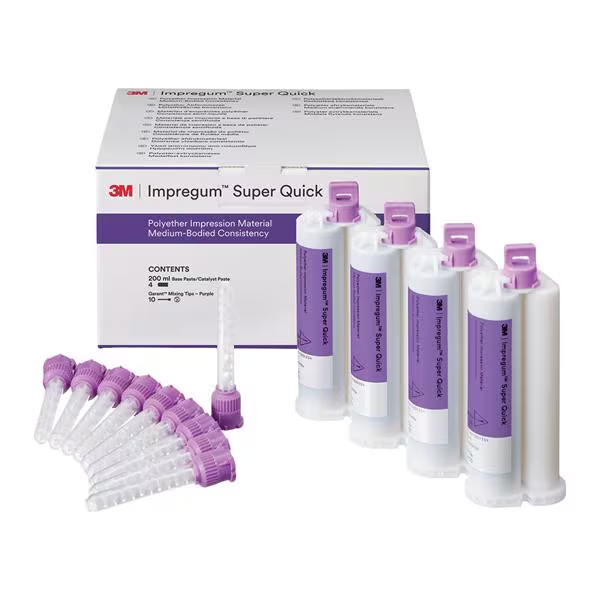
- Super Quick versions that set in 2:00 intraorally.
- No set inhibition from latex gloves.
- Consistent, void-free machine mixing with the Pentamix.
- Scannable Super Quick materials for CAD/CAM workflows.
Cons
- Higher removal force than VPS, even in Soft and DuoSoft versions.
- Water uptake during storage that requires dry handling.
- Traditional flavor in regular-set products.
- Upfront equipment cost for the Pentamix.
- A 45-second working time in Super Quick that leaves little room on more than two units.
- Lower tear strength than premium VPS in very thin sections.
- No putty or dedicated rigid dual-arch version in the range.
This Impregum review asks whether polyether still deserves a place on the restorative tray in 2026. Solventum now sells a two-minute polyether with a mint flavor, yet many practices have moved to VPS or scanners. The honest answer depends on where the margin sits and how wet the field is.
TL;DR
Impregum Super Quick sets in 2 minutes intraorally and removes the speed penalty polyether once carried against VPS.
Polyether wets moist preparations through its own chemistry and captures subgingival margins when isolation is imperfect.
Set stiffness makes removal harder, so clinicians should block out undercuts and switch to VPS for mobile teeth.
Aquasil Ultra+ suits dual-arch trays and taste-sensitive patients, while Impregum suits implant pickups and multi-unit work.
What Is Impregum Polyether?
Impregum is a family of polyether elastomers used for final impressions in fixed prosthodontics and implant dentistry. Its behavior in the mouth follows directly from its chemistry, which is why the background below matters for case selection.
From ESPE To Solventum
ESPE introduced polyether in Germany in the late 1960s, and Impregum became one of the first elastomers designed for dentistry instead of borrowed from industry. The brand later moved to 3M ESPE and then 3M Oral Care. In 2024, 3M spun off its health care business as Solventum, which states on its Impregum product page that the product, its formulation, and its application stay the same while names and packaging change. Practices will see both 3M and Solventum boxes during the transition, and the contents are interchangeable.
How The Chemistry Works
The base paste carries a polyether polymer, usually described as an ethylene oxide and tetrahydrofuran copolymer with reactive imine rings at the chain ends. The catalyst paste contains a sulfonic acid ester. Mixing triggers cationic ring-opening polymerization, and the chains cross-link into a stiff elastic network.
Four practical consequences come out of that reaction:
Hydrophilicity is built into the backbone, because the ether oxygens attract water without added surfactants.
Latex does not inhibit the set, since no platinum catalyst is involved.
The cured material is stiffer than VPS, which helps cast stability and complicates removal.
Set impressions take up water in humid storage, so they need dry handling after removal.
Delivery Systems
Impregum comes in three formats, and the choice affects both cost and consistency of the mix.
Penta foil bags (300 mL base with 60 mL catalyst) mixed in the Pentamix automatic unit for tray and monophase materials.
Garant 50 mL cartridges in a hand dispenser for light body wash and some medium body materials.
Hand-mix tubes, still available in some markets but rarely the first choice in a modern operatory.
The Pentamix produces a void-free tray mix with no hand-mixing variable, which suits busy restorative practices doing several impressions a day. For a single-chair office, the unit is an upfront cost that cartridge-only VPS systems avoid.
The Impregum Impression Material Lineup
The current Impregum impression material range covers three set speeds, from a 2:00 super quick set to regular sets of about 3:15 to 4:15 in the mouth. The old complaint that polyether is slow came from regular-set products with total setting times close to six minutes, as listed in 3M’s impression troubleshooting guide.
Product | Speed | Viscosity | Delivery | Technique | Working time (23 °C) | Intraoral set (37 °C) |
|---|---|---|---|---|---|---|
Impregum Penta Super Quick | Super quick | Heavy | Pentamix | 1-step | 0:45 | 2:00 |
Impregum Penta Super Quick | Super quick | Medium | Pentamix | Monophase or 1-step | 0:45 | 2:00 |
Impregum Super Quick | Super quick | Light | Garant | 1-step wash | 0:45 | 2:00 |
Impregum Penta Soft Quick | Quick | Heavy | Pentamix | 1-step | 1:00 | 3:00 |
Impregum Penta Soft Quick | Quick | Medium | Pentamix | Monophase or 1-step | 1:00 | 3:00 |
Impregum Soft Quick | Quick | Light | Garant | 1-step wash | 1:00 | 3:00 |
Impregum Penta H DuoSoft | Regular | Heavy | Pentamix | 1-step | 2:30 | 3:30 |
Impregum Penta Soft | Regular | Medium | Pentamix | Monophase or 1-step | 2:45 | 3:15 |
Impregum Garant Soft | Regular | Medium | Garant | Monophase or 1-step | 1:45 | 4:15 |
Impregum Penta | Regular | Medium | Pentamix | Monophase | 2:45 | 3:15 |
Impregum Garant L DuoSoft | Regular | Light | Garant | 1-step wash | 2:00 | 3:30 |
Figures come from the 3M Impregum Portfolio Overview. Availability differs by country, and the overview itself notes that some heavy body quick versions are not sold in every market.
Matching The Set Speed To The Case
Choosing the wrong speed causes more polyether failures than the material itself. The Super Quick technical data sheet recommends it for single-unit crowns, implants, inlays, onlays, veneers, and bridges up to three units.
Super Quick is the right call for one or two preparations with a trained assistant loading the tray while the clinician syringes wash. Soft Quick buys an extra 15 seconds, which matters more than it sounds when a second preparation sits distal to the first and needs retraction cord removed. Regular-set materials belong on quadrants, full arches, and multi-implant pickups. A long-span case planned as a dental bridge over four or more units should never be rushed with a 45-second material.
What Snap Set Means Chairside
Impregum is designed to stay fluid through its labeled working time and then set quickly once that window closes. The Impregum portfolio brochure describes this snap set as letting clinicians use the indicated working time to full capacity, with setting starting immediately afterward.
Chairside, this changes how the wash feels. Many VPS materials thicken gradually, so the last few seconds of syringing push a stiffer paste into the sulcus. With polyether, the paste going around the last margin flows like the paste at the first one, provided the clock has not run out. Clinicians switching from VPS often stop early out of habit and leave usable seconds on the table.
Clinical Performance Of Impregum Polyether
Impregum polyether earns its reputation on wet, deep margins and pays for it with stiffness on removal and sensitivity to storage moisture. Each property below has a direct chairside consequence.
Hydrophilicity In A Moist Field
Wetting is the main reason restorative dentists still reach for polyether. A preparation is never completely dry, and crevicular fluid sits right at the finish line where detail matters most. Solventum describes Impregum Super Quick as moisture-tolerant, with detail reproduction even in wet environments.
Independent data adds nuance. A study in the Journal of the Canadian Dental Association measured water contact angles on set materials and found a VPS (Imprint 4) reached a mean of 10.1° at 60 seconds. A vinyl polyether silicone hybrid measured 40.7° and behaved much like the Impregum Soft control. On a fully set surface, a well-formulated VPS can wet better than polyether.
The more clinically relevant moment is when the unset light body meets a moist tooth. Polyether’s wetting comes from its chemistry at that stage, while VPS depends on surfactants migrating to the surface. That is why VPS makers now advertise intraoral hydrophilicity specifically. Premium VPS has narrowed the difference considerably, and budget VPS has not.
No impression material replaces soft tissue management. A hemostatic product such as 3M Astringent Retraction Paste or a well-placed cord still decides whether the margin is visible. When the margin sits so deep that tissue control fails repeatedly, deep margin elevation or crown lengthening is often the better fix than any material change.
Accuracy And Dimensional Stability
Both polyether and VPS reproduce preparations accurately enough for well-fitting crowns when technique is sound. A systematic review by Lee and colleagues, cited in a comparative study of angulated implant impressions, found no significant difference in accuracy between the two families.
Individual in vitro studies sometimes favor one material. A 2022 digital analysis in BMC Oral Health reported mean dimensional deviations of 0.024 mm for VPS, 0.035 mm for a hybrid, and 0.051 mm for polyether. A 2024 Heidelberg study in Materials compared a new hydrophilic quadrofunctional VPS with established polyether across monophase and dual-phase techniques. Differences of a few hundredths of a millimeter are measurable on a bench and usually smaller than the variation caused by tray choice or delayed pouring.
Rigidity has an accuracy benefit that bench tests miss. A stiff impression resists flexing when the lab pours stone and when it travels in a courier bag. Many laboratories prefer polyether for multi-unit frameworks and for full-contour monolithic work, where the choice between zirconia and lithium disilicate leaves little room for a die that is slightly off.
Rigidity And Removal
Stiffness is the property that drives most clinicians away from polyether. Original Impregum could feel locked onto the arch, and removal took real force.
The Soft and DuoSoft formulations reduced that force noticeably, and Super Quick continues in the same direction. They remain stiffer than most VPS. In practice, the risks cluster in a few situations:
Periodontally compromised or mobile teeth that can be stressed during removal.
Open embrasures and pontic areas where set material locks under contacts.
Loosely cemented provisionals that come out with the impression.
Thin stone dies that fracture when the lab separates the cast.
A provisional that lifts with the impression is a common surprise. Seating provisionals made from a resin such as J-Temp with adequate retention, and blocking out the embrasures beforehand, avoids an unplanned recementation appointment.
Tear Strength
Older polyethers had modest tear strength, and earlier teaching recommended them for supragingival margins. Current Impregum products perform well on subgingival margins with good retraction. Thin interproximal flash and very deep, narrow sulci remain areas where premium VPS has an advantage. Dentsply Sirona positions Aquasil Ultra+ around high intraoral and 24-hour tear strength, and this is a fair point in its favor.
Storage, Disinfection, And Pouring
Set polyether absorbs water, and the British Dental Journal notes it can swell and distort in high humidity, so impressions should be stored dry and out of direct sunlight. Labs rarely see this problem when offices follow a few rules:
Disinfect with a spray or a short immersion as the instructions for use specify.
Avoid long soaks in disinfectant solution.
Bag polyether impressions separately from alginate impressions and wet gauze.
Ship them promptly and tell the lab the material used.
Polyether supports repeated pours when stored correctly, which helps when a lab needs a second model for a solid cast or a mounted working model.
Taste And Patient Comfort
Taste was polyether’s weakest point for decades, and patients who had a regular-set Impregum impression years ago often remember it. In 2017, 3M ran a field evaluation of the new Super Quick material with 447 participants across Europe and the United States, as reported in the Impregum portfolio brochure. The commercial result was a reformulated product with a fresh, minty flavor and a two-minute time in the mouth.
Shorter time in the mouth helps patients with a strong gag reflex more than flavor does. A two-minute set on a single molar crown lets the assistant keep suction going and the patient breathe through the nose without the tray sitting for three or more minutes. Regular-set Impregum still carries the traditional flavor, so taste-sensitive patients scheduled for long cases benefit from a warning beforehand.
Handling Technique That Prevents Remakes
Most failed polyether impressions trace back to timing, tray selection, or removal technique. The sequence below follows the manufacturer’s protocols and long-standing prosthodontic practice.
Pick the set speed by the number of preparations.
Start counting working time when paste enters the mixing tip, since tray loading is included.
Use a rigid stock or custom tray and let polyether tray adhesive dry completely.
Allow roughly 2–4 mm of material between tray and teeth so the impression can flex on removal.
Block out pontic areas, open embrasures, and large undercuts with wax.
Retract and control bleeding first, then syringe wash from the margin outward with the tip buried in material.
Seat the tray once and hold it still until the set time ends.
Break the seal with air or by lifting the buccal flange before removal.
Remove the tray in one quick motion along the path of insertion.
Rinse, disinfect, bag dry, and send to the lab with the material noted.
For regular-set Impregum Penta Soft, 3M lists a 2:45 working time and a 6:00 total setting time in its troubleshooting guide. Working time and time in the mouth share that six-minute budget, so a slow tray load shortens the intraoral set rather than extending the appointment.
Isolation aids help on the wash step. A system such as DryShield keeps the tongue and saliva away from lower molar preparations, which leaves the clinician free to concentrate on retraction and syringing.
Common Polyether Errors
The table pairs the most frequent lab complaints with their usual causes in the operatory.
Problem | Likely cause | Fix |
|---|---|---|
Drags or pulls at the margin | Working time exceeded | Use a slower set or have the assistant load the tray |
Impression locked on the arch | Undercuts not blocked out, too little bulk | Block out and use a larger tray |
Distorted die | Flexible tray or wet adhesive | Rigid tray and fully dried adhesive |
Rough or swollen surface | Humid storage or long disinfectant soak | Store dry and use spray disinfection |
Fractured stone teeth | Rigid impression with thin dies | Ask the lab to separate along the long axis |
Impregum Vs Aquasil
In the Impregum vs Aquasil decision, Impregum leads on built-in moisture tolerance and cast rigidity, while Aquasil Ultra+ leads on removal, tear strength, flavor, and the range of viscosities. A full product assessment sits in our Aquasil Ultra+ review.
Aquasil Ultra+ is a quadrafunctional hydrophilic addition silicone indicated for all impression techniques, according to its directions for use. Dentsply Sirona lists working times at 22 °C of at least 1:00 for Fast Set and 2:15 for Regular and Extended Set, with XLV, LV, Medium, Heavy, and Rigid consistencies.
Attribute | Impregum (Solventum) | Aquasil Ultra+ (Dentsply Sirona) |
|---|---|---|
Chemistry | Polyether, cationic ring-opening set | Addition silicone, platinum-catalyzed |
Hydrophilicity | Intrinsic to the polymer | Surfactant-enhanced, marketed as smart wetting |
Fastest version | Super Quick, 0:45 working, 2:00 intraoral set | Fast Set, 1:00 working at room temperature |
Regular version | Penta Soft, 2:45 working, 3:15 intraoral set | Regular Set, 2:15 working at room temperature |
Viscosities | Light, medium, heavy | XLV, LV, Medium, Heavy, Rigid, plus putty |
Delivery | Pentamix bags, Garant cartridges | Cartridges and digit unit-dose syringes |
Set stiffness | High, reduced in Soft and DuoSoft | Lower, with a Rigid tray option |
Flavor | Mint in Super Quick, traditional in others | Peppermint |
Latex sensitivity | Not inhibited | Can be inhibited, like all VPS |
Equipment | Pentamix recommended for tray material | Hand dispenser is enough |
Sources: 3M Impregum Portfolio Overview and Aquasil Ultra+ directions for use. The two manufacturers report timing differently, since 3M lists intraoral setting time at 37 °C and Dentsply Sirona lists working times at room temperature and in the mouth. Aquasil Ultra+ is also contraindicated for patients with a known peppermint oil hypersensitivity.
Cases That Favor Impregum
Polyether is the stronger choice when the field or the case type works against a silicone.
Deep subgingival margins with inflamed tissue and imperfect moisture control.
Open tray implant pickups where a rigid matrix must hold copings in position.
Multi-unit and full-arch cases where cast stability during pouring matters.
Practices where latex gloves or sulfur-containing products may contact the preparation.
Teams that want a consistent machine mix from a Pentamix.
3M’s guidance on implant impression techniques points to monophase polyether for exactly this reason, with its high rigidity securing the implant coping position. A practice planning multi-implant cases inside its dental implant treatment planning workflow benefits from keeping a regular-set polyether stocked.
Cases That Favor Aquasil
VPS is the safer pick when removal force or patient tolerance is the limiting factor.
Mobile teeth, advanced bone loss, or large undercuts that make a stiff impression risky.
Dual-arch tray single units, where a dedicated rigid VPS tray material exists.
Patients with a strong gag reflex or a history of disliking impression taste.
Practices without a Pentamix or those wanting unit-dose wash delivery.
Very thin interproximal areas where tear strength protects the margin.
Cost Per Impression
Box prices mislead because the two systems waste material in different places. A fair comparison counts material lost in mixing tips, typical tray volume, and equipment over its working life. A Pentamix adds upfront cost but reduces waste at high volume. Unit-dose VPS syringes cost more per milliliter and waste less on single units.
Remakes outweigh both. A single remade crown costs more in chair time and lab fees than a year of material savings, and current dental crown cost figures make that easy to see. Practices that log impression method against remakes inside their dental treatment plan records get a clear picture of which material earns its place for each case type. Clinicians should never mix brands within one impression, since polyether and VPS can interfere with each other’s set.
Impregum In A Digital Workflow
Impregum keeps a role in digital practices because physical impressions capture margins that a scanner cannot see. Scanners record only visible surfaces, so blood, fluid, or tissue over a deep finish line limits the optical result.
Scanners such as those covered in our 3Shape TRIOS review and Primescan 2 review handle most single units well, and a head-to-head comparison of iTero vs Primescan shows how far accuracy has moved. Practices on a tighter budget can review the cheapest intraoral scanners worth buying. Even well-equipped offices keep an elastomer for the hard cases.
Solventum states that all Impregum Super Quick materials are scannable with the current generation of scanners. Labs can scan the impression directly or pour and scan the model, then move into CAD design and a dental milling machine or printer. A comparison of 3D-printed vs milled crowns shows that either downstream route works from a conventional impression.
A hybrid protocol suits most restorative practices. Scan routine single units, take Impregum on deep or bleeding margins and long spans, and agree with the lab whether it prefers to scan the impression or the poured cast.
Bottom Line
The key conclusions for practices deciding whether to keep, adopt, or replace polyether follow below.
Polyether remains a strong impression material in 2026. Solventum has addressed the slow set and the taste with Super Quick, and the Soft formulations have reduced removal force. The chemistry that made Impregum popular in the first place, intrinsic wetting and a stiff, stable set, is unchanged.
Impregum fits best on deep subgingival margins, implant pickups, and multi-unit restorations where the cast must stay true through pouring and shipping. In those cases, the extra removal effort is a small price compared with a remade crown or bridge.
VPS products like Aquasil Ultra+ make more sense for mobile teeth, dual-arch trays, and patients who struggle with impressions. Practices without a Pentamix will also find cartridge VPS easier to adopt.
A sensible approach is to stock one regular-set polyether, one fast-set VPS, and a scanner if the budget allows. Track remakes by material for six months and let the numbers decide the mix.
Verdict
<p>Impregum remains one of the most dependable final impression materials available when cases are selected with its stiffness in mind.</p><p>Its value shows on the difficult margin. A distal molar preparation with a finish line 1.5 mm below inflamed tissue rarely stays dry for long, and polyether keeps wetting the tooth in conditions where an average VPS leaves voids. Premium VPS has closed much of the hydrophilicity gap on paper, though polyether still behaves more predictably when moisture control slips during the wash.</p><p>The historical objections carry less weight now. Super Quick sets in two minutes with a mint flavor, and the Soft formulations remove noticeably more easily than the material many clinicians trained on. Implant pickups and multi-unit frameworks continue to benefit from its rigidity.</p><p>Some patients should not receive it. Mobile teeth, large undercuts, dual-arch tray cases, and strong gagging do better with a premium VPS such as Aquasil Ultra+. Single-chair practices without a Pentamix may also find VPS simpler to run.</p><p>For most restorative practices, the best setup combines both materials with a scanner for routine units.</p>
Frequently Asked Questions
Is Impregum polyether still used by dentists?
Yes. Impregum remains common for crown, bridge, and implant impressions, especially where moisture control is difficult. Solventum continues to sell the full range with quick and super quick sets.
Who makes Impregum now?
Impregum was developed by ESPE and later sold by 3M. Since 3M’s health care business became Solventum, the product carries the Solventum name with the same formulation.
What is the setting time of Impregum Super Quick?
Impregum Super Quick has a 45-second working time and a 2-minute intraoral setting time. It is indicated for single units, inlays, onlays, veneers, implants, and bridges up to three units.
Which is better, Impregum vs Aquasil?
Neither wins every case. Impregum performs better in wet fields and for rigid implant and multi-unit impressions. Aquasil Ultra+ removes more easily, tears less in thin sections, and offers more viscosities.
Is polyether more hydrophilic than VPS?
Polyether is intrinsically hydrophilic, while VPS relies on surfactants. Some modern VPS products match or exceed polyether on set-surface contact angle tests, so results depend on the specific brands compared.
Can Impregum impressions be poured more than once?
Yes, polyether supports repeated pours when the impression is stored dry. Follow the instructions for use for storage limits.
How should Impregum impressions be disinfected?
Use an approved spray or a short immersion as the instructions for use specify. Long soaks can cause swelling because set polyether absorbs water.
Why is Impregum hard to remove from the mouth?
Set polyether is stiffer than VPS. Soft formulations, 2–4 mm of material bulk, blocked-out undercuts, and breaking the seal before a quick pull all make removal easier.
Do I need a Pentamix for Impregum?
Penta tray materials are designed for the Pentamix. Garant cartridge products work in a hand dispenser, so a practice can use part of the range without the machine.
Can Impregum be scanned for a digital workflow?
Yes. Solventum states that Impregum Super Quick materials are scannable with current-generation scanners, so labs can design directly from the impression or a poured model.
Is Impregum good for implant impressions?
Yes. Its rigidity holds impression copings firmly, and regular-set versions provide enough working time for several copings in one impression.
Does latex affect Impregum?
No. Polyether does not use a platinum catalyst, so sulfur compounds in latex gloves do not inhibit its set.