iTero vs Primescan: Head-to-Head Scanner Comparison (2026)
In 2026, the intraoral scanner market has matured to the point where software ecosystems and AI tools matter as much as hardware specs. Two names continue to dominate US...
Written by Mantas Petraitis
Read time: 12 min read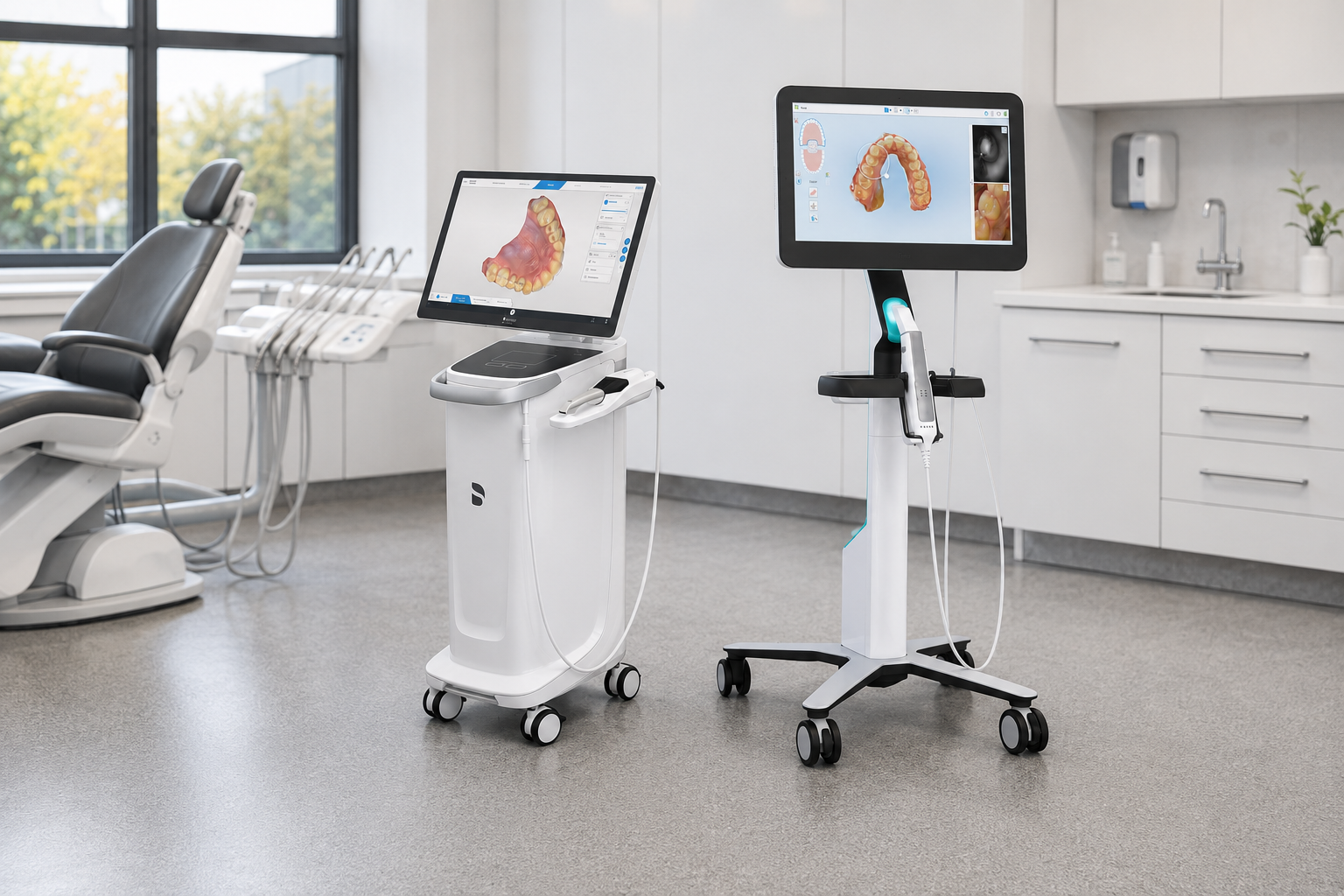
In 2026, the intraoral scanner market has matured to the point where software ecosystems and AI tools matter as much as hardware specs. Two names continue to dominate US purchasing conversations: iTero, from Align Technology, and Primescan, from Dentsply Sirona. Both platforms have released meaningful updates in the past two years, making this a pivotal moment to evaluate both options.
Both platforms went through meaningful product updates between 2024 and 2025. Align Technology released the iTero Lumina in early 2024, its first major hardware update in five years. In March 2025, Align added full restorative capabilities to the Lumina line and simultaneously introduced the iTero Lumina Pro, a variant of the same hardware that adds NIRI (Near-Infrared Imaging) for interproximal caries detection. Dentsply Sirona launched the Primescan 2 in September 2024, a cloud-native, fully wireless scanner that represents a fundamental shift from earlier Primescan generations. As a result, the iTero vs. Primescan comparison looks quite different today than it did even three years ago.
This article examines both platforms in detail, covering clinical accuracy, scan speed, AI and software features, patient comfort, ease of use, integration capabilities, and total cost of ownership. The focus throughout is the US market, addressing the specific questions dental professionals, orthodontists, prosthodontists, and practice owners ask before committing to a five-figure purchase.
For readers who want a broader context on what these devices do and how the technology works, a foundational overview is available in the intraoral scanner guide at Dental Reviewed.
TL;DR
Primescan 2 starts at $24,995, making it the most accessible premium scanner from either company – the iTero Element 5D Plus ranges from approximately $40,000 to $48,000 in market-reported pricing
iTero remains the gold standard for Invisalign-heavy practices, with native case submission and aligner monitoring tools that no competing scanner replicates
Primescan 2 is the only scanner with a direct feed into the CEREC in-house milling workflow, and its cloud-native design eliminates the need for a dedicated scanner PC
Both scanners are clinically accurate, well within the 200 µm threshold considered acceptable for full-arch work – the choice between them comes down to workflow philosophy, not raw scan performance
The 2026 Scanner Landscape at a Glance
Before comparing individual features, it helps to understand exactly what each company is bringing to market in 2026. Both Align Technology and Dentsply Sirona have updated their flagship products significantly over the past two years, and what is on sale today is meaningfully different from what was available even as recently as 2022. The table below summarizes the key specifications across the current active models.
iTero Lumina | iTero Lumina Pro | iTero Element 5D Plus | Primescan 2 | |
Manufacturer | Align Technology | Align Technology | Align Technology | Dentsply Sirona |
Launch year | 2024 | 2025 (variant) | 2021 | 2024 |
Connectivity | Wired / cloud | Wired / cloud | Wired / cloud | Wireless / cloud-native |
Full-arch scan time | ~30 seconds | ~30 seconds | ~45–60 sec (longer with NIRI) | <60 seconds |
Approx. hardware price* | $45,000–$50,000 | Higher than base Lumina (confirm with rep) | $40,000–$48,000 | $24,995 |
Monthly software fee* | Confirm with rep | Confirm with rep | ~$360/month | DS Core subscription (confirm with rep) |
Caries detection | None | NIRI (Near-Infrared Imaging) | NIRI (built-in) | NIR + fluorescence (US: confirm availability) |
Cloud platform | MyiTero / Design Suite | MyiTero / Design Suite | MyiTero | DS Core |
Key ecosystem strength | Speed, restorative design, ortho | Speed, NIRI diagnostics, ortho + restorative | Invisalign, NIRI diagnostics | CEREC milling, open restorative |
STL export | Yes | Yes | Yes | Yes |
Best for | Speed, ergonomics, non-diagnostic ortho + restorative | Full diagnostic + restorative workflow | Mixed ortho/restorative, diagnostics | Restorative, CEREC, multi-op flexibility |
Market-reported pricing; not an official MSRP. Confirm all figures with an authorized representative before purchase. The iTero Lumina and Lumina Pro share identical hardware – the Pro designation reflects the addition of NIRI caries detection as a software-level feature unlock.
The iTero side of this comparison covers four current products. The iTero Lumina, launched in January 2024, is Align’s biggest hardware redesign in years. In March 2025, Align added full restorative capabilities to the Lumina and simultaneously released the iTero Lumina Pro, a variant of the same hardware with NIRI included for interproximal caries detection above the gumline. The iTero Element 5D Plus, launched in 2021, remains commercially active and is a strong choice for practices that want a proven NIRI-based diagnostic workflow with a well-established restorative track record.
The Primescan side is equally layered. The Primescan 2, as the current flagship, is a cloud-native, wireless device that requires a paid DS Core subscription and relies on internet connectivity. The Primescan Connect, its predecessor, is a wired, PC-dependent device that requires no cloud subscription and suits practices in low-bandwidth environments. The comparison below focuses on Primescan 2, with the Connect referenced where the distinction matters.
Accuracy: Comparing Leading Intraoral Scanners
Clinical accuracy is typically the first specification practitioners examine when evaluating a new scanner, and for good reason. Fitting errors in crowns, bridges, and orthodontic appliances cost chair time, generate lab remakes, and erode patient trust. Understanding how published accuracy claims translate into real-world clinical performance matters as much as the numbers themselves.
The accepted clinical benchmark for full-arch scan accuracy is a mean absolute deviation (MAD) of 200 µm or less. Both iTero and Primescan 2 exceed this standard comfortably, but they achieve their accuracy through different optical approaches and show different strengths depending on the clinical scenario. For practices assessing the best digital scanner for capturing detailed 3D dental impressions, this distinction is worth understanding before visiting a rep.
Which Digital Dental Scanner Offers Higher Accuracy for Orthodontic Use?
For orthodontic workflows, the accuracy metrics that matter most are full-arch shape integrity, bite registration precision, and the consistency of sequential scans over time, particularly for monitoring aligner progress. Absolute per-tooth trueness matters less here than overall arch fidelity and repeatability across months of treatment.
Independent clinical testing has measured the iTero Element 5D Plus at a trueness of approximately 8.2 µm and precision of approximately 5.1 µm for single-unit restorations. The Primescan 2 achieves trueness of approximately 7.5 µm and precision of approximately 4.5 µm under comparable conditions, building on the optical foundation of its predecessor. A 2022 comparative study identified the original Primescan as the most accurate scanner in its category, a finding consistent with the clinical reputation this platform has held for several years.
For orthodontic use, raw accuracy is only part of the picture. The iTero platform integrates directly with Invisalign’s ClinCheck workflow, allowing orthodontists to submit cases, monitor aligner progress, and run Outcome Simulator Pro visualizations all within one ecosystem. No other scanner replicates this integration depth. Practices doing meaningful Invisalign volume cite this as the single most important clinical reason to choose iTero. For the best scanner for orthodontic practices running Invisalign cases, iTero is the clear choice on workflow grounds alone, regardless of how the raw accuracy figures compare.
The Primescan 2 supports the SureSmile aligner workflow through DS Core. Following the IDS 2025 updates, SureSmile simulations now initiate automatically after a treatment scan, with calculation times reportedly reduced by up to 90 percent, according to Dentsply Sirona’s IDS 2025 announcement. That represents a meaningful improvement for SureSmile-based practices, though the workflow remains distinct from the Invisalign path.
Restorative Accuracy: Margins, Depth, and Top-Rated Scanners for Prosthodontics
Restorative and prosthodontic use cases demand scanner performance in the most challenging anatomical areas, including deep subgingival margins, posterior preparations in patients with limited mouth opening, and full-arch implant cases where cumulative error is clinically significant.
The Primescan 2 inherits the patented scanning technology of the original Primescan, processing approximately 1 million 3D data points per second with depth scanning capability up to 20 mm, as documented on the Dentsply Sirona Primescan 2 product page. This makes it particularly capable in subgingival preparations and posterior molars. Independent reviewers consistently describe the Primescan’s margin capture as among the best available, and the Primescan 2 preserves that clinical reputation.
The iTero Lumina, following its restorative software update at IDS 2025, now supports full-contour crown design, margin detection, and comprehensive prosthetic workflows through the iTero Design Suite. Align published benchmarking data claiming the Lumina achieves accuracy within the threshold of photogrammetry for full-arch implant restorations, per the iTero scanner comparison page. That is a notable claim, though independent validation of this specific figure remains limited as of early 2026. Prosthodontic practices and those doing significant implant volume should evaluate both devices hands-on before committing.
Scan Speed and Patient Comfort
The comparison of digital dental scanners for impression speed and patient comfort is a practical and daily concern. Faster scans reduce chair time, minimize patient fatigue, and give operators more confidence during the capture process. Both platforms have improved substantially over prior generations, but their approaches differ in ways that affect how they perform in different operatory environments.
Which Digital Impression System Offers Faster Scan Times?
Raw scan speed is a frequently cited specification, but the clinically meaningful figure is total chair time, including scanner setup, any retakes, and additional imaging such as NIRI or caries detection sequences. These factors can extend total scan time well beyond the headline full-arch figure.
Primescan 2 completes a full-arch scan in under 60 seconds in most clinical scenarios, consistent with the original Primescan’s well-established performance. Single-crown preparations typically take 2 to 3 minutes in experienced hands. The cloud-native architecture means the scanner is immediately free for the next patient as soon as the scan is uploaded, without waiting for local processing to complete. This rapid handover is particularly valuable in high-volume multi-operatory practices.
The iTero Lumina achieves a full-arch scan in approximately 30 seconds, placing it among the fastest scanners commercially available. A 3x wider field of view compared to the Element 5D reduces the number of passes and repositioning required during scanning. The iTero Element 5D Plus, in standard scanning mode, completes full-arch scans in approximately 45 to 60 seconds, consistent with Primescan 2. However, when NIRI imaging is active, the Element 5D Plus takes considerably longer – typically 3 to 4 minutes for a single-crown preparation and 12 to 15 minutes for a full-arch diagnostic scan. That additional time captures genuinely valuable diagnostic data, but clinicians should factor it into scheduling and patient communication.
Patient Comfort Differences Between Leading Digital Impression Tools
Patient comfort during intraoral scanning is shaped primarily by two factors: how long the patient has to keep the mouth open and how physically intrusive the scanner wand feels during the procedure. Both platforms deliver the core comfort advantage of digital scanning over conventional alginate impressions, but they differ in ways that matter for specific patient populations.
A Dentsply Sirona customer satisfaction survey found that 84 percent of patients preferred digital scanning over conventional impression-taking. Both iTero and Primescan 2 benefit from this broad patient preference for the digital approach. At a device level, the Primescan 2 features a redesigned, slimmer tip compared to the original Primescan, improving access to molars and distal surfaces. A heating issue documented in earlier Primescan generations has been resolved in the Primescan 2. The fully wireless design eliminates cord tethering, giving the clinician more freedom to position the wand without the physical constraint of a cable.
The iTero Lumina addressed one of the most consistent criticisms of the iTero Element 5D Plus, which is wand weight. The Lumina weighs 260 grams, roughly 50 percent lighter than previous iTero models and closer to the weight of competing scanners such as the 3Shape TRIOS at 299 grams. The Element 5D Plus remains one of the heavier wands on the market, which contributes to clinician fatigue during long full-arch scans and can make precise positioning more difficult in patients with limited opening or a strong gag reflex. For those patient populations, the Lumina’s slimmer and lighter profile represents a real improvement in the scanning experience.
AI and Software: Software Features Comparison for High-End Dental Scanners
The software ecosystem surrounding a scanner now matters as much as the hardware itself. Both iTero and Primescan 2 have invested heavily in AI-driven clinical tools, cloud infrastructure, and workflow automation. The direction of those investments reflects each company’s core strategic priorities, and the differences have real implications for how the platforms serve different practice types day to day.
iTero AI and Software Features
Align Technology’s software strategy has focused on patient engagement, diagnostic value, and integration with the Invisalign treatment pathway. The tools available across the iTero platform reflect that focus, with particular depth in orthodontic visualization and caries detection.
The iTero Element 5D Plus carries NIRI technology, providing simultaneous optical and near-infrared imaging during a standard scan. This enables real-time detection of interproximal caries up to 3 mm below the tooth surface, without radiation. For general practices that incorporate wellness scans as a routine part of hygiene appointments, NIRI changes the diagnostic conversation with patients in a meaningful way. The ability to show a patient a visual of a subsurface lesion during the same appointment drives treatment acceptance in a way that verbal description alone rarely achieves.
The Invisalign Outcome Simulator Pro, available on the Element 5D Plus, generates photorealistic visualizations of post-treatment results. These simulations run in the background while the clinician discusses other findings, integrating directly into Invisalign case creation. iTero TimeLapse tracks oral health changes over time, creating visual comparisons across multiple visits that help patients see the progression of wear, recession, or tooth movement.
The iTero Lumina adds the Align Oral Health Suite, a multi-tool diagnostic package covering gum health assessment, airway visualization, and caries risk mapping alongside surface scanning. The Lumina Pro, the NIRI-equipped variant of the same hardware, extends these capabilities to include real-time interproximal caries detection up to 3 mm below the gumline, without radiation. The restorative update released at IDS 2025 introduced the iTero Design Suite for both Lumina models, a cloud-based CAD environment powered by Exocad, allowing practices to move from scan to restoration design without a file transfer, separate software license, or additional CAD workstation. The MyiTero cloud platform connects practices to more than 20,000 iTero-enabled labs globally, supporting structured digital dental treatment plan communication from the initial scan through to lab delivery.
Primescan 2 AI and Software Features
Dentsply Sirona built the Primescan 2 with DS Core as its operating foundation. That architectural decision shapes every aspect of how the software functions, from scan processing to patient communication to lab collaboration. Understanding DS Core is effectively the same as understanding how Primescan 2 works beyond the hardware.
Primescan 2 processes all scan data in the cloud in real time, with scans appearing in DS Core immediately after capture. DS Core acts as the central hub connecting the scanner to lab partners, SureSmile simulation tools, and patient communication through the Canvas diagnostic viewer. Canvas allows clinicians to arrange and annotate intraoral scans and X-rays in a single view, supporting patient education and treatment acceptance conversations. Practices should confirm the current US regulatory status of Canvas as a diagnostic viewer with a Dentsply Sirona representative before relying on it clinically.
Several notable software improvements arrived with the IDS 2025 updates. SureSmile simulations now initiate automatically after treatment scans, with calculation times reduced by up to 90 percent. Smart compression was introduced, cutting bandwidth requirements by up to 50 percent, which makes the cloud-native architecture more accessible in practices without high-speed fiber internet. Caries detection using near-infrared and fluorescence technologies was announced for EMEA markets at IDS 2025, while US availability of this feature should be confirmed directly with Dentsply Sirona before purchase. Primescan 2 also integrates with the CEREC chairside milling workflow, connecting to CEREC Software and the Primemill unit for same-day restorations – a pathway no competing scanner manufacturer offers.
Ease of Use: How Two Popular Dental Scanners Differ for Clinicians
The review of user experience with top CAD/CAM scanners consistently reveals that ease of use is as important as clinical performance for sustained daily adoption. A scanner that delivers superior specification-sheet accuracy but frustrates the clinical team during every scan session will underperform its potential. Both iTero and Primescan 2 have invested in reducing workflow friction, but they approach the problem differently.
The Primescan 2’s most distinctive usability feature is auto-activation: the scanner begins capturing when inserted into the patient’s mouth and stops when removed, with no foot pedal or button press required. The DS Core interface is browser-based, meaning no software installation or update management is necessary. The latest version is always active on login. Delegation is straightforward – the scanning device only needs to be present for the actual scan, after which it is immediately free for the next patient, while all processing happens in the cloud.
The most significant limitation of this architecture is internet dependency. Any lag in the connection produces visible interruptions during live scan stitching. Dentsply Sirona ships an edge device as a mitigation for low-bandwidth practices, but this adds cost and setup complexity. Practices in rural areas, or markets where broadband consistency is variable, should assess their connectivity before committing to Primescan 2. The Primescan Connect, the wired predecessor, is worth considering as an alternative for those environments.
What Are the Ergonomic Considerations for Modern Dental Scanners?
Ergonomics in intraoral scanning encompasses both patient and clinician comfort – wand weight, grip design, tip geometry, and the physical demands of holding a device in a precise position during multi-minute scans. These factors are easy to overlook in a specification comparison but become central to daily clinical experience, particularly for practitioners performing multiple full-arch scans per day.
The iTero Lumina’s redesign addressed ergonomics directly. Moving the six scanning modules from the body of the wand to the tip itself allowed for a thinner, lighter device. At 260 grams, the Lumina is meaningfully lighter than prior iTero models and compares favorably to competitors. The thinner tip profile improves access to distal molars and upper arch posterior regions that have historically been among the most technically demanding areas for intraoral scanning. The pen-grip design is familiar to clinicians who have used previous iTero scanners, with side buttons accessible during scanning without repositioning the hand.
The iTero Element 5D Plus remains heavier and bulkier, a recognized ergonomic drawback for clinicians doing long full-arch or full-mouth scans. The Primescan 2 features a slimmer redesigned tip versus the original Primescan, with improved posterior access. Being fully wireless also removes the physical tension of a cable during scanning, a practical comfort improvement that practitioners consistently note. For a broader assessment of ergonomic and feature considerations across the dental equipment category, the dental equipment guide at Dental Reviewed covers the landscape in useful detail.
Integration – Which Dental Scanner Has Better Integration With Practice Management Software?
The integration capabilities of two prominent dental scanning solutions matter because scanning does not happen in isolation. Every scan connects downstream to lab orders, patient records, treatment communication, billing, and scheduling. A scanner that integrates poorly with existing systems creates a workflow cost that compounds across every patient encounter throughout the practice year.
Invisalign and Aligner Workflows
Aligner integration is the clearest and most consequential workflow differentiator between iTero and Primescan 2. For practices where Invisalign volume is a meaningful part of the clinical and financial model, this comparison is effectively decisive.
iTero is the native scanner for Invisalign. Align Technology manufactures both products, and case submission, ClinCheck access, refinement ordering, and progress monitoring all operate within the iTero platform without file transfer or third-party software. Orthodontists and general practitioners running more than a handful of Invisalign cases per month should treat this integration as a core justification for iTero, not a secondary feature.
Primescan 2 does not integrate natively with Invisalign. For orthodontic practices exploring this question, the resource on Primescan Invisalign compatibility addresses the technical realities in detail. For practices primarily using SureSmile or similar aligner systems, the Primescan 2 DS Core workflow provides a smooth and increasingly capable path. For Invisalign-first practices, it does not.
Lab Connectivity and Data Export Compatibility of the Two Main Scanner Brands
Lab connectivity shapes how efficiently practices send cases, receive design feedback, and track order status. These activities affect scheduling accuracy and patient communication across the week.
The iTero MyiTero platform connects to more than 20,000 iTero-enabled labs, with a case ordering workflow integrated directly into the scanner interface. STL export is available for labs outside the network. The iTero Design Suite adds a cloud-based Exocad environment that allows practices to move from scan to design without additional software or a separate CAD workstation, which is particularly valuable for practices adding in-house design capabilities.
Primescan 2 sends scan data to DS Core, where labs access orders and files through their own DS Core account. The platform is validated with inLab, Exocad, and 3Shape Dental System, and open STL export is available for all other lab software. DS Core also accepts scans from 3Shape TRIOS via 3Shape Unite, making it a useful collaboration hub for multi-scanner practices. For practice management software integration, both scanners connect with major US platforms, including Dentrix, Eaglesoft, and Open Dental, though integration depth varies by software version and configuration. Practices should verify specific compatibility with their current system before committing to either platform.
A note on the broader scanner comparison: 3Shape TRIOS is the third platform most frequently mentioned in the same purchasing conversations. Those evaluating iTero vs TRIOS scanners alongside the Primescan comparison will find TRIOS most compelling for its open-platform flexibility and strong performance in edentulous cases. The 3Shape TRIOS review at Dental Reviewed provides a detailed independent assessment for practices considering all three platforms.
Pricing: Cost Comparison Between Two Popular Digital Dental Scanning Systems
The cost comparison of popular dental imaging devices reveals a significant price gap between these two platforms in 2026, and that gap has strategic implications for return-on-investment planning, total cost of ownership modeling, and the realistic financial commitment over a five-year depreciation cycle.
Neither Align Technology nor Dentsply Sirona publishes a fixed MSRP. All pricing figures below are market-reported, drawn from publicly listed dealer prices and aggregated practitioner reports. Actual quotes vary by region, Invisalign volume tier, and promotional programs. Practices should always obtain a formal written quote from an authorized representative before budgeting a purchase.
What Are the Subscription Fees for Major Dental Scanner Platforms?
Hardware purchase price is only one part of the financial comparison. Subscription fees for major dental scanner platforms represent a meaningful ongoing cost that fundamentally changes the five-year total cost of ownership calculation for any practice.
Primescan 2 hardware is listed at $24,995 through authorized dealers such as Henry Schein, making it the most affordable premium scanner entry point from either company. A paid DS Core subscription is required to operate Primescan 2, and the specific subscription tiers and pricing should be confirmed with a Dentsply Sirona representative. For reference, DS Core Care for the Primescan Connect is documented at approximately $175 per month, a figure that includes express replacement and support services. Practices should also factor in the cost of single-use scanning sleeves as a recurring consumable, and the optional edge device if required for their connectivity environment.
The iTero Element 5D Plus is market-reported in the range of approximately $40,000 to $48,000. The monthly software subscription is widely reported at approximately $360 per month, covering software updates, cloud access, and support. Over five years, that subscription cost alone totals approximately $21,600, making it a substantial component of total ownership cost and one that merits inclusion in any financial model. Disposable tip sleeves are an additional recurring consumable that should be factored into operating cost estimates.
The iTero Lumina is market-reported at approximately $45,000 to $50,000. Subscription terms for the Lumina and the Design Suite should be confirmed with Align Technology directly, as the structure may differ from the Element 5D Plus fees. For practices evaluating affordable intraoral scanners suitable for small dental clinics, Primescan 2’s hardware entry point is the most accessible among premium scanners from major manufacturers. Even when a DS Core subscription is added, the total cost profile is generally lower than iTero over a five-year horizon for practices not generating Invisalign volume. For context on value-tier alternatives, the Medit i700 review offers useful data for practices with tighter budgets.
Trade-Ins and Certified Pre-Owned Options
The secondary market for intraoral scanners has matured, and dental professionals asking whether they can trade in a current dental scanner for a newer model have more options than in prior years. Both manufacturers and their dealer networks participate in upgrade and trade-in programs, though the specifics vary by region and promotional cycle.
iTero certified pre-owned (CPO) units are available through authorized resellers such as Renew Digital. The iTero Element 5D CPO, not the Plus series, has been listed at approximately $13,995 to $16,995, including cart, wand, a 1-year warranty, and subscription access. These programs represent a meaningful entry point for smaller practices or those upgrading from first-generation digital workflows. For broader guidance on evaluating pre-owned equipment, a practical overview of used dental equipment covers condition assessment, warranty terms, and key verification steps before purchasing. Dentsply Sirona's authorized trade-in and upgrade programs should be explored directly with a DS representative, as these vary by region and promotional period.
Support, Training, and Where to Buy
Support and training options for advanced intraoral devices are consistently underweighted in purchasing decisions. Clinical adoption depends heavily on how well the team learns the device and its software, and downtime risk is a real operational concern for any busy practice. A scanner that sits unused while waiting for service is not performing the return on investment that justified the purchase.
iTero practices benefit from Align Technology’s onboarding support, online resources through the iTero Learning Center, and CE pathways that connect scanner training to Invisalign proficiency development. The iTero brand page at Dental Reviewed aggregates independent review content and practitioner-reported support experiences. Demos are available through Align Technology directly and through authorized dealers – practices should request a demo in their own operatory when possible, rather than relying solely on conference floor experiences, to test the scanner in their real clinical environment.
Primescan 2 is distributed through major US dental dealers, including Henry Schein, Patterson Dental, and A-dec. DS Core Care provides the primary support layer, with express replacement (next business day after remote diagnosis) for Primescan 2 users. Dentsply Sirona’s DS World conference and regional dealer events are the most common demo venues. Practices should request an in-practice demo that tests scanning, cloud upload, and DS Core case management within their own network environment, since Primescan 2’s cloud-native performance depends directly on local internet infrastructure.
For practices setting up a new practice and evaluating scanner options as part of a broader equipment procurement process, the new dental practice checklist provides a structured framework for assessing each equipment category within the context of a full startup investment. Practices can also browse the full range of dental equipment reviews at Dental Reviewed for independent assessments of both platforms and their competitors.
Pros and Cons of Two Leading Digital Scanners in Dentistry
Summarizing the comparison with a structured pros and cons view helps practices weigh the factors that matter most for their specific workflows. No scanner is universally superior – the right choice depends on practice specialty, existing infrastructure, budget, and long-term clinical goals.
iTero Element 5D Plus: Pros
NIRI caries detection is a genuine diagnostic differentiator, identifying interproximal caries up to 3 mm deep without radiation
Seamless Invisalign case submission and ClinCheck integration that no competing scanner replicates
TimeLapse and Outcome Simulator Pro drive patient engagement and measurably improve treatment acceptance
Well-established clinical accuracy record across restorative and orthodontic applications spanning several years of adoption
Strong global lab network connectivity via MyiTero
iTero Element 5D Plus: Cons
Higher hardware price in the $40,000–$48,000 range compared to Primescan 2
A monthly software subscription of approximately $360 adds approximately $21,600 over a five-year period
Wand weight is among the heaviest on the market, contributing to clinician fatigue during extended scanning sessions
NIRI scanning significantly extends chair time for full-arch diagnostic scans, affecting scheduling
iTero Lumina: Pros
Among the fastest full-arch scanners available, at approximately 30 seconds
Lightest iTero wand at 260 grams, with improved ergonomics and enhanced posterior tip access
Photorealistic scan quality reduces the need for separate intraoral photography in many consultation scenarios
Cloud-based iTero Design Suite (Exocad) enables in-house restoration design without third-party software, on both Lumina and Lumina Pro
Lumina Pro adds NIRI caries detection to the same hardware – practices can choose the diagnostic depth they need
Align Oral Health Suite adds multi-diagnostic value beyond standard impression capture
iTero Lumina: Cons
Restorative capabilities are newer than those of established competitors, with limited independent validation of prosthodontic performance in complex cases as of early 2026
Base Lumina has no caries detection – NIRI requires the Lumina Pro, which carries a higher price
Premium hardware costs in the $45,000–$50,000 range, with Lumina Pro pricing higher still
Subscription structure for Design Suite access requires confirmation with Align Technology
Primescan 2: Pros
Lowest hardware entry point among premium scanners at $24,995, confirmed through authorized dealers
Fully wireless, cloud-native architecture eliminates the need for a dedicated scanner PC
Auto-activation simplifies scanning and enables straightforward delegation to clinical staff
Direct integration with CEREC milling workflow for same-day restorations, available to no other scanner manufacturer
Smart compression and SureSmile simulation speed improvements following the IDS 2025 update
Open data export via STL, inLab, Exocad, and 3Shape Dental System
Primescan 2: Cons
Requires a reliable internet connection – scanning interruptions occur in low-bandwidth environments
A DS Core subscription is required to operate the scanner, and pricing must be confirmed with a representative
Caries detection feature not confirmed as available in the US as of early 2026
No native Invisalign integration – a significant limitation for orthodontic practices running Invisalign cases
Bottom Line: Who Should Buy Which Scanner?
The bottom line in the itero vs. Primescan debate is that both platforms are clinically excellent and well-supported in the US market. The decision comes down to workflow priorities, practice specialty mix, infrastructure readiness, and total budget commitment – not to any meaningful difference in raw scan performance at the top of the market.
Practices where Invisalign represents meaningful revenue should choose iTero. The integration depth is unmatched and directly translates into case efficiency, ClinCheck turnaround, and patient acceptance. Among iTero models, the Lumina and Lumina Pro are the better long-term investments for practices with the budget – lighter, faster, and more capable than the Element 5D Plus as the platform matures. Practices that need built-in caries detection should choose the Lumina Pro over the base Lumina, since NIRI is only available on the Pro variant. The Element 5D Plus remains a strong, established option for practices that want proven NIRI diagnostics at a potentially lower price point than the Lumina Pro.
Practices with a restorative or mixed general dentistry focus, where same-day crowns or in-house milling are a priority, should evaluate Primescan 2 seriously. The CEREC integration pathway is unique to Dentsply Sirona, and the $24,995 hardware price makes premium scanning accessible to practices that cannot justify a $45,000 investment. The cloud-native architecture suits multi-operatory practices that benefit from moving one scanner between rooms without cart logistics. Practices in low-bandwidth environments should consider the Primescan Connect or iTero instead, since Primescan 2’s internet dependency is a genuine operational risk in those settings.
For practices building a complete clinical roadmap or comparing across a broader set of options, the dental equipment reviews section at Dental Reviewed includes independent analysis of the iTero, Primescan, 3Shape TRIOS, and Medit i700 platforms. Wherever the decision lands, the most important step before purchase is a hands-on demo with your own team, in your own operatory, using clinical scenarios representative of your daily case mix. Both manufacturers and their authorized dealer networks facilitate in-practice evaluations.
Already own the scanner? Our step-by-step guide to the MyITero login covers account setup, doctor versus lab access, and the most common sign-in errors.
Frequently Asked Questions
Can I use Primescan 2 without an internet connection?
Primescan 2 is a cloud-native scanner and requires an active internet connection to operate. Dentsply Sirona ships an optional edge device for practices with low-bandwidth connections, which temporarily stores scans locally before uploading. Complete offline use is not supported. Practices in areas with inconsistent internet should evaluate Primescan Connect as an alternative.
Does iTero work with aligner brands other than Invisalign?
iTero scanners export STL files that can be used with other aligner systems, though the seamless in-platform integration that exists with Invisalign is exclusive to that product line. Practices using other aligner brands export scan files manually and submit through those systems’ own portals.
What is the Primescan 2 price in the US?
The Primescan 2 is listed at $24,995 through authorized dealers such as Henry Schein as of late 2024. A paid DS Core subscription is required in addition to the hardware purchase. Pricing is subject to change, and official quotes should be obtained from an authorized Dentsply Sirona representative.
Can I trade in my current dental scanner for a newer model?
Trade-in and certified pre-owned programs exist for both platforms. iTero CPO units are available through authorized resellers such as Renew Digital, with iTero Element 5D CPO units listed at approximately $13,995 to $16,995, including warranty and subscription. Dentsply Sirona trade-in programs vary by region and should be confirmed with a local representative.
Is the Primescan 2 caries detection feature available in the US?
As of early 2026, the near-infrared and fluorescence caries detection feature announced for Primescan 2 at IDS 2025 is available in EMEA markets. US availability should be confirmed directly with a Dentsply Sirona representative before purchase.
Where can I find demos or trials for these scanners?
Both manufacturers offer in-practice demos through their authorized dealer networks. iTero demos can be requested through Align Technology directly or through authorized dealers. Primescan 2 demos are available through Henry Schein, Patterson Dental, and A-dec. Requesting an in-practice demo, rather than relying on trade show experiences alone, is strongly recommended before purchase so that the team can evaluate the scanner within their real workflow environment.
Which intraoral scanner is better for a practice doing both orthodontics and restorative work?
Practices doing mixed ortho and restorative work face the most nuanced choice. If Invisalign is a significant revenue driver, iTero is generally the stronger fit. If same-day restorations and in-house milling are central, Primescan 2’s CEREC integration gives it a clear advantage. Practices where both are equally important may want to evaluate the 3Shape TRIOS platform as a third option, given its strong open-platform restorative performance and compatibility with multiple aligner systems.