Dental Flipper: A Temporary Replacement Tooth Explained
A dental flipper is a removable acrylic plate carrying one or more false teeth. It is the most common temporary tooth replacement for a missing front tooth, worn while an implant...
Written by Mantas Petraitis
Read time: 7 min read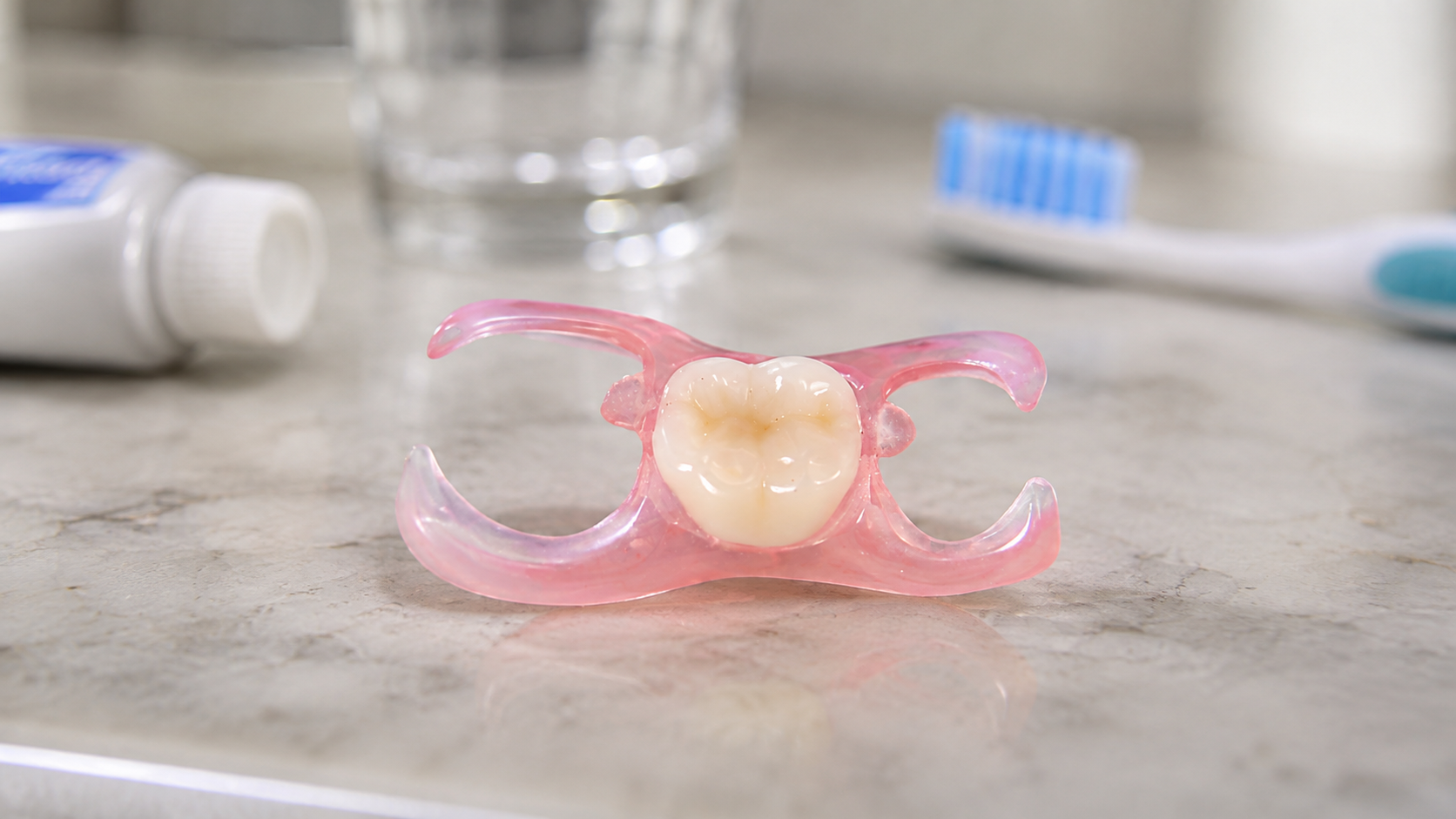
A dental flipper is a removable acrylic plate carrying one or more false teeth. It is the most common temporary tooth replacement for a missing front tooth, worn while an implant heals or a bridge is made, so patients never leave the office with a visible space.
TL;DR
A single-tooth flipper costs about $300 to $700 in most US practices.
It works best as a short bridge to an implant, a fixed bridge, or a long-term partial.
Front-tooth flippers handle soft, cut-up food and fail when used to bite into apples or bread.
Worn for years, a flipper can harm the teeth and gums it rests against.
What Is A Dental Flipper?
A dental flipper is the simplest member of the removable partial denture family. Patients call it a flipper tooth or flipper denture, and insurance claims list it as an interim partial denture.
The name comes from the way some wearers flick it loose with their tongue. That habit is worth breaking early, because it bends the clasps and fatigues the acrylic.
A pink acrylic base sits against the palate or behind the lower front teeth, with a denture tooth set where the natural tooth used to be. A snug fit, light suction, and, often, thin wire clasps hold it in place.
What a flipper lacks explains why it is temporary. A long-term partial rests on small seats cut into the neighboring teeth, which carry biting forces into the bone.
A flipper has no such support. Every bite pushes the plate into the gum, which the tissue tolerates for months and resents over years.
What Does A Dental Flipper Look Like?
Out of the mouth, a flipper looks like a small retainer with a tooth attached. In the mouth, a well-made one is hard to spot, because the lab matches the false tooth to the shade and shape of its neighbors.
Upper and lower flippers behave quite differently, and some bites rule out a flipper altogether.
Upper flippers gain suction and stability from the palate
Lower flippers rely on a narrow horseshoe of acrylic that sits where the tongue rests, so they feel more intrusive
Deep bites, where the lower front teeth touch the palate, often leave no room for acrylic behind the upper teeth
For deep-bite patients, a clear Essix-style retainer with a tooth or a bonded temporary is usually the better choice.
The most natural-looking flippers pay attention to the gum line as much as the tooth. When a flipper is made before an extraction, the lab can give the false tooth a rounded, egg-shaped base that rests lightly in the fresh socket.
That gentle support helps hold up the small triangles of gum between the teeth, so the final implant or bridge looks more natural.
The trade-off comes later. As the socket shrinks, a dark space opens above the false tooth, and that shadow is usually the first sign the flipper needs relining.
How Much Does A Flipper Tooth Cost?
A single-tooth flipper usually costs between $300 and $700 in the US. A 2026 cost analysis puts most single-tooth practice quotes at $300 to $500.
The same source cites a CareCredit national average of $605 for an interim partial, with a range of $471 to $1,164. Treat these as guide prices, and plan around a written quote from your dentist.
Several factors push the dental flipper cost up:
Each additional tooth being replaced
Tooth-colored or flexible clasps
Premium lab work and faster turnaround
Extra adjustment or reline visits
Practices in higher-cost cities and states
Digitally designed, 3D-printed flippers have become a quiet money-saver. The design file stays on record, so a lost or broken flipper can often be reprinted without new impressions.
Before paying for a flipper, ask two questions:
Does my implant or bridge quote already include a flipper?
Will an interim partial affect insurance coverage for my permanent prosthesis later?
Bone grafting carries its own fee, covered in our guide to the dental bone graft procedure.
How Much Does A Dental Flipper Cost In Each State?
No national survey publishes flipper prices by state, so the table below gives estimates.
California, the District of Columbia, and Hawaii come out highest. Arkansas, Mississippi, and Alabama come out lowest.
State | Estimated average | Estimated typical range |
|---|---|---|
Alabama | $535 | $265–$615 |
Alaska | $650 | $320–$750 |
Arizona | $590 | $295–$685 |
Arkansas | $520 | $260–$605 |
California | $735 | $365–$850 |
Colorado | $650 | $320–$750 |
Connecticut | $655 | $325–$760 |
Delaware | $600 | $300–$695 |
District of Columbia | $720 | $355–$830 |
Florida | $595 | $295–$690 |
Georgia | $575 | $285–$665 |
Hawaii | $690 | $345–$800 |
Idaho | $560 | $280–$650 |
Illinois | $600 | $295–$695 |
Indiana | $565 | $280–$650 |
Iowa | $555 | $275–$645 |
Kansas | $550 | $275–$635 |
Kentucky | $540 | $270–$625 |
Louisiana | $555 | $275–$645 |
Maine | $580 | $285–$670 |
Maryland | $635 | $315–$735 |
Massachusetts | $680 | $335–$785 |
Michigan | $570 | $285–$660 |
Minnesota | $625 | $310–$725 |
Mississippi | $525 | $260–$610 |
Missouri | $565 | $280–$650 |
Montana | $610 | $300–$705 |
Nebraska | $560 | $280–$650 |
Nevada | $610 | $305–$705 |
New Hampshire | $635 | $315–$735 |
New Jersey | $685 | $340–$790 |
New Mexico | $560 | $275–$645 |
New York | $690 | $340–$795 |
North Carolina | $570 | $280–$660 |
North Dakota | $610 | $300–$705 |
Ohio | $555 | $275–$645 |
Oklahoma | $545 | $270–$630 |
Oregon | $635 | $315–$735 |
Pennsylvania | $595 | $295–$685 |
Rhode Island | $630 | $310–$725 |
South Carolina | $565 | $280–$655 |
South Dakota | $610 | $300–$705 |
Tennessee | $555 | $275–$640 |
Texas | $595 | $295–$690 |
Utah | $575 | $285–$665 |
Vermont | $600 | $300–$695 |
Virginia | $600 | $295–$695 |
Washington | $675 | $335–$780 |
West Virginia | $555 | $275–$640 |
Wisconsin | $580 | $290–$670 |
Wyoming | $610 | $300–$705 |
Treat these numbers as a sanity check, since two practices in one city often differ more than two neighboring states.
Medicaid follows its own logic. Nebraska’s Medicaid program even classifies a flipper as the permanent replacement for one to three missing front teeth, a reminder of how often temporary appliances end up doing permanent jobs.
When Do Dentists Recommend A Dental Flipper?
A flipper earns its place when a visible tooth is missing, a permanent solution is planned, and the patient needs to look normal in between. The details depend on why the tooth is missing and what comes next.
Replacing A Missing Front Tooth
A missing front tooth changes how people smile and speak, which is why the flipper is so often ready on the day of extraction. It restores appearance far better than function, since a false tooth with no root behind it cannot take real biting force.
Waiting For A Dental Implant
An implant can take several months from extraction to final crown. During that time, a flipper that presses on the implant or graft can push chewing forces into the site and disturb healing.
To prevent that, the dentist hollows out the base over the surgical area and rechecks it at each visit.
For front-tooth implants, many surgeons prefer options that rest on the teeth instead of the gum:
An Essix retainer with a false tooth, which keeps all pressure off the healing site
The patient's own extracted crown, bonded to its neighbors as a short-term bridge
Our Essix retainer guide explains the first option, and our guide to dental implant costs covers the permanent stage.
After Tooth Extraction Or Bone Grafting
Some flippers go in on the day of extraction, and others after initial healing, depending on the site, any graft, and the design. There is no universal waiting period.
The gum and bone change shape fastest in the first months after a tooth comes out. A flipper that fits perfectly on day one often feels loose a few weeks later, which is normal remodeling that a reline can fix.
A base that digs into a healing socket is a different matter, since it can cause ulcers and slow recovery. Our guides to tooth extraction healing stages and dental bone graft healing explain what the site goes through.
Temporary Tooth Replacement For Younger Patients
Teenagers are one of the biggest flipper groups, usually after a sports injury or because an adult tooth, often an upper lateral incisor, never formed.
Implants are normally delayed until jaw growth finishes, often in the late teens or early twenties. An implant placed too early stays fixed while the neighboring teeth keep erupting, so it can end up looking short.
A flipper or a retainer with a false tooth holds the space until the jaw is ready.
Can You Eat With A Dental Flipper?
Most people can eat with a flipper, and eating with a flipper gets easier once you treat it as a cosmetic appliance rather than a working tooth. How much you can manage depends on how stable the appliance is and where the false tooth sits.
Some foods are easy, and others are the main reason flippers break.
Easy: pasta, eggs, fish, rice, cooked vegetables, and small pieces of meat
Risky: caramel and gum, which pull the plate off the palate
Risky: nuts, hard candy, and crusty bread, which load the thin acrylic where the tooth meets the base
That junction between the false tooth and the base is where most flippers crack.
Front-tooth flippers need the most care. Biting into an apple or a sandwich turns the false tooth into a lever that pries the plate off the palate, and repeated levering eventually snaps the tooth off.
A few habits avoid most problems:
Cut food into small pieces
Chew on your back teeth
Tear bread by hand instead of biting it
Remove the flipper for meals in the first weeks after surgery
How Should A Dental Flipper Fit And Feel?
Every new flipper feels foreign for a while, and knowing the usual pattern helps separate adaptation from a fit problem.
The first days follow a predictable pattern:
Tightness and a bulky feeling on the palate
Extra saliva while your mouth decides whether the plate is food
Changed "s" and "th" sounds, because the tongue lands on acrylic instead of the ridged palate
Reading aloud for a few minutes each day speeds things up, and most people sound normal again within one to two weeks.
A little movement when you talk or swallow is expected. Sore spots, bleeding, or a flipper that rocks when you bite point to a fit problem.
A dentist can find and relieve the pressure point in minutes, so it's best to pay a visit to a dental clinic rather than trying to live with pain. Filing or bending the appliance at home almost always makes things worse.
How Long Can You Wear A Dental Flipper?
A flipper is designed to last weeks or months, usually as long as the implant or bridge timeline takes. Some last a year or more, but durability varies widely with the bite, the design, and how the appliance is treated.
In practice, temporary often stretches into years. A clinical review of 575 interim partial dentures followed them for an average of about 31 months, far longer than most were designed for.
The authors linked that prolonged coverage to gum disease and decay, because the acrylic holds plaque against the gum line of every tooth it touches.
There is also a cost to waiting that patients rarely hear about. A flipper does not replace the root, so it does nothing to stop the jawbone from shrinking.
A patient who plans an implant and wears a flipper for two years can find the bone has narrowed enough to need grafting first. Signs a flipper has run its course include:
Repeated relines
Rocking when you bite
Cracks near the false tooth
A widening dark space above the false tooth
How Do You Clean And Care For A Dental Flipper?
Cleaning protects the appliance and the teeth and gums beneath it. A soak loosens debris, and brushing removes the plaque.
Rinse the flipper after every meal, and rinse your mouth before putting it back
Brush it once a day with a soft brush and mild soap or a denture cleaner
Skip regular and whitening toothpaste, which scratches acrylic
Use cool or lukewarm water, since hot water can warp the base
Avoid bleach soaks if the flipper has metal clasps, because bleach corrodes them
Store it in water or denture solution, and clean it over a folded towel
Most dentists recommend taking the flipper out at night so the gums can rest and saliva can clean the tissue. Sleeping in it carries two risks:
Denture stomatitis, a yeast infection that leaves a red patch on the palate in the exact shape of the plate
Swallowing a small single-tooth flipper that breaks or dislodges overnight
Patients with a dry mouth are the most prone to the yeast infection.
If the flipper cracks or the tooth comes loose, keep the pieces and book a repair. Our guide to denture repair explains why superglue and home kits usually create bigger problems.
Adhesive can steady a lower flipper for a short time, but it cannot fix a poor fit, as our denture adhesive guide explains.
What Are The Pros And Cons Of A Dental Flipper?
A flipper is excellent at solving a short-term cosmetic problem and poor at doing a long-term job. Suitability depends on the missing teeth, the healing stage, and the final plan.
Advantages | Disadvantages |
|---|---|
Low cost and quick to make | Less durable than permanent options |
No surgery or drilling of neighboring teeth | Bulky on the palate and can affect speech |
Restores appearance on the day of extraction | Moves when eating or speaking |
Removable for cleaning | Holds plaque against neighboring teeth |
Easy to adjust as the gums heal | Can irritate gums if poorly fitted |
Can replace one or several teeth | Does not prevent bone loss |
Dental Flipper Vs. Partial Denture: What Is The Difference?
A flipper is technically a partial denture, so the flipper vs partial denture question is really about temporary versus long-term design. The two look similar at a glance and are built for very different jobs.
Feature | Dental flipper | Conventional partial denture |
|---|---|---|
Materials | All acrylic, simple wire clasps | Metal framework with acrylic teeth |
Intended duration | Weeks to months | Many years |
Support | Rests mainly on the gums | Rests on teeth through rest seats |
Chewing | Soft foods, limited biting | Close to normal chewing |
Durability | Cracks and loosens more easily | Strong and repairable |
Relative cost | Lowest | Higher |
Maintenance | Frequent adjustments while gums heal | Occasional relines |
Flexible partial dentures sit between the two. Their nylon base grips the teeth without metal clasps, though it is hard to adjust or reline as the gums change. Our guide to flexible dentures compares the main types, and our breakdown of flexible partial dentures cost covers pricing.
What Are The Alternatives To A Dental Flipper?
Several temporary and permanent options can replace a missing tooth, and they differ mainly in whether you can take them out and how long they are meant to last.
Option | Removable? | Intended duration | Common use | Main limitation |
|---|---|---|---|---|
Essix retainer with tooth | Yes | Temporary | Implant healing, front teeth | Cannot eat with it in |
Bonded temporary bridge | No | Temporary | Front tooth while healing | Can debond under biting load |
Conventional partial denture | Yes | Long term | Several missing teeth | Metal clasps may show |
Flexible partial denture | Yes | Long term | Clasp-free appearance | Hard to adjust or reline |
Permanent dental bridge | No | Long term | One to three teeth | Neighboring teeth are drilled |
Dental implant | No | Long term | Single or multiple teeth | Surgery, cost and healing time |
A dental bridge or an implant is the usual permanent destination. Patients losing most of their teeth may need a full denture, covered in our comparison of same-day and traditional dentures.
Mapping each stage in dental treatment plan software helps the dentist schedule the switch before the flipper overstays its welcome.
When Should You Contact Your Dentist About A Dental Flipper?
Some soreness in the first week is part of adapting. Any of the following deserves a call, because most can be fixed in a short visit.
Pain that persists beyond the first few days
Gum sores or bleeding where the flipper rubs
A flipper that keeps falling out or rocks when you bite
Cracks, a loose false tooth, or a bent clasp
Pressure around an extraction, graft, or implant site
A dark space opening above the false tooth
A red patch on the palate in the shape of the plate
One rule applies to any mouth sore. An ulcer that has not healed within two weeks of the flipper being adjusted needs a proper examination, because persistent ulcers are not always caused by the appliance.
Bottom Line
A dental flipper is a fast, affordable way to avoid a visible missing tooth while an implant heals or a bridge is made, and a well-made one looks convincingly natural.
Its weakness is time. It rests on the gums, holds plaque against the neighboring teeth, and does nothing for the bone, so it works best as a planned, short stage on the way to permanent treatment.
This article is for informational purposes only and does not constitute medical advice. Always consult with qualified healthcare professionals for diagnosis and treatment recommendations specific to your situation.
Frequently Asked Questions
Can you sleep with a dental flipper?
Most dentists recommend taking a flipper out at night so the gums can rest and saliva can clean the tissue. Sleeping in one raises the risk of a yeast infection under the plate, and a small flipper can be swallowed if it breaks.
Can you eat normally with a flipper tooth?
Not quite. Soft, cut-up foods are easy, while sticky, hard, and chewy foods can pull the flipper loose or crack it. Front-tooth flippers cannot bite into apples or sandwiches, so chew on your back teeth or remove the flipper for meals.
How long after tooth extraction can you wear a flipper?
Some flippers are placed on the day of the extraction, while others are fitted after initial healing. Timing depends on the site, any bone grafting, and the appliance design. The base must not press on the healing socket, so expect a few adjustments as the gums shrink.
Can a dental flipper replace multiple teeth?
Yes. A flipper can replace several teeth in the same arch, either side by side or in different positions. Larger flippers are bulkier and less stable, so a flexible partial denture or conventional partial suits longer waits.
Does a dental flipper look natural?
A well-made flipper usually looks natural in conversation, especially with tooth-colored clasps. The false tooth is matched to your neighboring teeth. As the gum shrinks after an extraction, a small dark space can appear above it, and a reline usually fixes that.