Rating: 4.2/5
Cavitron 300 Ultrasonic Scaling System Review
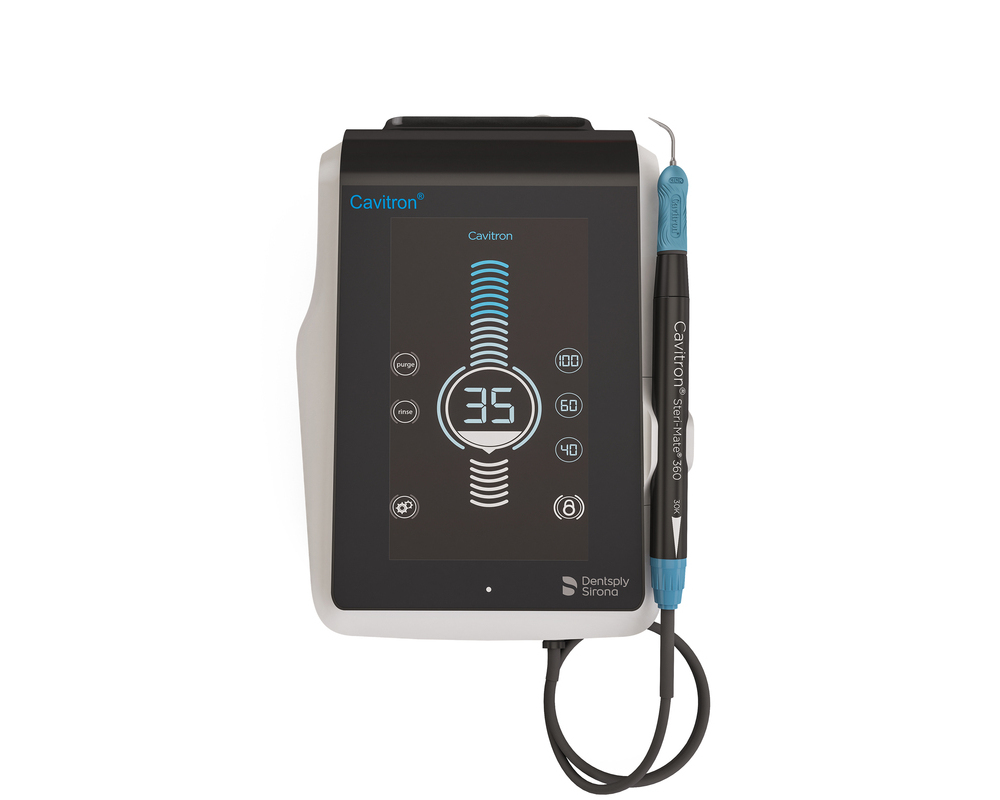
The Cavitron 300 ultrasonic scaling system is Dentsply Sirona's flagship tabletop magnetostrictive scaler, priced at roughly $3,650 to $5,200 through US dealers. This review...
Reviewed by Mantas Petraitis
Pros
- The Steri-Mate 360 handpiece rotates the insert between the fingers and keeps the wrist neutral.
- The 39 g cable is noticeably lighter than the 54 g Cavitron Plus cable.
- Tap-On activation lets the foot rest during scaling.
- Memory presets change power levels without reaching for the unit.
- Foot-activated boost adds at least 25% power on demand.
- Lower heat output allows less water and less pooling in the mouth.
- The flat touchscreen and screen lock simplify disinfection.
- The compact footprint suits narrow counters and carts.
- Dentsply Sirona backs the unit with a 3-year warranty.
Cons
- The price sits well above the Cavitron Plus.
- The unit accepts no 25K inserts.
- The handpiece and pedal work with no other Cavitron model.
- The screen does not display boost power.
- The pedal charges only when switched on, which confuses new staff.
- Air polishing requires a separate unit or the Jet Plus.
The Cavitron 300 ultrasonic scaling system is Dentsply Sirona's flagship tabletop magnetostrictive scaler, priced at roughly $3,650 to $5,200 through US dealers. This review covers its features, a hands-on test in a general practice hygiene department, the supporting research, and value for hygienists and practice owners weighing an upgrade.
TL;DR
The Steri-Mate 360 handpiece rotates the insert between the fingers and keeps the wrist neutral through line angles and furcations.
A 39 g cable and a wireless Tap-On pedal cut hand drag and ankle strain compared with the Cavitron Plus.
The unit accepts only 30K inserts, and its handpiece and pedal work with no other Cavitron model.
US dealers price the system between about $3,650 and $5,200, and Dentsply Sirona backs it with a 3-year warranty.
Cavitron 300 Series At A Glance
The table below pulls the core specifications from Dentsply Sirona's Cavitron 300 product page and its published FAQ. Dealer packages differ in the inserts they bundle, so confirm the contents before ordering.
Specification | Detail |
Manufacturer | Dentsply Sirona |
Technology | Magnetostrictive ultrasonic |
Insert compatibility | Cavitron 30K inserts only (no 25K) |
Handpiece | Steri-Mate 360, rotating, detachable, autoclavable |
Foot pedal | Wireless, rechargeable, Tap-On activation |
Controls | Capacitive touchscreen with memory presets |
Dimensions | 3.7 in H x 6.9 in W x 10.7 in D |
Handpiece cable weight | 39 g (Cavitron Plus cable: 54 g) |
Modes | Boost, Rinse, Purge, screen lock |
Manufacturer warranty | 3 years |
Typical US price | About $3,650 to $5,200, depending on package |
What Is The Cavitron 300 Ultrasonic Scaling System
The Cavitron 300 Series is a tabletop magnetostrictive scaler for calculus removal and subgingival biofilm disruption. Dentsply Sirona places it at the top of its current tabletop range, above the portable Cavitron Select SPS and the Cavitron Plus. The Jet Plus sits beside it as the combination unit that adds air polishing.
Warranty terms reflect that positioning. The manufacturer's comparison table lists a 3-year warranty for the 300 Series. The Plus and Jet Plus carry 2 years, and the Select SPS carries 1.
The standard box holds the unit with one Steri-Mate 360 handpiece and the wireless pedal. Some dealer packages add inserts or a redemption form for extra inserts, which changes the price noticeably.
How Magnetostrictive Ultrasonic Scaling Works
Magnetostrictive and piezoelectric scalers reach the same clinical endpoint through different physics. The difference explains a lot about how the Cavitron 300 behaves in the hand.
Inside each Cavitron insert sits a stack of thin metal strips. The handpiece coil produces an alternating magnetic field, and the stack lengthens and shortens with it about 30,000 times per second on a 30K insert. That motion travels down to the working tip, which moves in an elliptical path. Every surface of the tip is active, so the clinician can adapt whichever side reaches the root best, including the back of the tip.
Piezoelectric tips move in a more linear stroke, and their lateral surfaces do most of the work. Clinicians trained on one system often need a few weeks before the other feels natural.
Two fluid effects add to the mechanical action. Cavitation, the collapse of tiny bubbles in the lavage, releases energy that disrupts bacterial cells. Acoustic microstreaming sets up small currents around the tip that flush debris out of the pocket. The water also cools the insert, because a vibrating metal stack generates heat, and heat output is one of the areas where the 300 Series differs from older Cavitron units.
Key Features Of The Cavitron 300 Series
Most of the changes from older Cavitron units affect how the handpiece feels and how the clinician controls power. Each feature is covered below along with its clinical relevance.
Touchscreen Interface And Memory Presets
The control panel is a capacitive touchscreen, similar to a phone screen, in place of the dial found on older units. Clinicians can store power settings as presets and switch between them mid-appointment. A two-second press saves a preset, and the same long press opens the settings menu or locks the screen, according to Dentsply Sirona's FAQ.
The lock earns its place during room turnover. Scaling stays disabled while the screen is locked, so staff can wipe the housing without triggering the unit. The whole housing tolerates the disinfectant wipes listed in the directions for use.
Steri-Mate 360 Rotating Handpiece
This handpiece changes daily scaling more than any other part of the system. The insert turns freely while the clinician holds the nose of the handpiece, so the wrist stays neutral as the tip follows a molar from the mesial line angle around to the distal.
On a fixed handpiece, that same movement means pausing to rotate the insert or bending the wrist to keep the tip adapted. Across a day of periodontal maintenance, those small corrections add up to a great deal of wrist deviation.
The Steri-Mate 360 is detachable and autoclavable. It works only with the Cavitron 300 and its featherweight cable, so an office running older Cavitron Plus or Select SPS units cannot share handpieces across the fleet.
Featherweight Detachable Handpiece Cable
Cable drag never shows up on a spec sheet, and hygienists still feel it in the thumb and forearm by late afternoon. Dentsply Sirona lists the 300 Series cable at 39 g, against 54 g for the Cavitron Plus and Jet Plus cables. That is roughly 28% lighter.
The cable also detaches from the unit. A damaged cord can be swapped in the office without shipping the scaler out for repair.
Tap-On Technology Wireless Foot Pedal
The wireless pedal starts scaling with a single tap. The foot can then rest flat on the floor instead of holding the pedal down, which reduces static load on the ankle and calf over a long appointment.
One setup detail catches offices off guard. The pedal ships switched off, and it charges only when switched on, even while plugged into the unit. Holding the red button on the underside for two to three seconds turns it on. The pedal pairs only with the 300 Series and does not work with the Cavitron Plus.
Boost Mode
Older Cavitron units used a turbo button on the housing. The 300 Series moves boost to the pedal. Pressing the pedal into its second position adds at least 25% power, capped at 100%, so a setting of 30 rises to 55 and a setting of 90 rises to 100.
The screen keeps showing the base setting while boost is active. New users should know this before they start judging their technique by the number on the display.
Rinse And Purge Modes
Rinse mode delivers lavage with no cavitation, which helps when flushing a site or clearing the field for evaluation. Purge mode flushes the waterlines and runs automatically for two minutes. Both modes support the waterline routine described in the infection control section below.
Low-Heat Digital Operating System
Dentsply Sirona states that the 300 Series electronics produce less heat than other Cavitron units, which lets the system run with less water. The company also describes it as quieter than its other Cavitron systems.
Less water means less pooling at the back of the mouth and less work on suction. Patients with a strong gag reflex benefit most, along with those who cannot recline fully.
Compact Footprint
The unit measures 3.7 by 6.9 by 10.7 inches. It fits on a narrow counter or a mobile cart without crowding the delivery system, which helps when planning dental operatory design for new hygiene rooms.
Hands-On Clinical Evaluation
Manufacturer specifications only go so far. The Dental Reviewed clinical team placed a Cavitron 300 in a four-operatory general practice for three weeks and ran it alongside the office's existing Cavitron Plus units.
Test Setup
Two hygienists used the unit across 58 appointments. The schedule leaned toward periodontal maintenance, with 31 of those visits, and included 10 quadrant scaling and root planing appointments for patients classified as stage II or stage III under the current periodontitis staging and grading system.
Both hygienists had used Cavitron units for more than eight years. One had a history of right wrist tendinitis. Instrumentation relied on a standard-diameter insert for heavy deposits and a set of slim inserts for subgingival work.
Day one started with a dead pedal. It went flat by early afternoon because it had never charged. The pedal had shipped in the off position, exactly as Dentsply Sirona's FAQ warns, and nobody on the team had read that page. Once switched on, it held its charge for the rest of the test.
Calculus Removal And Debridement
On heavy supragingival calculus, the standard insert at a mid-range setting performed the same as the office's Cavitron Plus units. Raw removal speed showed no visible difference. One new patient arrived with a lingual calculus bridge across the lower anteriors, and the unit cleared it in a single appointment at a moderate setting with brief boosts.
The difference appeared on posterior roots. On lower molars with class I and class II furcation involvement, the rotating handpiece let the slim curved inserts follow the root trunk into the furcation entrance without stopping to reseat the insert. One hygienist said the first SRP appointment felt like having an extra joint in her fingers. A Gracey curette was still needed to finish a few tenacious deposits in pockets deeper than 6 mm.
Patient Comfort And Feedback
Water volume was the change patients noticed. A 71-year-old maintenance patient with a pronounced gag reflex, who usually needs several breaks per visit, completed full-mouth debridement with one pause. Afterward, she mentioned there was not as much water sitting at the back of her throat.
A second patient with hypersensitive exposed roots on the lower incisors tolerated a low preset paired with a slim insert. The hygienist switched between that preset and a higher one for the posterior sextants without reaching for the unit. Two patients said the scaler sounded quieter than they remembered. Most noticed nothing different at all.
What The Clinicians Noticed
The hygienist with a history of tendinitis reported less end-of-day wrist aching during the second and third weeks. That is one clinician's self-report and not a controlled measurement, and it lines up with what the handpiece design is meant to do.
The Tap-On pedal took about two days to learn. Both hygienists occasionally tapped twice out of habit and stopped the unit mid-stroke. The static boost display confused one of them early on because the number never changed. At the end of the test, both asked to keep the 300 in their rooms and move the Cavitron Plus units to the backup cart.
What The Research Says About Ultrasonic Debridement
No published trial compares the Cavitron 300 head to head against other scalers. The evidence on ultrasonic debridement as a method is well established and applies to any well-maintained magnetostrictive unit.
A 2002 systematic review in the Journal of Clinical Periodontology by Tunkel, Heinecke, and Flemmig found no clinical difference between machine-driven and hand debridement on single-rooted teeth. Ultrasonic and sonic debridement took about 36.6% less time than hand instrumentation.
A 2020 systematic review by Suvan and colleagues, published in the supplement that informed the European Federation of Periodontology treatment guideline, reached a similar conclusion. Six randomized trials comparing hand and powered instruments showed no significant differences in pocket depth or attachment outcomes.
Dentsply Sirona also cites an in-vitro study from the University of Glasgow, presented at the 2020 IADR/AADR/CADR General Session, that compared biofilm removal with Cavitron scaling against hand scaling. The company summarizes the results on its biofilm page. Conference in-vitro data should be read with that context in mind.
Hand instruments still have a job in deep or tenacious sites, and sharpen-free options such as American Eagle XP instruments pair well with an ultrasonic-first workflow. Residual pockets after debridement may also call for adjuncts like PerioChip.
Ergonomics For Dental Hygienists
Hand and wrist pain is the most common complaint among dental hygienists. A 2009 systematic review in the International Journal of Dental Hygiene reported hand and wrist problems in 60% to 69.5% of hygienists, the most affected region for that group.
A 2022 meta-analysis in F1000Research pooled 89 estimates from 88 publications and put overall musculoskeletal disorder prevalence among dental health care workers at 78.4%. Women showed higher prevalence than men.
The Cavitron 300 addresses more than one known risk factor. Its rotating handpiece reduces wrist deviation during adaptation, and the lighter cable lowers the pinch force needed to steady the handpiece. Tap-On activation removes the sustained ankle flexion that a conventional pedal demands.
Equipment is only part of the picture. Operator stool height and patient chair position matter as much, and so do magnification and light. Dental loupes and a well-adjusted dental chair such as the A-dec 500 belong in the same conversation as the scaler. Our guide to dental ergonomics covers positioning in more detail.
Infection Control And Waterline Maintenance
Ultrasonic scalers draw from the same kind of narrow-bore tubing as the rest of the dental unit. The CDC lists the ultrasonic scaler among the devices these waterlines supply and notes that such tubing encourages biofilm growth.
The CDC and the American Dental Association both recommend that water for nonsurgical dental procedures meet the EPA drinking water standard of 500 CFU/mL or less of heterotrophic bacteria. The CDC adds that water-bottle reservoirs alone do not meet that standard. Offices need a treatment product and routine monitoring as the manufacturer directs.
The risk has a documented case behind it. CDC training material describes an 82-year-old woman in Italy who died of Legionnaires' disease in 2011, with molecular testing tracing the bacteria to dental unit waterlines.
For the Cavitron 300, the daily routine is simple. Run Purge at the start of each day and between patients as the directions for use specify. Autoclave the Steri-Mate 360 after every patient, and lock the screen before wiping the housing. Dentsply Sirona posts waterline maintenance procedures and manuals on its Cavitron 300 resources page.
Handpiece sterilization depends on a reliable autoclave cycle. Offices reviewing that side of the workflow can start with the guides on choosing dental sterilization equipment and how often to run spore testing. The broader infection control in dentistry guide covers aerosol management and PPE.
Safety Considerations And Contraindications
Ultrasonic scaling suits most patients. A few situations call for caution or a different instrument.
Cardiac implantable electronic devices draw the most questions with magnetostrictive units. The ADA's summary of the evidence notes that modern cardiac devices are generally better shielded and that piezoelectric scalers may be safer than magnetostrictive models. It cites a 2015 in vivo study of 32 patients that found minor interference when a magnetostrictive scaler came within 18 inches of the device leads. Clinicians should follow the Cavitron directions for use and consult the patient's cardiologist when unsure.
Other situations that call for adjusted technique include the following.
Porcelain and composite margins can chip or roughen under an ultrasonic tip, so lower power and light adaptation help.
Titanium implant surfaces need implant-specific tips, since standard metal inserts can scratch them.
Patients with swallowing or breathing difficulties may not manage lavage well and may need a modified approach.
Patients with active respiratory infections may need aerosol-generating procedures postponed.
Demineralized enamel and hypersensitive roots often respond better to low power or hand instruments.
Insert Selection And Compatibility
The Cavitron 300 accepts all Cavitron 30K inserts and no 25K inserts. Practices converting from 25K units need to budget for a new insert inventory.
A four-insert starter set covers most hygiene schedules. It includes a standard-diameter insert for heavy supragingival deposits, a slim straight insert for general subgingival work, and a left and right curved slim pair for furcations and posterior roots.
Insert wear matters as much as insert choice. Tips lose efficiency as they shorten, and a worn tip pushes clinicians toward higher power and heavier pressure. Checking each insert against a wear guide at every sterilization cycle keeps performance consistent.
Setup And Learning Curve
Clinicians who already use Cavitron units adapt quickly, since insert handling and water adjustment carry over unchanged. The adjustments that remain are small and mostly involve the controls.
The touchscreen takes less than a day to learn, because one two-second press gesture controls every menu function. The rotating handpiece feels loose for the first few patients. Most clinicians stop noticing it within a week and then find a fixed handpiece awkward. Tap-On activation needs a short period of retraining for anyone used to holding a pedal down.
Clinicians moving over from a piezoelectric system face a larger change in tip adaptation and insert design. A dealer demonstration or a hands-on session at a manufacturer course is worth scheduling before the unit goes into daily use.
Cavitron 300 Vs Other Cavitron Models And Piezoelectric Scalers
Most buyers compare the 300 against the unit already sitting in their operatory. The main alternatives are covered below.
Cavitron 300 Vs Cavitron Plus
The Cavitron Plus uses the same Tap-On pedal concept and costs less. The 300 adds the rotating handpiece, the lighter cable, touchscreen presets, lower heat output, and a longer warranty. For clinicians who scale most of the day, the handpiece alone justifies the price difference.
Cavitron 300 Vs Cavitron Jet Plus
The Jet Plus combines scaling with air polishing in one unit. Practices without a separate air polisher may prefer it. Offices that already own a standalone unit such as the AquaCare Single will get more from the 300's scaling ergonomics.
Cavitron 300 Vs Piezoelectric And Other Magnetostrictive Units
Piezoelectric systems move the tip in a linear stroke and generate less heat at the handpiece. Clinical outcomes are comparable with good technique, as the systematic reviews above show. Among magnetostrictive competitors, COLTENE's third-generation unit uses automatic insert detection and a two-stage pedal, covered in the BioSonic US200 ultrasonic scaler review.
Cavitron 300 Price, Warranty, And Value
The Cavitron 300 sits at the premium end of tabletop scalers. US dealer pricing in 2026 generally falls between about $3,650 and $5,200, depending on package contents and promotions. Most dealers require a dental license to purchase.
Ongoing costs include replacement inserts and extra Steri-Mate 360 handpieces for busy offices, which let one handpiece stay in use while others go through the autoclave. Replacement cables and optional Cavitron Care maintenance plans add to the total cost of ownership.
Dentsply Sirona lists a 3-year warranty and asks owners to register the unit online to activate it. Some dealer packages advertise longer terms, so get the exact coverage in writing before purchase.
The value case rests on clinician comfort and chair time. Scaling and root planing visits scheduled from a dental treatment plan are long appointments, and a scaler that keeps the hygienist comfortable through the last quadrant of the day has real value. Patients also pay a meaningful fee for that work, as the breakdown of deep cleaning cost shows, and they notice a more comfortable visit.
Practices considering a refurbished unit can use the used dental equipment buying guide. The guide on assessing device reliability helps compare service records and warranty support between new and used options.
Who Should Buy The Cavitron 300
The 300 fits some practices far better than others, depending on hygiene volume and existing equipment.
It makes the most sense for hygiene-heavy general practices and periodontal offices where clinicians scale for most of the day. Clinicians with existing hand or wrist symptoms stand to gain the most from the handpiece. Offices already stocked with 30K inserts avoid the conversion cost entirely.
It fits less well in startups on a tight equipment budget, where a Cavitron Plus handles the same clinical work. Practices invested in 25K inserts, and teams trained only on piezoelectric systems, may find the switch costs more than it returns. For a wider view of recent hygiene equipment, see the roundup of new dental hygiene technology.
Bottom Line
The Cavitron 300 keeps the proven magnetostrictive scaling of earlier Cavitron units and pairs it with a handpiece and cable that reduce daily strain. On heavy calculus, it removes deposits at the same pace as a Cavitron Plus. The gains show up on posterior roots and furcations, where the Steri-Mate 360 lets the insert follow root anatomy without a pause to reseat it, and in the late afternoon, when a lighter cable and a resting foot leave the hygienist less fatigued.
Its limitations involve cost and compatibility. The unit sells for roughly $3,650 to $5,200 through US dealers and accepts no 25K inserts. Its handpiece and pedal will not move to an older Cavitron in the next room either. Offices converting from 25K units should add a full insert set to the budget. Mixed fleets need separate handpiece inventories for each unit type, and new staff should learn the pedal charging step during setup instead of discovering it with a patient in the chair.
Practices that scale for most of the day, and hygienists already dealing with hand or wrist symptoms, will get the most from the upgrade. A practice on a tight budget can still deliver sound periodontal care with a Cavitron Plus and good technique. Before committing, request a dealer demonstration and run the Steri-Mate 360 through a full maintenance appointment on a typodont or a willing patient.
Verdict
<p>The Cavitron 300 is the most refined magnetostrictive scaler Dentsply Sirona has built. The core technology is familiar. The gains come from removing small sources of strain that hygienists have worked around for decades.</p><p>The Steri-Mate 360 handpiece is the reason to buy it. Following a molar root into a furcation without stopping to reseat the insert changes how an SRP appointment feels, and both hygienists in the evaluation preferred it within the first week. The 39 g cable and the Tap-On pedal extend that benefit across a full schedule. Patients mostly noticed the reduced water, and the difference was largest for those with a gag reflex.</p><p>The drawbacks are practical. The price is high and 25K inserts will not fit. The proprietary handpiece and pedal also complicate a mixed Cavitron fleet. Offices should brief staff on pedal charging and on the static boost display before the first patient of the day.</p><p>For hygiene-focused and periodontal practices, the Cavitron 300 is worth the premium. A practice on a tight budget can still deliver excellent debridement with a Cavitron Plus.</p>
Frequently Asked Questions
What inserts does the Cavitron 300 use?
The Cavitron 300 accepts all Cavitron 30K inserts. It does not accept 25K inserts, so offices converting from 25K units need a new insert set.
Is the Cavitron 300 magnetostrictive or piezoelectric?
It is a magnetostrictive scaler. A metal stack inside the insert vibrates in a magnetic field, and the tip moves in an elliptical path with every surface active.
Does the Steri-Mate 360 work with the Cavitron Plus?
No. Among tabletop systems, the Steri-Mate 360 works only with the Cavitron 300 Series and its featherweight cable. The wireless pedal is also specific to the 300 Series.
Why is the Cavitron 300 foot pedal not charging?
The pedal must be switched on to charge. It ships in the off position, and while off it will still run the scaler without charging. Hold the red button on the underside for two to three seconds to turn it on.
How does boost mode work on the Cavitron 300?
Pressing the pedal into its second position adds at least 25% power, capped at 100%. The on-screen number stays at the base setting while boost is active.
How much does the Cavitron 300 cost?
US dealer pricing generally runs from about $3,650 to $5,200 in 2026. Packages that include inserts cost more than the unit-only configuration, and most dealers require a dental license.
What warranty comes with the Cavitron 300?
Dentsply Sirona lists a 3-year warranty and recommends online registration to activate it. Some dealer packages advertise different terms, so confirm coverage at purchase.
Can the Cavitron 300 be used on patients with pacemakers?
Magnetostrictive scalers produce electromagnetic fields, and the ADA notes that piezoelectric scalers may be safer for patients with cardiac implantable devices. Follow the directions for use and consult the patient's cardiologist when in doubt.
Can the Cavitron 300 be used on dental implants?
Yes, with implant-specific inserts or tips designed to protect titanium surfaces. Standard metal inserts should not touch implant surfaces directly.
How should the Cavitron 300 be cleaned between patients?
Lock the screen and wipe the housing with a compatible disinfectant. Autoclave the Steri-Mate 360 handpiece, and run Purge mode to flush the waterlines as the directions for use specify.