Waterpik Aquarius Review: A Dentist Tests The WP-660 Water Flosser
The Waterpik Aquarius is a countertop water flosser with 10 pressure settings and seven tips. This review covers six weeks of daily use, all 10 settings, and every tip. It also...
Written by Agnes Markovic
Read time: 6 min read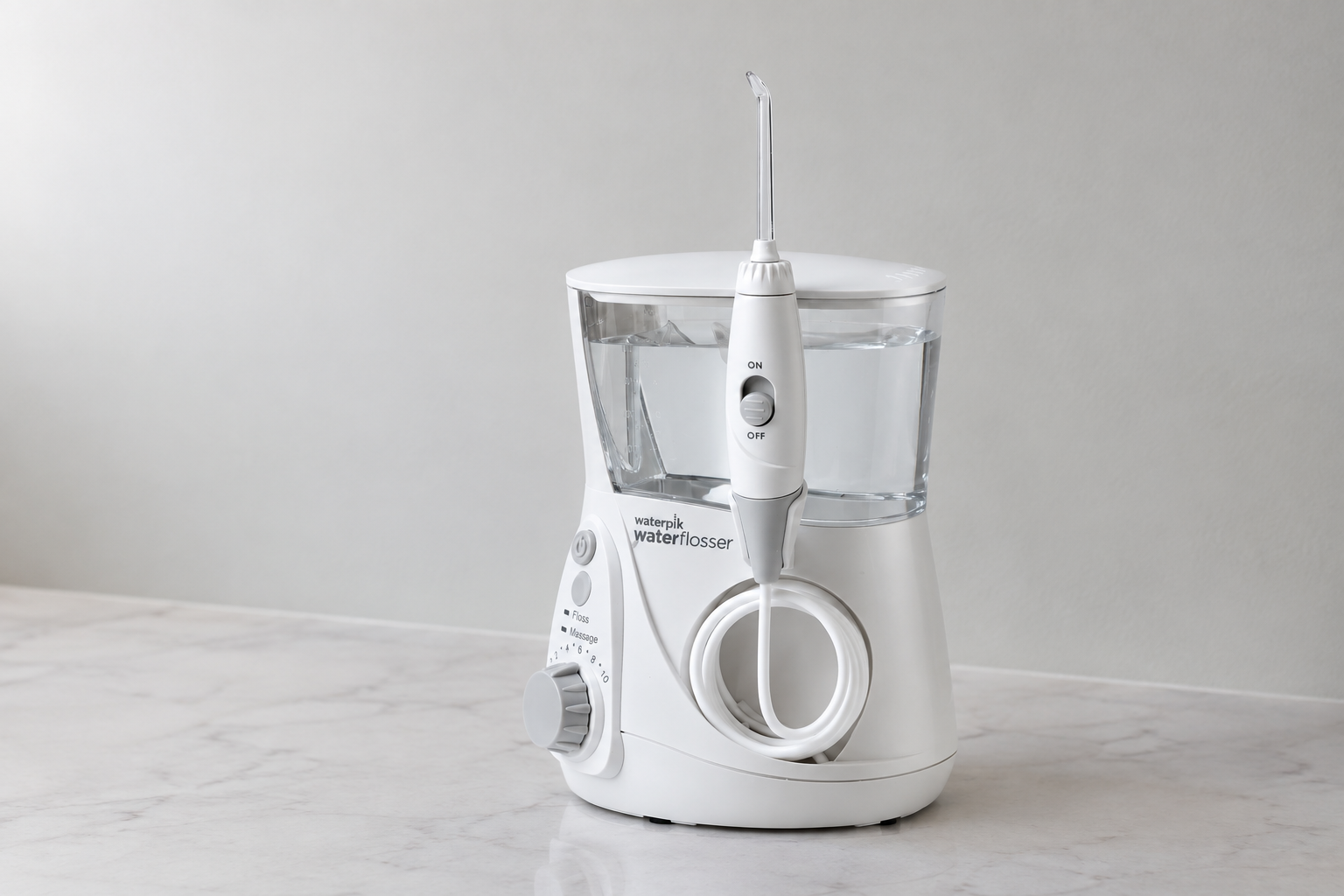
The Waterpik Aquarius is a countertop water flosser with 10 pressure settings and seven tips. This review covers six weeks of daily use, all 10 settings, and every tip. It also compares it with the WP-670, the Ultra, and cordless models. The last sections cover cleaning and who should buy it.
TL;DR
The Waterpik Aquarius pairs full countertop power with a timer and massage mode.
The Ultra delivers the same flow and pulse rate for about $30 less.
Braces, implant, and bridge patients get the most from its specialty tips.
Regular cleaning and vinegar descaling help keep the pressure from fading.
Waterpik Aquarius At A Glance
The table sums up the specs, price, and verdict. The rest of the review explains each line.
Attribute | Detail |
|---|---|
Model | WP-660 (colors sold as WP-662, WP-663, WP-667) |
Price | $99.99 MSRP |
Pressure settings | 10 |
Modes | Floss and Hydro-Pulse Massage |
Timer | 1-minute timer with 30-second pacer |
Reservoir | 22 oz, rated for 90+ seconds |
Tips included | 7: four Precision, Orthodontic, Plaque Seeker, Pik Pocket |
Power | Corded, 120V, North America only |
Warranty | 3 years |
Best for | Braces, implants, bridges, gum maintenance |
Rating | 4.5 out of 5 |
What Is The Waterpik Aquarius Water Flosser?
The Waterpik Aquarius water flosser is the brand's mid-to-upper countertop model. It sits between the basic Ultra and the feature-rich Promax.
A small motor pumps water from a 22 oz tank to a slim handle. The stream pulses 1,400 times a minute. That pulse is what knocks loose debris and soft plaque below the contact points. A dial on the base sets one of 10 pressure levels. A slider on the handle stops the water without turning off the motor.
Two features separate it from cheaper Waterpik models. Floss mode includes a one-minute timer. It pauses at 30 seconds to cue a switch to the other arch. A Hydro-Pulse Massage mode changes the pulse pattern for gum stimulation. The Aquarius carries the ADA Seal of Acceptance for safety and effectiveness.
The WP-660 is built for 120V, 60Hz outlets, so it suits North American bathrooms. The WP-670 Aquarius Professional is the same machine with chrome accents and two extras. It is a dental-office exclusive.
How Was The Waterpik Aquarius Tested?
The Aquarius was tested over six weeks of twice-daily use at the sink, the way patients use it.
Testing started at setting 1 and moved up one step every few days. Each of the 10 settings was rated for comfort and cleaning feel. Both modes were used in every session. All seven tips rotated through the six weeks. Tank use was checked against the rated flow at low, medium, and high settings. The unit was cleaned monthly and descaled once with white vinegar. For comparison, an Ultra and a cordless model each ran the same routine for one week. The comfort, noise, and feel notes below come from that testing and are subjective.
How Do All 10 Pressure Settings Feel?
The dial runs from a gentle rinse to a stream strong enough to sting. The right setting depends on gum health and experience.
Setting | How it felt in testing |
|---|---|
1 | Soft, low rinse with little pulse |
2 | Gentle stream, pulse just noticeable |
3 | Steady stream that flushed food well |
4 | Clear pulse, comfortable around the whole mouth |
5 | Firm stream, good flushing between teeth |
6 | Strong pulse, clean feel at the gumline |
7 | Noticeable force, mild sting at inflamed spots |
8 | Forceful, splashed whenever the lips opened |
9 | Very strong, needed a steady hand |
10 | Maximum force, hard to keep in the mouth |
The safest approach is to start at the lowest setting and step up gradually. The right level depends on the person, the tip, and the state of the gums. During testing, settings 5 to 7 became the daily range after about two weeks. Jumping straight to 9 or 10 mostly added soreness and splash. Some bleeding can occur when inflamed gums are first cleaned. Persistent, heavy, or worsening bleeding should be discussed with a dental professional.
How Long Does A Full Tank Last?
The 22 oz tank is rated for 90+ seconds of flossing. Six weeks of use backed that up.
In testing, one tank covered a full Floss mode session at medium settings. Water was left over each time. Lower settings move less water, so the tank lasted longer there. The timer pauses at 30 and 60 seconds, then keeps running until the power goes off. Adding a minute of Massage mode at high settings sometimes meant a refill. The table estimates maximum-setting water use from the rated 13 oz per minute flow. These are calculations, and the official rating remains 90+ seconds.
Session at the maximum setting | Estimated water use | Estimated result |
|---|---|---|
One minute of Floss mode | About 13 oz | About 9 oz left |
Full tank, run continuously | 22 oz | Roughly 100 seconds by calculation |
One minute of Floss, then one minute of Massage | About 26 oz | Refill needed partway through |
How Loud Is The Waterpik Aquarius?
The Aquarius makes a steady motor hum over a rapid clicking pulse. In testing, it sounded louder than an electric toothbrush and quieter than a hair dryer.
The pitch rose slightly with the pressure setting. Massage mode added a slower, rhythmic pattern to the sound. The Aquarius has no noise-dampening technology, which the pricier Promax offers. During early-morning sessions, the hum carried through a closed bathroom door. A folded towel under the base softened the vibration against the counter. Closing the lips around the tip also cut the splash noise in the sink.
How Do The Two Flossing Modes Compare?
The Aquarius offers two modes: Floss and Hydro-Pulse Massage. A button on the base switches between them, and an LED shows the active mode.
Mode | What it does | Timer | Best use |
|---|---|---|---|
Floss | Standard pulse at 1,400 pulses per minute | Yes, 30-second pacer and 1-minute mark | Daily cleaning between teeth and at the gumline |
Hydro-Pulse Massage | Slower, rolling pulse pattern aimed at the gums | No | Gum comfort after flossing, sore or puffy gums |
How Does Floss Mode Perform?
Floss mode does the cleaning work. It is the standard water-flossing pulse found on every Waterpik countertop model.
The pulse is steady and sharp at every setting. It flushes food and soft plaque from between teeth and just under the gumline. The built-in timer runs only in this mode. It pauses at 30 seconds to cue the switch to the other arch. It pauses again at one minute to mark a full session. Those pauses keep rushed users from skipping the lower teeth. Anyone who dislikes the pauses can turn the timer off with a three-second press of the mode button.
Verdict: Floss mode is the reason to own the Aquarius. It shares the same flow and pulse rate as the Ultra.
How Does Hydro-Pulse Massage Mode Perform?
Massage mode changes the pulse into a slower, rolling pattern. It is the Aquarius's main extra over the Ultra.
The best sequence is one minute of Floss mode first, then a switch to massage. Pressure can be adjusted again after switching. In testing, the sensation felt softer, a little like a spa jet along the gumline. It felt soothing on gums that were tender after a cleaning. Clinically, it works as a gum-comfort mode. Floss mode does the plaque removal. The extra minute made the routine feel less rushed. It also used more water, so a refill was sometimes needed at high settings.
Verdict: Massage mode is a pleasant comfort extra for the gums. Floss mode remains the one for plaque removal.
Which Tips Come With It, And Which Should You Use?
The seven tips are where the Aquarius earns its price. Four are general-use jets, and three target specific dental work.
Tip | Count | Best for | Technique | Replace every |
|---|---|---|---|---|
Precision (Classic Jet) | 4 | Everyday cleaning, shared households | Aim at 90° to the gumline, pause between teeth | 6 months |
Orthodontic | 1 | Brackets and wires | Glide along the gumline, pause at each bracket | 3 months |
Plaque Seeker | 1 | Implants, crowns, bridges, retainers | Let the bristles touch the teeth lightly | 3 months |
Pik Pocket | 1 | Periodontal pockets, root furcations | Lowest setting, 45° angle, tip just under the gumline | 3 months |
The Orthodontic tip ends in a small tapered brush. It scrubs around each bracket while the water flushes. The Plaque Seeker carries three thin tufts of bristles. They sweep around implant abutments and under bridge pontics. The Pik Pocket tip is soft rubber and sends a gentle stream into deep pockets. It works best under a dentist's direction.
Two tips fit in the storage well under the lid. The other five need a drawer or a separate case. Three useful tips are sold separately: the toothbrush, Implant Denture, and tongue cleaner tips. The Implant Denture tip suits patients with snap-in dentures, since it cleans around the locator attachments.
What Are The Pros And Cons Of The Waterpik Aquarius?
The Aquarius earns its price for patients who use the specialty tips. Buyers who only need basic flushing pay for features they skip.
Pros:
Ten settings from very gentle to very strong
Seven tips, including three for dental work
Timer and 30-second pacer build a full routine
A 22 oz tank rated for 90+ seconds
Handle slider stops the water without stopping the motor
ADA Seal of Acceptance
Three-year warranty
Cons:
Costs about $30 more than the Ultra with the same flow
Built for 120V North American outlets only
Louder than a toothbrush, with no noise dampening
Only two tips fit in the onboard storage
Massage mode is a comfort feature for the gums
Splashes easily until the technique clicks
Needs regular descaling in hard-water areas
How Does The Waterpik Aquarius Compare With Other Waterpik Models?
The Aquarius and the Ultra share the same flow and pulse rate. The real differences sit in tips, modes, power, and price. That makes the best Waterpik flosser a question of fit.
Model | Price | Settings | Tank | Tips | Extras | Power |
|---|---|---|---|---|---|---|
Aquarius WP-660 | $99.99 | 10 | 22 oz, 90+ s | 7 | Floss and Massage modes, timer | Corded, 120V |
Aquarius Professional WP-670 | $109.99, dental offices | 10 | 22 oz, 90+ s | 7 + storage case | Same as WP-660, chrome accents | Corded, 120V |
Ultra WF-100 | $69.99 | 10 | 22 oz, 90+ s | 5 | None | Corded, global voltage |
ION WF-12 | Varies | 10 | 20 oz, 90+ s | 7 | Magnetic handle | Cordless countertop |
Cordless Advanced 2.0 WP-580 | Varies | 3 | 7 oz, up to 45 s | 4 | Waterproof, travel bag | Cordless handheld |
Waterpik Aquarius Vs WP-670: Is The Professional Worth More?
The WP-670 Aquarius Professional is the same flosser in a dressier shell.
It adds chrome accents, a toothbrush tip, and a tip storage case. It swaps one Precision tip for the toothbrush tip, so the count stays at seven. Performance, modes, and tank size are identical. It costs $109.99 MSRP and is sold only through dental offices. Patients whose dentist stocks it can buy it at the chair. Everyone else loses nothing with the WP-660.
Waterpik Aquarius Vs Ultra: Which Should You Buy?
The Aquarius vs Ultra question comes down to extras and voltage. Both push 13 oz per minute at 1,400 pulses.
The Waterpik Ultra water flosser, now sold as the WF-100 and formerly the WP-100, costs $69.99. It keeps the same 10 settings and 22 oz tank. It drops the timer, the massage mode, and the LED panel. It ships with five tips, including the Implant Denture tip. It also runs on global voltage, so it travels abroad. The Aquarius suits patients who want the pacer and extra jets for a family. Buyers who skip those extras get the same flow for less with the Ultra.
Is A Cordless Waterpik A Better Choice?
Cordless models win on space and travel. They give up tank size and pressure range.
Handheld cordless models hold 5 to 7 oz and run up to 45 seconds. In the comparison week, the cordless model needed a refill mid-session. They offer two or three settings, which limits fine-tuning for sensitive gums. Most are waterproof, so they work in the shower. The ION WF-12 is a middle path. It keeps a 20 oz tank and 10 settings on a rechargeable battery. It suits bathrooms without an outlet near the sink. For daily use with braces or implants, a countertop model covers the mouth without a refill.
Is The Waterpik Aquarius The Best Waterpik?
The best Waterpik depends on who uses it and where.
The Aquarius suits households and dental-work patients. It packs seven tips, a timer, and a massage mode. The Ultra suits a single adult with healthy gums who wants the same flow for less. Travelers and small bathrooms do better with a cordless model. Buyers outside North America need the Ultra or another global-voltage model. The roundup of the best oral irrigator picks covers other brands as well.
Who Should Use A Waterpik Aquarius?
Water flossers help some mouths far more than others. The judgments below combine everyday experience with trials published from 2024 to 2026.
Is The Waterpik Aquarius Good For Braces And Retainers?
Yes, mainly because braces patients keep using it.
Threading floss under every wire takes minutes, and many teens give up within weeks. The Orthodontic tip cleans around each bracket in one quick pass. That speed is the real win. The research on added cleaning benefit is mixed. A 2024 randomized trial compared water flossing with floss in patients wearing fixed braces. Both cut plaque and bleeding over two weeks, with a small, non-significant edge for water flossing. A 2024 meta-analysis found adding a water jet to brushing did not significantly improve gum scores. The quality of that evidence was low.
The Aquarius might be the easiest tool a braces patient will use every night. Starting low and stepping up works around brackets too. Pair it with a toothbrush for braces and the routine in the guide to caring for teeth in braces.
Bonded retainers raise the same problem once the braces come off. A 2026 randomized trial followed 70 patients with lower bonded retainers for six months. The water flosser group had lower plaque, bleeding, and tartar scores than the interdental brush group. That result matches what shows up at recall visits. In practice, the tartar line behind a lower retainer is lighter in daily water flossers.
Is It Good For Implants And Bridges?
Yes, and this is where the Aquarius earns its place most clearly.
Implants and bridges have surfaces that floss handles poorly. In practice, floss can shred on crown margins and leave fibers under the gum. The Plaque Seeker tip reaches around abutments and under pontics without threading. A 2025 systematic review compared oral irrigators with other cleaning aids around implants. Irrigation reduced bleeding more than floss or interdental brushes. A 2024 trial on single implant crowns found all three methods improved plaque control.
The practical takeaway is to pick the tool the patient will use daily. For most implant patients, that tool is the water flosser. Anyone planning dental implants should budget for this daily step. Patients with a dental bridge benefit the same way.
Is It Good For Gum Disease?
It supports gum treatment and never replaces professional care.
A 2025 randomized trial compared a water flosser with interdental brushes in young adults with gingivitis. Both groups showed significant drops in gum bleeding over four weeks.
Ultimately, the choice depends on the spaces between the teeth. Tight contacts suit a water flosser. Open spaces from recession or bone loss suit interdental brushes, often alongside the flosser. After a deep cleaning, the Pik Pocket tip at setting 1 flushes deep pockets gently. Pocket depth and technique should be confirmed with the dentist or hygienist first. The disease stage, explained in periodontitis staging, sets how intense that routine should be. A dentist may also suggest adding a mouthwash for gingivitis to the tank.
Who Should Ask A Dentist First?
A few situations call for a dentist's input before starting.
Patients told to take antibiotics before dental work
Anyone with an open wound or recent oral surgery
Children, who need supervision and low settings
Patients with deep pockets planning to use the Pik Pocket tip
Anyone with oral piercings, which should come out first
How Do You Clean A Waterpik Aquarius?
Fading pressure is the most common Waterpik complaint. Mineral scale and clogged tips cause most of it, and both are easy to fix.
How Do You Do The Monthly Clean?
A monthly clean keeps the tank, handle, and tips in good shape.
Unplug the unit and empty the tank.
Wipe the base with a soft cloth and a mild, non-abrasive cleanser.
Soak the tip and handle in one part vinegar to two parts water for five minutes.
Remove the tank and rinse its valve under warm water for 30 to 45 seconds.
Wash the tank on the dishwasher's top rack or in warm soapy water.
Air-dry the tank, then reseat the valve dome side up.
Run one part vinegar to two parts warm water through the unit, then a full tank of clean water.
How Do You Descale A Waterpik Aquarius?
Hard water leaves mineral scale inside the pump and hose. This deeper clean belongs on the calendar every one to three months.
Mix 2 to 4 tablespoons of white vinegar with 16 oz of warm water.
Fill the tank with the solution and run half of it through the unit.
Turn the unit off and rest the handle in the sink so the solution drains out.
Run the remaining solution through the unit.
Rinse with a full tank of clean warm water.
White crust on the tip or tank base is a sign the unit is due. In hard-water homes, the shorter end of that range makes sense.
What If The Pressure Keeps Dropping?
Weak pressure usually traces back to the tip. These steps fix most cases in a few minutes.
Swap in a fresh tip first.
Soak the old tip in white vinegar or hydrogen peroxide for 5 to 7 minutes.
Carefully clear the tip opening with a fine needle.
Descale the unit if mouthwash has gone through it.
Check the hose for leaks and replace the handle and hose if needed.
Rinse the unit with plain water after any mouthwash. Iodine and oil-based additives shorten its life and can void the warranty. Replace the Orthodontic, Plaque Seeker, and Pik Pocket tips every three months. Precision, Implant Denture, and tongue cleaner tips last six months.
Where To Buy The Waterpik Aquarius And What Does It Cost?
The Waterpik Aquarius lists at $99.99, but retailers often discount it. On Amazon, for example, you can find it for as little as $59.99, so it's worth checking a few stores before buying.
The official Waterpik site sells the WP-660 directly, along with replacement tips and parts. Online giants like Amazon carry it as well, and pharmacies and big-box stores stock it too. On Amazon, stick to listings sold or shipped by Amazon or Waterpik. Check that the model reads WP-660 or a color version, such as WP-662 or WP-663. The box should also list 120V for North American outlets. The WP-670 costs $109.99 and comes through dental offices only. Budget for tip changes every three to six months.
Water flossers may qualify for FSA or HSA funds with a letter of medical necessity. Plans vary, so check with the plan administrator first. Keep the receipt, since the three-year warranty requires proof of purchase.
Bottom Line
The Waterpik Aquarius is a well-built countertop flosser with seven tips and a useful timer. After six weeks of testing, it fits braces, implants, bridges, and gum-maintenance patients well.
The Ultra shares its flow and pulse rate for $30 less. The Aquarius's timer, massage mode, and extra jets suit families who share one unit. For patients with dental work, its tip set makes it the most complete option compared here. Pair it with a good electric toothbrush for a complete routine. No water flosser removes hardened tartar, so regular cleanings stay on the calendar. The best results come when the flosser fits a personalized dental treatment plan.
We may earn a commission on purchases through affiliate links, though our recommendations remain independent.
Frequently Asked Questions
Is the Waterpik Aquarius worth it?
For braces, implants, bridges, or gum maintenance, yes. Buyers who skip the extras can save with the Ultra.
What is the difference between the Waterpik Aquarius and the Ultra?
Both share the same flow, pulse rate, settings, and tank. The Aquarius adds a timer, massage mode, and two more tips.
What is the difference between the WP-660 and the WP-670?
The WP-670 adds chrome accents, a toothbrush tip, and a storage case. It is sold through dental offices.
What pressure setting should I use on a Waterpik Aquarius?
Start at setting 1 and step up gradually. The right level depends on the tip, the gums, and comfort.
How long does a full Waterpik Aquarius tank last?
In practice, it lasts around 90 seconds. One tank covered a full session at medium settings.
Can I put mouthwash in a Waterpik Aquarius?
Yes, a dentist-recommended rinse works. Run plain water through afterward to prevent clogs.