Rating: 4.3/5
NOMAD Pro 3 Review
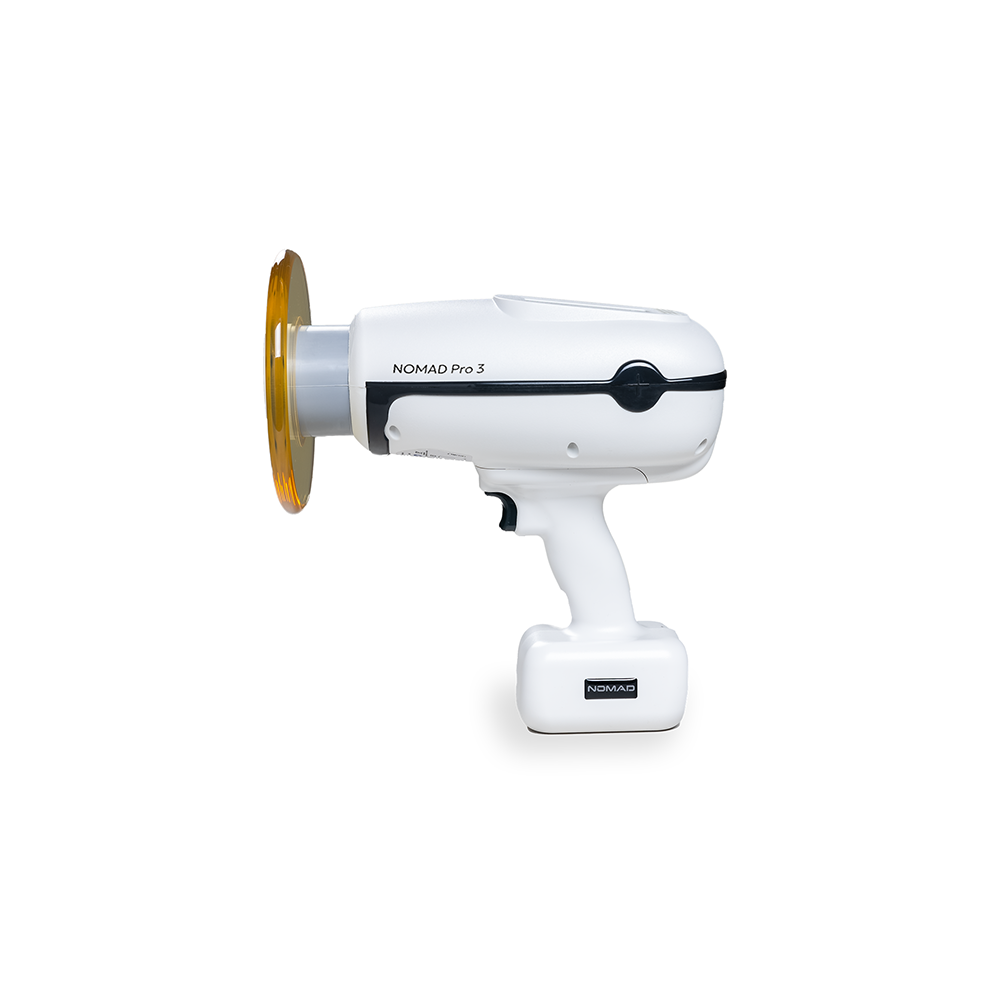
The NOMAD Pro 3 is the third-generation handheld intraoral X-ray from DEXIS, now replacing the discontinued NOMAD Pro 2. It runs at 65 kV and claims more than 600 exposures per...
Reviewed by Marcus Hale
Pros
- 65 kV true DC output improves penetration in posterior regions and in larger patients
- Integrated acrylic backscatter shield and internal shielding, backed by about 20 years of NOMAD dosimetry
- More than 600 exposures per charge, with two swappable batteries included
- Batteries also fit the NOMAD Pro 2, which helps staged upgrades
- 0.4 mm focal spot and fixed 20 cm cone keep images sharp and repeatable
- One unit can serve several operatories and replace multiple wall units
- Works with any receptor, from film to CMOS sensors of any brand
- Rugged outer shell built for daily handling and transport
Cons
- At 6.1 lb (2.7 kg), it is heavier than the Pro 2 and most rival handhelds
- Dealer pricing near $9,000 sits above many competing units
- No peer-reviewed dosimetry on the Pro 3 itself has been published yet
- Hand dose and retake rates depend heavily on operator technique
- Some countries and states restrict routine handheld use
- Fixed kV and mA leave exposure time as the only adjustment
- DEXAssist AI software costs extra
The NOMAD Pro 3 is the third-generation handheld intraoral X-ray from DEXIS, now replacing the discontinued NOMAD Pro 2. It runs at 65 kV and claims more than 600 exposures per charge. This review covers specifications, operator safety evidence, image quality, price and where the unit fits in a modern practice.
TL;DR
The NOMAD Pro 3 raises tube voltage to 65 kV and keeps the 0.4 mm focal spot that drives image sharpness.
An acrylic backscatter shield and internal shielding protect the operator, and studies on earlier NOMAD units put operator body dose far below occupational limits.
One battery delivers more than 600 exposures at 0.31 seconds, and the packs also fit the NOMAD Pro 2.
US dealers list the unit near $9,025, and it pays off fastest where it replaces several wall-mounted tubeheads.
What The NOMAD Pro 3 Is And Where It Came From
The NOMAD Pro 3 is a battery-powered intraoral X-ray source that the operator holds during exposure. DEXIS builds it in the United States and markets it as the successor to the NOMAD Pro 2, which the company now lists as discontinued.
The NOMAD name goes back to Aribex, the company that brought the first handheld dental X-ray to market in the mid-2000s. KaVo later acquired Aribex, and the brand moved to DEXIS within Envista. DEXIS reports more than 60,000 NOMAD units sold worldwide and more than 30 independent safety studies on the platform. Owners of the previous model can compare notes with our NOMAD Pro 2 review, since most positioning habits carry straight over.
Every NOMAD generation has followed one design brief. A high-frequency DC generator sits in a pistol-grip housing with the battery forming the handle, and a lead-impregnated acrylic disc at the end of the cone shields the operator from scatter. The Pro 3 changes the details inside that brief: more tube voltage, revised filtration, a tougher shell and a larger battery. For readers newer to the physics behind these choices, our primer on radiographic imaging explains how kilovoltage and focal spot shape the final image.
NOMAD Pro 3 Specifications Compared With The NOMAD Pro 2
Tube voltage and battery capacity carry most of the change between generations. The focal spot, tube current, cone length and field size stay where they were, so positioning technique is identical for teams moving from the older unit.
Specification | NOMAD Pro 3 | NOMAD Pro 2 |
|---|---|---|
Tube voltage | 65 kV true DC | 60 kV true DC |
Tube current | 2.5 mA | 2.5 mA |
Exposure time range | 0.02–1.00 s | 0.02–1.00 s |
Focal spot | 0.4 mm | 0.4 mm |
Filtration | 1.5 mm Al equivalent (minimum total) | 1.5 mm Al equivalent (total) |
Source-to-skin distance | 20 cm | 20 cm |
X-ray field | 60 mm round | 60 mm round |
Maximum duty cycle | 1:60 | 1:60 |
Battery | 21.6 V DC lithium ion, user-replaceable | 22.2 V lithium polymer |
Exposures per charge | More than 600 at 0.310 s | Not specified by DEXIS |
Weight | 6.1 lb (2.7 kg) | 5.5 lb (2.5 kg) |
Dimensions (W x L x H) | 14 x 28 x 27 cm | 15.9 x 27.3 x 25.4 cm |
Pro 3 figures come from the DEXIS technical specifications. Pro 2 figures come from published dealer specifications and the device description in a 2023 Applied Sciences study.
Only exposure time is adjustable. Kilovoltage and milliamperage are fixed at the factory, so the operator controls density and dose through presets and time alone. For routine adult and pediatric intraoral work this is enough, and it removes a source of operator error that adjustable wall units sometimes introduce.
Design, Build Quality, And Ergonomics
At 6.1 lb (2.7 kg), the NOMAD Pro 3 is 0.6 lb heavier than the Pro 2. DEXIS spends that extra mass on a rugged outer shell and additional shielding.
Balance matters more than weight on a handheld. The battery sits in the grip below the tubehead, so the center of mass rests in the palm instead of out toward the cone. Two hands steady the unit while the elbows brace against the torso. Exposures with a digital sensor last well under half a second, so the holding time per image is short. Clinicians who already manage neck or shoulder strain should handle a demo unit before buying, and our guide to dental ergonomics covers posture habits that apply to radiography as much as to restorative work.
Controls And Presets
The color LCD and touch controls follow familiar NOMAD logic. Presets are organized by patient size and tooth region for each receptor type, and the unit loads an exposure time as soon as the operator makes a selection.
DEXIS describes the presets as optimized for a fast start. Teams should still recalibrate them for their own sensor on installation day. A preset tuned for film or for a less sensitive receptor gives away the dose advantage that digital imaging is supposed to deliver.
Built-In Safety Interlocks
The unit refuses to fire on a battery too weak to deliver a full exposure, and it enforces the 1:60 duty cycle to protect the tube. A lock function blocks unauthorized use during storage or staff training, which matters in an office where the device may rest on a counter between patients.
Radiation Safety: How The NOMAD Pro 3 Protects Operators
Operator dose is the first question any regulator or staff member raises about a handheld unit. Published dosimetry on earlier NOMAD models places body dose well below occupational limits when the device is used as instructed, and the Pro 3 adds shielding on top of that baseline.
Four Layers Of Shielding
DEXIS describes the Pro 3 protection system in four parts. Each part handles a different radiation path.
Acrylic backscatter shield: a lead-impregnated disc at the cone tip creates a protected zone for the operator standing behind it
Internal shielding: material around the tube housing limits leakage from the body of the device
Optimized filtration: removes low-energy photons that add patient skin dose without improving the image
Beam geometry: a 60 mm round field and a 20 cm source-to-skin distance direct radiation toward the receptor
DEXIS states that the Pro 3 delivers up to 10 times less radiation leakage than the leading competitor. The claim rests on company data on file and does not name the competitor. In November 2025, DEXIS announced independent testing that found 7 times less leakage at the trigger for the NOMAD Pro 2. Both figures are manufacturer claims until peer-reviewed measurements on the Pro 3 appear.
What Independent Research Shows
No peer-reviewed dosimetry on the Pro 3 has been published yet. The evidence below comes from earlier NOMAD units that share its cone length and shield concept.
Danforth and colleagues tracked 915 intraoral radiographs taken with the original NOMAD and estimated an annual whole-body operator dose of 0.0453 mSv, roughly 0.9% of the permitted annual limit. Gray and colleagues monitored staff across 18 dental clinics and recorded a monthly body dose of 9.01 μSv for handheld operators, against 27.3 μSv for staff using fixed units.
Hand exposure runs higher than body exposure. Gray's group reported a mean monthly hand dose of 208 μSv, and the 2023 phantom study by Altındağ and colleagues measured its highest operator doses at the hands across all three devices tested. That study also found dose directly behind the NOMAD Pro 2 shield fell by about 85%, and the NOMAD produced significantly lower right-hand dose than the Rextar X and the Diox 602.
Rottke and colleagues concluded in 2018 that the NOMAD Pro 2 does not raise operator risk when it is used according to manufacturer guidelines. The ADA and FDA patient selection guidelines apply to handheld exposures exactly as they apply to wall units, so the justification for each radiograph stays with the clinician.
Technique Rules That Keep Operator Dose Low
Shielding only protects an operator who stands inside its shadow. These habits matter more with a handheld than with any wall unit.
Keep the backscatter shield at the end of the cone and as close to the patient's face as positioning allows
Stand directly behind the device and tilt the patient's head instead of angling the unit away from the body
Hold the unit with both hands at a consistent distance from the torso
Wear a body dosimeter plus a ring badge on the trigger hand for at least the first months of use
Calibrate presets to the sensor so every exposure is as short as the image allows
Image Quality And Sensor Compatibility
The NOMAD Pro 3 should match a wall-mounted unit for routine intraoral imaging and outperform earlier NOMAD units in dense regions. DEXIS credits an improved signal-to-noise ratio and enhanced filtration, and the 65 kV tube gives it more penetration than any previous NOMAD.
What 65 kV Changes In The Image
Five extra kilovolts matter most where bone and restorations are dense.
Maxillary molar periapicals and bitewings through large amalgam restorations are where 60 kV handhelds tend to produce light or noisy images unless exposure time climbs. Higher kV also lengthens the gray scale. Many clinicians prefer that longer scale for reading crestal bone and assigning periodontitis stage and grade, at the cost of a little contrast for early enamel lesions. The 0.4 mm focal spot and 20 cm cone keep geometric sharpness where it was on the Pro 2.
The unit also sits comfortably above the 60 kV floor that the German Federal Association of Dentists sets for intraoral imaging, a standard cited in the Nitschke study discussed below.
Evidence From The NOMAD Pro 2
Comparative studies on the previous generation give a reasonable baseline for the Pro 3.
Nitschke and colleagues compared the NOMAD Pro 2 with a Heliodent Plus wall unit on a maxillofacial phantom. Image quality was comparable overall, with a significant advantage for the NOMAD on anterior teeth (55% of criteria fully met versus 15%). Operator dose over two months and 203 images came to 0.1 mSv. Dentists produced better molar images than students or dental assistants, which points to training as the main variable.
Hoogeveen and colleagues found aiming precision similar between the NOMAD Pro 2 and a Planmeca Intra wall unit. A 2026 study in Gerodontology concluded that a portable unit can meet intraoral quality requirements in mobile dentistry and compares well with wall-mounted machines.
Sensors, Phosphor Plates, And Software
The NOMAD Pro 3 is only the X-ray source, so it works with any receptor.
Film and phosphor plates work with it, as do CMOS sensors from any manufacturer. Practices running a PSP workflow can check our Air Techniques ScanX Intraoral View review for scanner-side considerations. Inside the DEXIS ecosystem, the unit pairs with IXS and Ti2 sensors and with DTX Studio Clinic.
DEXIS promotes the Pro 3 alongside DEXAssist, software that flags up to 14 AI-supported findings on 2D images and measures alveolar bone levels. Those findings feed directly into a dental treatment plan that a patient can follow, and our overview of dental imaging AI explains where these tools help and where a clinician still has to make the call. DEXAssist is licensed separately from the X-ray unit.
Clinical Evaluation: One Week In A Four-Operatory Practice
The evaluating dentist placed the unit in a general practice with four operatories and two hygiene columns, using a size 2 CMOS sensor. Presets were recalibrated on day one and settled at 0.16 seconds for an adult posterior periapical with that sensor.
Across five clinical days the team took 212 exposures, including six full-mouth series. The first battery lasted the whole week and still showed charge on Friday afternoon. That result fits the DEXIS rating, which assumes longer exposures than this sensor needed.
Full-mouth series averaged just under six minutes on Monday and Tuesday. On Friday they took a little over four, once assistants stopped leaving the room out of habit. Retakes clustered in the maxillary molar region early in the week and dropped after the team began tilting patients' heads instead of angling the unit.
One appointment stood out. A 7-year-old with a strong gag reflex needed bitewings to check a suspected interproximal lesion. The assistant stayed at the chair with a hand on the sensor holder and exposed within seconds of placement, and both bitewings were diagnostic on the first attempt. The child's mother said she had expected a large machine to swing over her son and was relieved to see something closer to a camera.
Later that week, a 78-year-old patient in a wheelchair had two periapicals taken without a transfer to the dental chair. Her daughter asked whether the X-ray was safe for the assistant holding it, which opened a short conversation about the shield and the dosimeter badge clipped to the assistant’s scrubs.
Two complaints came up. A hygienist with a history of wrist tendinitis found the 2.7 kg unit tiring by the end of a heavy recall day and asked for a stand. With only one unit, two operatories sometimes needed it at the same moment, which added short waits on the busiest mornings.
Image review favored the Pro 3 for posterior bitewings on two large adult patients, where interproximal contacts and crestal bone were easier to read without adjusting brightness. Anterior periapicals looked much like those from the practice's existing wall unit.
Battery Life And Daily Workflow
DEXIS rates a fully charged NOMAD Pro 3 battery at more than 600 exposures at 0.310 seconds, which the company describes as a typical clinical week.
Two user-replaceable batteries ship with the unit, and DEXIS confirms both are compatible with earlier NOMAD generations, including the Pro 2. Practices upgrading one unit at a time can share spare packs across old and new devices. Exposures with a digital sensor usually run shorter than 0.31 seconds, so real counts can climb above the rating. Film exposures pull them down.
Battery power also stabilizes output. A high-frequency DC generator running from a battery does not respond to mains voltage dips, and the low-battery lockout stops an underpowered exposure before it happens. DEXIS states that a full-mouth series takes five minutes or less with the operator chairside, and the time saved compounds in hygiene schedules where bitewings come up at most recall visits.
The 1:60 duty cycle means each second of exposure needs 60 seconds of rest. Routine intraoral imaging never approaches that limit. A teaching clinic running back-to-back full-mouth series on a single unit could reach it.
Where The NOMAD Pro 3 Fits Best
The unit earns its price in settings where moving the X-ray source is easier than moving the patient.
Multi-operatory general practices that want one or two units to serve every room
Hygiene departments taking recall bitewings without booking a shared X-ray room
Pediatric and special-care dentistry, where staying beside the patient improves cooperation
Patients in wheelchairs or under sedation
Nursing homes and community outreach clinics
Endodontic working-length and post-operative images taken without repositioning the chair
Anxious patients are a quieter beneficiary. Our dental anxiety survey of 500 patients looks at what drives avoidance, and a compact device at the chair removes one large piece of equipment from the patient's view. Practices that already use radiation-free caries detection for recall screening can reserve the NOMAD for radiographs with a clear indication.
Regulations, Training, And Compliance
Handheld intraoral X-ray is permitted in many jurisdictions, and the conditions attached to it vary widely. DEXIS itself notes on its product pages that regulatory requirements differ by jurisdiction and state.
United States
NOMAD units are FDA-cleared, and federal performance standards set limits on leakage radiation. States handle registration and operator certification, and some add specific rules for handheld units.
Operators need the same credentials they would need for a wall unit, and our guide to X-ray certification for dental professionals outlines how state requirements work. Handheld use also belongs inside the practice's broader dental compliance program, alongside OSHA and state board rules.
Canada
Health Canada published a Type II recall notice for the NOMAD Pro 2 on February 25, 2025. The notice did not involve a hardware fault. DEXIS revised the instructions for use to add guidance on operating the unit with the NOMAD X-ray stand and its remote handset and switch. Any practice planning a stand or remote setup for the Pro 3 should follow the current instructions for that exact configuration.
European Union And United Kingdom
Handheld dental X-ray falls under national rules that implement the Euratom Basic Safety Standards Directive. Several European regulators expect handheld use to be justified, for example where a fixed unit is impractical. The Nitschke study notes that this debate has limited handheld adoption in Western Europe. Practices should confirm requirements with the national radiation protection authority and a radiation protection adviser before purchase.
Training, Governance, And Infection Control
A handheld makes the operator part of the protection system, so training needs written records. These steps keep governance simple.
Assign one responsible person for the device and its batteries
Issue personal dosimeters to regular operators and review results each quarter
Store the unit locked and away from public areas between patients
Audit retake rates for the first three months after introduction
Wipe the housing and shield between patients with a compatible intermediate-level disinfectant, following the instructions for use and the practice's infection control protocol. Inspect the acrylic shield for cracks or crazing, since a damaged shield weakens operator protection.
NOMAD Pro 3 Price And Return On Investment
US dealer listings place the NOMAD Pro 3 at about $9,025 with a transport case and two batteries. DEXIS does not publish a list price, and quotes vary with sensor bundles and trade-ins.
Cost item | What to plan for |
|---|---|
Device | About $9,000 at US dealers, with room to negotiate sensor or software bundles |
Installation | No wall reinforcement, electrical work or tubehead mounting |
Registration and shielding review | Set by the state or national regulator |
Batteries | Two included, and spares are interchangeable with NOMAD Pro 2 packs |
Accessories | Transport case (often bundled) and a stand with remote trigger |
Warranty and service | Standard warranty plus optional plans such as DEXIS Complete |
Software | DEXAssist and DTX Studio Clinic licenses are priced separately |
Training | Usually provided through the dealer, plus staff time |
How The Numbers Work
The return comes mainly from replacing several fixed tubeheads with one portable source.
Consider a four-operatory practice using assumed figures. Four wall-mounted units at $4,000 to $6,000 each, plus installation and electrical work, come to roughly $18,000 to $28,000. One NOMAD Pro 3 costs about $9,000. New builds gain the most, since operatory design can skip tubehead mounting entirely, and our new practice equipment checklist shows where imaging sits among other start-up purchases. Practices spreading the cost over time can compare dental clinic financing options.
Chair time adds a smaller, steady return. Two minutes saved per imaging appointment across 40 imaging visits a week adds up to more than five hours of chair time a month.
The main financial risk is dependence on one device. If a single NOMAD goes in for repair, intraoral imaging stops. Our guide to assessing device reliability covers service terms worth negotiating, and many practices keep one wall unit or plan a second handheld as volume grows.
NOMAD Pro 3 Compared With Wall Units And Competing Handhelds
NOMAD Pro 3 Vs NOMAD Pro 2
The Pro 3 adds 5 kV, revised shielding and a much longer battery rating in exchange for 0.6 lb of extra weight and a higher price.
The Pro 2 remains a well-studied unit and turns up on the used dental equipment market at lower prices. DEXIS has discontinued it, which affects long-term parts and support. A practice with a working Pro 2 has no urgent reason to upgrade. New buyers and practices with heavy posterior imaging will see the most benefit from the Pro 3.
NOMAD Pro 3 Vs Wall-Mounted X-Ray
A wall unit remains the benchmark for operator dose and regulatory acceptance. The NOMAD wins on flexibility and installed cost.
Factor | NOMAD Pro 3 (handheld) | Wall-mounted unit |
|---|---|---|
Operator position | Beside the patient, behind the shield | Outside the room or behind a barrier |
Units needed | One can serve several operatories | One per operatory |
Installation | None beyond registration | Wall mounting and electrical work |
Image quality | Comparable in published NOMAD Pro 2 studies | Established benchmark |
Operator dose | Low with correct technique, highest at the hands | Near zero when protocols are followed |
Portability | Bedside and off-site work | None |
Regulatory acceptance | Varies, restricted in some countries | Universal |
Downtime risk | High if it is the only unit | Other rooms keep working |
Neither option replaces 3D imaging. Implant planning and complex endodontic cases still call for CBCT scanning, and practices that already run a unit such as the DEXIS OP 3D LX can route NOMAD images into the same DTX Studio Clinic workspace.
NOMAD Pro 3 Vs Rextar X And Diox 602
Lighter Korean handhelds cost less and weigh less. The figures below come from the device descriptions in the 2023 Applied Sciences study, so later model revisions may differ.
Device | Tube voltage | Tube current | Focal spot | Weight | Backscatter shield |
|---|---|---|---|---|---|
NOMAD Pro 3 | 65 kV | 2.5 mA | 0.4 mm | 2.7 kg | Integrated acrylic disc |
Rextar X | 70 kV | 2 mA | 0.4 mm | 1.6 kg | Not integrated |
Diox 602 | 60 kV | 2 mA | 0.8 mm | 1.8 kg | Not integrated |
Most of the NOMAD weight comes from its shield and internal shielding. In the 2023 phantom study, the NOMAD Pro 2 recorded significantly lower right-hand dose than both lighter rivals. The NOMAD also brings a research record of nearly two decades, which no competitor matches. Weight and price are its two clear disadvantages.
Bottom Line
The NOMAD Pro 3 builds on the most studied handheld platform in dentistry and fixes its two most common complaints, limited penetration at 60 kV and mid-week battery swaps. The 65 kV tube and revised filtration target the posterior views where earlier handhelds struggled, and the shielding concept rests on nearly two decades of published operator dosimetry.
Practices that image in several rooms or run mobile and nursing-home programs will see the clearest return. One unit at roughly $9,025 can stand in for wall-mounted tubeheads that would cost two to three times as much once installed across four operatories. Pediatric and special-care offices gain something harder to price, because staying at the chair shortens radiographs for patients who struggle to hold still.
The weight of 2.7 kg tires some operators by the end of a long recall day, and a practice with only one unit will see occasional clashes when two rooms need it at once. The 10x leakage figure remains a manufacturer claim until peer-reviewed dosimetry on the Pro 3 is published. Regulators in parts of Europe and in some US states also expect handheld use to be justified case by case.
Before ordering, confirm local regulations and request an in-office demo with the practice’s own sensor, ideally on a day with a full hygiene schedule. The written quote is worth setting against the full installed cost of the wall-mounted units the device would replace, including electrical work and the chair time lost during installation.
Verdict
<p>The NOMAD Pro 3 is the strongest handheld option for a general practice that is prepared to train its team properly. The move to 65 kV produces visible gains in posterior bitewings and molar periapicals, the views where 60 kV handhelds most often deliver light or noisy images.</p><p>Protection is the deciding factor against lighter rivals. The integrated backscatter shield and internal shielding rest on two decades of dosimetry on earlier NOMAD models, including a measured annual operator body dose below 1% of the permitted limit. No competing handheld can point to a comparable body of research. The week-long battery and backward-compatible packs make the unit practical inside a busy hygiene schedule.</p><p>The weaknesses deserve weight. At 2.7 kg the unit tires some operators by the end of a long recall day. The price sits near the top of the handheld market, and the 10x leakage claim still needs independent confirmation. Local regulations need checking before any purchase order goes out.</p><p>For multi-operatory practices and mobile programs, the NOMAD Pro 3 is a sound investment. A single-room practice with a reliable wall unit has less reason to switch.</p>
Frequently Asked Questions
What is the NOMAD Pro 3?
The NOMAD Pro 3 is a handheld, battery-powered intraoral X-ray system made by DEXIS. It lets dental professionals take periapical and bitewing radiographs while standing beside the patient.
Who makes the NOMAD Pro 3?
DEXIS, the dental imaging company within Envista, manufactures it in the United States. Aribex developed the original NOMAD, and KaVo sold the line for several years before it moved to DEXIS.
How is the NOMAD Pro 3 different from the NOMAD Pro 2?
The Pro 3 runs at 65 kV instead of 60 kV and adds revised filtration and shielding. It also carries a longer-lasting 21.6 V lithium-ion battery and a tougher shell, and it weighs 6.1 lb compared with 5.5 lb. Focal spot and tube current are unchanged.
Is the NOMAD Pro 3 safe for the operator?
Used according to its instructions, the evidence on earlier NOMAD models supports its safety. Studies placed annual operator body dose below 1% of the occupational limit, with the hands receiving the most exposure. Correct shield placement and a personal dosimeter remain essential.
How many exposures does one battery deliver?
DEXIS rates a fully charged battery at more than 600 exposures at 0.310 seconds. Shorter digital-sensor exposures can raise that number, and longer film exposures lower it.
Do NOMAD Pro 2 batteries work in the NOMAD Pro 3?
Yes. DEXIS confirms that the Pro 3 batteries are compatible with previous NOMAD generations, including the NOMAD Pro 2.
How much does the NOMAD Pro 3 cost?
US dealer listings place it at about $9,025, including a transport case and two batteries. Final pricing depends on the dealer and the bundle.
Does the NOMAD Pro 3 work with any digital sensor?
Yes. The unit is only the X-ray source, so it works with any receptor, including phosphor plates and digital sensors from any manufacturer. Presets should be calibrated to the specific sensor during setup.
Can a handheld X-ray replace wall-mounted units?
In many practices it can. Published studies on the NOMAD Pro 2 found image quality comparable to wall units, and one handheld can serve several operatories. Some practices keep one wall unit as a backup.
Is handheld dental X-ray allowed in Europe?
Rules vary by country. Several European regulators expect handheld use to be justified, for example where a fixed unit is impractical, so practices should check with their national radiation protection authority first.
Can hygienists and dental assistants use the NOMAD Pro 3?
Where local law permits auxiliaries to take radiographs, they can generally use a handheld unit after proper training. Some states and countries add requirements specific to handheld devices.