CBCT Scanning In Dentistry: Cost, Safety, And What To Expect
Cone beam computed tomography, or CBCT, is a 3D imaging scan used in dental treatment planning for implants, root canals, and jaw surgery. A single rotation captures the teeth,...
Written by Mantas Petraitis
Read time: 8 min read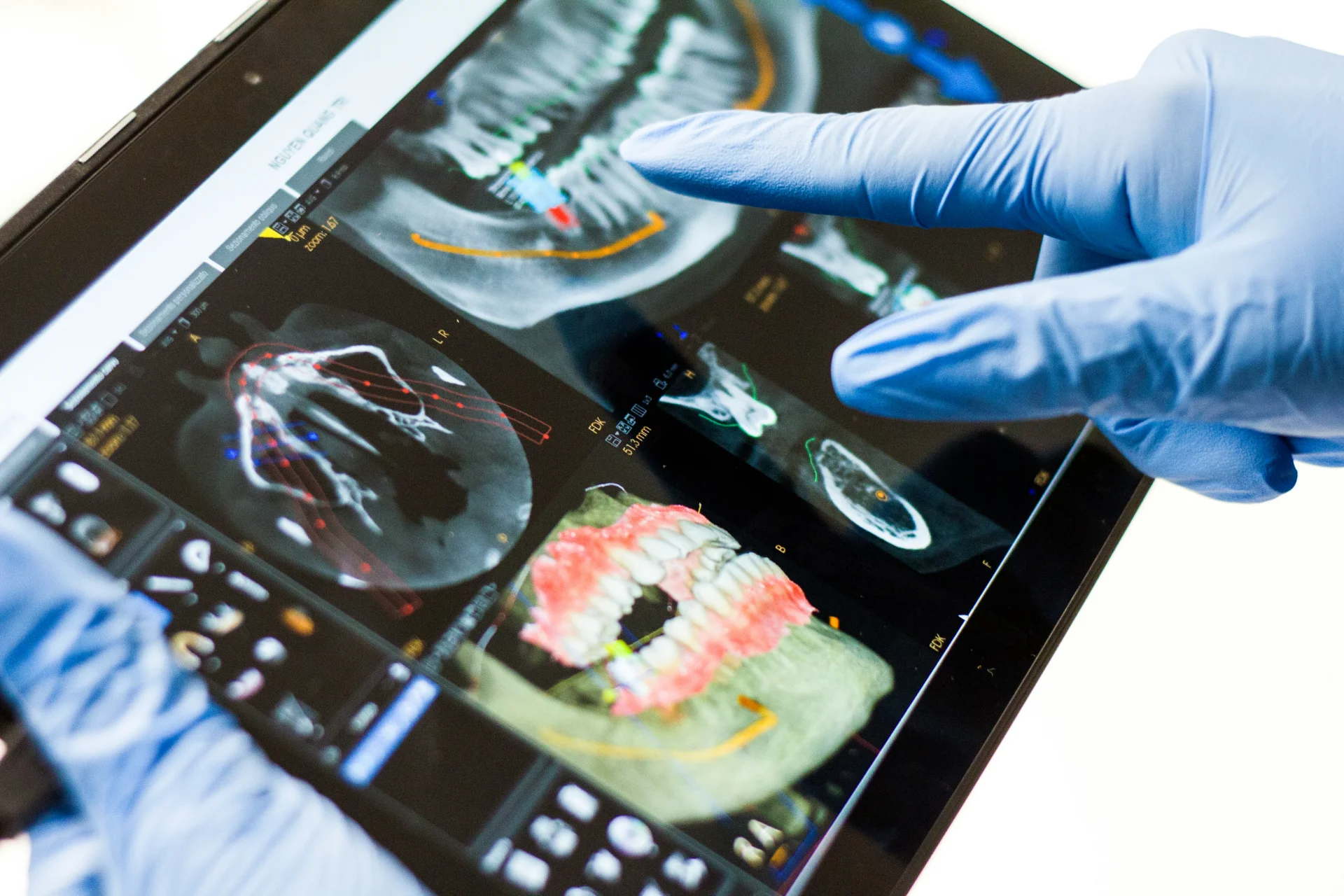
Cone beam computed tomography, or CBCT, is a 3D imaging scan used in dental treatment planning for implants, root canals, and jaw surgery. A single rotation captures the teeth, bone, nerves, and sinuses in under a minute, replacing several flat X-rays with one detailed model.
TL;DR
CBCT creates 3D dental images in 10 to 40 seconds using a single rotating scan.
Cost ranges from $150 to $500, and insurance rarely covers it unless billed as medical.
Radiation dose stays far below medical CT, typically 20 to 600 µSv per scan.
Dentists use CBCT for implants, root canals, wisdom teeth, orthodontics, and jaw surgery.
Traditional two-dimensional X-rays produce flat images with overlapping structures. Cone beam computed tomography creates three-dimensional views of teeth, bone, nerves, and soft tissues in a single scan.
The scanner uses a cone-shaped X-ray beam that rotates around the patient's head, capturing hundreds of images that specialized software reconstructs into a 3D model. Research published in the Journal of Indian Academy of Oral Medicine and Radiology found that CBCT delivers radiation doses up to 10 times lower than conventional medical CT scans, with sub-millimeter resolution suited to dental use.
This guide covers how CBCT works, what it costs, how it compares with traditional imaging, clinical uses across dental specialties, field of view options, radiation safety, and what to expect during a scan.
What Is CBCT Scanning?
CBCT stands for cone beam computed tomography. It is a medical imaging technique that uses a divergent, cone-shaped X-ray beam to create three-dimensional images of dental and maxillofacial structures.
The technology was developed independently in the late 1990s by Dr. Yoshinori Arai in Japan and Dr. Piero Mozzo in Italy for oral and maxillofacial imaging. The first commercial system reached the US market in 2001.
Basic Principles Of Cone Beam Technology
An X-ray source and detector rotate 180 to 360 degrees around the patient's head in a single pass. During this rotation, the scanner captures between 150 and 600 individual images from marginally offset angles. Software then processes these images into a digital volume made of three-dimensional voxels, the volumetric equivalent of pixels.
Traditional CT scanners capture thin axial slices and stack them into a 3D image. CBCT captures the entire region of interest in one rotation, which shortens scanning time to about 5 to 40 seconds and reduces motion artifacts.
Key Terminology In CBCT Imaging
Patients and dental professionals communicate more effectively when they share the same basic vocabulary for CBCT scans.
Term | Definition |
|---|---|
Voxel | Three-dimensional pixels that form the building blocks of CBCT images, ranging from 0.08 to 0.4 mm in size |
Field of view (FOV) | The anatomical area captured in the scan, measured in centimeters as diameter by height |
Flat panel detector | The two-dimensional detector that captures X-ray images as the machine rotates around the patient |
Multiplanar reconstruction | The ability to view images in axial, sagittal, and coronal planes from a single scan |
Isotropic voxels | Voxels with equal dimensions in all three directions, allowing accurate measurement without distortion |
How CBCT Scanning Works
Understanding the scanning process helps explain what happens during an appointment and why the images are useful for dental treatment plan decisions.
The Scanning Process
CBCT scanners are compact units built for dental and maxillofacial imaging, which makes them practical for a dental office rather than a hospital radiology department. The unit has an X-ray tube and a flat panel detector mounted on opposite sides of a rotating arm. Patients sit, stand, or lie down depending on the machine.
The C-arm rotates around the head while the detector captures a continuous series of two-dimensional images, usually completing the rotation in 10 to 40 seconds. A chin rest and head stabilizer keep the patient still to prevent blur.
Image Reconstruction And Viewing
Once scanning finishes, software processes the captured images using reconstruction algorithms adapted for cone beam geometry. This step takes about one minute and produces a digital volume that can be viewed from any angle.
The data displays as axial slices, sagittal views, coronal views, and full 3D reconstructions. Clinicians can zoom in, rotate the image, measure distances, and generate panoramic-style views from the same dataset.
Factors Affecting Image Quality
Several factors influence how clear and diagnostically useful the final image is.
Voxel size affects resolution, smaller voxels give finer detail but raise the radiation dose
Patient movement during the scan creates blur and reduces diagnostic value
Metal restorations, implants, and orthodontic appliances can create scatter artifacts
Field of view selection affects both anatomical coverage and radiation dose
CBCT Scan Cost And Insurance Coverage
Cost is one of the most common questions patients ask before scheduling a scan. Pricing depends on the field of view, the equipment used, and whether the scan is billed under dental or medical insurance.
Typical Cost By Scan Size
A CBCT scan generally costs between $150 and $500, though prices can run higher for full craniofacial scans used in orthognathic or airway assessment.
Scan type | Typical cost | Common use |
|---|---|---|
Small FOV | $150 to $300 | Single implant or root canal evaluation |
Medium FOV | $250 to $450 | Multiple implants or arch imaging |
Large FOV | $400 to $750 | Orthodontics, TMJ, airway, trauma |
Does Dental Insurance Cover CBCT?
Traditional dental insurance often classifies CBCT as a major or diagnostic service, and coverage varies by plan. Some plans pay a portion when the scan supports a documented medical need, such as implant placement or surgical planning. Medical insurance sometimes covers CBCT when a physician orders it for a condition like TMJ disorder or sleep apnea, though the claims process is more involved than a standard dental claim.
Patients can also use a health savings account or flexible spending account, since CBCT qualifies as an eligible medical expense. Comparing plan details before scheduling helps avoid surprise costs, and reviewing options on what could be the best dental insurance can clarify what a specific plan actually reimburses.
Patients should confirm coverage directly with their insurer before the appointment, since policies differ widely by state and plan tier.
CBCT Versus Traditional Imaging Methods
Comparing CBCT with conventional X-rays and medical CT clarifies why a dentist recommends one modality over another for a specific case.
CBCT Versus Conventional Dental X-Rays
Periapical, bitewing, and panoramic radiographs produce two-dimensional images that have served dentistry for over a century. These images carry limitations, including overlapping structures, geometric distortion, and magnification errors that can complicate diagnosis.
CBCT removes these limitations by providing true three-dimensional visualization with accurate 1:1 measurements. The FDA notes that CBCT delivers more radiation than standard dental X-rays, with doses ranging from 5 to 16 times higher than a panoramic radiograph. For this reason, CBCT is reserved for cases where two-dimensional imaging cannot answer the clinical question.
CBCT Versus Medical CT Scans
Medical computed tomography, also called multidetector CT, uses a fan-shaped X-ray beam with multiple detector rows to capture thin axial slices that are stacked into a 3D image. Medical CT offers strong soft tissue contrast, but it delivers substantially higher radiation doses than CBCT.
Research published in PMC found that CBCT delivers roughly 28 percent lower effective radiation doses than medical CT for dental applications. The compact size and lower cost of CBCT equipment also make it practical for a dental office, while medical CT requires a dedicated radiology facility. Medical CT remains the better option for detailed evaluation of soft tissue such as muscles, lymph nodes, and salivary glands.
Imaging Modality Comparison
The table below summarizes the key differences between common dental imaging technologies.
Feature | Dental X-ray | CBCT | Medical CT |
|---|---|---|---|
Image type | 2D | 3D | 3D |
Typical dose | 5 to 25 µSv | 20 to 600 µSv | 500 to 2,500 µSv |
Scan time | Seconds | 10 to 40 seconds | Minutes |
Resolution | Good | Excellent, sub-mm | Excellent |
Soft tissue detail | Poor | Limited | Excellent |
Equipment size | Compact | Compact | Large |
Typical cost | $25 to $50 | $150 to $500 | $500 to $1,500 |
Clinical Applications Of CBCT Scanning
CBCT has become a standard diagnostic tool across dental specialties. Three-dimensional visualization of hard tissue supports more accurate diagnosis and safer treatment planning.
Dental Implant Planning
CBCT is the standard of care for dental implant treatment planning. The scan measures bone height, width, and density at proposed implant sites, which helps clinicians select the right implant size and position. CBCT also identifies vital structures such as the inferior alveolar nerve canal, mental foramen, maxillary sinus floor, and nasal cavity, helping surgeons avoid complications.
The 3D data can also be used to fabricate surgical guides that improve accuracy and reduce surgical time. After surgery, CBCT can assess implant position, evaluate bone graft integration, and help diagnose complications in a failing implant.
Endodontics And Root Canal Treatment
CBCT imaging has changed endodontic diagnosis and treatment planning. It visualizes complex root canal anatomy, including the number of roots and canals, canal curvature, calcifications, and accessory canals that may not appear on conventional radiographs. The American Association of Endodontists states that CBCT strengthens the ability to diagnose, evaluate, and treat complex endodontic cases.
CBCT is particularly useful for detecting periapical lesions masked by overlying anatomy on 2D images, identifying vertical root fractures, locating root perforations, assessing root resorption, and planning endodontic surgery. The European Society of Endodontology recommends a small field of view scan when conventional radiographs are inconclusive.
Orthodontics And Orthognathic Surgery
Orthodontists use CBCT scanning to assess craniofacial structures, tooth position, and skeletal relationships. The scan provides superimposition-free images with accurate measurements for cephalometric analysis, impacted tooth assessment, evaluation of skeletal growth and facial asymmetry, airway analysis for suspected sleep apnea, and temporomandibular joint evaluation.
For patients requiring orthognathic surgery, CBCT supplies the anatomical detail needed for surgical planning, including bone volume assessment for osteotomies and visualization of tooth roots relative to planned bone cuts.
Oral And Maxillofacial Surgery
Oral surgeons rely on CBCT for a range of diagnostic and treatment planning tasks. It is essential for wisdom tooth extraction planning, particularly for assessing the relationship between impacted third molars and the inferior alveolar nerve canal. CBCT also supports evaluation of jaw pathology such as cysts, tumors, and inflammatory lesions, assessment of facial trauma and fractures, TMJ evaluation, and cleft palate assessment.
Field Of View Options In CBCT Scanning
Field of view, commonly abbreviated FOV, refers to the anatomical area captured during a scan. Selecting the right FOV affects both the diagnostic information gathered and the radiation dose delivered. The Dentalcare professional education portal categorizes CBCT systems by FOV capability, which relates directly to clinical use.
Small Field Of View, 4 To 5 Centimeters
Small FOV scans capture a limited region, typically a few teeth and surrounding structures. These scans provide the highest resolution with the lowest radiation dose, which makes them well suited for endodontic use where fine root canal detail matters. A small FOV works for evaluating individual teeth for root fractures, periapical pathology, root resorption, and complex canal anatomy. Single implant site assessment and localized pathology also benefit from a small FOV.
Medium Field Of View, 8 To 10 Centimeters
Medium FOV is the most versatile option for general dental practice, capturing one or both arches while keeping image quality and radiation dose reasonable. This size fits multiple implant planning, impacted tooth evaluation, quadrant or arch-level pathology, and general diagnostic work. Most medium FOV systems can also collimate down to a smaller area when localized imaging is needed.
Large Field Of View, 13 To 23 Centimeters
Large FOV scans capture the full craniofacial skeleton from the lower border of the mandible to the top of the skull. These scans deliver a higher dose, but they provide the anatomical coverage needed for orthodontic planning, cephalometric analysis, orthognathic surgery planning, TMJ evaluation of both joints, airway assessment, and facial trauma evaluation.
Field Of View Selection Guide
The table below matches each FOV size to its typical clinical use and dose range.
FOV size | Best applications | Typical radiation dose |
|---|---|---|
Small, 4 to 5 cm | Endodontics, single implants, localized pathology, root fracture diagnosis | 20 to 80 µSv |
Medium, 8 to 10 cm | Multiple implants, impacted teeth, full arch imaging, general diagnosis | 50 to 200 µSv |
Large, 13 to 23 cm | Orthodontics, orthognathic surgery, TMJ, airway analysis, trauma | 100 to 600 µSv |
Radiation Safety And Dose Considerations
CBCT scanning involves exposure to ionizing radiation. Understanding actual dose levels and the safety measures in place puts the exposure in context.
Understanding CBCT Radiation Dose
Radiation dose in dental imaging is measured in microsieverts, written µSv. Everyone receives radiation exposure from natural sources, including cosmic rays, radon gas, and radioactive materials in the environment. Average annual background radiation in the United States runs about 3,000 µSv.
A typical dental CBCT scan delivers between 20 and 600 µSv, depending on field of view and exposure settings, equal to roughly 2 to 70 days of natural background radiation. Research from the Journal of Indian Academy of Oral Medicine and Radiology confirms that CBCT exposure runs about 10 times lower than conventional medical CT for maxillofacial imaging.
Comparative Radiation Doses
The table below, sourced from RadiologyInfo.org, places CBCT dose levels next to other common exposures.
Examination | Typical dose (µSv) | Background equivalent |
|---|---|---|
Digital bitewing, single | 5 | Less than 1 day |
Digital panoramic | 15 to 25 | 2 to 3 days |
Full mouth series | 20 to 30 | 3 to 4 days |
CBCT, small FOV | 20 to 80 | 2 to 10 days |
CBCT, medium FOV | 50 to 200 | 6 to 25 days |
CBCT, large FOV | 100 to 600 | 12 to 70 days |
Medical CT, head | 2,000 | 8 months |
ALARA And ALADA Principles
Medical imaging operates under two established radiation protection principles. ALARA, meaning as low as reasonably achievable, guides practitioners to minimize exposure while still capturing a diagnostically useful image. ALADA, meaning as low as diagnostically acceptable, focuses on selecting exposure settings that produce adequate image quality for the clinical question without extra radiation.
Every CBCT scan needs a clear clinical reason where two-dimensional imaging falls short. Practitioners select the smallest field of view that supplies the needed diagnostic information, and exposure settings get adjusted for the patient's size and the clinical question.
Special Considerations For Specific Populations
Certain patient groups call for extra care around CBCT radiation exposure. Children are more radiosensitive than adults and have more years ahead during which radiation effects could appear, so pediatric protocols use reduced exposure settings. During pregnancy, a CBCT scan of the head poses minimal risk to the fetus since the beam points away from the abdomen, though imaging should still be justified and postponed when possible. Thyroid shielding during large FOV scans remains debated among practitioners.
What To Expect During A CBCT Scan
Knowing what happens before, during, and after a scan reduces anxiety and supports better imaging results. The process is quick and painless.
Preparing For Your Scan
CBCT scanning requires minimal preparation.
Tell dental staff about any possibility of pregnancy
Remove jewelry, eyeglasses, hearing aids, hairpins, and metal objects near the head and neck
Remove removable appliances, such as dentures or retainers, if they sit in the scanned area
No fasting or special preparation is needed for a standard dental CBCT
During The Scan
Dental staff position the patient in the CBCT machine, sitting, standing, or lying down depending on the equipment. A chin rest and head stabilizer maintain position throughout the scan. The C-arm rotates around the head, completing one full circle while capturing the images needed for the 3D reconstruction.
Scanning takes 10 to 40 seconds, depending on the machine and the field of view. Staying still during this window prevents motion blur. The scan itself is painless and produces no sensation.
After The Scan
There are no restrictions following a CBCT scan, and normal activities can resume right away. Digital images become available for review within minutes. The dentist or specialist interprets the three-dimensional images and discusses the findings, including how they shape the diagnosis and dental treatment plan. The images become part of the permanent dental record and can be shared electronically with other specialists involved in care.
Bottom Line
CBCT scanning gives dentists a detailed three-dimensional view of oral and maxillofacial structures that flat X-rays cannot capture. It supports accurate diagnosis of complex conditions and safer surgical planning across specialties, from endodontics to oral surgery.
CBCT delivers a higher radiation dose than conventional dental X-rays, but the exposure stays well below medical CT levels and is controlled through field of view selection and exposure settings. Applied under ALARA principles for a justified clinical indication, the diagnostic value of CBCT generally outweighs the radiation exposure involved.
Patients weighing cost, insurance, or scheduling questions can review options through a dental treatment plan before committing to a scan, and can compare coverage details through the practice's insurance plan documentation.
Frequently Asked Questions
What is the difference between a CBCT scan and a regular dental X-ray?
Regular dental X-rays produce flat two-dimensional images where structures overlap, and measurements can be distorted. CBCT creates three-dimensional images that can be viewed from any angle, rotated, and measured accurately. CBCT delivers a higher radiation dose than standard dental X-rays, so it is reserved for cases where 2D imaging cannot provide the needed diagnostic information.
How safe is CBCT scanning?
CBCT scanning is considered safe for a justified clinical indication. The dose from a typical scan ranges from 20 to 200 µSv, equal to a few days to a few weeks of natural background radiation. This dose runs well below that of a medical CT scan of the head, which delivers about 2,000 µSv. Dental practices follow guidelines to ensure CBCT is used only when conventional imaging cannot supply adequate diagnostic information.
Can I have a CBCT scan if I'm pregnant?
Dental CBCT scans direct radiation at the head and neck, not the abdomen, so fetal exposure stays minimal. The general practice in medicine is to avoid non-essential imaging during pregnancy when possible. Patients who are pregnant or think they might be should tell their dental provider before any imaging procedure, so the dentist can weigh clinical urgency against postponing the scan.
How much does a CBCT scan cost?
Cost varies by geographic location, practice, and scan size. Prices typically range from $150 to $500, with smaller field of view scans costing less than large full-skull scans. Some dental insurance plans cover CBCT when it is deemed medically necessary. Patients should check with their dental office about cost and confirm coverage with their insurer before scheduling.
How much does a CBCT scan cost?
The cost of a CBCT scan varies depending on geographic location, the dental practice, and the size of the scan required. Prices typically range from $150 to $500, with smaller field-of-view scans generally costing less than large full-skull scans. Some dental insurance plans cover CBCT imaging when it is deemed medically necessary for diagnosis or treatment planning. Patients should check with their dental office about specific costs and contact their insurance provider to verify coverage before scheduling the scan.
How long does a CBCT scan take?
The scan itself takes 10 to 40 seconds, depending on the machine and field of view. Including positioning, removing metal objects, and instructions, the full appointment typically runs 10 to 15 minutes. Images are available immediately for the dentist to review, and results can often be discussed the same day.