Rating: 4.3/5
Air Techniques ScanX Intraoral View Review
Digital radiography continues to reshape how dental professionals capture and analyze diagnostic images. Among the available technologies, phosphor storage plate (PSP) systems...
Reviewed by Mantas Petraitis
Pros
- Exceptional patient comfort with PSPs that are 30 times thinner and more flexible than wired sensors
- Four-track batch scanning supports efficient multi-operatory workflows
- Universal size compatibility covering all intraoral PSP formats (sizes 0 through 4)
- 100% active imaging area captures 17–38% more anatomy than comparably sized wired sensors
- Wi-Fi and LAN connectivity allow flexible placement anywhere in the office
- Offline imaging capability ensures uninterrupted scanning during network outages
- Film-like workflow enables virtually zero learning curve for staff trained on traditional radiography
- Low ongoing costs with reusable PSPs, no annual maintenance fees, and no chemical processing
- Built-in preview and diagnostic filters on the touchscreen for faster diagnostic assessment
- Broad software compatibility with DBSWin, VisionX, and third-party PMS platforms
Cons
- Multi-step workflow requires physically transporting plates from the treatment room to the scanner
- PSPs can accumulate scratches and wear over time, requiring periodic inspection and replacement
- Total time from exposure to on-screen image is slightly longer than with instant wired sensors
- Initial IT setup for Wi-Fi, LAN, and software integration may require professional assistance at extra cost
- The unit weighs 43 lbs and needs dedicated counter or shelf space
- Intraoral only, with no support for panoramic or cephalometric plates (the Classic View is needed for those)
- The 4.3-inch touchscreen is adequate for preview but limited for detailed diagnostic review at the scanner
- Ongoing consumable costs for barrier envelopes and occasional plate replacement add to total cost of ownership
Digital radiography continues to reshape how dental professionals capture and analyze diagnostic images. Among the available technologies, phosphor storage plate (PSP) systems have carved out a significant niche, offering a combination of patient comfort, workflow familiarity, and diagnostic capability that appeals to a broad range of practices. The Air Techniques ScanX Intraoral View is one of the most well-known PSP scanners on the market, designed to serve as a centralized digital imaging solution for practices of all sizes.
This review provides a thorough, evidence-based look at the ScanX Intraoral View, covering its technical specifications, key features, clinical performance, advantages, limitations, and ideal use cases. Whether a practice is considering its first digital radiography system or looking to complement an existing wired sensor setup with a PSP-based alternative, this guide delivers the information needed to make a confident decision.
About Air Techniques: The Company Behind the ScanX
Understanding the manufacturer behind a piece of dental equipment provides important context for evaluating product quality and long-term support.
Air Techniques, Inc. was founded in 1962 and is headquartered in Melville, New York. The company is the largest manufacturer of dental air compressors and vacuum systems in North America and has expanded into digital imaging, intraoral cameras, caries detection, and infection control products. In partnership with Dürr Dental, Air Techniques has been developing X-ray imaging technology for over 60 years, according to company materials published in 2022 (Decisions in Dentistry). The ScanX product line represents the company’s PSP scanning platform, with the Intraoral View model focused exclusively on intraoral imaging.
What Is the Air Techniques ScanX Intraoral View?
The ScanX Intraoral View is a PSP-based digital radiography system that digitizes phosphor storage plates for all standard intraoral formats. This section breaks down what the system does, how the underlying technology works, and where the Intraoral View fits within the broader ScanX family.
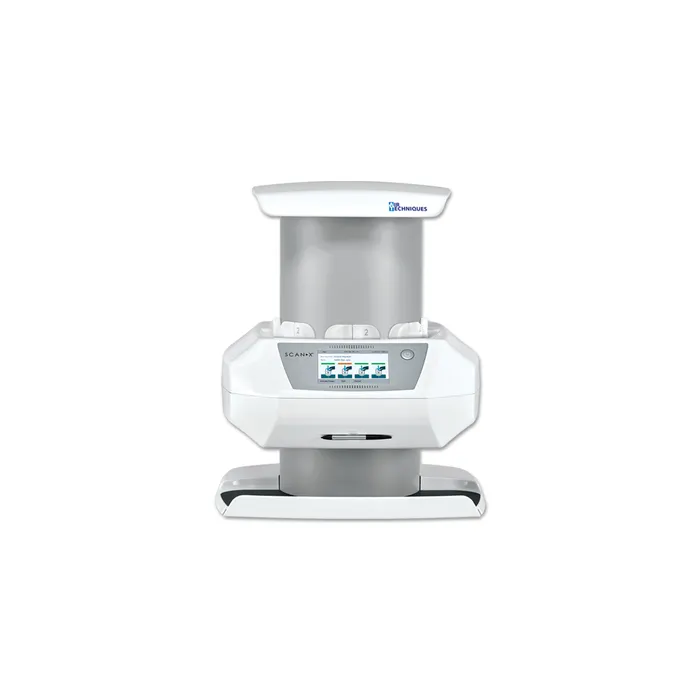
Unlike wired CMOS or CCD sensors that produce images instantly at the chairside, the ScanX Intraoral View uses thin, flexible, wireless phosphor plates as its imaging medium. After a plate is exposed to X-ray radiation in the patient’s mouth, it is transported to the ScanX scanner and inserted into one of four scanning tracks. A laser inside the unit scans the plate, causing the stored X-ray energy to be released as visible light (luminescence). This light is captured by a photodetector and converted into a high-resolution digital image that appears on the clinician’s screen within seconds. The plate is then automatically erased and ready for immediate reuse.
The system supports all standard intraoral PSP sizes (0, 1, 2, 3, and 4), making it suitable for imaging patients across every age group and anatomy, from pediatric patients requiring the smallest size 0 plates to adults needing size 4 occlusal views.
Where It Fits in the ScanX Product Line
Air Techniques offers multiple models within the ScanX family, and understanding the distinctions helps clarify whether the Intraoral View is the right choice.
The ScanX Intraoral View handles intraoral formats exclusively (sizes 0–4). The ScanX Classic View covers both intraoral and extraoral formats, including panoramic and cephalometric plates, making it the choice for practices needing a single scanner for all plate types. For practices seeking a hybrid workflow that combines PSP plates with a wired sensor, Air Techniques also offers the SensorX intraoral sensor, which pairs with any ScanX scanner.
Technical Specifications at a Glance
Having a clear picture of the hardware and performance numbers is essential for any equipment evaluation. The table below summarizes the key specifications of the ScanX Intraoral View, drawn from manufacturer documentation and authorized dealer listings.
Specification | Details |
Manufacturer | Air Techniques, Inc. (Melville, NY) |
Imaging medium | Phosphor storage plates (PSPs) |
Supported PSP sizes | 0, 1, 2, 3, and 4 (all intraoral formats) |
Scanning tracks | 4 simultaneous slots |
Theoretical resolution | Up to 40 lp/mm (2,000 DPI) |
Practical resolution | Up to 20 lp/mm |
Grayscale depth | 65,536 levels (16-bit) |
Display | 4.3" touchscreen, 800 x 480 pixels, 16.7 million colors |
Connectivity | Wi-Fi and LAN (Ethernet) |
Weight | Approx. 43 lbs (20 kg) |
Dimensions (W x D x H) | 15" x 16.2" x 18" |
Internal memory | SDHC card for offline storage |
Included software | DBSWin imaging software |
Software compatibility | VisionX, third-party PMS/imaging platforms |
Warranty | 24 months from authorized installation |
Key Features of the ScanX Intraoral View
Specifications tell part of the story, but understanding how the features translate into clinical utility is what matters most. The following sections examine the capabilities that define the ScanX Intraoral View’s day-to-day performance.
Four-Track Simultaneous Scanning
The four-track design is one of the ScanX Intraoral View’s most compelling features for multi-operatory practices.
The scanner accepts up to four PSPs at the same time, each in its own independent track. Multiple team members can expose plates in different treatment rooms and bring them to the centralized scanning station without creating a bottleneck. According to Henry Schein’s product catalog, this multi-track design can increase scanning efficiency by up to 300% compared to single-plate scanners, a figure that reflects the ability to batch-process images rather than queue them one at a time.
High-Resolution Touchscreen With Preview
A built-in screen on the scanner reduces the need to walk back to a workstation to confirm image quality.
The 4.3-inch touchscreen displays 16.7 million colors and offers a preview function that allows clinicians to check X-ray results immediately after scanning. This helps catch positioning errors or exposure issues before the patient leaves the treatment room, reducing retakes. The screen can be operated with bare fingers, gloved hands, or the included stylus.
Wi-Fi and LAN Connectivity
Network flexibility determines where the unit can be placed and how it integrates into the practice workflow.
The ScanX Intraoral View supports both Wi-Fi and Ethernet connections, meaning it does not require a direct USB tether to any workstation. Scan jobs can be initiated from any computer on the network, and the unit can be positioned in a central hallway, a shared X-ray alcove, or any other convenient location. A particularly useful feature is the system’s ability to continue scanning and saving images even if the IT network goes down. Images are temporarily stored on the internal SDHC memory card and automatically transferred to the imaging database once connectivity is restored.
Image Quality and Diagnostic Filters
The diagnostic value of any imaging system ultimately depends on the quality and clarity of the images it produces.
The ScanX Intraoral View delivers a theoretical resolution of up to 40 lp/mm and a practical resolution of up to 20 lp/mm, with 16-bit grayscale depth providing 65,536 shades of gray. Built-in digital filters allow clinicians to adjust contrast and sharpness directly on the touchscreen, supporting faster and more reliable diagnostic assessments. These filters are especially useful when communicating findings and explaining a dental treatment plan to patients chairside.
100% Active Surface Area on PSPs
One of the defining advantages of PSP technology over wired sensors is the proportion of the plate that actually captures diagnostic information.
Every part of a ScanX PSP captures imaging data. The housing of wired sensors, conversely, reduces the effective imaging area. According to Air Techniques’ product documentation, ScanX PSPs capture 17% to 38% more anatomical information than comparably sized wired sensors. In clinical practice, this means fewer missed root tips, more mesial-distal information, and a more comprehensive view of the patient’s anatomy in each exposure.
Preset Scan Modes
Simplified operation helps practices maintain image consistency across different team members.
The ScanX Intraoral View offers preset scan modes that optimize scanning parameters for different clinical scenarios. These presets eliminate the need for manual adjustment of exposure and processing settings, keeping results consistent and reducing the learning curve for new staff.
Patient Comfort and Clinical Workflow
The way a digital imaging system affects the patient experience and the daily workflow of the clinical team can be just as important as its raw specifications. The ScanX Intraoral View’s PSP-based approach offers several practical advantages in these areas.
PSP Comfort Compared to Wired Sensors
Patient tolerance during imaging is a daily challenge in most dental practices, especially with certain patient populations.
ScanX PSPs are approximately 30 times thinner than wired sensors, and their flexibility allows them to conform to the contours of the oral anatomy. The rounded corners further reduce soft tissue irritation during placement. For patients who present with small mouths, pronounced tori, a strong gag reflex, TMJ issues, or special needs, PSPs offer a meaningfully more comfortable imaging experience. According to a Dental Products Report overview of the system, the thin and flexible plates make positioning easier and improve patient cooperation.
Film-Like Workflow and Staff Adoption
The transition from film-based radiography to digital is a common concern for practices evaluating new systems.
The handling and positioning of ScanX PSPs closely mirrors the workflow of conventional dental film. Staff members already trained in film-based radiography can begin using the system with virtually no additional training. The process is straightforward: expose the plate, transport it to the scanner, insert it, and the digital image appears on screen in seconds. This familiar workflow reduces retakes, builds staff confidence, and eliminates the need for chemical processing, darkrooms, and associated consumable costs.
Infection Control
Maintaining rigorous infection control protocols is non-negotiable in any dental practice.
ScanX PSPs are used with dedicated barrier envelopes that hygienically seal each plate during patient use. After exposure, the envelope is discarded, and the plate is placed into the scanner. This protocol aligns with standard infection control and sterilization practices and ensures cross-contamination prevention.
Cost Efficiency Over Time
The long-term economics of an imaging system matter as much as the initial purchase price.
ScanX phosphor plates can be reused hundreds to thousands of times before needing replacement, according to Air Techniques. Unlike wired sensors, PSPs do not require annual maintenance fees or costly replacement insurance. The system also works with existing X-ray generators (both AC and DC), so there is no need to purchase a new X-ray unit to use it. The ongoing costs are limited to barrier envelopes, occasional plate replacement, and cleaning wipes.
Software Integration and Compatibility
A digital radiography system’s value is partly determined by how well it fits into the practice’s existing technology ecosystem. Integration issues can create workflow bottlenecks and reduce the return on investment.
The ScanX Intraoral View ships with DBSWin imaging software and is also compatible with VisionX and a wide range of third-party practice management systems and imaging platforms. The Wi-Fi and LAN connectivity enables centralized image management across the practice, with scan jobs initiated and received at any networked workstation. Initial software configuration may require additional IT support depending on the complexity of the existing network infrastructure. Some dealers include this service during installation, while others may charge separately.
What Comes in the Box
Knowing exactly what is included with a purchase helps practices plan for any additional items they may need from day one.
A standard ScanX Intraoral View package typically includes the following components, though the exact contents may vary by dealer and promotional period:
ScanX Intraoral View scanner unit
Power supply and cable
Network cable (3 m)
SDHC memory card for internal image storage
Stylus for touchscreen operation
Intraoral PSPs in sizes 0 and 2 (starter pack)
Additional size 2 PSPs (16 plates total)
Plate guides for sizes 0 and 2
Barrier envelopes: size 0 (100 pcs.) and size 2 (300 pcs.)
PSP cleaning wipes
Transfer box for transporting exposed PSPs
DBSWin imaging software
Third-party software configuration guide
24-month full system warranty
Practices should plan to purchase additional PSPs in sizes 1, 3, and 4, along with corresponding barrier envelopes and plate guides, to cover the full range of intraoral imaging needs.
ScanX Intraoral View (PSP) vs. Wired Digital Sensors
One of the most common questions dental professionals ask when evaluating the ScanX Intraoral View is how PSP technology compares to wired CMOS or CCD sensors. Both approaches have distinct strengths and trade-offs, and the right choice depends on the clinical priorities of the practice. For a deeper look at how intraoral scanners and related digital imaging tools compare, Dental Reviewed’s scanner guide is a useful resource.
Feature | ScanX Intraoral View (PSP) |
Imaging medium | Wireless phosphor storage plates |
Patient comfort | Excellent (thin, flexible, rounded) |
Active imaging area | 100% of plate surface |
Time to image | Seconds after plate transport to scanner |
Workflow | Film-like (expose, transport, scan) |
Sizes available | 0, 1, 2, 3, 4 |
Ongoing costs | Barrier envelopes, periodic plate replacement |
Durability | Plates reusable hundreds to thousands of times |
Network | Wi-Fi and LAN |
Many practices are now adopting a hybrid approach, using wired sensors for routine imaging where instant chairside display is the top priority, and PSPs for situations where patient comfort, anatomical coverage, or difficult placement scenarios make the thin and flexible plate the better tool. Air Techniques actively promotes this strategy, positioning the ScanX Intraoral View alongside the SensorX wired sensor as complementary technologies rather than competing ones.
Who Should Consider the ScanX Intraoral View?
The ScanX Intraoral View serves a broad range of practice types, but certain clinical settings stand to benefit the most from its design and capabilities.
Multi-operatory general practices: The four-track design and centralized workflow keep pace with busy imaging demands across three or more treatment rooms
Practices transitioning from film: The familiar film-like plate handling makes this the easiest path to digital for staff accustomed to traditional radiography
Pediatric and special needs dentistry: The thin, flexible PSPs are significantly more comfortable for children, patients with disabilities, and individuals with anatomical challenges
Endodontic and implant practices: Air Techniques positions PSP technology as a complement to sensors in endodontic and implant workflows, where precise placement and maximum anatomical coverage are critical
Budget-conscious practices: Reusable PSPs, no annual maintenance fees, and compatibility with existing X-ray generators result in one of the lowest total costs of ownership in the digital radiography category
Hybrid imaging practices: Offices already using wired sensors can add the ScanX Intraoral View to handle difficult-to-image patients, ensuring 100% of images are captured 100% of the time
Tips for Getting the Most Out of the ScanX Intraoral View
Following a few best practices helps maximize the clinical value and lifespan of the system.
Inspect PSPs before each use: Check for scratches, bends, or discoloration that could introduce artifacts
Always use barrier envelopes: Consistent envelope use extends plate lifespan and maintains infection control
Clean plates with approved wipes: Keep the plate surface free from residue using Air Techniques-approved cleaning products
Process exposed plates promptly: Phosphor plates lose stored energy over time after exposure, so scanning quickly yields the best image quality
Purchase a full set of PSP sizes: The starter pack covers sizes 0 and 2, but sizes 1, 3, and 4 are needed for complete clinical coverage
Place the scanner centrally: Take advantage of Wi-Fi capability to minimize transport time from all operatories
Train all staff on preset modes: Consistent use of scanning presets reduces retakes and ensures reproducible results
Bottom Line
Choosing a digital radiography system is one of the more consequential equipment decisions a dental practice will make. The system selected will affect diagnostic quality, patient comfort, daily workflow, staff morale, and long-term operating costs for years to come.
The Air Techniques ScanX Intraoral View is a mature, well-engineered PSP scanning system that performs reliably across a wide range of clinical scenarios. It is backed by a manufacturer with over 60 years of experience in the dental industry, supported by a broad dealer network, and covered by a 24-month warranty that reflects Air Techniques’ confidence in the product’s durability.
For practices that need versatile sizing for a diverse patient population, centralized multi-operatory efficiency, or the smoothest possible transition from film to digital, the ScanX Intraoral View checks the essential boxes. Paired with a wired sensor in a hybrid imaging configuration, it equips a practice to capture every image, every time, regardless of patient anatomy or clinical complexity.
As digital radiography technology continues to evolve, PSP systems remain a vital part of the imaging landscape. The ScanX Intraoral View from Air Techniques is one of the strongest expressions of that technology on the market today, and it represents a sound investment for practices that value comfort, efficiency, and long-term value in equal measure.
For more expert reviews of dental imaging systems and other practice equipment, explore our reviews.
Verdict
<p>The Air Techniques ScanX Intraoral View is one of the most well-rounded PSP digital radiography systems on the market today. The four-track simultaneous scanning design, combined with Wi-Fi connectivity and offline image storage, delivers a level of workflow efficiency that few competitors in the PSP category can match. Image quality at 20 lp/mm practical resolution and 16-bit grayscale depth is more than adequate for caries detection, periodontal assessment, endodontic evaluation, and implant planning.</p><p>Where the system truly stands out is patient comfort. The thin, flexible PSPs are dramatically easier to place than rigid wired sensors, making a noticeable difference with pediatric patients, gaggers, individuals with pronounced tori, and patients with TMJ disorders. The film-like workflow means staff adoption is nearly effortless, and the reusable plates keep long-term operating costs well below those of most wired sensor platforms.</p><p>The main trade-off is the extra step of transporting plates to the scanner, which adds a few seconds compared to instant chairside imaging with a wired sensor. The small touchscreen is also better suited for preview than detailed diagnostic review. These are minor considerations that do not diminish the overall value. For practices seeking a dependable, cost-effective, and patient-friendly digital radiography solution, the ScanX Intraoral View is a strong recommendation.</p>
Frequently Asked Questions
What is the Air Techniques ScanX Intraoral View?
The ScanX Intraoral View is a digital radiography system that uses phosphor storage plates (PSPs) to capture intraoral X-ray images. It features four simultaneous scanning tracks, a high-resolution touchscreen, Wi-Fi and LAN connectivity, and supports all intraoral PSP sizes from 0 through 4.
How does the ScanX Intraoral View compare to traditional dental film?
The system provides all the advantages of digital imaging, including faster image availability, no chemical processing, lower radiation doses, enhanced image manipulation, and electronic storage. The handling of PSPs closely mirrors traditional film, so staff trained on film typically require minimal additional training.
Can the ScanX Intraoral View work with my existing X-ray machine?
Yes. The ScanX Intraoral View is compatible with existing intraoral X-ray generators, both AC and DC. There is no need to purchase a new X-ray unit.
What sizes of phosphor plates does the scanner accept?
The system accepts all standard intraoral PSP sizes: 0 (child periapical), 1 (narrow adult periapical), 2 (standard adult periapical/bitewing), 3 (long bitewing), and 4 (occlusal).
How many plates can be scanned at once?
Up to four plates simultaneously. Each track operates independently, allowing different plate sizes to be processed in the same batch.
Does the unit require a direct USB connection?
No. The ScanX Intraoral View connects via Wi-Fi or Ethernet, allowing it to be placed anywhere in the office. Scan jobs can be sent from any workstation on the network.
What happens if the network goes down during scanning?
The system stores images on its internal SDHC memory card. Once network connectivity is restored, stored images are automatically transferred to the imaging database.
How long do ScanX phosphor plates last?
Under normal operating conditions, plates can be reused hundreds to thousands of times. Lifespan depends on careful handling, consistent barrier envelope use, and regular cleaning. Plates should be replaced when visible scratches or damage begin to affect image quality.
What imaging software is compatible?
The system ships with DBSWin and is compatible with VisionX and numerous third-party practice management and imaging platforms. A configuration guide is included, and dealers can assist with integration.
Is the ScanX Intraoral View a good option for pediatric patients?
Yes. The thin, flexible, and wireless PSPs are particularly well-suited for pediatric patients. Size 0 plates are designed for small mouths, and the pliability of the plates reduces discomfort and gagging compared to rigid wired sensors.
What is the image resolution?
The system offers a theoretical resolution of up to 40 lp/mm (2,000 DPI) and a practical resolution of up to 20 lp/mm with 16-bit grayscale depth (65,536 shades of gray).
Does the system support panoramic or cephalometric imaging?
No. The ScanX Intraoral View handles intraoral formats only (sizes 0–4). Practices needing extraoral scanning should consider the ScanX Classic View.
What warranty does Air Techniques provide?
A 24-month full system warranty from the date of installation by authorized Air Techniques dealer service personnel. Coverage protects against defects in material and workmanship.
Can the ScanX Intraoral View be used alongside wired sensors?
Absolutely. Air Techniques encourages a hybrid approach. Pairing the ScanX Intraoral View with a wired sensor like the SensorX ensures every patient can be imaged comfortably and effectively.
How much does the ScanX Intraoral View cost?
Pricing varies by dealer, region, and promotional offers. The system is generally positioned as one of the more affordable digital radiography solutions in its class. Dental professionals should contact an authorized Air Techniques dealer for a current quote and financing options.