Rating: 4.3/5
Medit i600 Review – Is This Budget Scanner Actually Worth It?
The Medit i600 has quietly become one of the most popular entry-level intraoral scanners in dental practices around the world. Released in April 2022 alongside the i700 wireless,...
Reviewed by Marcus Hale
Pros
- Exceptional value with no subscription fees and a price of $12,000–$14,000
- Full-arch accuracy of 10.9 µm, identical to the more expensive i700
- Lightweight at 245 grams with an improved grip and 180-degree reversible tip
- Same optical engine as the Medit i700 for equivalent scanning performance
- Plug-and-scan simplicity with a single USB Type-C cable
- Comprehensive free Medit Link software including Model Builder, Ortho Simulation, and Smile Design
- Open file export in STL, OBJ, and PLY for unrestricted lab compatibility
- AI-powered smart filtering for soft tissue, glove colours, and real-time scan guidance
- Fast full-arch scanning completed in 35–40 seconds
- Strong authorized dealer support through Henry Schein, CAD-Ray, and others
Cons
- FPS capped at 35, making scanning feel slightly less smooth than the i700
- No HD Mode for enhanced scan sharpness on veneer preparations
- No UV-C internal disinfection (a feature rarely used even on the i700)
- Wired only, with no wireless scanning option
- Third-party CAD software needed for permanent restoration design
- Bite scan alignment can occasionally be inaccurate, requiring a rescan
- Cloud storage incurs a monthly fee after the free 1 GB limit
- Requires a high-spec Windows PC with NVIDIA GPU, no AMD Radeon support
- Scanning tips rated for 100 autoclave cycles, adding a recurring consumable cost
The Medit i600 has quietly become one of the most popular entry-level intraoral scanners in dental practices around the world. Released in April 2022 alongside the i700 wireless, this scanner was designed to fill a specific gap in the market: delivering the core performance of Medit’s premium hardware at a price that makes digital impressions accessible to a much wider range of practitioners.
Medit, a South Korean digital imaging company founded in 2000, built its reputation on affordable precision. The i600 shares the same optical engine, scanner body, scanning tips, and cable as the more expensive Medit i700, which makes the performance gap between the two models surprisingly narrow. For dental professionals weighing their options in an increasingly crowded intraoral scanner market, the i600 deserves a serious look.
This review covers everything a practising clinician needs to know before purchasing, including detailed specifications, real-world scanning performance, software capabilities, pricing, pros and cons, and a head-to-head comparison with competing scanners.
Medit i600 Technical Specifications
Understanding the hardware underneath the i600’s distinctive blue shell is the first step in evaluating whether this scanner meets clinical requirements. The table below breaks down every specification that matters for daily use.
Specification | Medit i600 |
Full-arch accuracy | 10.9 µm ± 0.98 |
Scanning speed | Up to 35 frames per second |
Scan area | 15 × 13 mm |
Weight | 245 g |
Dimensions | 248 × 44 × 47.4 mm |
Connection | USB 3.1 Gen1 Type-C (plug and scan) |
Scanning tip | 180° reversible, autoclavable up to 100 cycles |
Light source | LED |
Output formats | STL, OBJ, PLY (open export) |
Software | Medit Link / Medit Scan for Clinics (no subscription fee) |
Warranty | 1 year standard, optional 2-year extension |
Estimated price (scanner only) | $12,000–$14,000 USD |
Recommended Computer Requirements
The i600 needs a Windows PC with fairly capable specs to run smoothly. Medit does not currently support macOS for scanning, and AMD Radeon graphics cards are not compatible. If your existing workstation falls short of these requirements, many authorized dealers bundle a laptop with the scanner at purchase. Practices planning a broader technology upgrade should factor this hardware cost into the total investment.
Component | Laptop | Desktop |
CPU | Intel Core i7-12700H | Intel Core i7-12700K / AMD Ryzen 7 5800X |
RAM | 32 GB | 32 GB |
GPU | NVIDIA RTX 3070 (8 GB+) | NVIDIA RTX 3070 (8 GB+) |
OS | Windows 10/11 Pro 64-bit | Windows 10/11 Pro 64-bit |
An internet connection of at least 25 Mbps is recommended for smooth scan file transfers through Medit Link, although a minimum of 5 Mbps will work for basic uploads.
Design and Ergonomics
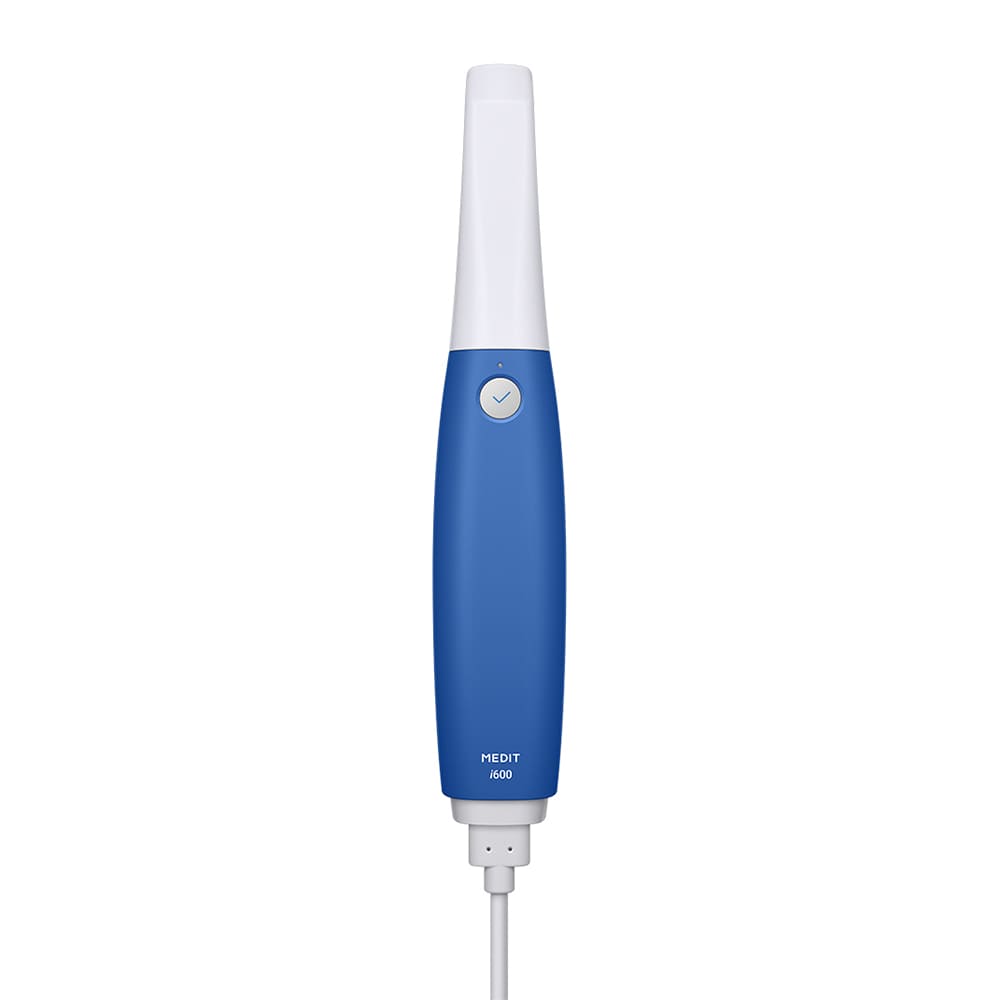
The i600 stands out visually with its bright blue colour, a departure from the understated greys and whites that dominate the intraoral scanner market. The design is far more than cosmetic, though. At 245 grams, the i600 matches the Medit i700 in weight, making it one of the lightest wired scanners available. The reduced weight translates to noticeably less hand fatigue during long scanning sessions.
The 180-degree reversible scanning tip is one of the most useful ergonomic features on the i600. It allows clinicians to flip the tip orientation without repositioning the entire handpiece, making distal surfaces of posterior teeth far easier to capture. The mirror angle has also been increased to 45 degrees compared to the i500’s 40 degrees, which further improves access to second and third molars.
Connectivity is simple. A single USB Type-C cable handles both power delivery and data transfer, eliminating the need for separate power adapters or docking hubs. Moving the scanner between operatories takes seconds, which is a practical advantage for multi-room practices.
Scanning Performance
Scanning speed and accuracy are the two metrics that matter most for clinical reliability. The i600 performs well on both fronts, especially considering its price point relative to premium competitors like the 3Shape TRIOS 5 and the iTero Lumina.
Speed
The i600 captures data at up to 35 frames per second, a figure that is software-capped rather than hardware-limited. In practice, clinicians consistently report completing full-arch scans in roughly 35 to 40 seconds, a pace that competes comfortably with scanners costing two to three times as much. The FPS cap makes the scanning experience feel marginally less fluid than the i700 (which exceeds 60 FPS), but this difference rarely translates to a meaningful clinical disadvantage.
Accuracy
The i600 achieves a full-arch accuracy of 10.9 µm ± 0.98, which is identical to the i700 and falls well within the range required for crowns, bridges, inlays, onlays, veneers, implant-supported restorations, and clear aligner fabrication. Independent studies have shown that modern intraoral scanners consistently outperform traditional PVS impression materials, which carry an average error of approximately 38 µm (PubMed, 2021).
Image Quality
Full-colour 3D scans from the i600 use the same optical system found in the i700. During live scanning, the image can appear slightly grainy, a characteristic shared across all Medit scanners, but post-processing produces detailed and clinically useful results. One difference compared to the i700 is the absence of HD Mode, a toggle that provides marginally sharper visuals on veneer preparations and overlapping structures. Clinical experts have noted that HD Mode does not affect accuracy, and the majority of i700 users either ignore it or are unaware it exists. The absence of HD Mode on the i600 should not factor heavily into a purchasing decision.
About Medit: Company Background
Medit was established in Seoul, South Korea in 2000, initially focused on industrial 3D scanning applications. The company transitioned into the dental sector with the Medit T-series desktop lab scanners before releasing its first intraoral scanner, the i500, in 2018. That debut product disrupted the market with a combination of strong scanning performance and aggressive pricing, and it set the template for everything Medit has done since.
The intraoral scanner lineup has expanded steadily. The i700 arrived in 2021 with faster speeds and a single-cord connection. The i600 and i700 wireless followed in 2022. Most recently, the Medit i900 launched in 2024 as the company’s first premium-segment device. Throughout this expansion, Medit has consistently offered subscription-free software, which remains a key differentiator in an industry where recurring fees are standard practice.
In the 2024 Intraoral Scanner Awards from the Institute of Digital Dentistry, Medit won the award for best software applications, recognition that reflects the depth and quality of the Medit Link ecosystem. The company was also recognized for making digital dentistry more accessible globally through competitive pricing and open-system file exports.
Software Ecosystem: Medit Link
The software platform is arguably where Medit delivers the most value relative to competitors. Medit Link is the primary application used to operate all Medit scanners, and it comes with zero recurring subscription fees. In a market where iTero charges around $5,000 per year and 3Shape charges approximately $2,500 annually, this represents a major long-term savings. The advantages of CAD/CAM in dentistry are well documented, and Medit’s open approach makes those benefits more financially accessible.
Medit Link includes a growing suite of free applications that extend the scanner well beyond basic impression-taking:
Model Builder – generates virtual dental models from scan data, reducing the need for physical model pouring
Medit Design – a CAD module for provisional restorations, custom trays, and appliances
Ortho Simulation – shows patients simulated orthodontic outcomes for improved case acceptance
Smile Design – cosmetic visualization tool combining scan data with facial photographs
Provisional Module – streamlines temporary restoration creation
Tooth shade detection – AI-powered shade matching during scanning
The AI features built into Medit’s scanning software are particularly impressive. Smart Scan Filtering removes soft tissue artifacts like the tongue, cheeks, and lips. Smart Color Filtering ignores specific colours such as gloves. The Smart Scan Guide provides real-time feedback to help operators achieve complete coverage.
The open-system architecture supports file export in STL, OBJ, and PLY formats, which are universally compatible with third-party CAD/CAM systems, dental laboratories, and 3D printers. This flexibility means the i600 is never locked into a single lab or manufacturing workflow.
One limitation worth noting is that the built-in Medit Design module handles provisional work but not definitive prosthetics. Most practitioners designing permanent restorations rely on third-party CAD software such as exocad. Cloud storage through Medit Link is free up to 1 GB, with a monthly fee for additional capacity.
Medit i600 vs. Medit i700: What Are the Differences?
This is the comparison that most prospective buyers want to see. The Medit i700 and i600 share identical hardware in many respects, so the differences are narrower than the price gap might suggest.
Feature | Medit i600 | Medit i700 |
Maximum FPS | 35 | 70+ |
HD Mode | Not available | Available |
UV-C disinfection | Not included | Included (requires power hub) |
Optical engine | Same as i700 | Same as i600 |
Weight | 245 g | 245 g |
Accuracy | 10.9 µm ± 0.98 | 10.9 µm ± 0.98 |
Price (approx.) | $12,000–$14,000 | $15,000–$17,000 |
The UV-C LED in the i700 was intended to disinfect internal scanner components, but it only operates when connected through the power hub rather than the standard USB-C cable. Very few practitioners use this feature in practice. The FPS difference is the most tangible distinction, and even this has minimal impact on clinical outcomes. For most dental professionals, the $3,000–$4,500 savings of the i600 over the i700 will be more meaningful than the features that separate them.
How the Medit i600 Compares to Other Scanners
The intraoral scanner market now includes dozens of options at widely varying price points. The i600 competes primarily against other entry-to-mid-tier scanners, but its specifications allow it to challenge premium devices on accuracy and speed. For a broader overview of the competitive landscape, the 3Shape TRIOS scanner review and Primescan 2 review provide additional context on how leading competitors stack up.
Medit i600 | 3Shape TRIOS 5 | iTero Lumina | Primescan 2 | |
Price (approx.) | $12–$14K | $29–$35K | $48–$61K | $45–$51K |
Annual subscription | None | ~$2,500 | ~$5,000 | ~$1,800 |
Open file export | Yes | Yes | Limited | Yes |
Weight | 245 g | ~370 g | ~600 g | ~340 g |
Chairside milling | Third-party | Third-party | No | Integrated |
The cost differential is dramatic. Over five years, a practice using the i600 could save $30,000–$60,000 compared to an iTero or CEREC system once subscription fees are factored in. Each competitor has specific strengths, though. CEREC excels in chairside milling workflows. The iTero Lumina offers deep Invisalign integration. The TRIOS line is known for versatility in implant planning and edentulous cases. The i600 occupies the sweet spot for practices that need a reliable, accurate scanner for general digital impression-taking without the premium price.
Clinical Applications
The i600’s open architecture and broad software support make it suitable for virtually any digital dentistry workflow. The scanner handles restorative, orthodontic, implant, and prosthodontic applications with equal competence, making it a versatile investment for practices across multiple specialties.
Restorative Dentistry
For crown and bridge work, the 10.9 µm accuracy produces well-fitting restorations across single-unit crowns, multi-unit bridges, inlays, onlays, and veneers. The ability to export STL files to any lab or CAD/CAM platform provides complete flexibility in choosing manufacturing partners. Scan data from the i600 is detailed enough for even demanding veneer cases, and the colour scan output gives laboratories additional visual context when shade matching.
The practical workflow is straightforward. After preparing the tooth, the clinician scans the arch, opposing arch, and bite registration. Post-processing takes only a few seconds, after which the case can be sent digitally to the lab through Medit Link or exported as a file for manual transfer. The entire digital impression process replaces what would otherwise require impression materials, shipping, and significantly more chair time.
Orthodontics
The i600 captures full-arch scans suitable for clear aligner fabrication with any manufacturer, retainer production, and digital orthodontic model storage. The Ortho Simulation tool within Medit Link allows clinicians to show patients simulated treatment outcomes during the consultation, which directly supports case acceptance. This feature is particularly valuable for practices that offer clear aligner therapy but are not tied exclusively to a single aligner brand.
The open file format means orthodontists can send scans to any aligner manufacturer, which is a significant advantage over systems like iTero that are optimized primarily for the Invisalign workflow. Practices offering multiple aligner brands will find the i600 especially useful for maintaining this flexibility.
Implant Dentistry
Implant practitioners can use the i600 to capture scan bodies from all major implant systems. The resulting digital impressions feed into third-party implant planning software for custom abutment design, implant-supported prosthetics, and surgical guide fabrication. When combined with CBCT scanning data, the i600’s intraoral scan data becomes part of a fully digital guided implantology workflow.
The scanner’s accuracy is well within the tolerance required for implant prosthetics, and its open export system means the scan data integrates smoothly with platforms like coDiagnostiX, Blue Sky Plan, and Implant Studio.
Patient Communication and Case Acceptance
Full-colour 3D scans displayed on a chairside monitor give patients a clear, immediate view of their oral conditions. Tools like Smile Design and Ortho Simulation help illustrate proposed treatments in a way that traditional clinical photographs or verbal explanations cannot match. Many clinicians report that this visual approach significantly improves patient communication and raises treatment acceptance rates, particularly for elective procedures like veneers, whitening, and orthodontics.
The ability to store and compare scans over time also supports longitudinal case documentation, which is useful for tracking wear patterns, monitoring orthodontic progress, and maintaining detailed digital records.
Who Should Buy the Medit i600?
The i600 fits several practitioner profiles particularly well. It is an excellent first scanner for practices transitioning from traditional impressions to digital workflows, and it works equally well as a secondary unit for multi-operatory or multi-location dental clinic setups.
General practitioners who need accurate digital impressions for everyday restorative work
Orthodontists seeking full-arch scanning for clear aligner cases and patient consultations
Multi-location practices looking to equip additional rooms without the premium price
Budget-conscious practitioners who want to avoid ongoing subscription fees
Clinicians who value open-system flexibility and freedom to work with any lab
The i600 may not be the ideal choice for practices requiring integrated chairside milling (CEREC would be more appropriate), those deeply embedded in the Invisalign ecosystem (iTero offers tighter integration), or clinicians who need wireless scanning. Practitioners wanting wireless freedom within the Medit lineup should consider the i700 wireless or the Medit i900 Mobility.
Total Cost of Ownership
Sticker price tells only part of the story. The true cost of an intraoral scanner includes the upfront purchase, subscription fees, consumable tips, warranty extensions, and any necessary computer hardware.
The i600’s five-year total cost of ownership lands in the range of $14,000–$18,000, including the scanner, extended warranty, and replacement tips. An iTero Element 5D reaches $73,000–$86,000 over the same period after subscription fees. Even a TRIOS 5 lands at $41,500–$47,500. For practices making careful procurement decisions, the i600’s financial profile is compelling.
Tips for Getting Started With the Medit i600
Adopting any new dental technology involves a learning curve, but the i600 is designed to make the transition as smooth as possible. The following recommendations can help practitioners maximize the scanner’s capabilities from day one.
Start with single-unit crown preparations before progressing to full-arch scans and more complex cases. This builds confidence with the scanning technique, particularly camera angle and movement speed, which are the biggest factors influencing scan quality regardless of the scanner used. Medit’s scanning protocol follows the same general principles as other intraoral scanners, so practitioners with prior experience will adapt quickly.
Calibrate the scanner on the recommended schedule. The calibration process is quick, taking only a couple of minutes, and maintaining a consistent calibration routine ensures optimal accuracy throughout the life of the device. Medit Link prompts users when calibration is due, so the process is easy to track.
Invest time learning the Medit Link applications beyond basic scanning. Model Builder, Ortho Simulation, and Smile Design are powerful tools that add tangible clinical and business value, but many practitioners never explore them because they are focused solely on impression-taking. The investment in learning these tools pays dividends through improved case acceptance and expanded treatment options.
Ensure adequate soft tissue retraction and haemostasis before scanning any preparation. Digital scanners, regardless of the brand, require clear visibility of preparation margins to produce accurate results. This principle applies just as much to the i600 as it does to a $60,000 iTero. Proper dental ergonomics during scanning also matters, as maintaining a comfortable posture reduces fatigue and improves scan consistency throughout the day.
Develop the habit of verifying bite registrations before sending cases to the lab. Bite alignment is the one area where the i600 can occasionally produce results that need a rescan. Checking this before finalizing the case takes only a few seconds and prevents potential remakes.
Common Problems and How to Solve Them
Every intraoral scanner has its quirks, and the i600 is no exception. Understanding the most frequent issues and their solutions helps practitioners avoid frustration and maintain a smooth digital workflow. For a broader perspective on assessing device reliability, dedicated resources can be helpful when evaluating any clinical equipment.
Grainy Scan Appearance During Live Capture
The live scanning image on all Medit scanners appears somewhat grainy compared to the final processed result. This is normal and expected behaviour. The post-processing algorithms clean up the scan data significantly, producing detailed and clinically useful final images. Practitioners who are new to Medit scanners sometimes mistake the live preview quality for the final output quality, which can cause unnecessary concern.
Bite Registration Misalignment
Automatic bite alignment can occasionally produce inaccurate results, particularly in cases with limited interocclusal clearance or when the bite scan captures insufficient overlap with the opposing arches. The solution is to always visually verify the bite registration in the software before finalizing the case, and rescan the bite if the alignment looks off. Capturing the bite from multiple angles can also improve alignment accuracy.
Scanner Not Recognized on USB Connection
If the computer does not recognize the scanner when plugged in, the most common causes are an outdated USB driver, an incompatible USB port (some USB-C ports on laptops are Thunderbolt-only), or a loose cable connection. Ensuring the computer meets Medit’s recommended specifications and using the provided USB-C cable rather than a third-party alternative typically resolves this issue.
Slow Performance or Lag During Scanning
Scanning lag is almost always related to the computer rather than the scanner itself. The most common culprits are insufficient GPU memory, background applications consuming system resources, or an outdated version of Medit Link. Closing unnecessary programs, updating to the latest software version, and verifying that the GPU meets the recommended specifications will resolve most performance issues.
Bottom Line
The Medit i600 delivers an unusual combination of clinical-grade accuracy, lightweight ergonomics, comprehensive free software, and a total cost of ownership that undercuts nearly every competitor on the market. The 10.9 µm accuracy is identical to scanners costing two to four times as much, and the Medit Link software suite offers more free functionality than any other scanning platform available today.
The trade-offs are real but modest. The 35 FPS cap, the lack of HD Mode, the absence of wireless capability, and the need for third-party CAD software for permanent restorations are all genuine limitations. None of them are dealbreakers for the vast majority of clinical workflows.
For any dental professional looking to move into digital impressions, or add a cost-effective scanner to an existing digital workflow, the Medit i600 is one of the strongest recommendations available in 2025.
Verdict
<p>The Medit i600 is one of the strongest value propositions in the intraoral scanner market. Sharing the same optical engine as the i700, it delivers 10.9 µm accuracy and full-arch scan times of 35–40 seconds, performance that competes directly with scanners priced at $30,000–$60,000. The Medit Link software ecosystem, with free applications covering model building, ortho simulation, smile design, and AI-powered scan filtering, provides functionality that other manufacturers charge thousands annually to access.</p><p>The areas that leave room for improvement are relatively minor. Bite scan alignment can occasionally require a rescan, permanent restoration design requires third-party CAD software, and the 35 FPS cap makes scanning feel slightly less smooth than the i700. None of these issues are significant enough to diminish the overall clinical experience.</p><p>For general practitioners, orthodontists, and multi-location practices looking for a reliable, accurate, and affordable intraoral scanner, the i600 earns a confident recommendation. The combination of premium scanning hardware, industry-leading free software, open file exports, and zero subscription fees makes it one of the best entry points into <a target="_blank" rel="noopener noreferrer nofollow" class="text-primary underline hover:text-primary/80" href="https://dentalreviewed.com/blog/advantages-of-cad-cam-dentistry"><u>digital dentistry</u></a> available today.</p>
Frequently Asked Questions
Is the Medit i600 accurate enough for crown and bridge work?
The i600 achieves a full-arch accuracy of 10.9 µm ± 0.98, which surpasses the accuracy of traditional PVS impression materials. This level of precision is more than adequate for crowns, bridges, inlays, onlays, veneers, and implant-supported restorations.
What is the price of the Medit i600?
The scanner-only price typically falls between $12,000 and $14,000 USD, depending on the dealer and region. Some dealers offer bundles that include a laptop, additional scanning tips, and extended warranty coverage. Pricing can vary, so confirming with an authorized Medit distributor is always recommended.
Are there subscription fees with the Medit i600?
There are no monthly or annual subscription fees for Medit Link or any of the included applications. The only recurring costs are cloud storage beyond the free 1 GB limit and replacement scanning tips.
Can the Medit i600 be used with any dental lab?
The i600 exports scan files in STL, OBJ, and PLY formats, all of which are universally accepted. There is no lab lock-in, which means clinicians can freely choose and switch between any lab partner.
How does the i600 compare to the iTero Element?
The i600 costs roughly $12,000–14,000 compared to $48,000–61,000 for an iTero 5D. The iTero also requires approximately $5,000 in annual subscription fees. In terms of accuracy, both scanners deliver clinically excellent results. The iTero’s main advantage is its deep integration with the Invisalign platform, which matters most for orthodontic-heavy practices.
Is the Medit i600 suitable for orthodontic practices?
The i600 captures detailed full-arch scans suitable for clear aligner fabrication with any manufacturer. The Ortho Simulation tool in Medit Link allows clinicians to visualize treatment outcomes during patient consultations, which supports case acceptance.
How often do scanning tips need replacement?
Standard tips can be autoclaved up to 100 times. Medit also sells tips rated for 150 cycles separately. Depending on daily scanning volume, a single tip typically lasts several months in a general practice setting.
Does the Medit i600 work with a Mac?
The scanning software requires Windows 10 or 11 Pro (64-bit). Mac users would need to run Windows through Boot Camp or a similar solution, though this setup is generally not recommended for performance-sensitive scanning tasks.
What warranty comes with the i600?
The scanner includes a one-year manufacturer warranty. An optional two-year extension is available for purchase, but it must be activated before the original warranty expires. Support is handled through the authorized dealer where the scanner was purchased.
How long does it take to learn the Medit i600?
Most dental professionals feel comfortable with basic scanning within one to two days of hands-on use. The single-button operation and intuitive Medit Link interface make the learning curve manageable for complete beginners, and practitioners with prior scanning experience often adapt immediately.