Rating: 3.9/5
Aoralscan 3 Intraoral Scanner Review
Digital impressions have moved from novelty to infrastructure in general practice, and the segment under $15,000 is where most first purchases now happen. The Aoralscan 3...
Reviewed by Marcus Hale
Pros
- Fully open system with STL, OBJ, and PLY export, allowing any laboratory and any CAD platform
- No mandatory software subscription, with cloud storage included rather than metered
- Software suite rated by independent reviewers above that of considerably more expensive scanners
- Effective artificial intelligence soft tissue filtering, which supports solo scanning without an assistant
- Generous 22 mm depth of field, assisting with scan bodies, deep preparations, and narrow interproximal access
- Motion-sensing control that minimizes contact with the computer during scanning
- Documented accuracy in peer-reviewed in vitro testing rather than manufacturer claims alone
- Autoclavable tips to approximately 100 cycles with reliable heated anti-fogging
- Wireless configuration priced well below comparable cable-free scanners from mainstream brands
- Established manufacturer with two decades of three-dimensional metrology experience and continuing software support
- MacOS compatibility through the Aoralscan 3 S variant, which remains uncommon in this segment
Cons
- Previous-generation platform, superseded within the manufacturer's own range
- Wired model difficult to justify at full list price given ELF pricing
- Unsuitable as a standalone solution for complete-arch implant frameworks
- Heavier than current-generation alternatives at 240 g wired and 330 g wireless
- Certain newer software modules tied to the Elite platform camera system
- Meaningful computer requirements that add real cost and are often omitted from quotations
- Accuracy degrades measurably on edentulous and long-span scanning, as confirmed in comparative testing
- Support quality, warranty terms, and training vary considerably between distributors and regions
- Wireless premium of roughly $3,000 that not every practice layout will recover
- Resale value under pressure as the platform ages and the product range expands
Digital impressions have moved from novelty to infrastructure in general practice, and the segment under $15,000 is where most first purchases now happen. The Aoralscan 3 intraoral scanner from Shining 3D has occupied that segment since September 2021, and it remains one of the most frequently shortlisted devices for practices stepping away from conventional impression materials.
This review examines the hardware, the scanning performance, the published accuracy evidence, the software ecosystem, and the full cost of ownership. It also addresses the question that matters most to a clinician signing a finance agreement in 2026, which is whether this particular scanner still represents the right use of a practice technology budget.
What Is The Aoralscan 3 Intraoral Scanner?
Understanding what the device actually does, and what it does not do, provides the foundation for every other section of this review. The specification sheet only becomes meaningful once the underlying technology is clear.
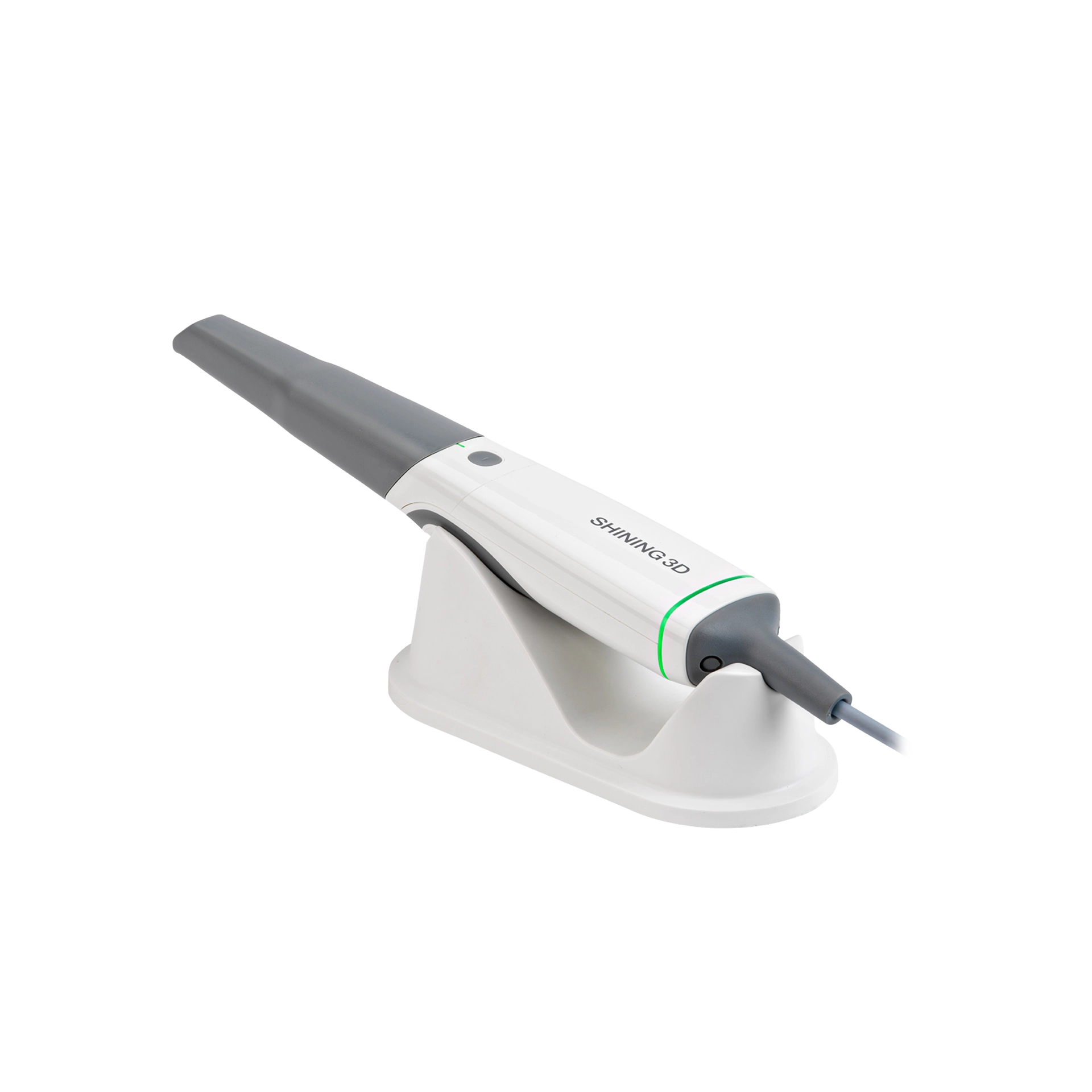
The Aoralscan 3 is a powder-free, non-contact intraoral scanner that captures three-dimensional digital impressions using structured light projection. A light pattern is cast onto the dental arches, distortion of that pattern is captured by imaging sensors, and proprietary algorithms convert the resulting point cloud into a rendered color model in real time.
Shining 3D, the manufacturer, was founded in 2004 and built its expertise in industrial three-dimensional digitizing and additive manufacturing before entering dentistry. The company released its first intraoral scanner in 2019, the second generation in 2020, and the Aoralscan 3 on 12 September 2021. A wireless variant followed in March 2023.
The scanner exports open STL, OBJ, and PLY files, carries no mandatory software subscription, and covers indications spanning general restorative work, orthodontics, and implant scan body capture. Two hardware configurations are available, a wired model and a wireless model, and both share identical optics and software.
Aoralscan 3 Specifications At A Glance
The table below consolidates the manufacturer published specifications for both hardware configurations. Figures come from Shining 3D technical documentation and authorized distributor specification sheets.
Specification | Aoralscan 3 (Wired) | Aoralscan 3 Wireless |
|---|---|---|
Scan principle | Non-contact structured light | Non-contact structured light |
Scan field, standard tip | 16 x 12 x 22 mm | 16 x 12 mm |
Scan field, mini tip | 12 x 9 x 22 mm | 12 x 9 mm |
Depth of field | Minus 2 mm to 20 mm from tip exit surface | Minus 2 mm to 20 mm from tip exit surface |
Dimensions | 285 x 33 x 46 mm | 270 x 50 x 40 mm including battery and tip |
Weight | 240 g plus or minus 10 g | 330 g plus or minus 20 g including battery and tip |
Connectivity | USB 3.0 | Wi-Fi 6, wired option included |
Wireless range | Not applicable | Same room, up to approximately 5 m |
Battery | Not applicable | About 2 hours continuous scanning, 10 days standby, 3 batteries supplied |
Tip sterilization | Autoclavable up to 100 cycles | Autoclavable up to 100 cycles |
Autoclave parameters | 121 C for 30 min or 134 C for 4 min | 121 C for 30 min or 134 C for 4 min |
Anti-fogging | Heated tip | 40 second instant tip heating |
Scanning powder | Not required | Not required |
Output formats | STL, OBJ, PLY | STL, OBJ, PLY |
Mandatory subscription | None | None |
Indicative street price | About $10,999 to $12,999 | About $14,000 |
Shining 3D quotes a single arch scan time of roughly 25 seconds and a complete record of both arches plus occlusion in approximately one to two minutes. Those figures reflect optimal conditions and should be treated as a benchmark rather than a guarantee of chairside performance with a difficult patient.
Where The Aoralscan 3 Sits In The Shining 3D Lineup In 2026
Product pages rarely explain generational positioning, yet this single factor carries more weight than any specification when evaluating the Aoralscan 3 today. Shining 3D currently markets six intraoral scanners, and they fall into two clearly separated technology platforms.
The Aoralscan 3 platform contains the wired Aoralscan 3, the Aoralscan 3 Wireless, and the Aoralscan Lync. All three share a common camera system, the same scanning technology, and a common hardware design philosophy. The Lync is essentially the same device packaged with different software entitlements.
The Elite platform contains the Aoralscan ELF, the Aoralscan Elite, and the Aoralscan Elite Wireless. These models use a newer camera system, refined algorithms, a redesigned form factor, and they receive the newest software modules first.
Pricing makes the consequence unavoidable. Independent analysis from the Institute of Digital Dentistry places the ELF at approximately $11,999, which delivers current-generation scanning at the historic price point of the wired Aoralscan 3. The same analysis describes the wired Aoralscan 3 as effectively a legacy product for that reason.
The wireless model withstands this logic more successfully. At roughly $14,000, it sits well below the Elite Wireless at approximately $23,999, so practices requiring cable-free operation without integrated photogrammetry retain a legitimate reason to consider it.
Hardware And Ergonomics
Handpiece design determines how a scanner feels across a full clinical day, and fatigue accumulates in ways that specification sheets never capture. The sections below examine the physical characteristics that matter most during routine scanning.
Weight, Balance, And Handling
Mass and length govern operator comfort during extended appointments and influence how easily a clinician can reach posterior sites.
The wired handpiece weighs 240 grams and measures 285 mm in length, which places it comfortably in the middle of the market. Current-generation devices have pushed toward 106 grams, so the Aoralscan 3 no longer competes on lightness, though most operators complete a full scanning day without meaningful wrist fatigue. The wireless configuration weighs 330 grams once battery and tip are fitted, a penalty common to every wireless scanner.
Scanner Tips And Field Of View
Tip geometry has direct clinical consequences, particularly in patients with limited opening or pronounced gag reflex.
Shining 3D made the Aoralscan 3 tips slimmer and approximately 15 percent longer than the previous generation. The additional length assists most in the posterior region, where capturing a distal margin on a second molar becomes a matter of physical access rather than optical capability. The standard tip provides a 16 by 12 mm field of view, and the mini tip drops to 12 by 9 mm for pediatric patients and restricted adult access. All tips tolerate autoclaving for up to 100 cycles.
Anti-Fogging And Infection Control
Condensation on the optical window interrupts acquisition and forces rescanning, so thermal management deserves attention in any equipment assessment.
The scanner heats the tip to prevent fogging, and the wireless model reaches working temperature in approximately 40 seconds. Motion-sensing control allows a clinician to start, pause, and navigate scans with minimal contact with the computer, which supports single-operator workflows and reduces cross-contamination pathways. Practices reviewing their wider protocols may find the guidance on choosing dental sterilization equipment useful when planning tip reprocessing cycles.
Depth Of Field
Depth of field determines whether a scanner can capture recessed anatomy without constant repositioning, and it separates capable devices from frustrating ones.
The Aoralscan 3 offers up to 22 mm of usable depth from the tip exit surface. That figure explains why the device handles implant scan bodies, deep preparations, narrow interproximal spaces, and periodontal scanning more comfortably than several competitors in the same price band. Clinicians working in guided implantology workflows will notice the benefit when capturing scan bodies at varied angulations.
Scanning Performance In Clinical Use
Laboratory specifications translate imperfectly into chairside experience, so this section focuses on acquisition behavior observed in practical use.
Speed And Acquisition
Scan speed influences appointment length, patient tolerance, and ultimately the economics of adopting digital impressions.
Shining 3D states that the Aoralscan 3 scans 30 percent faster and delivers 30 percent higher accuracy than the Aoralscan 2. Clinicians should note the comparator carefully, since that claim measures the device against the manufacturer's own previous model rather than against competing brands. Independent testing has nonetheless confirmed that acquisition is fast and the scanning experience is smooth across routine indications.
AI Soft Tissue Filtering
Automatic removal of unwanted anatomy during acquisition affects real-world scan times more than raw capture speed does.
The software identifies and filters cheek, tongue, and lip data as the scan progresses, producing a cleaner mesh with less post-processing. Reviewers have consistently rated this function among the strongest features of the device. The practical benefit is straightforward, since the alternative involves either a second pair of hands managing retraction or a lengthy cleanup pass after the patient has left the chair.
Margin Capture And Metal Handling
Restorative outcomes depend on the quality of data at the preparation margin, and existing metallic restorations have historically challenged structured light systems.
A restoration refinement function concentrates capture density on the prepared tooth, improving margin definition and surface detail exactly where the laboratory needs it. An enhanced algorithm addresses specular reflection from amalgam and cast metal, which reduces the noise and dropout that once made metal scanning unreliable. Undercut values can be displayed live during acquisition, allowing the path of insertion to be assessed before the appointment concludes, and margin lines can be marked within the software to sharpen communication with the technician.
How Accurate Is The Aoralscan 3?
Accuracy claims circulate widely in dental equipment marketing with little methodological context. This section defines the terminology, presents the published evidence, and translates both into chairside decisions.
Trueness And Precision Explained
International standards separate two distinct measures, and conflating them produces misleading conclusions about scanner capability.
Trueness describes how closely a scan matches the actual geometry of the object being captured. Precision describes how closely repeated scans of the same object agree with one another. A scanner can therefore be highly precise while remaining consistently inaccurate. Any single accuracy figure quoted without specifying which measure it represents, and under what test conditions, carries very little diagnostic value.
What The Published Studies Report
Peer-reviewed in vitro research provides the most defensible evidence base available, though every study carries methodological limitations worth stating openly.
An in vitro comparison of seven intraoral scanners using full dentate and partially edentulous complete-arch mandibular casts, published in Heliyon, placed the Aoralscan 3 in the leading group. On the partially edentulous cast, it recorded trueness of approximately 0.17 mm, ahead of the 3Shape TRIOS 3, the Medit i500, and the Carestream CS 3600, and behind the Planmeca Emerald and the iTero Element 5D. The same study reported that several scanners, including this one, produced significantly higher deviation values on the partially edentulous cast than on the fully dentate cast.
A more recent evaluation of current systems for complete-arch impressions, published in the Journal of Dentistry, assessed the Aoralscan 3 alongside Primescan, Primescan 2, TRIOS 5, Medit i900, iTero 5D, and Emerald Green. All tested scanners produced full-arch deviations below 100 micrometers, a threshold generally accepted as clinically acceptable, with Primescan achieving the highest accuracy. Notably, high-quality conventional impressions still outperformed every digital system on both trueness and precision.
A systematic review and meta-analysis comparing photogrammetry with intraoral scanning for complete-arch implant impressions included the Aoralscan 3 among the devices assessed. The authors concluded that stereophotogrammetry demonstrated significantly greater trueness and precision, that intraoral scanners exceeded the angular deviation threshold of approximately one degree associated with passive fit, and that a rigid prototype try-in remains advisable.
How To Apply This Chairside
Translating study data into clinical protocol requires attention to indication rather than headline figures.
Single units, quadrants, short-span bridges, and orthodontic records fall well within the accuracy envelope of this scanner
Complete-arch dentate scans remain achievable and clinically acceptable, though premium scanners retain a measurable edge
Complete-arch implant frameworks require photogrammetry, a verification jig, or a prototype try-in regardless of which intraoral scanner is used
In vitro casts eliminate saliva, blood, restricted access, and patient movement, so real-world deviation will exceed published figures
Scanning protocol and operator technique influence outcomes more than the difference between two competent mid-range devices
Wired Versus Wireless: Choosing The Right Version
Both configurations deliver identical optics, identical software, and identical clinical output, so the decision reduces to workflow economics rather than scanning capability.
The wired configuration suits practices scanning from a fixed chairside position. It offers the lighter handpiece at 240 grams, removes battery management from the daily routine, and eliminates an entire category of intermittent connectivity troubleshooting. Where a distributor offers a meaningful discount, this version becomes considerably more attractive.
The wireless configuration suits clinicians moving between operatories or working with patients who are difficult to position. It ships with three batteries and a charging hub, supports approximately two hours of continuous scanning per charge, holds standby charge for around ten days, and works with multiple cradles so the handpiece can be docked wherever the clinician finishes. A wired fallback is included, which proves valuable when a battery depletes mid-appointment.
The wireless premium sits at roughly $3,000. A defensible test involves estimating the minutes lost each day to cable management, multiplying across the finance term, and assessing whether the result clears that threshold. Single-operatory practices frequently find that it does not, whereas multi-chair clinics and high-volume orthodontic offices often find that it does. Practices weighing the capital outlay may want to review the available dental clinic financing options before committing.
The IntraoralScan Software Ecosystem
Software determines how much clinical value a practice extracts from scan data, and this remains the area where the Aoralscan 3 most convincingly outperforms its price bracket. Independent reviewers have rated the IntraoralScan suite above that of considerably more expensive scanners.
Chairside Design Tools
Built-in design functions allow a practice to complete work internally that would otherwise require an external design service or a separate software license.
Model creator, which generates printable models directly from scan data and pairs naturally with in-house 3D printing
Temp design, for chairside provisional restorations
Indirect bonding tray design, which supports orthodontic practices bonding in-house
Removable denture workflow, capturing bite relationships from existing dentures and bite rims for edentulous cases
An artificial intelligence design marketplace for more complex cases including splints, bridges, and full-arch work
Practices operating a chairside milling unit alongside the scanner can move from acquisition to delivery within a single appointment, which is where the wider advantages of CAD/CAM dentistry become financially visible.
Patient Communication And Monitoring
Communication modules convert scan data into material that supports case discussion and longitudinal monitoring, which affects treatment acceptance as much as clinical accuracy does.
Orthodontic simulation, showing a patient a predicted alignment result in real time
Oral health report, producing a structured patient-facing summary
Data track and MetronTrack oral analysis, offering measurement tools and comparison across appointments to monitor wear, recession, and treatment progress
Intelligent plaque management suite, a hygiene and education module supplied at no additional cost
Scan-derived visuals integrate naturally into case presentation, and practices building a structured dental treatment plan around restorative or orthodontic findings can use the exported reports as supporting documentation during the consultation.
Cloud Collaboration With The Laboratory
Case transfer and technician communication determine turnaround time, and a poorly designed transfer process erodes the efficiency gains that justified the scanner purchase.
The Shining 3D Dental Cloud handles case transmission between clinic and laboratory, with a management dashboard, a data assessment step allowing technicians to confirm or reject scan quality before commencing work, and patient record management. Cloud storage is included rather than metered per case, which represents a genuine recurring saving compared with several competing ecosystems.
One generational caveat applies. Certain newer modules are tied to the Elite platform camera system. The Aoralscan 3 continues to receive IntraoralScan software updates and shares most of the suite, though full feature parity with current-generation devices should not be assumed.
Open Architecture And Laboratory Integration
File format policy shapes long-term flexibility more than most clinicians anticipate at the point of purchase, and it deserves explicit consideration.
The Aoralscan 3 exports STL, OBJ, and PLY without proprietary encoding, per-case export charges, or mandatory subscription. Three practical consequences follow for a purchasing practice.
Any laboratory can receive cases, since the technician requires no matching license or dedicated software seat
Files import cleanly into exocad and other major dental CAD environments, as well as third-party aligner and implant planning software
Ongoing costs stay predictable, which matters because subscription differences across a seven-year ownership period can exceed the purchase price gap between two scanners
Clinicians assessing long-term supplier risk may find the framework in this guide to assessing device reliability helpful when comparing open and closed ecosystems.
Clinical Indications And Limitations
Matching a scanner to a case mix produces better purchasing decisions than comparing specification sheets in isolation. The lists below separate confident indications from those requiring caution.
Indications Where The Scanner Performs Well
These applications sit comfortably within the documented capability of the device and represent the majority of general practice workload.
Single-unit crowns, inlays, onlays, and veneers
Short-span fixed bridgework
Quadrant and opposing-arch records
Orthodontic records, aligner scans, and retainer fabrication
Study models and printable model workflows
Single and multiple implant scan body capture
Periodontal assessment and longitudinal monitoring
Removable prosthodontic workflows using the denture module
Occlusal splints and nightguards
Indications Requiring Care Or Verification
These situations remain achievable, though they demand deliberate technique and, in some cases, independent confirmation of the result.
Complete-arch dentate scanning, where stitching error accumulates across long spans
Deep subgingival margins, which depend primarily on soft tissue management
Fully edentulous arches lacking anatomical landmarks for the stitching algorithm
Indications Better Served By Other Equipment
Recognizing the boundary of a device protects both clinical outcomes and the reputation of the practice.
Routine full-arch implant rehabilitation falls outside what any intraoral scanner reliably delivers alone. The published evidence consistently indicates that intraoral scanning does not achieve the angular accuracy required for a passively fitting complete-arch framework. Practices performing this work regularly should consider the Aoralscan Elite with integrated intraoral photogrammetry, or a standalone photogrammetry system used alongside any scanner. Standalone units typically cost between $15,000 and $30,000, which explains the commercial logic behind integrating the technology into a scanner body.
Computer Requirements And Practical Setup
Undersized computing hardware is among the most common reasons a capable scanner underperforms in practice, and quotations frequently omit this cost entirely.
Component | Manufacturer minimum | Practical recommendation |
|---|---|---|
Processor | Intel Core i7-8700 or higher | Intel Core i7-11800H class or newer |
Memory | 16 GB | 32 GB |
Storage | 256 GB SSD | 1 TB NVMe SSD |
Graphics | NVIDIA RTX 2060 6 GB | NVIDIA RTX 4060 or higher |
Operating system | Windows 10 Professional 64-bit | Windows 11 Professional |
Display | 1920 x 1080 at 60 Hz | 1920 x 1200 at 144 Hz or higher |
Ports | Two or more USB 3.0 Type-A | Two or more USB 3.0 Type-A plus USB-C |
The Aoralscan 3 S variant supports macOS across Apple Silicon processors from the M1 series onward. Clinicians intending to run the scanner on a Mac should confirm the exact variant and software build with the distributor before purchase rather than assuming compatibility.
Two further points deserve attention. Practices running a recent NVIDIA 50 series graphics card should confirm the software is on version 3.6.5 or later before the first scan, since earlier builds predate that hardware. Dedicating a machine to the scanner, rather than sharing it with practice management duties, materially improves uptime and rendering performance.
Total Cost Of Ownership
Purchase price represents only part of the financial picture, and the omitted items frequently determine whether a scanner delivers the return a practice expected.
Cost item | Typical range | Notes |
|---|---|---|
Scanner, wired | About $10,999 to $12,999 | Varies considerably by distributor and region |
Scanner, wireless | About $14,000 | Includes three batteries and charging hub |
Software license | No recurring fee | No mandatory subscription |
Cloud storage | Included | Not metered per case |
Replacement tips | Consumable | Autoclavable to approximately 100 cycles |
Compatible computer | About $1,500 to $3,000 | Frequently omitted from quotations |
Cart or mounting solution | Optional | Dedicated cart available |
Warranty | Commonly 2 to 3 years | Confirm terms with the distributor |
Training | Varies | Often bundled, confirm what is actually included |
The absence of a software subscription constitutes a structural financial advantage. Across a seven-year ownership period, a competing system charging even a moderate annual license fee can eliminate a purchase price advantage of several thousand dollars. Practices building a wider technology budget may find the reasoning in this guide on why to upgrade dental technology a useful companion to the figures above.
How The Aoralscan 3 Compares To Competing Scanners
Competitive context clarifies whether the device represents good value at its current price, and the comparison below covers both the internal Shining 3D range and the wider market.
Scanner | Approximate price | Generation | Key differentiator |
|---|---|---|---|
Aoralscan 3 wired | $10,999 to $12,999 | Previous | Open system, no subscription, mature software |
Aoralscan 3 Wireless | About $14,000 | Previous | Affordable cable-free scanning |
Aoralscan ELF | About $11,999 | Current | Elite optics at entry pricing, about 106 g |
Aoralscan Elite | About $20,000 | Current | Integrated intraoral photogrammetry |
Aoralscan Elite Wireless | About $23,999 | Current | Photogrammetry without a cable |
Medit i600 | About $10,500 | Current | Established ecosystem, large user base |
3Shape TRIOS Core | About $12,400 | Current | Brand recognition and lab familiarity |
3Shape TRIOS 5 | About $25,900 | Current | Premium wireless performance |
The internal comparison against the ELF decides the outcome for most buyers. The ELF is broadly the Elite without the photogrammetry hardware, housed in a plastic rather than metal body, with the same camera system and scanning technology at approximately $11,999. Unless the Aoralscan 3 carries a substantial discount, the ELF represents the better allocation of the same budget for a general practice.
Against the wider market, the Medit i600 offers current-generation technology at a similar entry price with a mature support community, while the Medit i700 and Medit i900 sit above it. The 3Shape TRIOS Core competes directly on price with strong laboratory familiarity, though the wider 3Shape TRIOS lineup typically involves ongoing subscription costs that alter long-term ownership economics considerably.
Who Should Buy The Aoralscan 3
Suitability depends on case mix, budget, existing equipment, and the specific offer on the table, so the guidance below separates favorable circumstances from unfavorable ones.
Practices Well Suited To This Scanner
These scenarios make the Aoralscan 3 a defensible and often excellent purchase.
Practices offered a genuinely discounted unit, demonstration stock, or a bundled package
Clinics already operating Shining 3D equipment that want a matched second-chair scanner and consistent staff training
Budget-conscious practices requiring wireless scanning without a $24,000 outlay
Orthodontic and aligner-focused practices, where the simulation and indirect bonding tools align with daily workflow
Laboratories placing scanners with referring dentists as an accessible entry point into digital impressions
Teaching and training environments benefiting from open file export and the absence of per-seat licensing
Practices That Should Consider Alternatives
In these situations, the same budget produces a better clinical and financial outcome elsewhere.
First-time buyers paying full list price for the wired model, where the ELF is the stronger choice
Practices performing routine full-arch implant rehabilitation
Clinicians who prioritize the lightest available handpiece above all other factors
Practices requiring guaranteed access to every future software feature
Buyers unable to secure a reputable local distributor with clear warranty and service terms
Buying Advice And Due Diligence
Careful negotiation and verification protect a practice from the most common purchasing mistakes in this category. The points below apply to new and pre-owned units alike.
Confirm the exact variant in writing, since wired, wireless, Lync, and the macOS-compatible 3 S are distinct products
Negotiate against ELF pricing, because the generational gap justifies a meaningful discount rather than a token reduction
Establish the trade-up path before purchase, as distributors have historically offered upgrade routes
Clarify warranty duration, coverage, repair turnaround, and whether a loaner unit is provided
Obtain written confirmation of continuing software update entitlement and which modules will not reach the platform
Treat gray-market units cautiously, since warranty transfer, software registration, and regional support eligibility commonly fail
Budget for a compatible computer within the same quotation rather than discovering the cost afterward
Practices considering a pre-owned unit should apply the same scrutiny recommended in this guide to buying used dental equipment, with particular attention to remaining tip cycles and software registration status.
Bottom Line
A final assessment should account for both clinical capability and the market conditions a buyer faces today, since the two have diverged for this particular device.
The Aoralscan 3 earned its reputation legitimately. It brought competent, open-architecture, subscription-free digital impressioning to practices previously priced out of the category, supported by software that outperformed considerably more expensive systems. Clinicians already using one own a capable instrument with no clinical reason to replace it.
For a new buyer in 2026, the calculation has shifted, largely because Shining 3D built better scanners and priced them aggressively. The Aoralscan ELF now delivers current-generation technology at what the wired Aoralscan 3 has always cost, and the Elite offers a full-arch implant capability that no competing manufacturer integrates.
The Aoralscan 3 has therefore become a value proposition rather than a default recommendation. Secured at a genuine discount, purchased for affordable wireless capability, or added for consistency across an existing Shining 3D practice, it remains a sound clinical decision. Purchased at full list price as a first scanner, it represents previous-generation technology at current-generation pricing. Clinicians should ask for the discount, and where it is granted, the device still delivers considerable capability for the money.
Verdict
<p>The following assessment weighs clinical capability against the current market position of the device, since both factors determine whether a purchase makes sense today.</p><p>The Aoralscan 3 remains a competent clinical instrument that has been overtaken by its own manufacturer. On performance alone it delivers what a general practice requires, namely fast powder-free acquisition, clean margin data, effective artificial intelligence filtering of soft tissue, and open file export that never restricts a practice to a single laboratory or design platform. For crown and bridge work, quadrant restorations, orthodontic and aligner records, study models, and single-unit implant scans, the device performs reliably. Practices already running one have a capable scanner and no clinical reason to replace it.</p><p>The difficulty is positional rather than technical. Shining 3D now sells current-generation Elite platform scanners, and the Aoralscan ELF delivers newer optics, improved algorithms, and a substantially lighter body at roughly $11,999, which is close to what the wired Aoralscan 3 has always cost. That comparison makes the wired model hard to justify at full list price for a first-time buyer in 2026. The wireless version holds a narrower advantage, since it remains one of the least expensive routes to untethered scanning at approximately $14,000.</p><p>A reasonable conclusion follows. The Aoralscan 3 is worth buying at a genuine discount, when affordable wireless capability is the priority, or when adding a matched second scanner to an existing Shining 3D practice. Clinicians performing routine full-arch implant rehabilitation should look elsewhere.</p>
Frequently Asked Questions
Is the Aoralscan 3 still worth buying in 2026?
Conditionally. The wired version now functions as a legacy product, since the Aoralscan ELF offers current-generation scanning technology at roughly $11,999. The Aoralscan 3 makes sense at a substantial discount, where affordable wireless capability is required, or where a practice is standardizing on Shining 3D across multiple operatories. At full list price for a first scanner, current-generation hardware is the better choice.
How accurate is the Aoralscan 3?
Peer-reviewed in vitro testing placed it in the leading group among mid-range scanners, recording trueness of approximately 0.17 mm on a partially edentulous complete-arch cast and outperforming several better-known competitors in that comparison. A separate seven-scanner study found that all tested devices, including this one, produced full-arch deviations below 100 micrometers. For single units, quadrants, and orthodontic work, accuracy is not a limiting factor.
Is the Aoralscan 3 an open system scanner?
Yes. It exports STL, OBJ, and PLY without proprietary formatting or per-case export charges, and it integrates with exocad and other major CAD platforms. Cases can be sent to any laboratory without requiring the technician to hold a matching license.
Does the Aoralscan 3 require a subscription?
No. Software access and cloud storage are included with the scanner. Across a seven-year ownership period this represents a genuine financial advantage over subscription-based ecosystems, where recurring fees can exceed the difference in purchase price between two devices.
What is the difference between the wired and wireless versions?
Scanning technology, software, and clinical performance are identical. The wireless model uses Wi-Fi 6, ships with three batteries and a charging hub, delivers approximately two hours of continuous scanning per charge with around ten days of standby, supports multiple cradles, and includes a wired fallback. It weighs 330 g against 240 g for the wired model and costs roughly $3,000 more.
Can the Aoralscan 3 handle full-arch implant cases?
It captures scan bodies effectively, and the 22 mm depth of field assists considerably. However, current evidence indicates that no intraoral scanner reliably achieves the angular accuracy required for a passively fitting complete-arch framework. A systematic review found stereophotogrammetry significantly more accurate for these cases and recommended a rigid prototype try-in. Practices performing routine full-arch implant work should consider the Aoralscan Elite with integrated photogrammetry.
What computer specification does the Aoralscan 3 need?
The stated minimum is an Intel Core i7-8700 or better, 16 GB of memory, a 256 GB solid state drive, and an NVIDIA RTX 2060 6 GB graphics card running Windows 10 Professional 64-bit or later. In practice, 32 GB of memory, a 1 TB drive, and a newer graphics card deliver a far better experience. The Aoralscan 3 S variant supports macOS on Apple Silicon.
How long do the scanner tips last?
Tips are autoclavable for up to approximately 100 cycles, at 121 degrees Celsius for 30 minutes or 134 degrees Celsius for 4 minutes. High-volume practices should budget for replacement accordingly, since four adult tips cycling through daily sterilization will reach that limit within a couple of years.
Does the Aoralscan 3 require scanning powder?
No. It is a powder-free structured light scanner, which simplifies the clinical process and improves patient comfort compared with systems requiring surface treatment.
How fast is the Aoralscan 3 in real clinical conditions?
Shining 3D quotes approximately 25 seconds for a single arch and one to two minutes for a complete record. Those figures reflect optimal conditions. Actual times depend on access, moisture control, patient cooperation, and operator experience, though independent testing has consistently confirmed that acquisition is fast and the scanning experience is smooth.
How does the Aoralscan 3 compare to the Medit i600 or i700?
The Medit i600 is a current-generation scanner at a similar entry price with a mature ecosystem and large user base, and the i700 sits above it. The Aoralscan 3 competes on software breadth and the absence of subscription costs, while Medit competes on generational currency and community support. Comparing total seven-year cost rather than sticker price produces the more useful answer.
What is the difference between the Aoralscan 3 and the Aoralscan Elite?
The Elite is a current-generation platform with a newer camera system, refined algorithms, redesigned lighter hardware, and integrated intraoral photogrammetry capturing full-arch implant positions to approximately 30 micrometers. It costs around $20,000 in wired form. The Aoralscan 3 is previous-generation and has no photogrammetry capability.
Is the Aoralscan Lync the same scanner as the Aoralscan 3?
Essentially yes. The Lync shares the Aoralscan 3 platform camera system and scanning technology, packaged with different software entitlements. Buyers should compare the specific software inclusions before choosing between the two.
Will the Aoralscan 3 continue receiving software updates?
It continues to receive IntraoralScan updates and shares most of the software suite, including the plaque management module and the removable denture workflow. Certain newer modules are tied to the current-generation camera system, so buyers should obtain the distributor position on future entitlement in writing.
Should a practice buy a used Aoralscan 3?
Careful verification is essential. Warranty transferability, software registration status, remaining tip cycles, and regional support eligibility all require confirmation. Given how closely the ELF now sits on price, a pre-owned Aoralscan 3 needs to be considerably cheaper to represent good value.