Rating: 3.8/5
Aoralscan Elf Review: Elite-Level Scanning At Half The Price?
Every few years a piece of dental hardware arrives that forces the rest of the market to redraw its pricing sheet. The Aoralscan Elf from Shining 3D Dental has a credible claim to...
Reviewed by Marcus Hale
Pros
- Exceptional value, delivering flagship level scanning technology at roughly half the flagship price.
- Lightest modern scanner available at 106 grams, with genuine ergonomic benefit across long sessions.
- Scanning performance identical to the Aoralscan Elite, with no throttled frame rate and no artificial software limitation.
- Complete software suite included, covering orthodontic simulation, CAD design modules, patient reporting, and longitudinal monitoring.
- Zero subscription fees, which compound into five figure savings across a typical ownership period.
- Fast full arch capture at 30 to 45 seconds with reliable stitching.
- Strong capture of difficult surfaces, including deep margins, interproximal regions, metal restorations, dentures, and mini implant components.
- Single USB-C cable with no external power box and minimal cable clutter.
- Open export in STL, OBJ, and PLY with direct exocad integration, avoiding ecosystem lock-in.
- Intelligent Plaque Management Suite included free, adding a preventive care and case acceptance workflow.
- Effectively no pre-heat time, with the scanner ready within seconds.
- Tips cross-compatible with the Elite series, which simplifies inventory across a mixed fleet.
Cons
- No intraoral photogrammetry, so full arch implant restoration requires the Elite or Elite Wireless.
- Polymer housing feels less premium than metal bodied competitors.
- Calibration required every two weeks, a recurring task in a market moving toward calibration-free designs.
- Wired operation only, with no wireless option in this model line.
- Basic cradle, visibly cost reduced compared with the Elite series.
- Software polish trails Medit and 3Shape across several modules, even where feature coverage is broader.
- macOS build is feature incomplete, currently lacking the Plaque Management Suite, CreIBT, and CreTemp.
- No fluorescence caries detection, since the AI caries feature analyzes standard scan data rather than using a separate detection technology.
- Limited model-specific published validation to date, given the recent release.
- Free cloud storage carries no contractual guarantee of remaining free.
- Meaningful workstation requirements that may force an unbudgeted computer purchase.
Every few years a piece of dental hardware arrives that forces the rest of the market to redraw its pricing sheet. The Aoralscan Elf from Shining 3D Dental has a credible claim to being that product for the intraoral scanner category in 2026.
The scanner was announced in November 2025, the third release in a rapid sequence that also produced the Aoralscan Elite and the Elite Wireless. On paper the Elf reads like a budget model, with a polymer housing, no photogrammetry, and an entry-level price. In clinical use it turns out to be something considerably more interesting, namely the same optical engine and the same complete software suite as the flagship, with one specialist capability removed and roughly forty percent taken off the price.
For a general practice that restores crowns, bridges, single implants, orthodontic cases, and removable prosthetics, that trade sits close to irrelevant. This review covers what the Aoralscan Elf is, what its specifications mean chairside, where it performs, where it does not, what it costs to own across five years, and which practices should be signing the purchase order.
Aoralscan Elf At A Glance
The summary below gives the headline figures that most practices screen on before requesting a demonstration. Detailed specifications, clinical performance data, and pricing analysis follow in the sections beneath it.
Manufacturer | Shining 3D Dental |
Launch date | November 2025 |
Scanner type | Wired, powder free, full color intraoral scanner |
Weight | 106 g, handpiece excluding cable |
Connection | Single USB Type-C, no external power box |
Stated accuracy | Up to 0.05 mm, manufacturer figure |
Scan tips | Three sizes, autoclavable, shared with the Elite series |
Standout feature | IntelliBite AI occlusal registration |
Key omission | No intraoral photogrammetry (IPG) |
Subscription fees | None |
Typical US list price | USD 11,999, verify locally |
What The Aoralscan Elf Actually Is
The clearest way to understand the Elf is through subtraction. Take the Aoralscan Elite, Shining 3D’s flagship wired scanner, which launched in late 2024 and introduced intraoral photogrammetry to the category, then remove the photogrammetry system and replace the metal housing with a lighter polymer shell. What remains is the Elf.
That description sounds reductive until the list of unchanged components is examined. The camera system and scanning technology carry over intact. The three tip sizes are identical and physically interchangeable with the Elite series. The USB-C single cable architecture, the calibration procedure, and the recommended computer specification are all the same. Most significantly, the software suite is the same, with every application included, no feature gating, and no tiered licensing.
This deserves emphasis, because the industry norm has been the opposite. Manufacturers routinely create entry-level models by throttling frame rates, locking CAD modules behind paywalls, or restricting export options, so that the cheaper unit functions as a permanent argument for upgrading. Shining 3D has used that approach before with the software-limited Aoralscan Lync. The Elf takes a different route, offering a full-capability scanner with one specialist workflow removed.
The name works as an acronym for Ergonomic, Lightweight, and Functional. Unusually for dental marketing, all three descriptors survive contact with the operatory.
Where It Sits In The Shining 3D Lineup
Shining 3D now runs two parallel scanner families, and the Elf occupies a genuinely new position between them.
Aoralscan 3 and 3 Wireless, the older generation, still capable and still catalogued, built on previous generation optics with a smaller 16 mm by 12 mm field of view.
Aoralscan Elite and Elite Wireless, the flagships, defined by intraoral photogrammetry for full arch implant verification.
Aoralscan Elf, flagship optics and the complete software suite, priced beneath most of the entry-level market.
The Institute of Digital Dentistry maintains a comparison of the full Aoralscan range for practices weighing more than one model.
Full Technical Specifications
The figures below are drawn from the manufacturer’s published specification sheet. Accuracy values quoted by any scanner manufacturer are laboratory results obtained under controlled conditions, so they indicate the ceiling of the optical system rather than a prediction of clinical trueness across a full arch.
Specification | Aoralscan Elf |
|---|---|
Scan principle | Non-contact, structured light |
Powder required | No |
Color capture | Full true color 3D |
Scan field, big tip | 19 mm × 14 mm |
Scan field, standard tip | 16 mm × 12 mm |
Scan field, mini tip | 12 mm × 9 mm |
Handpiece dimensions | 245.5 mm × 27 mm × 30.5 mm |
Weight | 106 g without cable |
Stated accuracy | Up to 0.05 mm |
Capture rate | Up to 20 fps, reseller listed, confirm with distributor |
Output formats | STL, OBJ, PLY |
Connection | USB Type-C, plug and play |
Tip sterilization | Autoclavable at 134 °C, rated for approximately 100 cycles |
Calibration | Automated unit, every two weeks, 4 to 5 minutes |
Cart compatibility | AoStation and e-Motion all-in-one carts |
Operating systems | Windows primary, macOS with reduced feature set |
Warranty | Commonly listed as three years, verify locally |
Recommended Workstation Specification
Hardware requirements for this scanner are substantial rather than nominal, and an underpowered workstation produces dropped frames and unstable stitching that are frequently misattributed to the scanner itself.
Component | Requirement |
|---|---|
Processor | Intel Core i7-8700 or higher |
Memory | 32 GB RAM recommended |
Storage | 256 GB SSD minimum |
Graphics | NVIDIA RTX 2060 6 GB or higher |
Operating system | Windows 10 Professional 64-bit or later |
Display | 1920 × 1080 at 60 Hz or higher |
Ports | One USB Type-C 3.0 at 5 V and 3 A, plus one USB-A 3.0 |
A practice running a five year old front-office machine with integrated graphics should budget USD 2,000 to 3,000 for a replacement and count it as part of the purchase rather than a later surprise. The USB-C port must deliver the full 5 V at 3 A, since underpowered ports are a common source of intermittent connection faults.
Design And Ergonomics: The 106 Gram Question
Weight is the specification most often dismissed as marketing copy and most often felt in the clinician’s wrist. At 106 grams the Aoralscan Elf is currently the lightest modern intraoral scanner available, and the margin over its competitors is not trivial.
Scanner | Handpiece weight |
|---|---|
Aoralscan Elf | 106 g |
Aoralscan Elite | 124 g |
Panda Smart | 138 g |
Medit i900 | 165 g |
TRIOS 5 and TRIOS 6 Wireless | 299 g |
Medit i900 Mobility | 328 g |
Set against a wireless 3Shape TRIOS, the Elf carries roughly a third of the mass. Against the Medit i900 it saves close to 60 grams, which is the difference between a device the clinician holds and a device the clinician notices holding.
The practical benefit appears in three situations. Long appointments come first, including full mouth records, complex orthodontic scans, and consecutive hygiene appointments. Difficult access comes second, particularly distal of the second molars in patients with limited opening, where wrist rotation under load is the limiting factor. Delegation comes third, since a lighter, better balanced handpiece is easier to pass to a hygienist or assistant with less training overhead.
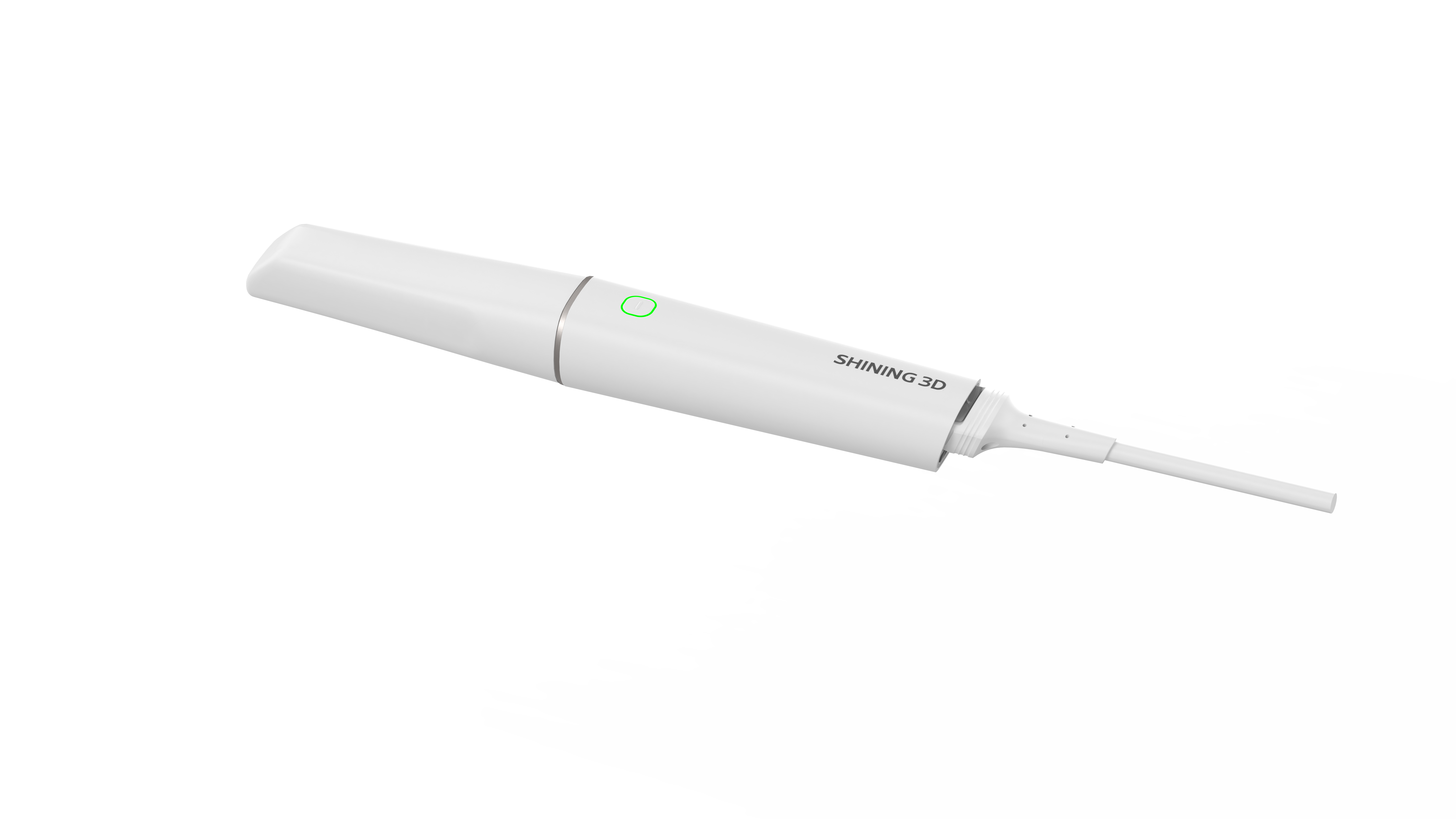
The 245.5 mm length produces a pen-like balance rather than the front-heavy feel of scanners that carry their optics far forward. A single control button sits where the index finger naturally rests.
The Polymer Housing
The weight saving comes from replacing the Elite’s metal housing with polymer, and this represents the most honest criticism of the scanner. The Elf does not feel like a premium instrument. Placed beside an Elite or a TRIOS it feels lighter in the way inexpensive objects feel lighter. Many clinicians will be indifferent to this, while practices where visible equipment quality forms part of the patient experience may weigh it more heavily.
A counter-argument deserves recording. Polymer housings resist visible scratching better than anodized metal, which tends to accumulate marks along the barrel across years of cradle contact. Five years into ownership, the plastic unit may well present better than the metal one.
The cradle is the other visible economy. It holds the handpiece securely, functions correctly, and looks like a cost-reduced accessory, which it is. It has no bearing on clinical performance.
Scanner Tips And Consumable Costs
The Elf uses the same three-tip system as the Elite series, and the tips are cross-compatible between the two models, which simplifies inventory for practices running a mixed fleet across several operatories.
Big tip, 19 mm by 14 mm, one of the largest fields of view on any intraoral scanner. This is the workhorse for adult scanning, since the wider capture window means fewer passes per arch and better stitching stability across flat edentulous spans. Resellers sometimes list it as the IPG tip because it is the same physical component used for photogrammetry on the Elite, but on the Elf it functions purely as the large tip.
Standard tip, 16 mm by 12 mm, the general purpose option and the correct default when the big tip causes discomfort or cannot clear the retromolar region.
Mini tip, 12 mm by 9 mm, for pediatric patients, restricted opening, and severe crowding with a limited buccal corridor. Most clinicians reach for it rarely, though nothing else substitutes when it is needed.
Tips are autoclavable at 134 °C for approximately 100 cycles and cost around USD 50 each, which works out to roughly USD 0.50 per patient scan in consumable cost. That figure sits in line with the wider market rather than representing an advantage or a penalty. A practice scanning fifteen patients per day needs a rotation of at least four to six tips per operatory to avoid autoclave bottlenecks.
One detail earns more goodwill than its technical significance suggests. The heating system carried over from the Elite means there is effectively no pre-heat wait, and the scanner is ready within seconds of power-up. Anyone who has stood chairside watching a progress bar while a patient waits will recognize the value.
Scanning Performance And Accuracy
What matters clinically is trueness and precision across a real arch, with saliva, patient movement, existing restorations, and soft tissue in the way. On that measure the Elf inherits a well-validated platform.
Independent testing published by the Institute of Digital Dentistry, which evaluated the Elf alongside both Elite models, found scanning performance effectively identical to the flagship, and awarded the Elf an overall score of 91 percent. The same assessment placed the underlying Elite technology among the current market leaders for standard restorative work.
Translated into chairside terms, several performance characteristics stand out.
Full arch acquisition completes comfortably within 30 to 45 seconds in experienced hands, which is competitive with any scanner at any price.
Stitching and scan flow remain stable, and the AI artifact removal that strips soft tissue, fingers, retractors, and instruments from the capture in real time is among the stronger implementations available, which reduces the post-scan editing that consumes chairside minutes.
Deep margins and interproximal areas are captured reliably, which is the practical difference between scanners that perform on a typodont and scanners that perform on a subgingival chamfer with retraction cord in place.
Metal surfaces scan without powder, covering existing amalgams, gold copings, metal-ceramic restorations, and implant components including the ball and hex geometry of mini implants.
Dentures and edentulous ridges scan well, which is not universal, since flat surfaces with few geometric landmarks present the hardest stitching problem in intraoral scanning. The large field of view assists here.
A Note On Clinical Validation
The Elf is a recent release and the peer-reviewed literature specific to this model remains thin. What exists is validation of the Elite platform it shares, which is a reasonable proxy given that the optics and algorithms are common to both. Practices that require published, model-specific accuracy studies before committing should wait for the literature to develop and should request current data from the distributor rather than accepting a marketing claim at face value.
IntelliBite: AI Driven Occlusal Registration
The most substantive new capability on the Elf is IntelliBite, Shining 3D’s artificial intelligence occlusion system, which the scanner shares with the Elite series.
Digital bite registration has a well-documented failure mode. The scanner captures the buccal bite through alignment of two arches against a lateral scan, and small deviations in that alignment propagate into the finished restoration. Two clinical expressions follow. A cross-bite artifact occurs when the software seats the arches in a laterally displaced position. Over-opening occurs when the recorded vertical dimension exceeds the patient’s actual maximum intercuspation. Either outcome produces a restoration requiring chairside occlusal adjustment, or in the worse case a remake.
Earlier bite optimization tools in the Shining 3D software addressed cross-bite specifically, correcting for scanning deviation. According to the manufacturer, IntelliBite takes a broader approach, combining AI-driven occlusal analysis, 3D intelligent reconstruction, and an intelligent tooth chart that identifies occlusal surface condition, with the aim of reproducing genuine occlusal contact distribution rather than a geometrically plausible approximation.
For a restorative practice the value proposition is direct, covering fewer chairside adjustments, fewer remakes, and less back and forth with the laboratory. Whether it delivers consistently across heavy wear cases, minimal remaining occlusal anatomy, and unstable occlusion in shortened arches is something each practice will establish across its first hundred cases. The mechanism is sound and the direction is correct, though the specific claim of reduced remakes is best treated as a hypothesis to test in practice.
The Intelligent Plaque Management Suite
Bundled free with the Elf, and retroactively with the Elite series and the Aoralscan 3 line, the Intelligent Plaque Management Suite carries more commercial significance than its modest name suggests.
The suite combines the scanner’s color capture with deep learning algorithms to visualize plaque deposits in high definition, true color 3D. Patients see their own dentition, rotatable and zoomable, with plaque distribution rendered visibly, including the interproximal and lingual surfaces they have never been able to inspect in a mirror. The software then calculates the proportion of plaque coverage per tooth surface, converting a subjective conversation into an objective figure.
The second half of the feature is the part that changes patient behavior. Records taken at the first appointment and again at recall allow visit-to-visit comparison, so the patient observes a measured change rather than being told about one. Reports export for mobile sharing, which means patients leave with their own data.
Three consequences are worth planning for.
Acceptance of professional mechanical tooth cleaning rises when hygiene recommendations carry an image the patient can interpret without assistance.
Hygienist workflow becomes a revenue and retention asset rather than a recall obligation.
The scanner earns hours it would otherwise lose, since a restorative-only scanner sits idle between crown preparations while a scanner integrated into hygiene runs throughout the day, which materially changes the return on investment.
Practices building this into a structured recall protocol may find it useful alongside a documented dental treatment plan, since plaque coverage data gives the preventive component of the plan an objective baseline to measure against.
The Software Suite
The software package is where the Elf’s positioning becomes difficult for competitors to answer. The complete Shining 3D application ecosystem is included, with no subscription and no per-module purchase.
Patient Communication And Diagnosis
Four applications address case presentation, monitoring, and treatment acceptance, which are the areas where scanner ownership most often justifies itself outside restorative production.
ConsulReport, generating AI-assisted patient-facing reports.
ConsulOS, an orthodontic outcome simulator that previews a predicted post-treatment result.
ConsulDSD and ConsulFace, covering digital smile design and facial integration.
MetronTrack, providing longitudinal monitoring and measurement comparison across visits.
Design And Production Modules
Five design applications are included at no additional cost, covering the appliances most commonly outsourced by general practices.
AccuDesign, an AI model builder for orthodontic and restorative printing.
CreTemp, for crown and temporary design.
CreSplint, for night guard and occlusal splint design.
CreRetainer, for retainer design.
CreIBT, for indirect bonding tray design in bracket placement.
Core Scanning Tools And Export
The scanning environment itself includes the editing and interoperability functions that determine how smoothly data moves from chair to laboratory.
Dynamic bite registration and automatic margin line recognition.
AI caries detection applied to standard scan data, which is algorithmic analysis rather than fluorescence-based detection, an important distinction that is addressed further below.
Comprehensive scan editing and trimming tools.
Cloud storage and clinic-to-laboratory transfer, currently provided free.
Direct exocad integration, with export to STL for routine laboratory communication and to PLY or OBJ where color data must be preserved.
The architecture is genuinely open, so scan data travels wherever the practice sends it. That protects against ecosystem lock-in if laboratory relationships change, an advantage the Elf shares with most of the scanners covered in the Dental Reviewed equipment review library.
An Honest Assessment Of Software Polish
Breadth and refinement are separate qualities, and the Shining 3D suite scores far higher on the first than the second. Several applications are functional rather than polished, and clinicians arriving from the Medit ecosystem or the 3Shape design environment will notice that some modules feel a generation behind in interface design and workflow smoothness. They work correctly, though they are not always elegant.
The counterweight is that they cost nothing, receive regular updates, and the equivalent capability in most competing ecosystems is either absent or sold as a paid add-on. Among scanners at this price, only Medit offers comparable software comprehensiveness.
Mac Compatibility
The software runs on both Windows and macOS, though Windows is the better optimized platform. The Mac build currently omits the Plaque Management Suite, CreIBT, and CreTemp. Mac-based practices should verify current feature parity before purchase, since this gap matters considerably if plaque visualization or chairside crown design sits at the center of the digital plan.
Calibration And Maintenance
The Elf requires calibration every two weeks using a dedicated automated calibration unit connected over USB. The process is guided on screen, takes four to five minutes, and the software prompts when it falls due.
This counts as a legitimate mark against the scanner in 2026, when calibration-free designs are increasingly common. It creates a recurring administrative task, requires storing a piece of hardware that must not be misplaced, and adds one more item to practice protocol. The software permits continued scanning past the due date, although operating outside the calibration window undermines the accuracy assurance the practice paid for.
In fairness the impact is small and the process is reliable. Assigned to a named team member on a fixed day, it disappears into routine. Fifteen minutes per month is a reasonable trade against a system that quietly drifts, though practices comparing the Elf against a calibration-free competitor should record it as a genuine, if minor, disadvantage.
Clinical Indications And Limitations
Scanner selection should follow case mix rather than specification sheets, so the indications below matter more than any single performance figure.
Cases The Elf Handles Well
The Elf covers the clinical range that occupies most general and specialist practices on a daily basis.
Single unit crowns, inlays, onlays, and veneers.
Fixed bridgework.
Single and multiple implant restorations up to quadrant span.
Orthodontic records and clear aligner workflows.
Retainers, splints, and night guards.
Removable prosthetics and denture scanning.
Study models, monitoring, and pre-treatment records.
Hygiene and preventive documentation.
Mini implant restorations, including ball and hex geometry.
Practices running aligner cases should confirm laboratory and system compatibility separately, since submission requirements vary between providers. The Dental Reviewed guide to intraoral scanner compatibility with Invisalign covers the current position across manufacturers.
The One Real Limitation
Full arch implant restoration is the single clinical area where the Elf falls short. The scanner has no intraoral photogrammetry and cannot use the coded scanbody kit. For All-on-X and comparable full arch implant-supported prostheses, where passive fit is the entire clinical problem and cumulative stitching error across an edentulous arch is the failure mode, the Elite or Elite Wireless with IPG is the appropriate instrument.
This omission is designed rather than accidental, and it forms the entire basis of the price difference. Practices should be honest about case mix. A clinician placing and restoring full arch implant cases regularly will genuinely use the capability that the additional USD 8,000 buys. A clinician who refers those cases, or completes two per year, pays a substantial premium for a workflow that sits idle.
A middle path exists. The Elf can be paired with third party verification systems such as Scan Ladder or IO Connect for occasional full arch work, which allows an intermittent case to proceed without purchasing the flagship. That approach functions as a workaround rather than a replacement, and it should be validated in the practice’s own hands before use on a patient.
Aoralscan Elf Versus Elite Versus Elite Wireless
The table below isolates every point of difference within the Shining 3D flagship family, which makes the purchasing decision considerably easier to reason about.
Feature | Aoralscan Elf | Aoralscan Elite | Elite Wireless |
|---|---|---|---|
List price, USD | 11,999 | Approx. 20,000 | Approx. 23,999 |
Weight | 106 g | 124 g | Heavier, battery |
Housing | Polymer | Metal | Metal |
IPG photogrammetry | No | Yes | Yes |
Coded scanbody kit | Not supported | Supported | Supported |
Scanning technology | Identical | Identical | Identical |
Tip sizes | Three, cross-compatible | Three | Three |
IntelliBite | Yes | Yes | Yes |
Plaque Management Suite | Yes | Yes | Yes |
Full software suite | Yes | Yes | Yes |
Connection | USB-C | USB-C | Wireless |
Cradle | Basic | Premium | Premium |
Subscription | None | None | None |
Reading down the table, every row where the Elf differs is either cosmetic, covering housing and cradle, or specific to full arch implant photogrammetry. Nothing in the routine restorative, orthodontic, or prosthetic workflow is affected.
Choose the Elite when full arch implant restoration forms a meaningful part of the case mix, or when the metal build is a priority.
Choose the Elite Wireless when untethered scanning across multiple operatories justifies roughly USD 12,000 on top of the photogrammetry capability.
Choose the Elf in every other scenario.
How The Aoralscan Elf Compares To Competing Scanners
Placing the Elf against recent competitor launches at United States list pricing shows why the release has attracted attention across the category.
Scanner | List price, USD |
|---|---|
Aoralscan Elf | 11,999 |
TRIOS Core | 12,400 |
Alliedstar Sensa | 13,995 |
Straumann SIRIOS X3 | 17,995 |
Medit i900 | 18,999 |
Aoralscan Elite | 20,000 |
Medit i900 Mobility | 21,999 |
TRIOS 5 | 25,900 |
TRIOS 6 | 27,900 |
The most instructive comparison is against TRIOS Core, which occupies almost the same price point. TRIOS Core delivers the 3Shape ecosystem, strong brand recognition with laboratories, and a long research record, though it remains a deliberately reduced product within its own family. The Elf, in contrast, is a full-capability scanner within its family, minus one specialist module. On feature count and software inclusion the Elf wins clearly, while 3Shape retains a real advantage in ecosystem maturity and laboratory familiarity, which matters if the practice’s primary laboratory is heavily invested in TRIOS workflows.
Set against the Medit i900 at USD 18,999, the Elf costs USD 7,000 less and weighs 59 grams less. Medit counters with better polished applications and a larger user community, which carries real weight for troubleshooting and peer support. Practices weighing that trade may find the Medit i700 review useful for understanding how the ecosystem behaves in daily use.
Against TRIOS 5 and TRIOS 6 the gap widens to between USD 14,000 and USD 16,000. Those scanners add wireless operation, fluorescence-based caries detection, and the full 3Shape clinical ecosystem, and they are better scanners in specific identifiable ways, though not two and a half times better. Practices weighing premium alternatives may also want to review the iTero Lumina and Primescan 2, both of which compete on different strengths.
The broader consequence is that the Elf resets the reference price for the sub-USD 15,000 segment. Any scanner in that bracket now has to justify itself against a device offering flagship optics, an unrestricted software suite, and zero subscription cost, which reframes the entire budget intraoral scanner conversation.
Cost Of Ownership And Return On Investment
List price marks the beginning of the calculation rather than the end, and the components below determine what the scanner actually costs across a typical ownership period.
Acquisition Costs
Three line items belong in the initial budget, and only the first appears on the manufacturer’s price list.
Scanner at USD 11,999 list. Dealer promotions, trade-in credits, and bundle rebates are common, with some resellers advertising the Elf near USD 10,400 after rebate, and manufacturer bundle rebates on scanner plus printer purchases appearing periodically. Negotiation is expected.
Workstation at USD 0 to 3,000 depending on existing hardware.
Installation and training, which varies by distributor, so confirm in writing what the quoted figure includes.
Ongoing Costs
Recurring expenditure is where this scanner separates itself most decisively from subscription-based competitors.
Subscription fees are absent, with no mandatory annual license for scanner operation or software access.
Cloud storage is currently free, although the word currently deserves attention, since free tiers across the industry have a history of becoming paid tiers. Local backups remain advisable.
Scanner tips cost approximately USD 50 each across roughly 100 autoclave cycles, working out to about USD 0.50 per patient.
Calibration carries no consumable cost and consumes around fifteen minutes of staff time per month.
The Five Year Picture
Measured against a scanner carrying a USD 3,000 annual software subscription, the Elf saves USD 15,000 across five years in license fees alone, which exceeds the purchase price of the scanner itself. Subscription cost is the most under-weighted factor in scanner purchasing, largely because it stays invisible at the point of decision and relentless afterward.
Return on investment remains practice-specific, though the levers are consistent across most clinics. Eliminated impression material and shipping, reduced remakes and adjustment appointments, fewer re-appointments for failed impressions, chairside production of splints and retainers previously outsourced, and improved acceptance of preventive treatment through the plaque suite all contribute.
A practice replacing fifteen conventional impressions per week typically finds that material, shipping, and remake savings alone justify a scanner in this price bracket within eighteen to thirty months. Adding in-house splint and retainer production against outsourced laboratory fees shortens that window further. Every practice should run the calculation against its own case mix rather than relying on a vendor supplied model.
Who Should Buy The Aoralscan Elf
Purchasing fit depends far more on case mix and workflow than on any individual specification, so the two profiles below are the fastest route to a decision.
Strong Fit
The Elf suits a broad range of practices, and the profiles below represent the clearest cases for purchase.
General practices going digital for the first time, where budget discipline matters and the case mix is restorative and orthodontic.
Established practices replacing an aging first or second generation scanner.
Multi-operatory practices equipping additional chairs without paying flagship pricing per unit.
Orthodontic practices, where the included orthodontic modules represent significant standalone value.
Practices with heavy hygiene throughput that can exploit the plaque management suite.
Clinicians who scan for long sessions and have experienced wrist fatigue with heavier units.
Poor Fit
Several practice profiles would be better served elsewhere, and recognizing them early avoids an expensive mismatch.
Practices routinely restoring full arch implant cases, which should specify the Elite or Elite Wireless.
Clinicians for whom wireless operation is a non-negotiable requirement.
Practices needing fluorescence-based caries detection, where a dedicated system remains necessary.
Mac-only practices dependent on the modules currently missing from the macOS build.
Practices where the perceived premium quality of visible equipment forms part of the business case.
Bottom Line
The Aoralscan Elf is a deliberate market intervention rather than a cost-reduced afterthought. Shining 3D has taken one of the strongest scanners released in recent years, removed the single feature set that applies to a minority of clinicians, and priced the result beneath most of the entry-level segment.
In routine clinical use the scanner does not behave like an entry-level device. Full arch scanning is fast, stitching is dependable, deep margins and interproximal anatomy are captured accurately, and the software suite continues to expand without subscription cost. The dividing line is clear and narrow, since practices routinely restoring full arch implant cases need the photogrammetry that only the Elite models provide, while every other practice receives essentially the same scanning experience for a dramatically lower investment.
For dentists evaluating an intraoral scanner purchase in 2026, the Elf belongs on every shortlist in the sub-USD 15,000 bracket, and it sets the benchmark that competing manufacturers now have to answer.
Verdict
<p>For a general practice the Aoralscan Elf occupies a position that is difficult to argue against. The scanner delivers the same optical performance as the Shining 3D flagship, retains the complete software suite without feature gating, and carries no subscription obligation. Full arch capture sits comfortably in the 30 to 45 second range, margins and interproximal surfaces are recorded reliably, and metal restorations scan without powder. IntelliBite addresses the occlusal registration errors responsible for most chairside adjustment time, which represents a more meaningful daily saving than any headline speed figure.</p><p>The 106 gram handpiece is the feature clinicians notice by the fourth scan of the day, particularly across long orthodontic appointments and full mouth records.</p><p>Three reservations temper the enthusiasm. The polymer housing feels less substantial than metal bodied competitors, the fortnightly calibration requirement looks dated against calibration-free rivals, and several software modules remain functional rather than refined. None of these affect the quality of the impression that reaches the laboratory.</p><p>Practices restoring full arch implant cases on a regular basis should specify the Elite or Elite Wireless for photogrammetric verification. For every other clinical profile, the Elf represents the strongest value currently available in intraoral scanning.</p>
Frequently Asked Questions
How much does the Aoralscan Elf cost?
United States list price is USD 11,999. Dealer promotions, trade-in credits, and manufacturer bundle rebates frequently reduce the effective price, with some resellers advertising it near USD 10,400 after rebate. Pricing varies significantly by region and distributor, so a local quote is essential.
Does the Aoralscan Elf require a subscription?
No. There are no mandatory annual fees for scanner operation or software access, and the full application suite is included. Cloud storage is currently free, although the manufacturer has not guaranteed this permanently.
What is the difference between the Aoralscan Elf and the Aoralscan Elite?
The Elf omits intraoral photogrammetry and uses a polymer housing instead of metal. It is also 18 grams lighter and ships with a simpler cradle. Scanning technology, tip sizes, software suite, calibration procedure, and computer requirements are identical. The price difference is approximately USD 8,000.
Can the Aoralscan Elf be used for All-on-X or full arch implant cases?
Not with photogrammetric verification. The Elf does not support the IPG workflow and cannot use the coded scanbody kit. Occasional full arch cases can be approached using third party verification systems such as Scan Ladder or IO Connect, though practices doing this work regularly should specify the Elite or Elite Wireless.
Can it scan implant scan bodies and mini implants?
Yes. The Elf scans metal surfaces without powder, including standard scan bodies and the ball and hex geometry of mini implants, across single unit and quadrant span cases. The limitation applies specifically to full arch photogrammetric verification rather than to metal capture in general.
How accurate is the Aoralscan Elf?
The manufacturer states accuracy up to 0.05 mm. Independent testing found scanning performance comparable to the Aoralscan Elite, which ranks among the current market leaders for standard restorative work. Model-specific peer-reviewed literature remains limited given the recent release date.
How fast is a full arch scan?
Typically 30 to 45 seconds in experienced hands, which is competitive with scanners at any price point.
What is IntelliBite?
IntelliBite is an AI-driven occlusal registration system combining occlusal analysis, 3D reconstruction, and an intelligent tooth chart to reproduce the patient’s actual occlusal contact distribution. It is designed to prevent cross-bite artifacts and over-opening in the digital bite record, reducing chairside adjustment and remakes. It is supported on the Elf and the Elite series.
Does the Aoralscan Elf detect caries?
It includes an AI caries detection application that analyzes standard scan data. This is not fluorescence-based detection and should not be considered clinically equivalent to a dedicated fluorescence-capable scanner or to conventional diagnostic methods.
How often does the Aoralscan Elf need calibrating?
Every two weeks, using a dedicated automated calibration unit connected over USB. The process takes four to five minutes and is prompted by the software.
How many times can the scanner tips be autoclaved?
Approximately 100 cycles at 134 °C. Replacement tips cost around USD 50 each, which works out to roughly USD 0.50 per patient scan.
Are the tips compatible with other Aoralscan models?
Yes. The three tip sizes are shared with the Aoralscan Elite series, which simplifies inventory for practices running more than one Shining 3D scanner.
What file formats does the Aoralscan Elf export?
STL, OBJ, and PLY, with PLY and OBJ preserving color data. Direct exocad integration and batch export are supported, and the architecture is open to any CAD or CAM platform and to any laboratory.
Does the Aoralscan Elf work on Mac?
Yes, with reduced functionality. Windows is the better optimized platform, and the macOS build currently lacks the Plaque Management Suite, CreIBT, and CreTemp. Mac-based practices should verify current feature parity with the distributor.
What computer specification does the Aoralscan Elf need?
The practical minimum is an Intel Core i7-8700 or better, 32 GB RAM, a 256 GB SSD, an NVIDIA RTX 2060 6 GB or higher, Windows 10 Professional 64-bit or later, and both USB-C 3.0 at 5 V and 3 A plus USB-A 3.0 ports. Budget USD 2,000 to 3,000 if existing hardware falls short.
Is the Aoralscan Elf wireless?
No. The Elf is a wired scanner using a single USB-C connection with no external power box. Practices requiring wireless operation should consider the Aoralscan Elite Wireless.
Can the Aoralscan Elf be used with an all-in-one cart?
Yes. Shining 3D confirms compatibility with the AoStation and e-Motion all-in-one carts.
What warranty does the Aoralscan Elf carry?
Three years is commonly listed by distributors, consistent with the Elite series. Warranty terms vary by market and dealer, so coverage, response times, and loaner policy should be confirmed in writing before purchase.
Is the Aoralscan Elf worth buying in 2026?
For general practices that do not routinely restore full arch implant cases, it represents one of the strongest value propositions currently available in intraoral scanning, combining flagship optics, an unrestricted software suite, and no subscription at a price beneath most of the entry-level market. Practices with a significant full arch implant caseload should specify the Elite or Elite Wireless instead.