Rating: 4.5/5
EMS AIRFLOW Prophylaxis Master Review
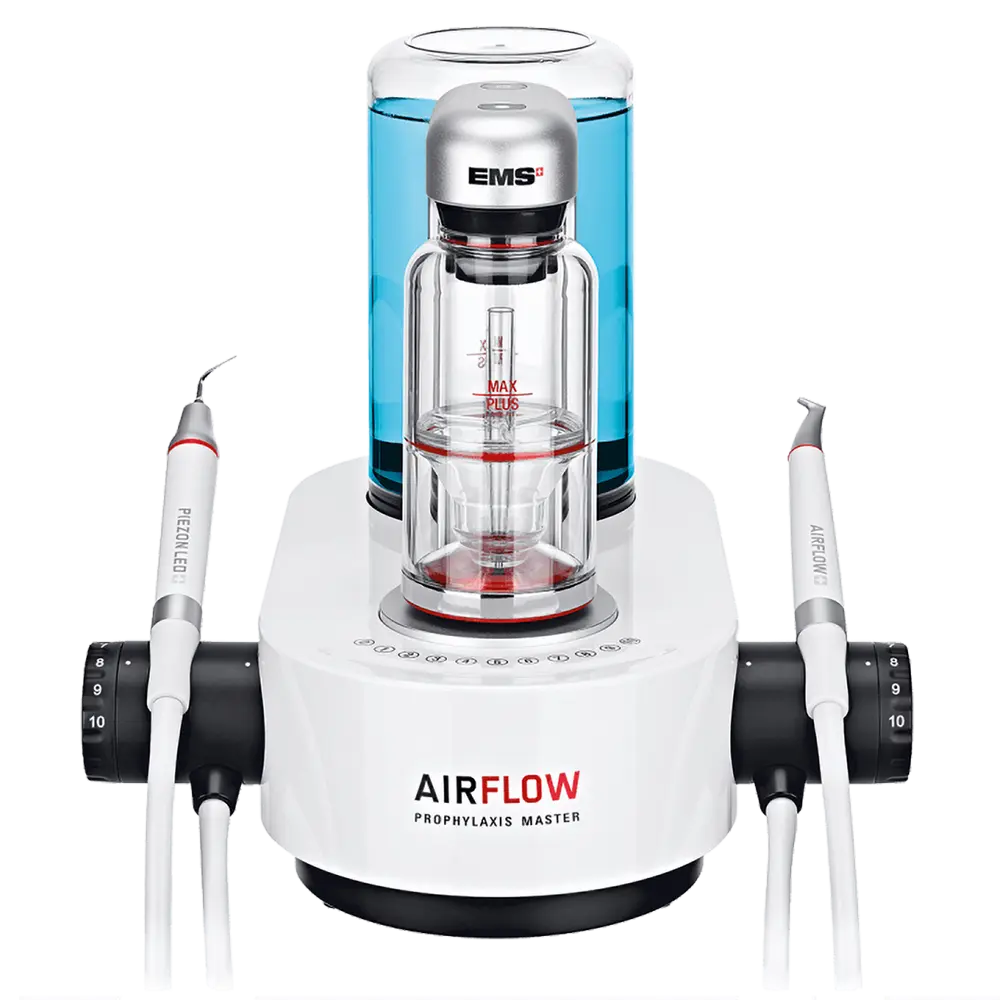
The EMS AIRFLOW Prophylaxis Master is a tabletop air polishing and ultrasonic unit that EMS launched at IDS 2017 for Guided Biofilm Therapy. It remains a common fixture in hygiene...
Reviewed by Rachel Thompson
Pros
- Three GBT instrumentation steps run from one cabinet and one wireless pedal.
- Water heated to 40 °C reduces sensitivity complaints during recalls.
- PLUS powder works on enamel, dentin, gingiva, restorations, orthodontic appliances and implants.
- Two powder chambers allow a switch between PLUS and CLASSIC without emptying either one.
- Lab testing shows steady powder flow and low consumption per refill.
- Integrated purge and NIGHT CLEANER bottle simplify waterline protocols.
- Independent trials report shorter chair time and better patient perception than conventional maintenance in some settings.
- A large installed base keeps refurbished units and parts easy to find.
Cons
- Upfront cost is high compared with a stand-alone air polisher or scaler.
- Powder and single-use PERIOFLOW nozzles add a cost to every appointment.
- EMS supports its own powders only, which limits purchasing choice.
- The GBT Machine superseded it in 2025, so long-term parts support needs confirming.
- Aerosol control requires good evacuation and ideally extraoral suction.
- Safe use depends on training in angle, distance and power.
- One maintenance trial found conventional scaling reduced bleeding on probing more.
- Powder chambers clog in humid conditions without daily care.
The EMS AIRFLOW Prophylaxis Master is a tabletop air polishing and ultrasonic unit that EMS launched at IDS 2017 for Guided Biofilm Therapy. It remains a common fixture in hygiene rooms, and EMS has now named a successor. This review weighs its chairside performance against the published evidence and the buying case in 2026.
TL;DR
The AIRFLOW Prophylaxis Master combines supragingival air polishing, subgingival PERIOFLOW and PIEZON scaling in one tabletop unit built for Guided Biofilm Therapy.
Erythritol PLUS powder and water warmed to 40 °C make recalls gentler, and independent trials report outcomes on par with conventional debridement.
A 2024 Bern trial found that scaling and root planing lowered bleeding on probing more in maintenance patients, so the ultrasonic step still matters.
EMS replaced the unit with the GBT Machine in 2025, which turns discounted and refurbished units into strong value when parts support is confirmed.
What The AIRFLOW Prophylaxis Master Does
The unit puts two instrumentation methods in one cabinet. A powder jet removes biofilm and stain, and a piezoelectric scaler removes calculus. Both run from one wireless foot pedal and draw on one water system that can be heated. EMS designed it around the three instrumentation steps of its GBT protocol, and every feature on the panel serves one of those steps.
Air Polishing With A Water Envelope
Air polishing sends compressed air and fine powder at the tooth inside a sheath of water. The water limits spread and cools the field. The particles disrupt biofilm through impact, so there is no frictional heat and no paste left in the sulcus.
Particle chemistry decides how safe that impact is. Sodium bicarbonate at 40 to 65 µm clears heavy stain quickly but abrades exposed dentin and soft restorative margins. Low-abrasive powders made from glycine and later erythritol moved air polishing below the gingival margin and onto implant surfaces. Readers who know air abrasion for cavity preparation should keep the two apart. Air abrasion uses aluminum oxide to cut tooth structure, while prophylaxis powders are chosen to leave it intact.
PIEZON NO PAIN Scaling
The PIEZON module uses piezoceramic crystals that move the tip in a linear stroke. The working side stays parallel to the root, which reduces the lateral hammering patients feel with some magnetostrictive inserts. EMS calls its feedback system NO PAIN. The generator reads resistance at the tip and raises power only when it meets a deposit.
This design differs from the elliptical tip motion of magnetostrictive scalers such as the Cavitron 300 or the BioSonic US200. Clinicians trained on one system often need a few weeks to adjust their adaptation and lateral pressure on the other.
Where It Fits In Guided Biofilm Therapy
GBT is an eight-step protocol that EMS developed with clinicians and universities. The Prophylaxis Master covers steps four to six. The sequence reverses the traditional order, with disclosing and air polishing first and scaling afterward. Once biofilm and stain are gone, the remaining calculus is easier to see, so the ultrasonic only goes where it is needed.
Key Specifications Of The EMS AIRFLOW Prophylaxis Master
The specification sheet favors control over raw power. The table lists the features EMS and its authorized dealers publish for the standard FT-229 unit. GBT Ready kits ship the same cabinet with spare handpieces and training.
Feature | Detail | Clinical relevance |
|---|---|---|
Powder chambers | Two, one for PLUS and one for CLASSIC | Switch powders mid-appointment without emptying a chamber |
Power control | 10 levels for AIRFLOW and 10 for PIEZON on a touch panel | Fine adjustment for implants, children and sensitive sites |
Water temperature | Unheated, 25 °C, 30 °C, 35 °C or 40 °C (77 °F to 104 °F) | Less thermal sensitivity on exposed dentin |
Foot control | Wireless pedal with boost | Clear floor, quick power increase on tenacious deposits |
Bottles | Two 800 ml bottles, one for PIEZON water and one for NIGHT CLEANER | Independent water source and end-of-day line disinfection |
Purge system | Integrated for AIRFLOW and PIEZON lines | Supports daily waterline protocols |
Cords | Detachable plug-and-play cords | Faster servicing and swaps |
Chamber pressurization | Pressurizes and releases within seconds via a magnetic connection | Short downtime during refills |
Maintenance | Automatic service reminder | Keeps the annual service on schedule |
Powder delivery is where the unit separates itself in lab testing. A 2021 study in Applied Sciences built a light-dispersion rig to measure powder output over time. The EMS table-top device showed the lowest and steadiest consumption of the units tested, and handheld devices used roughly 25% more powder than table-top models. The authors worked with EMS, so the result is best read as a well-designed manufacturer-linked comparison.
AIRFLOW Powders And When To Use Each
Powder choice drives both safety and comfort, and for most patients the answer is AIRFLOW PLUS. EMS designs and tests the unit for its own powders only. Third-party powders can change flow behavior, clog chambers and complicate warranty claims.
Powder | Base | Mean particle size | Main indication | Use zone |
|---|---|---|---|---|
AIRFLOW PLUS | Erythritol with 0.3% chlorhexidine | About 14 µm | Biofilm, light and moderate stain, young calculus on all surfaces | Supragingival and subgingival |
AIRFLOW PERIO | Glycine | About 25 µm | Subgingival biofilm through the PERIOFLOW nozzle | Mainly subgingival |
AIRFLOW CLASSIC Comfort | Sodium bicarbonate | About 40 µm | Heavy extrinsic stain on intact enamel | Supragingival only |
AIRFLOW PLUS
PLUS is the default powder in GBT. Erythritol is a pH-neutral sugar alcohol with a mild sweet taste, and its 14 µm particles are among the finest used in prophylaxis. The spray removes biofilm from enamel, dentin, gingiva, composite, ceramics, titanium, and orthodontic hardware with little surface change.
The 0.3% chlorhexidine in the powder works as a preservative. The Kiel research group notes that after dilution with spray water, it has no meaningful therapeutic effect. Patients with a known chlorhexidine allergy should still receive a different powder.
AIRFLOW PERIO
Glycine made subgingival air polishing mainstream before erythritol arrived. Many GBT practices now use PLUS for nearly everything, while some periodontists keep PERIO for deep pocket work or for patients who must avoid chlorhexidine. The EMS user manual lists PLUS and PERIO as the compatible powders for the PERIOFLOW application.
AIRFLOW CLASSIC Comfort
Sodium bicarbonate remains the fastest option for tea, red wine, tobacco, and coffee stains on intact enamel. It does not belong on exposed roots, implants, glass ionomer, or composite margins. It also adds sodium, which matters for patients on restricted diets. A practical routine starts every patient with PLUS and switches chambers only for stain left after the first pass.
Handpieces And Instruments
Three applications come with the unit, and each matches one GBT step. GBT Ready kits add spare handpieces so a sterilized set is always available for the next patient.
AIRFLOW MAX Handpiece
The AIRFLOW MAX handpiece mixes air and powder before the nozzle and wraps the stream in water at the tip. This layout keeps the jet narrow and reduces clogging. Clinicians hold the nozzle about 3 to 5 mm from the surface, keep it moving, and avoid aiming straight into the sulcus. With PLUS powder, it reaches biofilm in pockets up to about 4 mm.
Working angle matters more than most new users expect. An ex vivo porcine study published in Clinical Oral Investigations in 2023 found that the angle of low-abrasive air polishing influenced gingival damage. Training on angulation is worth the hour it takes.
PERIOFLOW Handpiece
PERIOFLOW is a subgingival application. A thin, flexible single-use nozzle enters the pocket and releases powder and water sideways, which lowers the risk of driving air into tissue. EMS indicates it for biofilm removal in pockets of roughly 4 to 10 mm around teeth and implants. The nozzles cost money per patient, and they remove the worry of reprocessing a fine lumen.
PIEZON Handpiece With PS And PI Instruments
The PIEZON handpiece has LED illumination and drives EMS Swiss Instruments. The PS instrument is the universal tip of GBT, slim and polished, and it handles most supragingival and subgingival calculus. GBT Ready kits add curved PSL and PSR tips for furcations and posterior root surfaces.
Implants call for the PI instrument, or the newer PI MAX. Its tip is made from PEEK reinforced with carbon fiber, so it removes cement and calculus from titanium abutments without scratching them.
What The Clinical Evidence Shows
Independent trials put GBT on par with conventional debridement for most outcomes, with shorter treatment time and better patient perception in some studies. They do not show it beating scaling and root planing on every measure.
Supportive Periodontal Therapy Trials
Three randomized trials frame the maintenance picture. At Aristotle University of Thessaloniki, Vouros and colleagues assigned 50 maintenance patients to GBT or scaling and root planing. Both groups improved plaque and bleeding scores at six weeks. GBT took about 15% less chair time, a mean difference of 5.1 minutes, and patients rated it more favorably.
The University of Bern ran a longer test. Stähli and colleagues followed 41 maintenance patients for one year with treatment every six months. Mean bleeding on probing fell from 14.7% to 7.9% in the conventional group, a significant drop, and from 12.2% to 9.0% in the guided biofilm group, which did not reach significance. Furcation-involved teeth fared better in the guided biofilm group, and treatment time did not differ.
For clinicians working to the EFP S3 clinical practice guideline, the message is consistent. Air polishing helps with biofilm control in maintenance, and residual bleeding pockets still need thorough mechanical instrumentation. Accurate periodontitis staging and grading should drive the recall interval more than the device does.
Nonsurgical Periodontal Therapy
A 2024 split-mouth trial from the University of Kiel, published in BMC Oral Health, used the Prophylaxis Master itself. Dental students under supervision treated 60 patients with stage III or IV periodontitis. Pocket closure was nearly identical between GBT and conventional quadrants, at 11.5% versus 11.2% for sites reaching 4 mm or less without bleeding. GBT quadrants took 4.3 fewer minutes each. Bleeding on probing at re-evaluation was 15.9% with GBT and 14.3% with the conventional protocol, a small difference the authors judged clinically irrelevant.
One detail from the Kiel methods deserves attention. The authors used only the supragingival nozzle, even in deep pockets, following the manufacturer's advice on emphysema risk during active therapy. They also excluded patients with asthma or COPD.
Gingivitis And Patient Acceptance
A split-mouth trial in gingivitis patients by Mensi and colleagues found no significant difference in bleeding or plaque between GBT and ultrasonic debridement followed by rubber cup polishing. Patient acceptance data come mainly from Switzerland. A Swiss Dental Journal survey reported strong patient acceptance after practices switched to GBT. EMS also publishes figures from more than 400,000 surveyed patients in certified practices, and those come from its own program.
Safety Signals Worth Knowing
Serious complications are rare, and the published ones cluster around implants. Case reports describe subcutaneous emphysema after air-powder treatment for peri-implantitis, including a report by Lee and colleagues and a case of pneumocephalus documented by Bruckmann and colleagues. An in vitro study by the Kiel group in BMC Oral Health also examined simulated years of biofilm removal on the luting margins of ceramic restorations. Low power and correct angulation reduce these risks, and inflamed peri-implant tissue calls for extra caution.
Clinical Walkthrough
A 52-year-old patient in periodontal maintenance arrives for a four-month recall. The chart shows stage III periodontitis treated two years earlier, one implant at tooth 19, and dentin sensitivity on the lower premolars. Earlier visits with hand scaling and prophylaxis paste left the patient tense, and the sensitivity made cold water a running complaint.
The hygienist applies a two-tone disclosing agent. Heavy plaque shows along the lingual surfaces of the lower anteriors and around the implant crown. With the stained surfaces visible in a hand mirror, the hygienist selects a size for interdental brushes and has the patient try one at the chair.
AIRFLOW MAX with PLUS powder goes on at a moderate setting, with water at 40 °C. The premolars that usually react to cold stay quiet. Biofilm and light tea stain clear in one pass per quadrant. Two pockets of 5 mm on the lower left molar get the PERIOFLOW nozzle. The PS tip then removes a small calculus deposit on the lower incisors, and the PI tip cleans around the implant abutment.
Patients in this profile commonly say the visit felt shorter and warmer. The common complaint is the sweet taste and the powder that settles on the lips and nose despite good suction. The appointment fits a 45-minute slot with time left for the home care discussion.
Two practical lessons come out of cases like this. Warm water does the most for patients with dentin sensitivity, more than any power setting. Disclosing also changes the conversation, because patients see the plaque they missed instead of hearing about it.
Guided Biofilm Therapy Workflow In Practice
The device performs best inside the full protocol. Used as a stand-alone air polisher, it delivers only part of its value. The sequence below reflects the eight GBT steps as EMS teaches them.
Assess the medical history and risk, then have the patient rinse with an antiseptic before any aerosol work.
Disclose all surfaces so the patient and the clinician can see the biofilm.
Motivate the patient with the stained surfaces and coach interdental cleaning.
Remove biofilm, stain, and young calculus with AIRFLOW MAX and PLUS powder in pockets up to 4 mm.
Treat pockets deeper than 4 mm with PERIOFLOW where it is indicated.
Remove remaining calculus with the PIEZON PS tip, or the PI tip on implants.
Check that all biofilm and calculus are gone, assess caries risk, and apply fluoride where indicated.
Set the recall interval by risk and record the findings.
Step one and step eight sit outside the device, and they are where most practices lose consistency. A structured dental treatment plan that records risk, pocket charting, and recall interval keeps the protocol repeatable across hygienists and makes the appointment value easier to explain at the front desk.
Infection Control, Waterlines And Maintenance
The Prophylaxis Master is easier to keep clean than most combination units, though it still depends on a disciplined routine. Powder, humidity, and water create clogs and biofilm quickly when steps are skipped.
Aerosol Control
Every air polisher produces aerosol. The CDC summary of infection prevention practices in dental settings sets the baseline expectations for personal protective equipment and dental unit waterlines. For air polishing appointments, practices add a pre-procedural rinse, high-volume evacuation held close to the field, and the lowest effective power. Many also run extraoral suction. Lip and cheek retraction keeps more of the spray inside the mouth.
Waterline Hygiene
The separate PIEZON bottle can hold distilled water or an approved disinfectant, independent of the dental unit supply. The NIGHT CLEANER bottle and the integrated purge flush both lines at the end of the day. For broader protocols, the guide to infection control in dentistry covers waterline testing and surface disinfection.
Daily And Weekly Care
A short routine prevents most service calls. These tasks take a few minutes and should sit on a written checklist.
Close or empty the powder chambers at the end of the day, since powder absorbs humidity and cakes overnight.
Run the purge between patients and the cleaning cycle at closing.
Reprocess handpieces and tips according to EMS instructions and local regulations.
Replace worn chamber seals and O-rings, which cost little and cause most pressure faults.
Check the external air and water filters on schedule.
Book the annual service, since some extended warranties depend on it.
Handpiece reprocessing follows the same rules as any other semicritical device. The article on mistakes in dental sterilization protocols lists the errors that show up most often during audits. Air quality from the practice compressor also affects performance, so the dental air compressor should deliver dry, oil-free air at stable pressure.
Ergonomics And Team Workflow
The unit reduces hand instrumentation, and that is its main ergonomic benefit. Hygienists who move from curettes to air polishing and piezo scaling often report less wrist and forearm strain by the end of a full schedule.
The handpieces are light, and the cords detach. The wireless pedal removes one cable from the operator's floor space. The tabletop cabinet needs a bench or cart room, air and water lines, and a power outlet nearby. The optional AIRFLOW Station mounts it beside the chair. For a wider look at posture and setup, the guide to dental ergonomics covers seating and loupe angles that pair well with powered instrumentation.
Staffing adds another angle. With a dental hygienist shortage affecting many US practices in 2026, a protocol that shortens training time and standardizes appointments has value beyond the clinical result. New hires learn one sequence and one device.
Cost And Return On Investment
The Prophylaxis Master is a premium purchase, and it pays back through recall retention and appointment value more than through time saved. EMS sells through authorized dealers with quote-based pricing, and the price depends on the kit and the region.
Running costs come mainly from powder and PERIOFLOW nozzles. PLUS powder is the largest line, and its cost per patient falls as the team learns to work at lower power. Seals, O-rings, hoses, and filters are inexpensive wear parts.
A Worked ROI Example
A simple model shows how time savings translate into dollars. The figures below use published trial results and a national salary benchmark, and each practice should replace them with its own numbers.
The Thessaloniki trial measured a 5.1-minute saving per maintenance visit. Assume a hygienist sees eight such patients a day, four days a week, for 46 weeks. That adds up to 7,360 minutes, or about 123 hours a year. At the national median dental hygienist salary of $94,260, roughly $45 an hour, that time is worth about $5,500 in wages. The Bern trial found no significant time difference, so a cautious budget should treat this as an upper estimate.
Retention is harder to price. Comfortable appointments reduce cancellations and recall drop-off, and the effect on why patients decline dental treatment can outweigh the time saving over several years.
Buying In 2026: New, End-of-Line Or Refurbished
The GBT Machine changes the buying math. End-of-line Prophylaxis Master stock can be good value when the dealer guarantees parts and service for several years. Refurbished units suit a second hygiene room or a practice testing GBT before committing. The guide to used dental equipment explains what to check in service records, and the checklist for assessing device reliability applies to any second-hand unit.
How It Compares With Alternatives
Its closest rival in 2026 is its own successor. Against other brands, its strength lies in the integrated GBT protocol and the PLUS powder system more than in any single specification.
Device | Type | Built-in ultrasonic | Best fit |
|---|---|---|---|
EMS GBT Machine (2025) | Air polishing and piezo | Yes, PIEZON NO PAIN MAX | New GBT practices with a long horizon |
EMS AIRFLOW Prophylaxis Master (2017) | Air polishing and piezo | Yes, PIEZON NO PAIN | Proven GBT platform at end-of-line or refurbished prices |
EMS AIRFLOW One | Air polishing only | No | Practices that already own a good piezo scaler |
Velopex AquaCare Twin | Fluid air abrasion and air polishing | No | Practices that want cavity preparation and polishing in one unit |
Separate air polisher plus magnetostrictive scaler | Two devices | Yes, separate unit | Practices with existing Cavitron or BioSonic equipment |
The AquaCare Twin serves a different purpose. It combines air abrasion for minimally invasive preparation with air polishing, so it competes with the Prophylaxis Master only in practices that want one device for both jobs. The wider set of dental equipment reviews covers the scalers mentioned in the table.
GBT Machine Versus AIRFLOW Prophylaxis Master
EMS introduced the GBT Machine at IDS in March 2025 as the official successor. It adds automatic handpiece recognition and a GBT mode that loads preset power and water settings when a handpiece is lifted. The interface drops to three settings for power and water. The cabinet uses aluminum and tempered glass with 30% less plastic, and treatment data flows to a MyEMS dashboard.
The main gain is standardization. New team members start with safe defaults instead of memorizing ten power levels. Experienced hygienists who like fine manual control often prefer the older panel. Both units run the same AIRFLOW PLUS powder, so clinical results should be close. Practices tracking new dental hygiene technology will see connectivity as the direction EMS is taking.
Bottom Line
The EMS AIRFLOW Prophylaxis Master earned its place in hygiene rooms through comfort and consistency. Water warmed to 40 °C and a 14 µm erythritol powder make maintenance visits easier for patients who used to dread them. Patients who stop dreading recalls tend to keep booking them, and that retention is where most of the device's value sits.
The published trials support the device without overselling it. Studies from Thessaloniki and Kiel found results comparable to conventional debridement, with about 4 to 5 minutes saved per visit or quadrant. The Bern trial found that scaling and root planing lowered bleeding on probing more in maintenance patients over one year. Bleeding pockets still need careful probing and thorough PIEZON work, and air polishing cannot stand in for either.
The 2025 launch of the GBT Machine changes the purchase decision more than the clinical one. Both units run the same PLUS powder and the same eight-step protocol, so a discounted end-of-line unit or a well-serviced refurbished one delivers nearly the same chairside result for less money. Practices buying new at full price with a ten-year horizon should get a quote on the GBT Machine before deciding.
Before signing, ask the dealer in writing how many years of parts and service support remain. Budget for PLUS powder, PERIOFLOW nozzles, filters, and the annual service, since those costs recur every year. Plan an hour of training on nozzle angle and power settings for each clinician who will use the unit.
Verdict
<p>The AIRFLOW Prophylaxis Master remains one of the most complete prophylaxis platforms available, even after EMS replaced it. Its value comes from the system around the cabinet. Disclosing, PLUS powder, warm water and the PS tip turn a routine scale and polish into a structured, biofilm-first appointment that patients notice.</p><p>The clinical case is solid and measured. Trials from Thessaloniki and Kiel show outcomes comparable to conventional debridement, with a few minutes saved per visit and better patient perception. The Bern trial is the honest counterweight. Maintenance patients with bleeding sites did better with thorough scaling and root planing, which means the PIEZON step and careful probing cannot be shortened to save time.</p><p>The device suits recall-heavy general practices most, especially those with many implant and orthodontic patients. It suits periodontists as a biofilm tool alongside curettes and fine ultrasonic tips. Practices with high stain loads will still use the CLASSIC chamber regularly.</p><p>Cost is the main hesitation. Consumables accumulate, and buyers should confirm how many years of parts and service the dealer will support now that production has moved on. A discounted new unit or a well-serviced refurbished one gives excellent value. Practices buying new at full price with a ten-year horizon should price the GBT Machine first.</p>
Frequently Asked Questions
What is the EMS AIRFLOW Prophylaxis Master?
It is a tabletop prophylaxis unit from EMS that combines AIRFLOW air polishing, PERIOFLOW subgingival air polishing and PIEZON NO PAIN ultrasonic scaling. EMS launched it at IDS 2017 to deliver Guided Biofilm Therapy.
Is the AIRFLOW Prophylaxis Master discontinued?
EMS introduced the GBT Machine as its successor at IDS 2025, and several dealers now list the Prophylaxis Master as end of line. Units remain widely used, and new and refurbished stock is still sold. Ask the dealer how long parts and service will be supported.
What is Guided Biofilm Therapy?
GBT is an eight-step protocol covering assessment, disclosing, motivation, AIRFLOW, PERIOFLOW, PIEZON, quality check and recall. It removes biofilm first with air polishing and uses the ultrasonic only where calculus remains.
Which AIRFLOW powder should be used for most patients?
AIRFLOW PLUS, an erythritol powder of about 14 µm, suits nearly all patients and surfaces above and below the gingival margin. CLASSIC Comfort sodium bicarbonate fits heavy stain on intact enamel only.
Is air polishing safe on dental implants?
Air polishing with erythritol or glycine powder is considered safe on implant surfaces when used at low power and the correct angle. Use the PI instrument for calculus and avoid sodium bicarbonate. Take extra care in inflamed peri-implant tissue, where emphysema cases have been reported.
Can non-EMS powders be used in the unit?
EMS designs and tests the device for its own powders. Other powders may differ in particle size and flow, which can cause clogging and inconsistent output and may affect warranty coverage.
How deep can PERIOFLOW reach?
EMS indicates PERIOFLOW for pockets of roughly 4 to 10 mm around teeth and implants. The AIRFLOW MAX handpiece with PLUS powder reaches biofilm in pockets up to about 4 mm.
Does GBT replace scaling and root planing?
GBT reduces hand instrumentation, and trials show comparable results for most outcomes. A 2024 Bern trial found that conventional scaling and root planing lowered bleeding on probing more in maintenance patients, so bleeding pockets still need thorough debridement.
Who should not receive air polishing?
Patients with uncontrolled asthma or COPD need an alternative or extra caution. A known erythritol or chlorhexidine allergy rules out PLUS powder, and sodium restrictions rule out bicarbonate powder. Avoid open wounds and fresh extraction sites.
How much time does GBT save per appointment?
Trial results vary. The Thessaloniki trial reported 5.1 minutes saved per maintenance visit and the Kiel trial reported 4.3 minutes per quadrant. The Bern trial found no significant difference.
How should the unit be maintained day to day?
Run the purge between patients and the NIGHT CLEANER cycle at closing. Close or empty powder chambers overnight, reprocess handpieces per EMS instructions, replace worn seals and filters, and book the annual service.
Should a practice buy the Prophylaxis Master or the GBT Machine?
The Prophylaxis Master offers strong value at discounted or refurbished prices and runs the full GBT protocol. The GBT Machine adds automatic settings, handpiece recognition and connectivity, with the longest support horizon.