Dental Hygienist Salary In 2026: Pay By State And Setting
The dental hygienist salary sits well above most healthcare support roles. The national median is $94,260 a year. This guide covers pay by state, cost-of-living-adjusted figures,...
Written by Mantas Petraitis
Read time: 4 min read
The dental hygienist salary sits well above most healthcare support roles. The national median is $94,260 a year. This guide covers pay by state, cost-of-living-adjusted figures, top metros, practice settings, and the five-year trend behind the number.
TL;DR
The national median dental hygienist salary is $94,260 as of May 2024, per BLS, with newer 2025 data trending near $98,100
Pay by state ranges from the high $50,000s to over $120,000, and cost of living closes part of that gap
Private dental offices pay the most, public health and academic settings typically pay less but offer other trade-offs
Licensure requires an associate degree, about two to three years, one of the shortest paths to six-figure pay in healthcare
What Is The National Dental Hygienist Salary?
Two BLS figures matter here, and they come from different release schedules, worth keeping straight rather than blending into one number.
The Bureau of Labor Statistics Occupational Outlook Handbook reports a median annual wage of $94,260 for May 2024. The lowest 10 percent earned below $66,470. The highest 10 percent earned above $120,060.
A newer May 2025 OEWS release puts the national median closer to $98,100. The Occupational Outlook Handbook page has not yet updated to reflect it at the time of writing, since OOH and the raw OEWS survey publish on different schedules. Both figures are real BLS data, just from different release dates.
Employment for the role sits above 210,000 nationally, and the Bureau projects 7 percent growth from 2024 to 2034, well above the average for all occupations. About 15,300 openings are projected each year on average, driven mostly by retirements and workers leaving the field rather than new positions alone.
Nearly all hygienists work in dentists' offices, and part-time work is common across the profession. A 2022 ADA Health Policy Institute survey found close to 29 percent of hygienists worked under 32 hours a week, which means the annual figures above understate what a full-time hygienist can earn and overstate what many part-time hygienists actually take home.
Dental Hygienist Salary Trend, 2020 To 2025
National pay has climbed every year on record, not just recently. The chart below uses only confirmed BLS actuals, not projected or estimated years.
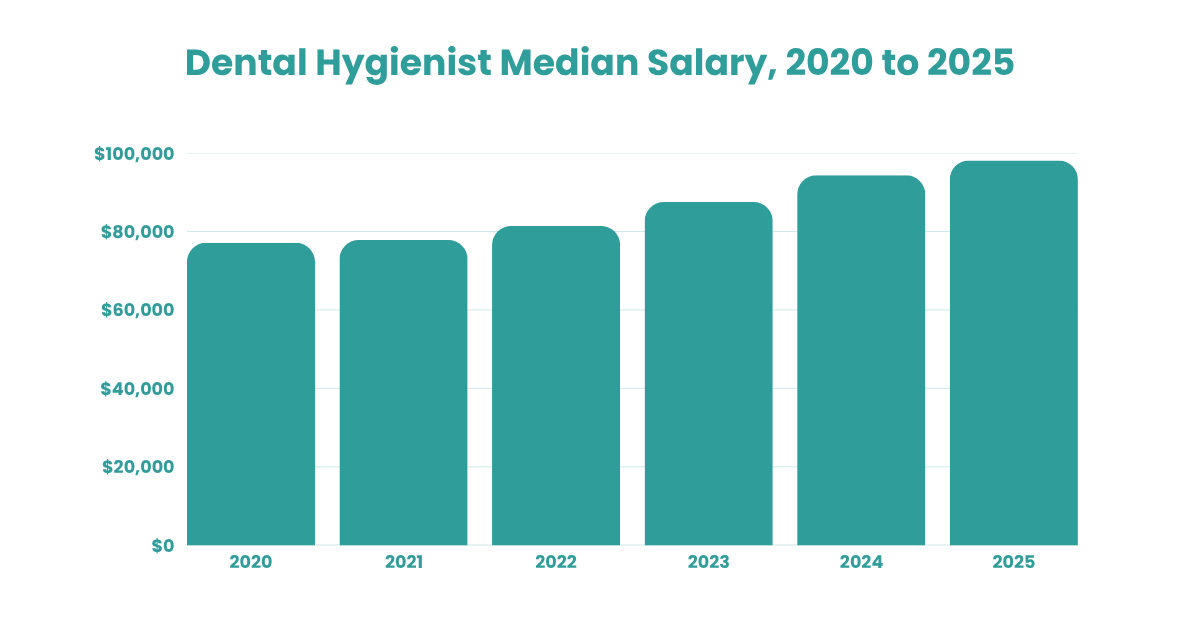
The median climbed from $77,090 in 2020 to $98,100 in 2025, a gain of roughly 27 percent over five years. Growth accelerated after 2022, alongside a documented hygienist shortage and expanding scope-of-practice laws in several states.
That acceleration matters for anyone timing a career move. The jump from 2022 to 2023 alone was larger than the two prior years combined, and 2024 kept that pace rather than leveling off. A hygienist evaluating job offers today is negotiating in a market that has moved meaningfully in workers' favor over a short window, not a flat, predictable pay scale.
Two forces drove most of that movement. Dental offices reported ongoing difficulty filling hygienist openings coming out of the pandemic, which pushed starting offers higher across nearly every state. At the same time, several states expanded what a hygienist is legally allowed to do without direct dentist supervision, and expanded duties tend to command expanded pay.
Dental Hygienist Salary By State
State pay varies by tens of thousands of dollars a year, and nominal pay alone can be misleading. The cost-of-living-adjusted column below restates each state's pay in national-average dollars, using each state's cost of living index.
A state with lower nominal pay can still offer better real purchasing power once that adjustment applies, which the table makes visible rather than leaving it to guesswork.
Reading the table well means looking at both columns together, not just sorting by the highest nominal number. A hygienist earning $94,000 in a state with a cost-of-living index of 90 effectively out-earns a hygienist making $110,000 somewhere the index reads 135. That gap shows up constantly in relocation decisions, and it is the single most common mistake in comparing two job offers from different states.
State | Median salary | Cost-of-living index | COL-adjusted salary |
|---|---|---|---|
Alaska | $126,590 | 125 | $101,270 |
Washington | $123,910 | 113 | $109,650 |
California | $121,240 | 138 | $87,860 |
Oregon | $114,710 | 114 | $100,620 |
District of Columbia | $114,510 | 156 | $73,400 |
Colorado | $108,650 | 105 | $103,480 |
Maryland | $107,550 | 114 | $94,340 |
Nevada | $107,010 | 103 | $103,890 |
Minnesota | $104,760 | 98 | $106,900 |
New Jersey | $102,230 | 114 | $89,680 |
New York | $101,450 | 125 | $81,160 |
Arizona | $97,350 | 99 | $98,330 |
Massachusetts | $97,200 | 135 | $72,000 |
Hawaii | $96,900 | 188 | $51,540 |
Virginia | $96,670 | 100 | $96,670 |
New Hampshire | $96,540 | 109 | $88,570 |
Connecticut | $96,260 | 110 | $87,510 |
Texas | $95,830 | 92.6 | $103,490 |
Montana | $95,200 | 99 | $96,160 |
Vermont | $94,150 | 112 | $84,060 |
Oklahoma | $93,260 | 87.9 | $106,100 |
Delaware | $93,030 | 101 | $92,110 |
Maine | $92,730 | 110 | $84,300 |
North Carolina | $92,690 | 95 | $97,570 |
Wisconsin | $92,640 | 95 | $97,520 |
Illinois | $92,180 | 94 | $98,060 |
Idaho | $91,590 | 95 | $96,410 |
Georgia | $91,270 | 91.5 | $99,750 |
New Mexico | $90,240 | 93 | $97,030 |
Nebraska | $89,710 | 89 | $100,800 |
Missouri | $89,590 | 89 | $100,660 |
South Dakota | $87,940 | 92.3 | $95,280 |
Indiana | $87,830 | 91.3 | $96,200 |
Ohio | $87,470 | 90 | $97,190 |
Utah | $86,440 | 97 | $89,110 |
Rhode Island | $86,330 | 106 | $81,440 |
Florida | $86,250 | 103 | $83,740 |
Kansas | $85,910 | 86.7 | $99,090 |
Pennsylvania | $85,600 | 96 | $89,170 |
Louisiana | $84,390 | 93 | $90,740 |
Wyoming | $84,350 | 92 | $91,680 |
Iowa | $84,120 | 90.4 | $93,050 |
North Dakota | $83,990 | 92.1 | $91,190 |
Arkansas | $83,800 | 89 | $94,160 |
Tennessee | $82,830 | 90 | $92,030 |
South Carolina | $82,710 | 96 | $86,160 |
Michigan | $80,730 | 92.3 | $87,460 |
Kentucky | $76,550 | 91 | $84,120 |
Mississippi | $67,840 | 87.5 | $77,530 |
West Virginia | $67,580 | 84.8 | $79,690 |
Alabama | $58,550 | 88.8 | $65,930 |
Top 10 Highest-Paying Metro Areas
City-level pay climbs well above the state average in the most competitive markets. The table below lists the highest-paying metro areas nationally.
Rank | Metro area | Median salary |
|---|---|---|
1 | Oakland, CA | $144,220 |
2 | Fremont, CA | $141,040 |
3 | San Francisco, CA | $141,020 |
4 | Sunnyvale, CA | $137,670 |
5 | Santa Clara, CA | $136,760 |
6 | San Jose, CA | $134,510 |
7 | Santa Rosa, CA | $130,880 |
8 | Santa Maria, CA | $130,670 |
9 | Bellevue, WA | $129,770 |
10 | Petaluma, CA | $129,630 |
California metros hold eight of the top ten spots, all within the Bay Area. Every metro on this list also carries a cost of living well above the national average, which the state table above helps put in perspective.
Why Does Dental Hygienist Pay Vary So Much By State?
Cost of living explains part of the spread, but not all of it. Scope of practice explains most of the rest.
Some states authorize direct access or unsupervised practice, letting a hygienist treat patients in schools, nursing homes, or public health settings without a dentist examining the patient first. California's RDHAP credential is the best-known example. Oregon, Colorado, Washington, Minnesota, and several others allow similar expanded practice in specific settings.
A smaller group of states, including Minnesota, Vermont, Maine, Alaska, Connecticut, and Washington, has gone further and authorized a dental therapist role, a mid-level provider between hygienist and dentist. States with broader scope of practice consistently show higher pay ceilings, not just higher averages, since expanded duties support more advanced, better-compensated positions.
DSO consolidation adds a second, related driver. States with heavy dental service organization presence, including Texas, Florida, Arizona, and North Carolina, tend to anchor pay through sign-on bonuses and production incentives rather than a higher base rate alone. That structure can make take-home pay harder to compare across a simple state-median table, since two offers with similar posted salaries can differ substantially once bonus structure factors in.
Local supply matters too. States with fewer CODA-accredited dental hygiene programs graduate fewer new hygienists each year, which keeps competition for experienced staff higher in those markets and puts upward pressure on offered pay, independent of cost of living.
Dental Hygienist Salary By Practice Setting
Where a hygienist works changes take-home pay as much as location does. The table below breaks down typical pay patterns by setting.
Setting | Typical pay pattern | Tradeoffs |
|---|---|---|
Private practice | Highest average pay, BLS industry data puts dentist-office pay above other settings | Fewer benefits at small independent offices |
DSO-affiliated practice | Competitive base pay plus sign-on bonuses common | More structured schedules, production targets |
Public health and community clinics | Lower base pay than private practice | Loan forgiveness eligibility through programs like the National Health Service Corps |
Academic and educator roles | Lower clinical pay overall | Different hours, path toward program faculty positions |
BLS industry-level wage data shows offices of dentists paying an annual mean above $90,000, compared with roughly $74,000 for hygienists working in federal, state, and local government settings. That gap holds up across nearly every state in the table above.
The trade-offs are not purely financial. Public health roles often come with federal loan repayment eligibility, similar to programs available to dentists working in health professional shortage areas, which can offset a lower salary meaningfully for a hygienist carrying student debt. Academic roles trade clinical income for predictable hours, no evening or weekend chair time, and a path toward program leadership that private practice does not offer in the same way.
DSO-affiliated practice sits between the two extremes. Base pay tends to track close to the private-practice average, and sign-on bonuses in the $2,000 to $10,000 range are common in markets with heavy DSO competition for staff. The tradeoff shows up in scheduling and production expectations, which run more standardized than a small independent office.
Can Dental Hygienists Work Remotely?
Clinical hygiene work happens in person, full stop. Cleaning and examining teeth cannot move to a laptop. A small number of adjacent roles do offer remote or hybrid work for licensed hygienists who want to step away from the chair.
Tele-dentistry triage and patient consultation roles
Dental insurance utilization review and claims support
Clinical education or sales roles with dental product manufacturers
Remote teaching or curriculum development for dental hygiene programs
These roles exist, but they represent a small slice of total hygienist employment and often pay less than full-time clinical work. Anyone searching specifically for remote dental hygiene work should treat it as a career pivot, not a like-for-like swap for chairside pay.
How Does Dental Hygienist Pay Compare To Other Dental Careers?
Hygienists sit in the middle of the dental pay ladder, well above dental assistants, well below general dentists.
Role | Median salary | Typical education |
|---|---|---|
Dental hygienist | $94,260 | Associate degree, 2 to 3 years |
Dental assistant | $48,070 | Certificate, under 1 year |
General dentist | $179,210 | DDS or DMD, 8 years total |
The full breakdown for the assistant role, including certification paths, lives in the site's dental assistant salary guide.
A dentist earns roughly double a hygienist's pay, though dental school adds six additional years of training and typically six figures of debt. The full picture, including specialty pay and dental school costs, is covered in the guide to how much a dentist can earn in the US.
What Education Does A Dental Hygienist Need?
The path is short compared with most six-figure healthcare careers. An associate degree from a CODA-accredited program, typically two to three years, covers the coursework and clinical hours needed to sit for licensure.
Every state requires passing the National Board Dental Hygiene Examination, plus a state or regional clinical exam. A closer look at accredited options is available in the guide to online dental hygiene programs.
Tracking continuing education and license renewal alongside a patient's dental treatment plan keeps both compliance and clinical records organized in one place, a habit worth building early in a hygiene career.
Bottom Line
Dental hygiene pays well relative to its training length. The national median sits near $94,260 to $98,100 depending on which BLS release is cited, with a real state-by-state spread that cost of living only partly explains. Scope of practice and setting matter as much as geography. Private practice pays the most on average. Public health and academic roles trade some pay for other benefits. Anyone comparing offers across state lines should weigh the cost-of-living-adjusted figure, not just the nominal salary.
Frequently Asked Questions
How much does a dental hygienist make a year?
The median is $94,260 as of May 2024, with newer 2025 data trending near $98,100. Pay varies widely by state and setting.
Which state pays dental hygienists the most?
Alaska and Washington lead in nominal pay, both averaging well above $120,000. California and Oregon also rank near the top.
Do dental hygienists make more than dental assistants?
Yes, significantly. The median for hygienists is roughly double the median for dental assistants, reflecting the difference in required education and licensing.
Can dental hygienists work remotely?
Clinical work cannot be done remotely, but a small number of adjacent roles, tele-dentistry, insurance review, and education, offer remote or hybrid options.
Does dental hygienist pay vary by scope of practice?
Yes. States that allow direct access or unsupervised practice, and states with a dental therapist role, tend to show higher pay ceilings, not just higher averages.