What Is a Dental Technician? Roles, Skills, Training, and Salary Explained
Every crown, bridge, and denture that restores a patient’s smile starts with the work of a dental technician. Most patients never meet the person who crafts their restoration, and...
Written by Mantas Petraitis
Read time: 7 min read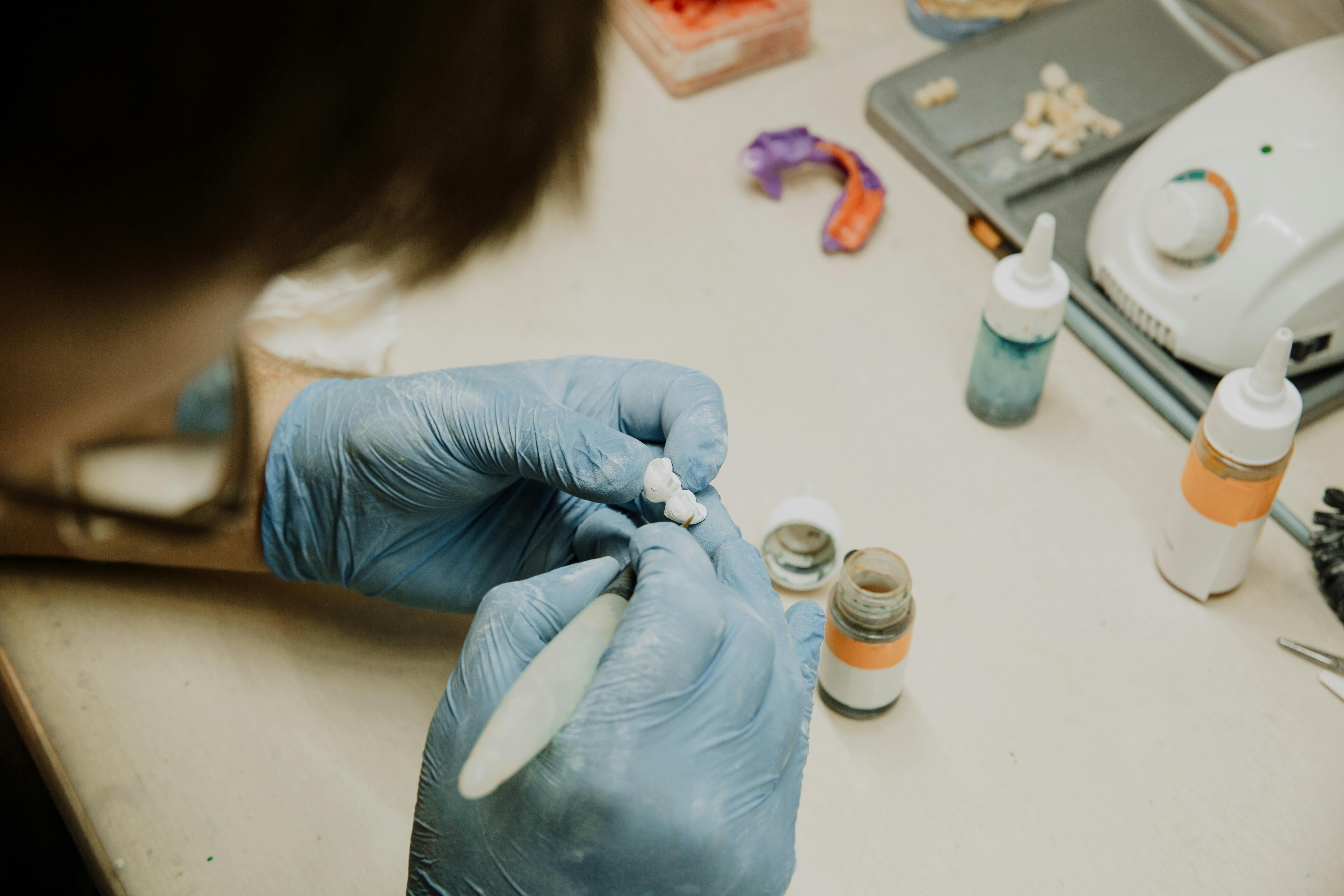
Every crown, bridge, and denture that restores a patient’s smile starts with the work of a dental technician. Most patients never meet the person who crafts their restoration, and many dental students only discover this career path well into their studies. So, what is a dental technician, and what services do they offer? A dental technician, also known as a dental laboratory technician, is a trained professional who designs and fabricates dental prosthetics, restorations, and appliances in a laboratory setting. They work from prescriptions provided by dentists, translating clinical impressions or digital scans into functional, lifelike dental devices that patients rely on every day.
This article covers everything patients and aspiring dental professionals need to know about the dental technician role, from daily responsibilities and required skills to education pathways, salary expectations, and how the profession compares to other dental careers.
The dental technology profession occupies a unique space in healthcare. It blends science, artistry, and manufacturing into a single discipline. Unlike most clinical roles, dental technicians do not need to be licensed in the United States, though voluntary certification is available and highly valued. The work appeals to people who enjoy solving tangible problems with their hands, take pride in precision, and find satisfaction in creating something that directly improves another person’s quality of life.
What Does a Dental Technician Do?
Understanding what a dental technician does starts with recognizing that this role operates almost entirely behind the scenes. Dental technicians rarely interact with patients directly. Instead, they receive detailed prescriptions from dentists that specify the type of restoration needed, the materials to use, and the desired shade and fit.
On a typical day, a dental technician might review incoming cases and prescriptions, pour and trim dental models from physical impressions, design restorations digitally using CAD/CAM software, mill or 3D-print frameworks and copings, layer porcelain or ceramic to build lifelike tooth anatomy, adjust occlusion (the way upper and lower teeth meet), polish and finish restorations to exact specifications, and perform quality checks before shipping the completed work back to the dental office.
Dental technicians, what do they do beyond fabrication? They also communicate regularly with dentists to clarify case details, troubleshoot fit issues, and discuss material choices. Strong collaboration between the dental office and the lab is essential for producing restorations that meet clinical and aesthetic standards. Every case a technician receives traces back to a dentist’s treatment plan, which outlines the procedures and restorations a patient needs. Practices that use a structured dental treatment plan template or a dental treatment plan software provide labs with clearer, more detailed prescriptions, reducing the likelihood of remakes and miscommunication.
What Does a Dental Lab Technician Do?
The terms “dental technician” and “dental lab technician” are often used interchangeably, and in most contexts they refer to the same profession. However, exploring what a dental lab technician does in detail reveals several distinct specializations within the laboratory environment. Many large labs divide their workforce by specialty, with individual technicians focusing on a single discipline throughout their career. Smaller labs may require technicians to handle a broader range of case types.
Crown and Bridge Work
Technicians in this discipline fabricate fixed restorations such as crowns, bridges, inlays, and onlays. Materials include porcelain-fused-to-metal (PFM), full zirconia, lithium disilicate, and various metal alloys. The work demands precise color matching, anatomical shaping, and an understanding of how restorations must function under occlusal load.
Removable Prosthetics
This area involves constructing full dentures and removable partial dentures. Technicians create wax try-in models, set artificial teeth, process acrylic bases, and make adjustments to achieve a comfortable fit and natural appearance.
Orthodontic Appliances
Orthodontic lab technicians fabricate retainers, space maintainers, expanders, and other corrective devices. The growth of clear aligner therapy has expanded this specialty significantly, with technicians now using digital design and 3D printing to produce sequential aligner trays.
Implant Restorations
As dental implants continue to grow in popularity, technicians specializing in implant work create custom abutments, implant-supported crowns, and screw-retained bridges. This specialty requires familiarity with various implant systems and their components.
Maxillofacial Prosthetics
This highly specialized area involves fabricating prostheses for patients who have experienced facial trauma, congenital defects, or surgical removal of tissue due to cancer. Maxillofacial prosthetics include artificial ears, noses, eyes, and sections of the jaw or palate. The work requires exceptional artistic skill and a deep understanding of anatomy.
Across all of these specialties, digital workflows are transforming daily practice. Intraoral scanners, digital design platforms, and milling machines have become standard dental equipment in modern labs, reducing turnaround times and improving precision.
What Does a Dental Sterilization Technician Do?
A dental sterilization technician occupies an entirely different role from a dental lab technician, and the distinction matters for anyone exploring careers in the dental field. While lab technicians work in a manufacturing environment creating prosthetics, sterilization technicians work in clinical settings such as dental offices and hospitals.
The primary responsibilities of a dental sterilization technician include cleaning, disinfecting, and sterilizing instruments and equipment between patient appointments. They operate and maintain autoclaves and sterilization equipment, monitor biological and chemical indicators to verify sterilization effectiveness, package and organize instrument cassettes for each procedure, maintain sterilization logs and compliance documentation, and ensure the practice meets infection control standards set by the CDC and OSHA.
For patients, the sterilization technician is a critical, often invisible, member of the care team. For dental students, understanding this role helps clarify the full range of support positions that keep a dental practice running safely. The educational requirements for sterilization technicians are generally less extensive than those for lab technicians, with most positions requiring a high school diploma and on-the-job training. Some employers prefer candidates who hold a Certified Registered Central Service Technician (CRCST) credential. The role is a practical entry point for individuals interested in working in a dental or healthcare environment who want to gain experience before pursuing further education in dental assisting, dental hygiene, or dental technology.
What Types of Dental Prosthetics Do Technicians Create?
Dental technicians produce a wide variety of prosthetics and appliances. Each type serves a specific clinical purpose and requires distinct fabrication techniques and materials. The following overview explains the most common categories.
Crowns. A crown is a cap that covers a damaged or weakened tooth, restoring its shape, strength, and appearance. Technicians fabricate crowns from materials such as porcelain, zirconia, metal alloy, or a combination. Every crown must be custom-shaped to match the patient’s bite and the color of surrounding teeth.
Bridges. A dental bridge replaces one or more missing teeth, anchored to the natural teeth or implants on either side of the gap. Technicians construct the pontic (false tooth) and the supporting framework as an integrated unit.
Full dentures. Complete dentures replace an entire arch of missing teeth. Fabrication involves setting acrylic or porcelain teeth into a gum-colored acrylic base, carefully arranged to support proper function and a natural look.
Partial dentures. Removable partial dentures fill gaps where some natural teeth remain. They typically use a metal framework with clasps that attach to existing teeth, combined with acrylic bases and replacement teeth.
Veneers. Porcelain veneers are thin shells bonded to the front surfaces of teeth to improve appearance. Technicians press or layer porcelain to achieve the exact shade, translucency, and contour the dentist prescribes.
Inlays and onlays. These indirect restorations fit inside or over a tooth’s cusps when the damage is too extensive for a filling but does not warrant a full crown. Technicians fabricate them from ceramic, composite resin, or gold.
Orthodontic retainers and appliances. Retainers maintain tooth position after orthodontic treatment. Other appliances include Hawley retainers, fixed lingual retainers, expanders, and habit-breaking devices.
Mouthguards and night guards. Custom mouthguards protect teeth during sports, while night guards (occlusal splints) help manage bruxism and temporomandibular joint (TMJ) issues. Technicians vacuum-form or pressure-form these devices over dental models.
Implant-supported restorations. These include single crowns, multi-unit bridges, and full-arch prostheses anchored by dental implants. The fabrication process involves working with implant analogs, scan bodies, and specialized components from the implant manufacturer.
Maxillofacial prosthetics. Prostheses for the face and jaw, including obturators for palatal defects, orbital prostheses, and nasal prostheses. This work combines dental technology with advanced artistic sculpting.
The range of prosthetics that dental technicians create underscores the breadth and depth of the profession. Patients who receive any of these restorations benefit from the technician’s precision, material knowledge, and artistic ability.
What Skills Are Essential for a Dental Technician?
Success as a dental technician depends on a blend of technical expertise and interpersonal ability. The role demands precision at a microscopic level, comfort with advanced technology, and the patience to refine work until it meets exacting clinical standards.
Technical Skills
Manual dexterity and fine motor precision. Dental restorations are measured in fractions of a millimeter. Technicians must work confidently with small hand tools, wax carvers, porcelain brushes, and polishing instruments.
CAD/CAM proficiency. Digital design and manufacturing are now central to dental technology. Technicians need working knowledge of software platforms such as exocad, 3Shape, and Dentsply Sirona’s inLab, along with the ability to operate milling machines and 3D printers.
Material science knowledge. Technicians work with ceramics, acrylics, metals, composites, waxes, and silicones. Understanding how each material behaves during processing, firing, and finishing is essential for producing durable, biocompatible restorations.
Dental anatomy and occlusion. A solid grasp of tooth morphology, jaw relationships, and functional occlusion ensures that every restoration fits properly and allows the patient to bite and chew comfortably. Understanding dental charting concepts can also be helpful.
Prescription interpretation. Technicians must accurately read and follow the dentist’s written or digital prescription, which includes shade specifications, material preferences, and design instructions.
3D printing and milling machine operation. Operating and maintaining CNC milling machines, resin-based 3D printers, and sintering ovens are increasingly standard expectations in modern labs.
Soft Skills
Attention to detail. Even a slight discrepancy in fit or shade can result in a remake. Successful technicians develop an eye for detail that extends to every stage of the fabrication process.
Problem-solving. Cases rarely go perfectly from start to finish. Technicians troubleshoot issues such as model distortion, shade mismatches, and framework fit problems on a daily basis.
Communication. Clear communication with dentists and clinical staff prevents costly errors and remakes. Technicians who can articulate material options, design decisions, and potential trade-offs are highly valued.
Time management. Labs handle dozens or hundreds of active cases simultaneously. Managing priorities, meeting deadlines, and maintaining quality across a full workload requires strong organizational discipline.
Patience and persistence. Porcelain layering, shade matching, and occlusal adjustment demand repetition and refinement. Technicians who embrace this iterative process tend to produce the best clinical outcomes.
How to Become a Dental Technician
The path to becoming a dental technician offers more flexibility than many other healthcare careers. There is no single mandatory route, which makes the profession accessible to a broad range of candidates. That said, structured education and credentialing significantly improve job prospects and earning potential.
Step #1: Build a strong educational foundation
High school students interested in dental technology should focus on courses in biology, chemistry, art, and computer science. Art classes are particularly relevant because much of the work involves sculpting, color theory, and three-dimensional visualization.
Step #2: Complete a dental technology program
Accredited programs are available at community colleges, technical schools, and some universities. The Commission on Dental Accreditation (CODA) accredits dental laboratory technology programs in the United States. These programs typically lead to an associate degree and combine classroom instruction with hands-on laboratory training in areas such as crown and bridge fabrication, denture construction, orthodontic appliance design, ceramics, and digital dentistry workflows.
Step #3: Gain hands-on experience
Many dental technicians enter the field through on-the-job training or apprenticeships at dental laboratories. This route can take two to four years to reach full competency, depending on the complexity of the work being learned. Some technicians combine formal education with part-time lab work to accelerate their development.
Step #4: Pursue certification
The Certified Dental Technician (CDT) credential, offered by the National Board for Certification in Dental Laboratory Technology (NBC), is the profession’s most respected voluntary certification. Eligibility requires either five years of documented work experience or graduation from a CODA-accredited program. The CDT examination covers six specialty areas: complete dentures, partial dentures, crown and bridge, ceramics, orthodontics, and implants. Candidates must complete three exam sections within a four-year window.
Step #5: Specialize and advance
Experienced technicians often focus on a single discipline, such as ceramics or implant restorations, where deep expertise commands higher compensation. Some technicians eventually open their own laboratories or move into lab management, quality assurance, sales, or education roles.
What Education or Training Is Required to Be a Dental Technician?
Education and training requirements for dental technicians vary depending on the employer, the state, and the level of work expected. The minimum requirement for entry-level positions is generally a high school diploma or equivalent, combined with on-the-job training. However, formal education is increasingly preferred, particularly at labs that handle complex restorative and implant cases.
CODA-accredited associate degree programs typically span two academic years and include coursework in dental materials, dental anatomy, laboratory procedures, and digital design. Certificate and diploma programs offer a shorter path, often lasting around one year, and focus more narrowly on core fabrication skills. Both formats include supervised clinical or lab practice.
Continuing education is important for maintaining CDT certification and keeping pace with technological change. The NBC requires CDT-certified technicians to complete continuing education credits during each renewal cycle. Topics commonly covered include new material systems, updated CAD/CAM platforms, implant protocols, and infection control practices.
How Long Does It Take to Become a Dental Technician?
The timeline depends on the pathway chosen. An associate degree from a CODA-accredited program takes approximately two years. Shorter certificate programs can be completed in about one year. Technicians who learn entirely through on-the-job training typically need two to four years to develop sufficient proficiency across common case types. Adding CDT certification extends the timeline further, as the examination process spans up to four years. Overall, a new technician can expect to spend two to six years reaching full professional standing, depending on their chosen educational route and certification goals.
How Can I Find Dental Technician Training Programs or Certification Courses Nearby?
Finding the right training program is one of the most important early decisions for anyone entering the profession. Several resources can help narrow the search.
CODA program directory. The Commission on Dental Accreditation maintains a searchable online database of accredited dental laboratory technology programs across the United States. This is the most reliable starting point for identifying reputable programs.
Community colleges and technical schools. Many two-year institutions offer dental technology programs. Contacting the admissions department directly can provide information on program availability, class schedules, and financial aid options.
NBC certification resources. The National Board for Certification in Dental Laboratory Technology website provides details on CDT exam eligibility, registration, testing locations, and study materials.
State dental associations and workforce development boards. These organizations often maintain lists of approved training providers and may offer scholarship or grant opportunities for students entering allied dental professions.
Online and hybrid programs. Some institutions now offer dental technology coursework in online or hybrid formats, which can be helpful for students who need scheduling flexibility. However, hands-on lab components are difficult to replicate remotely, so programs with strong in-person lab components tend to produce better-prepared graduates.
Before enrolling in any program, confirm its accreditation status through CODA. Accreditation ensures that the curriculum meets national standards and that graduates are eligible to sit for the CDT examination.
How Much Does a Dental Technician Earn?
Compensation for dental technicians varies based on experience, specialization, geographic location, and type of employer. Salary data from multiple sources paints a broad but informative picture of earning potential in this field.
What Is the Average Salary Range for a Dental Technician in the United States?
The U.S. Bureau of Labor Statistics (BLS) reported a median annual wage of $45,820 for dental and ophthalmic laboratory technicians as of May 2024. This is the most authoritative benchmark available.
ZipRecruiter places the average annual salary at approximately $51,156, with most technicians earning between $38,500 (25th percentile) and $60,500 (75th percentile). Top earners at the 90th percentile reach around $80,000 per year. Indeed reports an average hourly rate of approximately $24.36 based on over 1,200 salary submissions.
Several factors influence where an individual technician falls within this range:
Experience is the most significant variable. Entry-level technicians earn considerably less than those with a decade or more of experience, particularly in specialized areas like ceramics or implant work.
Geographic location plays a major role. States such as Washington, New York, and California tend to offer higher wages, partly reflecting the higher cost of living in those areas. Metropolitan labs generally pay more than rural operations.
CDT certification often translates to higher pay. Employers value the credential as evidence of verified competency, and certified technicians are frequently entrusted with more complex, higher-margin cases.
Specialization matters. Technicians who focus on implant restorations, high-end ceramics, or maxillofacial prosthetics typically command premium compensation.
Employer type also affects earnings. Technicians employed by government agencies, such as military dental labs, tend to earn above the private-sector average.
Just a heads up – salary aggregator websites vary widely in methodology and reported figures. Cross-referencing BLS data with multiple sources gives the most accurate picture. For a broader look at dental industry compensation, see this overview of how much dentists earn in the US.
Dental Technician vs Dental Hygienist
Dental students and career-changers often weigh these two professions against each other. Both are essential to the dental team, but they differ significantly in daily responsibilities, work environment, education requirements, and earning potential. The following comparison highlights the key distinctions.
Factor | Dental technician | Dental hygienist |
Work setting | Laboratory (minimal patient contact) | Clinical (direct patient contact) |
Primary role | Fabricate prosthetics and appliances | Clean teeth, take X-rays, educate patients on oral health |
Education | Associate degree or on-the-job training | Associate degree minimum, some states require a bachelor’s degree |
Licensure | Voluntary (CDT certification) | Mandatory state licensure in all US states |
Median salary (BLS, May 2024) | ~$45,820 | ~$87,530 |
Job outlook (BLS, 2024–2034) | Slight decline (~−1%) | Growth (~7%) |
Patient interaction | Rare | Constant |
Key appeal | Creative, hands-on lab work and independence | Direct patient care and strong job growth |
Neither role is inherently better than the other. A dental technician career suits professionals who enjoy meticulous craftsmanship, creative problem-solving, and working independently in a lab environment. A dental hygienist career appeals to those who thrive on patient interaction, preventive education, and clinical variety. For a closer look at another clinical support role, see this guide to dental assistant responsibilities.
The Future of Dental Technology
The dental technology profession is in the middle of a significant transformation driven by digital tools and advanced materials. Understanding these trends matters for both patients, who benefit from faster and more precise restorations, and dental students, who need to prepare for a rapidly evolving workplace.
CAD/CAM technology has moved from an optional upgrade to a baseline expectation in most dental laboratories. Software platforms allow technicians to design restorations digitally, reducing manual steps and improving consistency. Milling machines carve restorations from solid blocks of zirconia, lithium disilicate, or composite resin with sub-millimeter accuracy. To learn more about how this technology is reshaping dental practices, see this overview of the advantages of CAD/CAM in dentistry.
3D printing has expanded rapidly in dental labs, enabling the production of surgical guides, denture bases, orthodontic models, and temporary restorations directly from digital files. As printable materials improve in strength and biocompatibility, the range of applications will continue to grow.
Artificial intelligence is beginning to play a role in automated design suggestions, shade matching, and quality control. While AI is unlikely to replace skilled technicians, it is expected to streamline repetitive design tasks and help less experienced technicians produce more consistent work.
The BLS projects a slight decline in overall employment for dental laboratory technicians from 2024 to 2034. However, this projection reflects the automation of simpler tasks rather than a shrinking need for skilled professionals. Technicians who invest in digital skills, advanced materials expertise, and specialized disciplines are well-positioned to remain in demand. Approximately 7,700 openings are still projected each year, primarily to replace technicians who retire or transition to other careers.
For dental students considering this path, the takeaway is clear: the profession rewards those who embrace technology, pursue continuing education, and develop deep expertise in a specialty area. The technicians who thrive in the coming decade will be the ones who combine traditional craftsmanship with digital fluency. Labs that invest in modern diagnostic and digital tools are also positioning themselves to attract top talent and deliver superior clinical outcomes. For anyone considering opening or equipping a new lab or practice, the new dental practice checklist is a great planning framework.
Bottom Line
Dental technicians are the skilled professionals behind every crown, bridge, denture, and orthodontic appliance that restores function and confidence to patients. For patients, understanding this role builds appreciation for the craftsmanship involved in their dental care. For dental students and career-changers, the profession offers a hands-on, creative, and increasingly technology-driven career with multiple specialization paths.
The road into the profession is flexible, with options ranging from associate degree programs to on-the-job training and voluntary CDT certification. Salaries vary based on experience, location, and specialization, with the BLS reporting a median of $45,820 and higher-end earners exceeding $60,000 to $80,000 annually. The profession faces headwinds from automation at the lower-skill end, but technicians who invest in digital proficiency, advanced materials, and niche specializations will find a stable and rewarding career ahead.
Frequently Asked Questions
What is a dental technician and what services do they offer?
A dental technician is a laboratory-based professional who designs and fabricates dental prosthetics, restorations, and appliances. Services include creating crowns, bridges, full and partial dentures, veneers, orthodontic retainers, mouthguards, implant-supported restorations, and maxillofacial prosthetics. They work from prescriptions provided by dentists and use a combination of traditional handcrafting techniques and digital tools such as CAD/CAM software and 3D printers.
How long does it take to become a dental technician?
The timeline depends on the educational pathway. An associate degree from a CODA-accredited program typically takes two years. Shorter certificate programs can be completed in approximately one year. Technicians who learn through on-the-job training usually need two to four years to reach competency. Earning the CDT certification adds additional time, as the examination process spans up to four years.
What is the difference between a dental technician and a dental hygienist?
Dental technicians work in laboratories, fabricating prosthetics and restorations with minimal patient contact. Dental hygienists work in clinical settings, providing preventive care such as cleanings, X-rays, and patient education. Hygienists require mandatory state licensure, while dental technician certification (CDT) is voluntary. Hygienists earn a higher median salary (~$87,530 vs. ~$45,820), but the roles attract different personalities and career preferences.
What is the average salary for a dental technician in the United States?
According to the U.S. Bureau of Labor Statistics (May 2024 data), the median annual wage for dental laboratory technicians is $45,820. ZipRecruiter reports a broader average of approximately $51,000, with a typical range of $38,500 to $60,500. Experienced, CDT-certified technicians in specializations such as ceramics or implants, especially in metropolitan areas, can earn significantly more.
Do dental technicians need to be licensed?
In the United States, dental technicians are not required to hold a license to practice. The CDT certification offered by the National Board for Certification in Dental Laboratory Technology is voluntary. However, earning the CDT credential demonstrates verified competency and is widely recognized by employers. It can improve job prospects and earning potential.
What does a dental sterilization technician do?
A dental sterilization technician works in a clinical setting, not a lab. Their responsibilities include cleaning and sterilizing dental instruments, operating and maintaining autoclaves, monitoring sterilization indicators, packaging instruments for procedures, and maintaining compliance documentation for infection control standards set by the CDC and OSHA.