Medit i900 Vs iTero Lumina: Which Scanner Fits Your Practice
Choosing between the Medit i900 and the iTero Lumina comes down to case mix and budget. One is a lightweight, open-system scanner with no recurring fees. The other is a premium,...
Written by Agnes Markovic
Read time: 7 min read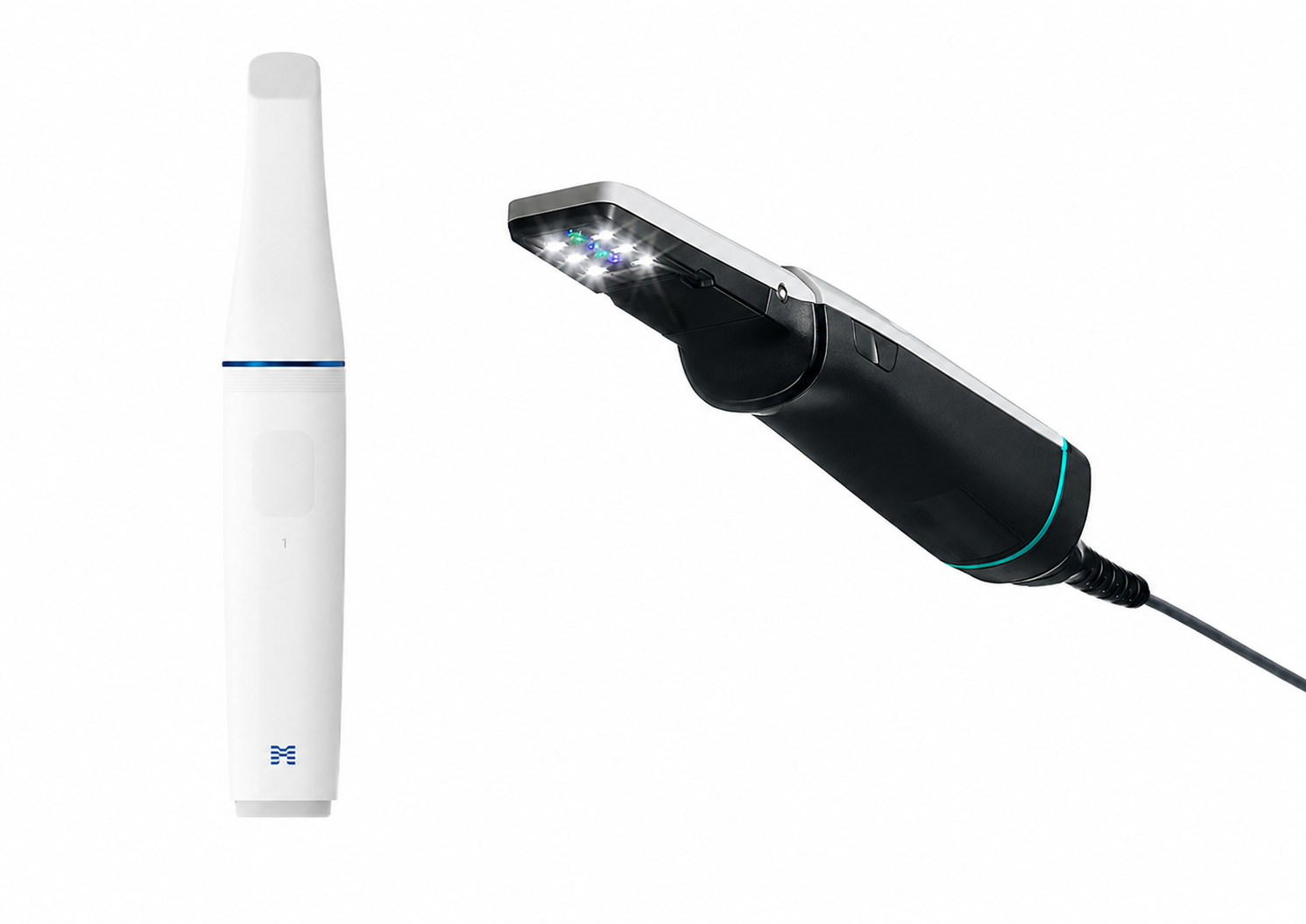
Choosing between the Medit i900 and the iTero Lumina comes down to case mix and budget. One is a lightweight, open-system scanner with no recurring fees. The other is a premium, cloud-connected scanner built around Invisalign. This comparison covers accuracy, hardware, software, and true cost.
TL;DR
The Medit i900 costs about $19,000, carries no subscription, and weighs 165 grams.
The iTero Lumina costs $45,000 to $50,000 and requires a mandatory monthly subscription.
Medit exports open STL files directly to any lab. Lumina routes files through its cloud portal.
Lumina leads on Invisalign integration and scan realism. Medit leads on cost of ownership and ergonomics.
Medit i900 and iTero Lumina At A Glance
A side-by-side spec comparison makes the core trade-offs clear before getting into clinical detail. Both scanners target the premium segment, but they solve different problems for different practice types.
Spec | Medit i900 | iTero Lumina |
|---|---|---|
Manufacturer | Medit Corp | Align Technology |
Launch | April 2024, Classic variant added 2025 | Early 2024, restorative update in 2025 |
Wand weight | 165 grams | 260 grams |
Field of view | 22 x 20 mm | 34 x 27 mm |
Connection | Wired, USB-C | Wired, cart or tablet |
US price | From $18,999 to $20,999 | From $45,000 to $50,000 |
Subscription | None | Required monthly |
File export | Direct STL, PLY, OBJ | Via iTero cloud portal |
Consumables | Autoclavable tips | Single-use sleeves, about $3 per scan |
Best known for | Value, ergonomics, open ecosystem | Invisalign integration, scan realism |
The Medit i900 sits in the mid-premium tier. The iTero Lumina is priced at the top of the market. That price gap shapes most of the buying decision, but the two scanners also differ in software, exports, and daily ergonomics.
Accuracy And Scan Quality
Accuracy is the first thing most clinicians ask about. Both scanners perform well in independent clinical testing. The differences that matter most show up in full-arch cases and margin capture, not single-unit crowns.
The i900's accuracy comes down to how much of the arch it captures in a single pass. A wider field of view means fewer individual frames get stitched together into the final mesh, and fewer stitch points mean fewer places for cumulative drift to appear. On full-arch and All-on-X cases using horizontal scan bodies, this translates to more consistent alignment across the arch rather than small pockets of distortion near the edges of long spans.
The Lumina takes a different route to accuracy. Its 34 x 27 mm field of view comes from Align's Multi-Direct Capture technology. It places sensors directly in the scanner tip instead of using mirrors. According to Align Technology's own product data, this delivers a field of capture roughly three times wider than the prior Element 5D. In practice, dentalreviewed.com's hands-on testing found Lumina produced clinically acceptable full-arch implant scans without photogrammetry or horizontal scan bodies. That result once required extra hardware on older scanners.
Mesh density is a separate question from clinical accuracy, and it is worth keeping the two apart. A denser mesh simply means more data points per square millimeter, which can make a scan look sharper on screen without necessarily improving how well a restoration actually seats. Field of view, stitching quality, and how the software handles soft tissue interference all matter more to fit than raw point density alone.
For a typical crown or single-unit case, the accuracy gap between top-tier scanners is small. Most practices will find it clinically insignificant. The gap widens on full-arch and implant cases, where both scanners perform well through different technical approaches.
Hardware, Weight, And Everyday Handling
Wand weight and grip design affect hand fatigue over a full clinical day. This is one of the sharpest differences between these two scanners. The i900 was built to minimize size and weight. The Lumina was built to maximize capture area.
At 165 grams, the Medit i900 is the lightest mainstream scanner on the market. That is roughly 100 grams lighter than Medit's own prior-generation i700 when cabled. The scanner measures 248 x 44 x 47.4 mm. It uses a unibody design with no external joints. Two interface options exist. The original i900 uses a 360-degree TouchBand and touchpad. The i900 Classic replaces the touch controls with a physical button after clinicians reported accidental inputs while wearing gloves.
The iTero Lumina weighs about 260 grams, a 50 percent reduction from the older Element 5D. That is lighter than the 3Shape TRIOS 5 at 299 grams. It is far lighter than Primescan 2 at over 500 grams. Still, it is noticeably heavier than the i900. Reviewers consistently note the Lumina's scanner head is wider than most competitors. That can slow distal molar access until a clinician adjusts technique. Build quality on the Lumina feels premium, with LED lighting and materials that feel like a step up from earlier iTero hardware.
Scan speed favors both devices in different ways. Medit reports the i900 captures over 60 frames per second with a medium tip in fast mode. Clinicians who upgraded from the i700 measured roughly a 31 percent speed increase after adjusting to the new scan path. The Lumina's wider field of view means fewer sweeps per arch. Most users experience this as faster overall case completion, even without a higher raw frame rate.
Software, File Export, And Lab Workflow
How each scanner handles files day to day is a practical difference buyers often overlook. Medit exports directly. iTero routes everything through a connected cloud account. That single distinction changes how a practice works with outside labs.
Medit Link operates on a fully open platform. Scans export as STL, PLY, or OBJ files that go straight to any compatible lab, CAD/CAM system, or in-office printer. No format conversion is required. The software includes companion apps for orthodontic simulation, implant planning through Medit SmartX, and model building. These are included for scanner owners at no extra cost. Updates ship regularly with no license renewal.
The iTero workflow is cloud-first by design. Instead of exporting a direct STL file from the scanner software, Lumina scans are uploaded to the iTero cloud. Labs retrieve cases through the MyiTero portal rather than pulling a file from the wand itself. This ties the scanner tightly into Align's ecosystem, which pays off for practices with meaningful Invisalign volume. A March 2025 software update improved the interface substantially. It added a magnifying-glass tool for reviewing NIRI and intraoral images site by site. The update also brought the iTero Design Suite. It is a cloud-based Exocad integration that moves practices from scan to design, with no local software or file exports.
Where iTero pulls ahead is Invisalign-specific tooling. One-click ClinCheck submission, automatic Outcome Simulator projections, and NIRI caries detection are capabilities the i900 does not currently match. Where Medit pulls ahead is flexibility. Open export means a practice is never locked into one lab, one CAD platform, or one aligner provider. That flexibility extends to broader case coordination too. Open scan data feeds directly into tools like a dental treatment plan generator, which speeds up case presentation.
Pricing And True Cost Of Ownership
Sticker price only tells part of the story. This is where the two scanners diverge the most. A full cost comparison needs the hardware price, the software model, and the per-scan consumable cost, not just the invoice total.
The Medit i900 launched at roughly $24,500. Medit reduced the price in 2025 to approximately $18,999 for the scanner alone. Bundled packages that include a laptop run closer to $20,999. Medit charges no subscription fee for its core software, apps, or updates. The only recurring cost is replacement scanner tips, which are autoclavable and reusable. Optional premium cloud storage is available for practices that want backup capacity beyond the free tier.
The iTero Lumina runs $45,000 to $50,000 depending on configuration. It sits at the top of a broader iTero lineup that starts around $42,000 for the Element 5D Plus. Lumina requires a mandatory monthly subscription for software updates, cloud storage, and design tools. It also uses single-use scanner sleeves instead of autoclavable tips, at roughly $3 per scan. That cost scales directly with patient volume.
Modeled over five years at 1,000 scans per year, a representative mixed-practice volume, the gap becomes significant. Industry cost modeling from GIE Dental Lab puts the Lumina's five-year cost near $83,000 once subscription fees and sleeves are included. The same model puts the Medit i900 at roughly $21,000 over the same period. That is close to a four-times difference, driven mostly by consumables and subscription costs rather than the initial hardware price.
These figures are directional. Actual cost depends on scan volume, negotiated bundle pricing, and regional dealer promotions. Request a current quote before budgeting either purchase. The broader point holds regardless of exact numbers. Model your annual scan volume against both pricing structures before comparing sticker prices alone.
Which Scanner Fits Your Practice
Neither scanner is the objectively better device. Each is built for a different practice profile. Matching the scanner to your case mix matters more than chasing the highest spec sheet.
Choose the iTero Lumina if:
Invisalign makes up a meaningful share of monthly case volume
One-click ClinCheck submission and Outcome Simulator visuals matter for chairside conversion
NIRI caries detection adds diagnostic value to your exam workflow
Budget comfortably supports a premium purchase price plus an ongoing subscription
Cloud-based Exocad design through iTero Design Suite fits your in-house workflow
Choose the Medit i900 if:
The practice is general or restorative-focused with mixed case types
Minimizing per-scan and annual software costs is a priority
Open lab and CAD/CAM flexibility matters more than a single closed ecosystem
Top-tier accuracy without a recurring subscription is the goal
Hand fatigue across a full day of scanning is a real concern
Some multi-doctor or multi-location practices run both scanners rather than choosing one. A Lumina in the ortho-heavy operatory alongside a Medit i900 for general restorative chairs is a common setup. It works well for groups with mixed patient bases and separate intraoral scanner workflows across locations.
Bottom Line
The Medit i900 and iTero Lumina represent two different philosophies for the same problem. Medit competes on ergonomics, open architecture, and total cost of ownership. It delivers accuracy that matches the top tier of the market for a fraction of Lumina's five-year cost. iTero competes on ecosystem depth, scan realism, and Invisalign integration that no open-system scanner currently replicates.
A general or restorative-heavy practice without heavy aligner volume gets more value from the i900's lower cost and lighter wand. A practice built around Invisalign case acceptance, patient visualization, and chairside consultation tools gets more return from the Lumina. Model your own case volume and five-year costs against both scanners before signing a purchase agreement. Request current pricing from an authorized dealer, since both companies adjust bundle pricing and promotions throughout the year.
If you're shopping around for your dental practice, you can also compare intraoral scanners on our dedicated matrix or take a quick quiz to find out the best option for your practice.
Already own the scanner? Our step-by-step guide to the MyITero login covers account setup, doctor versus lab access, and the most common sign-in errors.
Frequently Asked Questions
Is the Medit i900 as accurate as the iTero Lumina?
Independent clinical testing places both scanners among the top-performing devices on the market. There is no clinically significant difference for single-unit restorations. The i900 tests in a top accuracy cluster with Primescan 2. Lumina's wider field of view gives it an edge on full-arch and All-on-X cases that previously needed extra scan-body hardware.
Does the iTero Lumina require a monthly subscription?
Yes. The Lumina requires a mandatory monthly subscription for software updates, cloud storage, and design tools through iTero Design Suite. This is a recurring cost on top of the initial hardware purchase and single-use sleeve consumables.
Can the Medit i900 be used for Invisalign or clear aligner cases?
Yes, though without direct ClinCheck integration. The i900 supports orthodontic scanning, treatment simulation, and aligner planning through Medit Link. Its open export format lets practices send scan data to a wide range of aligner providers beyond Invisalign.
Which scanner is better for a general restorative practice?
The Medit i900 tends to fit general and restorative-focused practices well. Its lower total cost of ownership, open file export, and lightweight ergonomics suit mixed case types. Practices with meaningful Invisalign volume often find the Lumina's ecosystem integration worth the added cost.
How much does each scanner cost over five years?
At roughly 1,000 scans per year, industry cost modeling estimates a five-year total near $21,000 for the Medit i900. The iTero Lumina lands close to $83,000 once subscription fees and single-use sleeves are factored in. Actual costs vary by scan volume and regional pricing.
What is the difference between the Medit i900 and the i900 Classic?
The i900 Classic uses a physical button instead of the original's capacitive touch controls. This addresses complaints about accidental inputs while wearing gloves. Internal hardware, optics, and scanning performance are identical between the two variants.