AI in Dentistry: What 300 Dental Professionals Revealed About Adoption and Workflow in 2026
AI in dentistry is no longer a conference talking point reserved for early adopters. It is actively reshaping how dental professionals diagnose, plan treatment, and communicate...
Written by Marcus Hale
Read time: 16 min read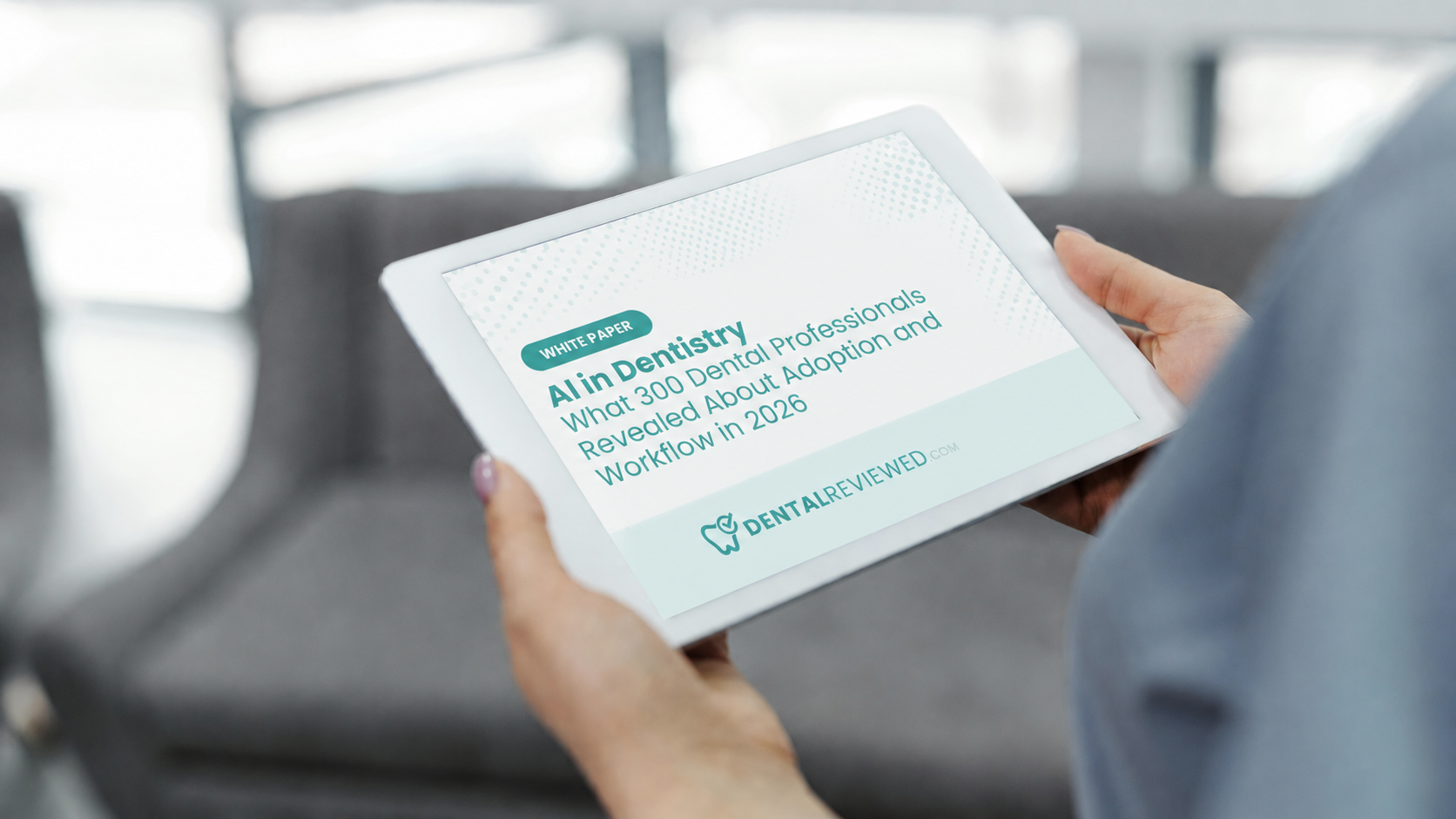
AI in dentistry is no longer a conference talking point reserved for early adopters. It is actively reshaping how dental professionals diagnose, plan treatment, and communicate with patients across the United States, the United Kingdom, and Canada. Dental Reviewed surveyed 300 licensed dentists to find out what is actually happening with dental AI software at the practice level.
TL;DR
Roughly 32% of 300 surveyed dentists currently use at least one AI tool, while another 38% are actively considering adoption
AI-powered radiograph analysis is the most widely adopted category, mentioned by 82% of current users, followed by AI treatment planning software at 36%
Over half of AI-using dentists describe the technology as a helpful second opinion rather than a replacement for clinical judgment
Cost and poor integration with existing practice management systems are the leading reasons dentists stop using AI tools, with 40% of those who quit doing so within three months
What AI Augmentation Means in Dentistry
Before examining the survey data, it is worth defining the concept at the center of every AI conversation in clinical practice. AI augmentation refers to the use of artificial intelligence to enhance a clinician’s existing capabilities rather than replacing them. Understanding the AI augmentation meaning in a dental context matters because it shapes expectations, purchasing decisions, and clinical trust.
In fields like radiology and pathology, AI augmentation has been studied for over a decade. Dentistry is now following a similar trajectory, though with some important differences. The critical distinction is that AI augmentation positions the practitioner as the final decision-maker while the technology adds speed, consistency, or detection sensitivity to existing workflows. A dentist reviewing a bitewing radiograph still makes the call on whether to restore, monitor, or refer. An AI tool simply highlights areas of concern that the clinician may want to examine more closely.
The Dental Reviewed survey results firmly support this framing. When asked how much they trust AI output compared to their own clinical judgment, 52% of dentists who use AI tools selected “I use AI as a helpful second opinion.” Another 33% said they trust their own judgment more than the AI’s output. Only 2% reported trusting AI more than their own clinical assessment, and 8% said they trust it equally. The remaining 5% said they do not trust AI output at all.
Co-founder and Author at Dental Reviewed, Marcus Hale, commented, The most telling number in this survey isn't the 32% who use AI. It's the 52% who call it a second opinion. That tells you exactly where the profession stands: dentists want sharper tools, not a shorter leash. The clinician stays in charge, and the technology earns its place by proving useful, not by promising to take over."
This distinction also matters practically for vendors and developers. Dental AI companies that market their products as augmentation tools, designed to confirm, catch, and communicate, appear to achieve higher sustained adoption than those promising to automate clinical decision-making entirely. Products that position themselves as a second set of eyes tend to resonate more deeply with clinicians than those promising a replacement brain. The rest of this report examines the data through this augmentation lens, exploring where AI is adding value, where it falls short, and what dental professionals want to see next.
For dental companies that want similar insight into their own category, Dental Clarity runs custom surveys and dental market research led by practicing dentists and marketers.
Who Is Using AI and Who Is Not: The Adoption Landscape
AI adoption in dentistry is growing, but remains far from universal. The survey’s 300 respondents reveal a profession in transition, with significant variation across practice types, experience levels, and geographies. The numbers tell a more nuanced story than the simple “is dentistry adopting AI?” question would suggest.
Overall Adoption Breakdown
Among the 300 dental professionals surveyed, approximately 32% are currently using at least one AI-powered tool in their daily clinical or administrative workflow. Another 12% have tried an AI tool but stopped using it, a churn rate that reveals important friction points discussed later in this report. The largest segment, roughly 38%, falls into the “considering” category, meaning these practitioners are aware of AI options and evaluating them but have not yet committed. The remaining 18% reported no interest in AI adoption at this time.
The global AI in dentistry market supports this momentum. According to industry analysts, the AI in dentistry market was valued at $0.53 billion in 2022 and is projected to reach $11.3 billion by 2030, growing at a compound annual growth rate of 37.9%. North America accounts for the largest regional share, driven by clinic-level adoption, faster regulatory pathways, and significant venture capital investment.
Adoption Across Practice Settings
Practice setting plays a meaningful role in who adopts AI and how quickly. Group private practices and DSO-affiliated locations showed the highest rates of current AI use among the survey respondents. These settings tend to have larger technology budgets, dedicated IT support, and standardized workflows that make integration smoother. A DSO with 50 locations can negotiate volume pricing and deploy a new tool across all operatories simultaneously, amortizing the setup cost.
Solo practitioners trailed behind, consistent with a broader trend in dental technology adoption where the cost and complexity of implementation fall disproportionately on smaller practices. For a solo general dentist managing every aspect of the business from clinical care to payroll, adding a new AI platform represents both a financial commitment and a learning curve that competes with immediate patient care demands.
Academic and hospital-based practitioners showed moderate adoption rates but higher-than-average familiarity scores, suggesting that exposure to AI during training or research does not always translate into clinical deployment. Many academic dentists encounter AI tools in research settings but work in institutional environments where technology purchasing decisions are made at the department or hospital level, introducing bureaucratic delays.
Familiarity Versus Actual Use
About 35% of respondents rated themselves as moderately familiar with AI tools designed for dentistry, yet a substantial portion of this group had not adopted any tool. Another 27% described themselves as very familiar, and 8% claimed expert-level knowledge. On the lower end, 22% said they were only slightly familiar, and 8% reported no familiarity at all.
The gap between knowing about AI and committing to it is one of the defining features of the current adoption landscape. Familiarity alone does not drive adoption. Price, integration ease, peer validation, and tangible clinical evidence appear to be the factors that tip practitioners from awareness to action. The “considering” segment of 38% represents a large addressable market for dental AI companies, but converting these practitioners requires more than marketing. It requires demonstrable value delivered in a format that fits their existing workflow.
Where Dentists Learn About AI Tools
Respondents reported learning about new AI tools through a mix of channels. Conferences and trade shows, dental publications and journals, and peer recommendations were the most frequently cited sources. Social media and vendor outreach also appeared, though with lower frequency. CE courses and online forums rounded out the list. The prevalence of peer recommendations as a discovery channel reinforces how word-of-mouth drives purchasing behavior in dentistry, a profession where trust in colleagues’ clinical judgment extends naturally to technology recommendations.
The Tools: What Dental AI Software Practitioners Actually Use
Among the 132 respondents who have used or are currently using AI tools, the distribution across categories tells a clear story. Radiograph analysis dominates, treatment planning is growing steadily, and several other categories remain in earlier stages of adoption. This section breaks down each category and identifies the specific dental AI software that practitioners reported using in their daily practice.
AI Dental X-Ray and Radiograph Analysis
Radiograph analysis is the most widely adopted AI application in dentistry, and the survey data confirms it. Of the 132 respondents who have used AI tools, 108 mentioned AI-assisted radiograph analysis, making it the dominant use case at roughly 82% of all adopters. Products in this space, including Overjet, Pearl, and VideaHealth, use machine learning models to flag caries, measure bone loss, detect periapical pathology, and annotate digital imaging outputs in real time.
The clinical rationale for this category is straightforward. An AI dental X-ray analysis tool can highlight areas of concern that might be missed during a morning packed with back-to-back patients, fatigue, or suboptimal radiograph quality. According to market data compiled by Gitnux, AI-powered caries detection has achieved accuracy rates as high as 94% in large-scale radiograph studies, and tools like VideaHealth have detected 52% more interproximal caries than unaided clinicians in multi-center trials involving thousands of patients.
A PMC review of FDA-cleared AI devices in dentistry found that oral radiology accounts for 48% of all AI/ML devices that have received clearance, making it the most regulated and validated dental AI category. This regulatory foundation gives practitioners additional confidence in the clinical reliability of radiograph analysis tools.
Practitioners frequently cited patient communication as a secondary benefit of these tools. When an AI system annotates a radiograph with color-coded overlays highlighting bone loss or carious lesions, the conversation about treatment becomes more visual and more concrete. Patients can see what the dentist sees, and that shared visual language tends to improve understanding, reduce anxiety around proposed procedures, and increase the likelihood of accepting recommended treatment. For practices investing in intraoral scanners and other digital workflow tools, AI-annotated radiographs become part of a cohesive, technology-forward patient experience.
AI Treatment Planning Software
Treatment planning was the second most-cited AI category among adopters. In the survey, 47 respondents named Dental Reviewed’s dental treatment plan tool specifically, while another 12 mentioned generic AI treatment planning software without specifying a product. Combined, treatment planning AI was used by roughly 45% of all adopters, a share that has grown considerably compared to even a year ago.
AI-powered treatment planning tools take clinical input, including tooth numbers, radiographic findings, symptoms, and patient history, and generate structured, evidence-based plans that practitioners can review and edit. This category addresses one of the most time-consuming administrative tasks in dental practice. Preparing a comprehensive treatment plan for a complex restorative, prosthodontic, or periodontal case can take 15 to 20 minutes when done from scratch. AI reduces that to a matter of minutes by generating a professional starting point with standardized phasing, patient-friendly summaries, and cost estimates.
The appeal extends beyond time savings. Treatment plans generated by AI tend to include clearer sequencing and plain-language explanations that help patients understand what is being recommended and why. For practices that present complex, multi-phase treatment options, a well-structured dental treatment plan template gives clinicians a professional foundation they can customize rather than building from a blank page. Several respondents noted that AI-generated plans improved case acceptance because patients found the visual layout and phased breakdown easier to follow than traditional narrative-style proposals.
Dental Reviewed’s platform was the most frequently named tool in this category. During the platform’s closed beta, participating dentists reported that treatment plan preparation time dropped from roughly 20 minutes per case to under three minutes. Practitioners interested in learning more about these tools can explore how to prepare a dental treatment plan using AI-assisted workflows and compare the best dental treatment plan creation platforms currently available.
AI Dental Receptionist and Patient Communication Tools
AI-powered front-desk tools, sometimes called an AI dental receptionist, were mentioned by 28 respondents. These tools automate appointment scheduling, recall reminders, phone call triage, patient intake forms, and frequently asked patient questions. The dental AI receptionist category sits at the intersection of practice management and patient experience, and while adoption is still modest compared to radiograph analysis, it is gaining traction as labor costs rise and front-desk staffing shortages persist across all three countries surveyed.
Practitioners who use these tools reported that the primary benefit is handling overflow rather than replacing human staff. Missed calls, after-hours inquiries, and routine scheduling requests can be managed by an AI system, freeing team members to focus on in-office patient interactions that require empathy, judgment, and clinical knowledge. One common use case is after-hours phone management, where an AI receptionist can book appointments, answer insurance questions, and triage urgent calls without requiring overtime staffing.
Integration with existing practice management software remains a challenge for some platforms in this space, and several respondents noted that poor integration was a reason they abandoned a patient communication tool. When the AI receptionist does not sync with the appointment book or patient records in the practice’s main software, staff end up doing double data entry, which erodes the efficiency gains that motivated the purchase.
AI Clinical Documentation and Note Generation
Documentation tools were cited by 33 adopters, making this the third most popular AI category in the survey. These tools use natural language processing to transcribe, structure, or auto-generate clinical notes, reducing the documentation time that follows every patient encounter. For general dentists managing 15 to 25 patients per day, the cumulative time spent on notes can easily exceed an hour of unbillable work. AI documentation tools aim to reclaim that time.
The category is still evolving, and respondents noted variability in accuracy across different products. Tools that allow practitioners to dictate findings in real time during or immediately after a procedure tend to perform better than those attempting to interpret free-text notes after the fact. Some respondents who stopped using documentation AI cited accuracy concerns, particularly around dental-specific terminology and procedure codes. However, the majority of current users reported satisfaction with the net time savings, even when occasional manual corrections were needed. Accurate dental charting remains a critical responsibility, and AI documentation tools work best when paired with a thorough review step before finalizing patient records.
AI Billing, Insurance, and Oral Cancer Screening
Two smaller but noteworthy categories round out the adoption data. AI billing and insurance tools were mentioned by 29 respondents, while AI-assisted oral cancer screening appeared 28 times. Billing AI focuses on claim preparation, coding accuracy, denial management, and revenue cycle optimization. For practices handling hundreds of insurance claims monthly, AI-assisted coding can reduce errors and accelerate reimbursement cycles.
Oral cancer screening AI uses image analysis to flag suspicious lesions, providing an additional detection layer beyond the standard visual and tactile exam. These tools are particularly relevant in general practice, where early-stage oral malignancies can be difficult to distinguish from benign conditions during a routine examination.
Both categories are relatively early in their adoption curves based on the survey data, and practitioners appear to view them as promising but not yet essential. Further regulatory clarity and additional published clinical validation will likely determine how quickly these tools transition from niche to mainstream adoption.
How AI Changes the Clinical Workflow
Adopting an AI tool is one step. Understanding how it changes daily practice is where the real story emerges. This section draws on responses from practitioners with hands-on AI experience to examine the tangible effects on diagnostic confidence, clinical efficiency, patient trust, and case acceptance rates.
Diagnostic Confidence and Detection
When asked how AI has most significantly changed their diagnostic workflow, 28% of adopters selected “catches findings I might have missed.” This was the most common answer among all options, followed by “confirms my existing diagnoses” at 22% and “helps me explain findings to patients” at 20%. Another 18% said AI primarily speeds up their review of imaging, while 12% reported no meaningful workflow change.
These results frame AI’s diagnostic role as one of reinforcement and safety-netting. Practitioners are not delegating diagnosis to an algorithm. They are using AI as a backstop that catches what a busy schedule, a suboptimal radiograph angle, or simple human variability might allow to slip through. Research published through the National Institutes of Health confirms this trajectory, noting that oral radiology accounts for the highest number of FDA-approved AI devices in dentistry, with 48% of all cleared dental AI products falling in the diagnostic imaging category.
The clinical implications are significant. A dentist who catches one additional early carious lesion per day, thanks to AI-assisted detection, may prevent dozens of more invasive restorative procedures annually. Multiply that across a practice’s entire patient population, and the public health benefit compounds quickly, even if the individual time savings per patient appear modest.
Time Per Patient: A More Complex Picture
The relationship between AI adoption and clinical efficiency is more nuanced than vendor marketing often suggests. Roughly 40% of AI-using respondents reported no change in their average time per patient after adopting AI. About 34% said their time decreased, with 28% noting a slight decrease and 6% reporting a significant one. On the other side, 26% reported that time per patient actually increased, with 22% describing a slight increase and 4% calling it significant.
The time increase may seem counterintuitive for a technology marketed on efficiency, but it reflects a common clinical reality. When AI flags additional findings on a radiograph, findings that might previously have gone undetected until a later visit, the practitioner needs to evaluate each flag, discuss the findings with the patient, update the chart, and potentially revise the treatment plan. More detected pathology means more conversation, more documentation, and more clinical decision-making in the same appointment window.
The net clinical benefit may still be strongly positive even when time per patient increases, because the additional time is spent addressing genuine clinical needs rather than being lost to administrative inefficiency. A practitioner who spends two extra minutes per patient discussing an AI-detected area of early bone loss is delivering better care, even if it compresses the schedule slightly.
Case Acceptance: The Strongest ROI Argument
This finding may represent the strongest practical argument for AI adoption across the entire survey. Among current and former AI users, 44% reported at least a slight increase in case acceptance rates after integrating AI into their workflow. Of those, 14% called the increase noticeable while 30% described it as slight. Only 3% reported a decrease, and 21% were unsure. The remaining 32% reported no change.
The mechanism connecting AI to improved case acceptance likely flows through patient communication. When an AI tool annotates an image, and the dentist walks a patient through a color-coded visualization of bone loss, a carious lesion, or a failing restoration, the conversation shifts from abstract clinical language to shared visual evidence. The patient can see the problem rather than relying solely on the dentist’s description.
Respondents who indicated that AI changed their patient communication, 52% reported at least some change, and these appear to overlap significantly with those reporting higher case acceptance. For practitioners evaluating the return on investment of AI, case acceptance improvement may be the most measurable financial benefit. A practice that converts even a small percentage of previously declined recommendations into accepted treatment plans can generate meaningful revenue over the course of a year.
Combining AI-annotated diagnostics with a well-structured treatment plan builder creates a workflow where detection, presentation, and planning are connected rather than siloed. The diagnostic AI catches the finding, the annotated image helps explain it, and the treatment plan gives the patient a clear roadmap for addressing it.
When AI Does Not Stick: Why Dentists Stop Using Tools
Not every AI adoption story ends with long-term integration into the practice. Roughly 12% of the survey’s respondents tried an AI tool and stopped using it. Their reasons provide valuable insight for practitioners considering adoption and for the dental AI companies building these products. Understanding why tools get abandoned is just as informative as understanding why they get adopted.
"When 40% of dentists abandon an AI tool within three months, the clinical capability isn't what failed them. Pricing, poor software integration, and a lack of published evidence are doing more to slow adoption than any skepticism about AI itself. The companies that solve those friction points will win the next wave," noted Co-founder and Author at Dental Reviewed, Rachel Thompson.
Primary Reasons for Stopping
Cost was the leading factor behind discontinuation, cited by approximately 28% of respondents who stopped using an AI tool. Poor integration with existing practice management software came second at 22%. Inaccurate or unreliable results accounted for 18%, too time-consuming to use was cited by 12%, staff resistance or training burden by 8%, data privacy and security concerns by 7%, and vendor discontinuation of the product by 5%.
The pattern is revealing. Most practitioners who stopped did not abandon AI because the technology failed to perform its core clinical function. They left because the economics or logistics did not justify continued use within their specific practice context. A tool that costs $500 per month but saves ten minutes per day faces a difficult value proposition for a solo practitioner seeing 60 patients per week. The math changes significantly for a group practice or DSO where the same tool is deployed across multiple operatories, but for smaller practices, the per-provider cost can feel disproportionate to the benefit.
Integration friction compounds the cost problem. If a dental AI tool requires practitioners to switch between platforms, manually re-enter data, or use a separate interface that does not communicate with the existing patient management system, the time savings erode quickly. Several respondents described scenarios where they spent more time managing the AI tool’s interface than the tool saved them in the clinical workflow.
How Quickly Dentists Decide
Among respondents who stopped using an AI tool, 10% did so within the first month, 30% within one to three months, 28% within four to six months, 22% within seven to twelve months, and 10% after more than a year. The data suggests that most practitioners give a tool a 90-day window to prove its value. If the return on investment is not clearly visible within that period, the subscription gets canceled, and the tool gets removed from the workflow.
Secondary reasons for stopping reinforced the picture painted by the primary data. Workflow disruption, unclear ROI, and lack of responsive customer support appeared frequently as contributing factors. Several respondents also cited regulatory or compliance uncertainty, suggesting that ambiguity around data handling standards and clinical liability creates discomfort for some practitioners even when the technology itself performs well.
For anyone considering a new AI tool, the practical lesson is clear. Start with a product that integrates cleanly with your existing systems, offers a free trial or low-commitment pricing tier, and can demonstrate clear value within the first 30 to 60 days. Reading dental equipment reviews and seeking peer recommendations before purchasing significantly reduces the risk of a short-lived and costly adoption cycle.
The Dental AI Companies Shaping the Market
The survey data, combined with broader market intelligence, highlights a growing ecosystem of dental AI companies operating across diagnostic, planning, communication, and administrative categories. This section maps the current landscape without ranking individual products, recognizing that the right tool depends on each practice’s specific clinical priorities, technical infrastructure, and budget.
Radiograph Analysis
Overjet, Pearl, and VideaHealth are the most frequently mentioned names in AI-powered X-ray and radiograph analysis. All three have received FDA clearance for at least one product, and their tools are now deployed in thousands of practices and DSOs across the United States. Overjet has positioned itself with a dual focus on clinical analysis and insurance claim review, giving it a unique value proposition that appeals to both clinicians and practice administrators. Pearl’s platform received a notable strategic investment from the American Dental Association in late 2024, signaling mainstream institutional confidence in the technology. VideaHealth has published among the strongest clinical evidence in the category, with multi-center trials demonstrating significantly higher caries detection rates compared to unaided practitioners.
"We expected radiograph analysis to lead. What surprised us was how directly AI-annotated imaging connects to case acceptance. When patients can see a color-coded overlay of bone loss on screen, the conversation changes. Nearly half of AI-using dentists reported higher acceptance rates, and for most practices, that alone justifies the investment," noted Marcus Hale, Co-founder and Author at Dental Reviewed.
Treatment Planning
Dental Reviewed’s AI treatment plan software emerged as the most frequently named product in the treatment planning category within this survey, cited by 47 respondents. The platform converts clinical notes into structured, editable, evidence-based treatment plans complete with patient-friendly summaries, phased timelines, and estimated costs. Practitioners interested in evaluating alternatives can review a comparison of treatment plan creation platforms for a broader view of the category, or learn more about what a treatment plan builder does to determine whether this type of tool fits their workflow.
Patient Communication and AI Reception
The AI dental receptionist category includes a growing number of tools designed to handle appointment booking, patient inquiries, recall management, and phone call routing. These products target the administrative burden on front-desk staff, especially during high-call-volume periods, after hours, and in practices experiencing chronic staffing challenges. The category remains fragmented, with no single dominant player, and the quality of integration with existing practice management platforms varies considerably.
Documentation, Billing, and Screening
AI clinical documentation, billing optimization, and oral cancer screening represent emerging categories that collectively address the growing administrative overhead in dental practice. Documentation AI targets the note-writing bottleneck, billing AI improves coding accuracy and claims throughput, and screening AI adds a layer of computer-assisted detection to visual oral exams. All three categories are earlier in their adoption curves compared to radiograph analysis and treatment planning, but the problems they solve are significant enough to attract continued investment and product development.
What Would Make Dentists Adopt: The Outlook for AI Dentistry
The forward-looking data from this survey paints a picture of a profession that is broadly open to AI but conditional in its commitment. The next wave of adoption depends less on technological breakthroughs and more on practical improvements in how tools are priced, integrated, and validated. Understanding what drives practitioner decisions is essential for anyone tracking the evolution of AI dentistry across North America and the UK.
Likelihood of Adoption in the Next 12 Months
Among current AI users, approximately 56% said they are very or somewhat likely to adopt an additional AI tool within the next year. This signals that satisfied users are ready to expand their AI technology stack rather than stopping at a single product. Among the larger “considering” group, the number jumps to 70%, indicating significant latent demand waiting to be converted. Even among those who tried AI and stopped, 38% remain open to trying again, suggesting that a better product, a more competitive price, or improved integration could win them back.
The “not interested” group remains firm in its position, with only about 10% expressing any openness to adoption. These practitioners, representing roughly 18% of the overall sample, are unlikely to convert through marketing or vendor outreach alone. Peer influence, observable results at neighboring practices, and endorsement from dental associations may be the only factors that move this group over time.
The Six Factors That Would Accelerate Adoption
When asked to select the single factor that would most increase their willingness to adopt an AI tool, respondents prioritized the following.
Lower cost was the leading answer at 24%, reinforcing the message that current subscription pricing models represent a barrier for many practice types, particularly solo and small group practices
Better integration with existing practice management software is followed at 22%, reflecting widespread frustration with disconnected workflows and double data entry
Stronger clinical validation studies came third at 20%, sending a clear signal that the profession wants peer-reviewed, published evidence rather than vendor-supplied marketing claims
Peer recommendation from trusted dentists accounted for 14%, underscoring the outsized role that word-of-mouth plays in a tightly connected professional community
Endorsement by professional dental associations was cited by 12%, a notable figure given that the ADA’s investment in Pearl has already set a precedent for institutional engagement with AI
Clearer regulatory guidance was cited by 8%, the smallest share, suggesting that while regulatory uncertainty exists, it is not the primary barrier to adoption for most practitioners
Taken together, the data tells a clear story. Dental professionals are not philosophically opposed to AI, and most do not fear replacement or harbor deep skepticism about the technology’s capabilities. They are waiting for the economics, logistics, and evidence base to improve. The fastest path to mainstream AI dentistry adoption runs through better pricing models, seamless integration with the tools practices already use, and more published clinical validation.
Survey Methodology
Dental Reviewed designed and administered this survey between February and April 2026. The research team developed a 20-question instrument organized into five sections covering practitioner demographics, AI awareness, tool adoption, workflow impact, reasons for discontinuation, and forward-looking attitudes toward AI in clinical practice.
The survey was distributed to dental practices through three primary channels. First, Dental Reviewed’s existing professional network and email subscriber list of verified dental practitioners received direct invitations. Second, the team conducted targeted outreach to dental practices across the United States, the United Kingdom, and Canada through professional directories and regional dental association mailing lists. Third, the survey was promoted through dental professional forums and continuing education communities frequented by licensed practitioners.
A total of 300 completed responses were collected from licensed dental professionals across the United States (180 respondents), the United Kingdom (60 respondents), and Canada (60 respondents). The US weighting reflects the relative market size and the higher concentration of dental AI software vendors in that geography.
Respondents represented a cross-section of practice settings. Approximately 30% work in solo private practice, 35% in group private practice, 20% in DSO or corporate-affiliated settings, and 15% in academic or hospital-based environments. Experience levels ranged from early career (0 to 5 years at 18%) to established practitioners (21+ years at 22%), with the largest segment falling in the 11 to 20 year bracket at 32% and the 6 to 10 year bracket at 28%.
The primary area of clinical focus among respondents was general dentistry at 52%, followed by orthodontics (10%), oral surgery (8%), endodontics (7%), periodontics (7%), pediatric dentistry (6%), prosthodontics (5%), and other specialties (5%).
All responses were self-reported and collected anonymously through a secure online survey platform. Specific tool and product mentions reflect name recognition and usage recall, and may undercount lesser-known products that respondents did not recall at the time of completion. The survey did not require respondents to verify their AI usage through purchase records or software logs. As with any self-reported study, the findings should be interpreted with an understanding that practitioners more interested in AI may have been more likely to participate, introducing potential selection bias. The margin of error for the full sample of 300 is approximately plus or minus 5.7 percentage points at the 95% confidence level.
Bottom Line
This survey of 300 dental professionals across the US, UK, and Canada reveals a profession that sees AI as a clinical enhancement rather than a clinical replacement. The dominant adoption model is augmentation, where practitioners use AI to sharpen diagnostic accuracy, streamline treatment planning, and improve patient communication, while retaining full authority over every clinical decision.
Radiograph analysis leads the adoption landscape, powered by FDA-cleared products with strong published clinical evidence. Treatment planning AI is the fastest-growing category, with various tools reducing preparation time from 20 minutes to under three, while improving the clarity and professionalism of patient-facing plans. AI-powered receptionist and documentation tools are earlier in their adoption curves but address real, persistent pain points around administrative overhead and staffing challenges.
The barriers to broader adoption are clear and actionable. Lower cost, better software integration, and stronger clinical evidence are the three improvements that would most accelerate the next wave of AI adoption across dental practices. AI dentistry is a present reality for roughly one in three practitioners, and the gap between interest and adoption continues to narrow. For dental professionals evaluating their first AI tool, the survey data suggests starting with a well-validated product in radiograph analysis or treatment planning, testing it rigorously within the first 90 days, and measuring its impact on concrete workflow metrics like detection rates, documentation time, and case acceptance.
Frequently Asked Questions
What is AI in dentistry and how is it used?
AI in dentistry refers to software tools that use artificial intelligence and machine learning algorithms to support clinical and administrative dental tasks. The most common applications include radiograph analysis, where AI flags potential caries or bone loss on X-rays, treatment planning, where AI generates structured clinical plans from practitioner notes, and patient communication, where AI automates scheduling, reminders, and phone triage. These tools are designed to augment the practitioner’s clinical judgment rather than replace it.
What does AI augmentation mean in a dental context?
AI augmentation means using artificial intelligence to enhance a dentist’s existing skills, detection capabilities, and clinical workflows. Rather than automating decisions or replacing the clinician, augmentation tools provide additional data points, flag potential findings for review, or accelerate routine administrative tasks. In the Dental Reviewed survey, 52% of AI-using dentists described their tools as a “helpful second opinion,” confirming that augmentation is the dominant operational model in dental AI today.
What are the most popular dental AI software tools?
Based on the Dental Reviewed survey of 300 dental professionals, the most popular tools fall into three main categories. Radiograph analysis leads, with Overjet, Pearl, and VideaHealth cited most frequently. Treatment planning follows, with Dental Reviewed’s AI-powered software as the most-named product. Patient communication, scheduling, and clinical documentation tools round out the top categories. Radiograph analysis tools were mentioned by 82% of all adopters, making diagnostic imaging the dominant application of dental AI software.
How accurate is an AI dental X-ray analysis?
Published studies suggest that AI dental X-ray tools can achieve caries detection accuracy rates as high as 94%, and multi-center clinical trials have demonstrated that tools like VideaHealth detect significantly more interproximal caries than unaided clinicians. Accuracy varies across individual products, clinical scenarios, and radiograph quality. AI tools should always be used as a supplement to professional clinical judgment, and flagged findings should be verified through additional examination before treatment decisions are made.
What is an AI dental receptionist?
An AI dental receptionist is a software tool that automates front-desk functions, including appointment scheduling, patient reminders, phone call triage, insurance verification questions, and common patient inquiries. These tools are designed to manage overflow volume rather than replace human reception staff entirely. They are especially useful for handling after-hours calls, peak scheduling periods, and routine administrative requests that do not require clinical expertise.
Why do some dentists stop using AI tools?
The Dental Reviewed survey found that cost (28%), poor integration with existing software (22%), and inaccurate or unreliable results (18%) were the three leading reasons dentists discontinued AI tools. Secondary factors included workflow disruption, unclear ROI, and lack of responsive customer support. Approximately 40% of those who stopped did so within the first three months, indicating that practitioners expect quick, visible returns on their technology investments.
Which dental AI companies are leading the market in 2026?
Key players include Overjet, Pearl, and VideaHealth in radiograph analysis, with all three holding FDA clearances and growing deployment across US dental practices and DSOs. Dental Reviewed leads in the AI treatment planning category based on survey mentions. The market also includes a growing number of companies focused on clinical documentation, billing optimization, patient communication, and oral cancer screening. The ecosystem is expanding rapidly, with continued venture capital investment and institutional endorsement from organizations like the American Dental Association.
How much does dental AI software typically cost?
Costs vary widely depending on the tool category, practice size, and licensing model. Radiograph analysis subscriptions typically range from $200 to $600 per month per provider. Treatment planning tools may offer free tiers, trial periods, or usage-based pricing. Patient communication AI pricing often depends on practice volume and the number of integrated channels. Cost was the top adoption barrier identified in the survey, with 24% of all respondents naming it as the single factor that would most increase their willingness to adopt. Lower, more flexible pricing models are likely needed to drive adoption beyond DSOs and large group practices.