Hawley Retainer: Cost, Care, and How It Compares
A Hawley retainer is a removable wire and acrylic appliance that holds teeth after orthodontic treatment. This article covers fit, wear schedule, cleaning, breakage, and retainer...
Written by Mantas Petraitis
Read time: 6 min read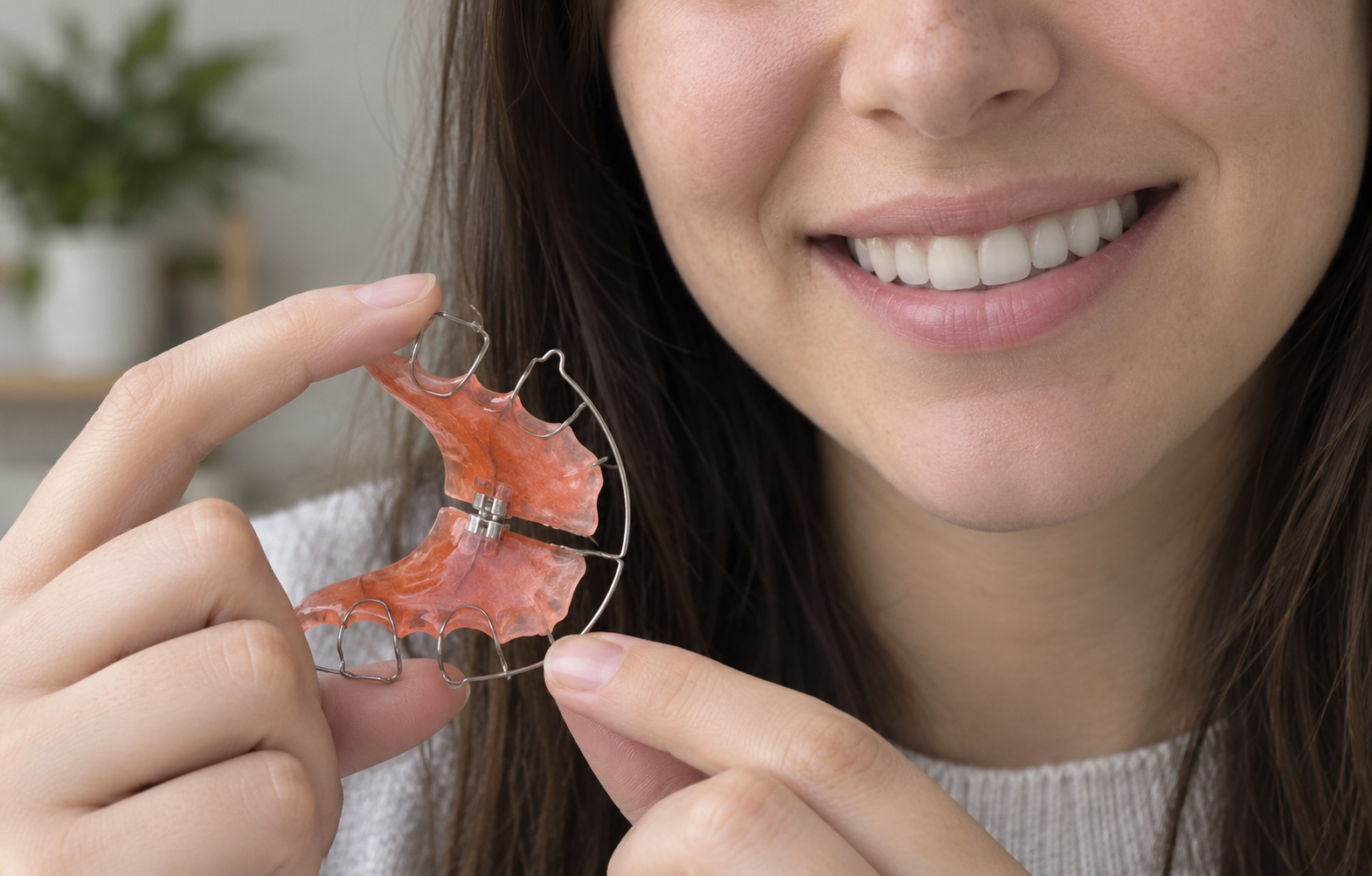
A Hawley retainer is a removable wire and acrylic appliance that holds teeth after orthodontic treatment. This article covers fit, wear schedule, cleaning, breakage, and retainer cost. It also compares Hawley, clear, and bonded retainers. A clinical section covers indications, adjustment, lab turnaround, and practice costs.
TL;DR
Most practices charge $150 to $350 per Hawley arch, and replacements cost about the same.
Patients wear the retainer full time for 3 to 6 months, then every night long term.
Dentists can adjust and repair a Hawley retainer chairside or through the lab.
Clear retainers hold alignment as well as Hawleys, and bonded wires suit high relapse risk.
What Is a Hawley Retainer?
The Hawley retainer is the classic wire retainer most people picture after braces. Dr. Charles Hawley described the design in 1919, and its layout has changed little since. A lab bends the wire by hand and processes a custom acrylic plate for each patient. The result is a rigid, adjustable appliance that clips onto the back teeth.
Parts of a Hawley Retainer
Each part of the appliance has a separate job. Knowing the parts helps patients describe a problem clearly when they call the office.
Labial bow: a stainless steel wire across the front teeth, with adjustment loops near the canines
Clasps: Adams, ball, or C-clasps that grip the molars and keep the appliance seated
Baseplate: acrylic resin that rests on the palate or behind the lower front teeth
Springs: optional finger springs or Z-springs that nudge a single tooth a short distance
Pontic: an optional false tooth set in the acrylic to fill a missing tooth space
How a Hawley Retainer Keeps Teeth Stable?
Teeth moved by braces or aligners sit in bone and fibers that are still remodeling. Those fibers pull teeth back toward their old positions for months after treatment ends.
The ligament around each root reorganizes within about three to four months. The gum fibers around the neck of each tooth take a year or longer. Rotated teeth carry the highest relapse risk because those gum fibers stretch the most.
The Hawley design counters this pull from three directions. The labial bow holds the front teeth from the lip side. The acrylic plate blocks tipping toward the tongue. The clasps lock the appliance onto the molars. The chewing surfaces stay uncovered, so upper and lower teeth can meet and settle. Chairside, this settling often shows as firmer back tooth contact within a few months.
Retention follows the same biology after any treatment. Patients comparing Invisalign vs braces often leave the retainer out of their planning. Both routes end with a retainer, so retainer cost belongs in the first budget. The Invisalign cost guide and the braces pricing breakdown show what first retainers usually include.
Who Is a Good Fit for a Hawley Retainer?
The right retainer depends on the bite, oral habits, and daily routine. A Hawley retainer suits some patients far better than others.
Strong Candidates:
These patients tend to do well with a wire and acrylic design. Each point reflects a practical advantage of the appliance.
Patients whose back teeth still need to settle into full contact
Patients who may need small corrections after treatment ends
Patients who crack or wear through clear retainers from heavy clenching
Patients planning crowns or veneers that will change tooth shape
Patients missing a tooth who need the space held until an implant
Patients after palatal expansion, where the acrylic helps hold arch width
Less Suitable Candidates:
Some patients struggle with the Hawley design. A clear or bonded retainer usually works better for them.
Adults who dislike a visible wire at work or in photos
Patients with a strong gag reflex, since the upper plate covers part of the palate
Performers and public speakers who cannot tolerate a temporary lisp
Patients with a history of losing removable appliances
Hawley Retainer Pros and Cons
Every retainer involves trade-offs between durability, looks, and comfort. The lists below cover the main points patients weigh.
Advantages:
The Hawley retainer's strengths come from its rigid materials and open design. A well-kept Hawley often lasts 5 to 10 years before it needs replacing.
Long service life compared with thin plastic retainers
Adjustable wire, so minor changes rarely need a new appliance
Open chewing surfaces that let the bite settle naturally
Easy removal for brushing, flossing, and meals
Room to add a false tooth or a spring
Custom acrylic colors and patterns, popular with teens
Drawbacks:
The drawbacks mostly relate to appearance, comfort, and breakage. Most patients adapt to the comfort issues within two weeks.
Visible wire across the front teeth
A temporary lisp and extra saliva at first
Wire and acrylic fractures after drops or careless removal
A bulkier feel against the palate
Clasps that loosen and need periodic tightening
Results that depend entirely on daily wear
What Dentists and Research Say About Hawley Retainers
Clinical opinion on Hawley retainers draws on two sources: chairside experience and trial data. The two mostly point the same way.
In daily practice, the Hawley earns its place through adjustability. A clinician can close a small space or tighten a loose fit in one short visit. A clear retainer offers no such option, so any shift means a new appliance. Minor settling happens most in the first year, when this option gets used most.
The trade-offs are just as predictable chairside. Patients report more speech trouble and more self-consciousness with the wire. Wear time often drops once the novelty fades, and relapse follows missed nights. Compliance tends to decide the result more than design does.
Recent evidence supports that view. A 2024 systematic review and meta-analysis in the European Journal of Orthodontics pooled 22 studies with 1,797 patients. It found clear retainers as effective as Hawley retainers for arch width, length, and alignment. The authors rated the evidence as low to moderate quality.
Fit strength is one area where the designs differ. A 2024 cohort study of upper retainers tracked retention force over six months. Both types lost grip over time, and clear retainers kept a higher retention force. This matches the chairside need to tighten Hawley clasps periodically.
The usual clinical pattern follows from this. A common pairing uses an upper Hawley and a lower bonded wire. The upper Hawley lets the bite settle, and the lower wire guards the incisors. Lower front crowding is the most frequent relapse pattern.
Hawley Retainer Wear Schedule
Each orthodontist sets a schedule based on relapse risk. The pattern below reflects a common approach after braces or aligners.
Phase | Timing | Daily wear | Goal |
Full time | First 3 to 6 months | 20 to 22 hours, out for meals and brushing | Let the ligament fibers reorganize |
Transition | Months 6 to 12 | 12 to 16 hours, including every night | Confirm stability as wear drops |
Maintenance | Year 1 onward | Every night, 8 hours or more | Hold the result long term |
Most patients keep wearing the retainer every night indefinitely. Teeth drift throughout life, including in people who never had braces. A tight fit after a missed night means teeth have started to move. Wearing the retainer full time for a day or two often brings them back. A retainer that still will not seat after two days needs an office visit. Forcing it can crack the acrylic or bend the clasps.
The First Two Weeks
The adjustment period is a short one for most patients. The tongue and lips need a few days to adapt to the plate and wire.
Speech often sounds slightly lisped for the first few days. Reading aloud for 10 minutes a day speeds up adaptation. Extra saliva is normal and fades within a week. A sore spot on the gum or palate usually means the acrylic needs relief. The dentist can smooth it in minutes. Filing it at home risks a poor fit.
How to Clean a Hawley Retainer?
Acrylic has tiny surface pores that hold plaque and bacteria. A dirty retainer smells, tastes bad, and can irritate the gums.
Rinse the retainer in cool or lukewarm water each time it comes out.
Brush every surface daily with a soft toothbrush and mild, unscented dish soap.
Scrub around the clasps and wire loops with a small interdental brush.
Soak it once or twice a week in a retainer cleaning tablet.
Rinse again, then store it in a vented case.
Heat ruins acrylic faster than anything else. Hot water, boiling, and dishwashers can warp the plate. Bleach corrodes the steel wire and weakens solder joints over time. Alcohol mouthwash can dry and cloud the acrylic. Whitening toothpaste scratches the surface, and scratches collect more plaque.
White, crusty buildup is tartar from minerals in saliva. A 20-minute soak in equal parts white vinegar and water loosens it before brushing. The retainer cleaner roundup compares tablets, ultrasonic units, and UV devices. The Zima Dental Pod Pro review tests one popular ultrasonic cleaner. The interdental brush guide helps with sizing a brush for the clasps. Patients moving from aligners can adapt the routine in the aligner cleaning guide.
Breakage, Repairs, and What to Do Next
A Hawley retainer is sturdy, and it still breaks under repeated stress. Fast action keeps teeth from shifting while a repair is made.
Common Ways a Hawley Retainer Breaks
Most failures follow a few predictable patterns. Each one has a typical cause.
Wire fractures where the wire enters the acrylic
Clasp fatigue from pulling the retainer out at an angle
Acrylic cracks after a drop on a hard floor or sink
A bent labial bow from flicking the retainer with the tongue
Chew damage from dogs, which are drawn to the scent of saliva
A retainer that seats firmly with no sharp edges can stay in until the visit. A broken clasp or cracked plate often lets the appliance rock, and rocking can move teeth. Superglue and home repair kits change the fit and irritate soft tissue. Patients should bring every broken piece to the visit.
Repair or Replace?
The fix depends on which part failed. Many problems take one short visit.
Most problems fall into one of two groups. Wire and clasp issues are often fixed the same day. Damage to the acrylic body or a fit change usually needs lab work or a new appliance.
A simple test guides the first decision. The patient seats the retainer and presses gently on the plate. If it stays put without rocking, a repair is usually worth trying. If it rocks, lifts, or pinches, the fit has likely changed.
Situation | Repair or replace | What usually happens | Typical timing |
Labial bow bent, retainer still seats | Repair | Chairside wire adjustment | Same visit |
Clasp loose, retainer lifts off the molars | Repair | Clasp tightened with pliers | Same visit |
Sore spot or rough acrylic edge | Repair | Acrylic trimmed and polished | Same visit |
Clasp broken off | Repair | Lab embeds a new clasp | 3 to 7 business days |
Crack through the acrylic, pieces still fit together | Repair | Lab rejoins the plate on a new model | 3 to 7 business days |
Labial bow snapped at the acrylic | Replace | New appliance from a current scan | About a week |
Acrylic warped by heat | Replace | New appliance, since warped acrylic cannot be reshaped | About a week |
Retainer lost or chewed by a pet | Replace | New appliance from a scan on file | About a week |
Retainer will not seat after 2 days of full-time wear | Replace, sometimes after minor re-treatment | New scan and a check for relapse | Varies |
Several repairs within a year, or retainer older than 5 to 7 years | Replace | New appliance, old one kept as a backup | About a week |
Odor or buildup that cleaning no longer removes | Replace | New appliance | About a week |
Repairs cost less and keep the fit the patient already knows. Lab repairs still need a working model, so the office takes a new scan or impression. Old models may not match current tooth positions. A repair made on an outdated model can fit poorly from day one.
Replacement is the safer call when teeth have moved. A new scan captures the current position, and the clinician checks it against the treatment goal. Small relapse can sometimes be corrected with springs on the new Hawley. Larger shifts may need a short round of aligners first.
Speed is the other factor. Teeth can start shifting within days without a retainer. A digital scan on file lets the office reorder without new impressions. A backup or older retainer should fill in until the new one arrives. Patients without a backup can ask about a temporary clear retainer.
Hawley Retainer Cost
Retainer cost depends on the type, the number of arches, and the local market. Replacement pricing deserves as much attention as the first set.
Typical US fees for a Hawley retainer run $150 to $350 per arch in 2026. Practices in high-cost cities often charge $375 to $475 per arch. A full upper and lower set usually runs $300 to $600.
Most orthodontic fees include the first retainers. Replacements are usually paid out of pocket, since insurers treat them as maintenance. A prescribed retainer typically qualifies for FSA, HSA, or HRA funds.
Hawley Retainer Cost by State
Retainer fees track local living costs, so the same appliance costs more in some states. The table adjusts the national range of $150 to $350 per arch using 2024 regional price parities. That data comes from the Bureau of Economic Analysis, published through FRED. The index compares each state's price level with the US average of 100. Figures are estimates rounded to the nearest $5. Large cities usually sit at the top of each range, and rural towns near the bottom.
State | Price index (US = 100) | Estimated cost per arch | Estimated upper and lower set |
Alabama | 88.8 | $135 to $310 | $270 to $620 |
Alaska | 102.4 | $155 to $360 | $310 to $720 |
Arizona | 100.7 | $150 to $350 | $300 to $700 |
Arkansas | 86.9 | $130 to $305 | $260 to $610 |
California | 110.7 | $165 to $390 | $330 to $780 |
Colorado | 103.1 | $155 to $360 | $310 to $720 |
Connecticut | 103.6 | $155 to $365 | $310 to $730 |
Delaware | 99.8 | $150 to $350 | $300 to $700 |
District of Columbia | 109.9 | $165 to $385 | $330 to $770 |
Florida | 103.4 | $155 to $360 | $310 to $720 |
Georgia | 96.3 | $145 to $335 | $290 to $670 |
Hawaii | 110.0 | $165 to $385 | $330 to $770 |
Idaho | 95.5 | $145 to $335 | $290 to $670 |
Illinois | 100.0 | $150 to $350 | $300 to $700 |
Indiana | 93.3 | $140 to $325 | $280 to $650 |
Iowa | 87.8 | $130 to $305 | $260 to $610 |
Kansas | 90.1 | $135 to $315 | $270 to $630 |
Kentucky | 90.2 | $135 to $315 | $270 to $630 |
Louisiana | 88.2 | $130 to $310 | $260 to $620 |
Maine | 97.1 | $145 to $340 | $290 to $680 |
Maryland | 105.0 | $155 to $365 | $310 to $730 |
Massachusetts | 105.8 | $160 to $370 | $320 to $740 |
Michigan | 96.2 | $145 to $335 | $290 to $670 |
Minnesota | 98.6 | $150 to $345 | $300 to $690 |
Mississippi | 87.0 | $130 to $305 | $260 to $610 |
Missouri | 90.8 | $135 to $320 | $270 to $640 |
Montana | 94.6 | $140 to $330 | $280 to $660 |
Nebraska | 90.1 | $135 to $315 | $270 to $630 |
Nevada | 100.0 | $150 to $350 | $300 to $700 |
New Hampshire | 104.2 | $155 to $365 | $310 to $730 |
New Jersey | 108.8 | $165 to $380 | $330 to $760 |
New Mexico | 92.2 | $140 to $325 | $280 to $650 |
New York | 107.9 | $160 to $380 | $320 to $760 |
North Carolina | 94.3 | $140 to $330 | $280 to $660 |
North Dakota | 89.0 | $135 to $310 | $270 to $620 |
Ohio | 92.8 | $140 to $325 | $280 to $650 |
Oklahoma | 87.8 | $130 to $305 | $260 to $610 |
Oregon | 103.4 | $155 to $360 | $310 to $720 |
Pennsylvania | 97.6 | $145 to $340 | $290 to $680 |
Rhode Island | 102.3 | $155 to $360 | $310 to $720 |
South Carolina | 93.7 | $140 to $330 | $280 to $660 |
South Dakota | 88.6 | $135 to $310 | $270 to $620 |
Tennessee | 91.9 | $140 to $320 | $280 to $640 |
Texas | 97.1 | $145 to $340 | $290 to $680 |
Utah | 98.9 | $150 to $345 | $300 to $690 |
Vermont | 98.0 | $145 to $345 | $290 to $690 |
Virginia | 101.1 | $150 to $355 | $300 to $710 |
Washington | 107.0 | $160 to $375 | $320 to $750 |
West Virginia | 89.5 | $135 to $315 | $270 to $630 |
Wisconsin | 94.1 | $140 to $330 | $280 to $660 |
Wyoming | 92.7 | $140 to $325 | $280 to $650 |
Office fees can fall outside these ranges. Specialist practices in major metros often charge more, and some bundle adjustments into the fee. A written quote should list the lab fee, scan, delivery visit, and any follow-up adjustments.
Cost Per Year by Retainer Type
Upfront price tells only part of the story. Dividing cost by typical lifespan gives a clearer comparison.
Retainer type | Cost per arch | Typical lifespan | Estimated cost per year |
Hawley | $150 to $350 | 5 to 10 years | $15 to $70 |
Clear (Essix) | $100 to $300 | 1 to 3 years | $33 to $300 |
Bonded | $250 to $600 | Many years, with occasional repairs | Varies with repairs |
These ranges reflect typical US fees in 2026. Real lifespan depends on care and grinding habits. A $300 Hawley kept for six years costs about $50 a year. A $200 clear retainer replaced every 18 months costs about $133 a year.
Online and Mail-Order Hawley Retainers
The cost-per-year math pushes many patients to look for a cheaper replacement. Mail-order labs are usually the first search result, at roughly $100 to $200 per arch.
The process runs entirely through the mail. The patient takes putty impressions at home and ships them to the lab. The lab pours a model, bends the wire, and mails the finished retainer back. No one checks the fit in person.
That missing step is where most problems start. Home impressions often tear, bubble, or distort, especially around the back molars. Clasps built on a flawed model either grip too hard or barely hold. The labial bow may sit too high or press unevenly on the incisors. A dentist would adjust these in minutes, and a mail-order kit leaves them to the patient.
Relapse is the second risk. A replacement copies the teeth as they are today. If they have already drifted, the new retainer locks in the crooked position. A chairside check compares the current bite with the treatment result before anything is made. The SmileDirectClub shutdown shows how orthodontic care without follow-up can leave patients stranded.
Online kits make the most sense in one narrow case. The patient already has a well-fitting retainer and wants a spare. Even then, a quick office check of the new one catches fit errors early.
A cheaper route often exists at the original office. A digital scan on file lets the practice order a backup without new impressions. Some offices discount a second retainer ordered at debond. FSA or HSA funds can also cover the office fee.
Hawley vs. Clear vs. Fixed Retainers
Each retainer type solves a different problem. The table below compares them on the points patients ask about most.
Feature | Hawley | Clear (Essix) | Fixed (bonded) |
Appearance | Visible front wire | Nearly invisible | Hidden behind teeth |
Cost per arch | $150 to $350 | $100 to $300 | $250 to $600 |
Typical lifespan | 5 to 10 years | 1 to 3 years | Many years, with repairs |
Adjustable | Yes | No | No |
Speech impact | Mild lisp at first | Minimal | None |
Chewing surfaces | Open | Covered | Open |
Daily compliance | Required | Required | Not required |
Cleaning | Easy, removable | Easy, removable | Needs floss threaders |
Main failure | Wire or acrylic fracture | Cracks and wear holes | Wire debonding |
Clear Retainers
Clear retainers are thin plastic trays formed on a model of the teeth. Most adults prefer them for appearance.
They cost less upfront and hold alignment well. They cover the biting surfaces, so heavy grinding wears holes through them. Patients with bruxism often replace them within a year. They also stain and trap liquid against the teeth. Branded aligner-style retainers typically cost $500 to $1,000 per set.
Fixed Retainers
A fixed retainer is a thin braided wire bonded behind the front teeth. It works around the clock without any effort from the patient.
The lower canine-to-canine area is the most common site. Flossing takes more work, and tartar builds up along the wire. A debonded wire can let a tooth move without the patient noticing. Regular checkups catch these problems early. The floss threader habits in the braces care guide carry over well.
Combining Retainer Types
Many treatment plans use two retainer types at once. The mix depends on where relapse risk sits.
An upper Hawley with a lower bonded wire is a common combination. Some offices add a clear retainer over a bonded wire for patients who grind. A Hawley wearer can also keep a clear retainer as a travel backup.
Clinical Notes for Dental Practices
Hawley retainers remain a practical option for general dentists and orthodontists. This section covers case selection, chairside adjustment, lab logistics, and practice economics.
Indications
A Hawley design works best when the case needs flexibility after debonding. These are the most common clinical indications.
Retention where vertical settling of posterior teeth is wanted
Space maintenance with a pontic before implant placement
Minor tooth movement with finger springs or Z-springs
Retention after palatal expansion or crossbite correction
Anterior open bite with tongue thrust, using a tongue crib
Cases with planned restorations that would change clear retainer fit
Poor compliance or high lower crowding risk favors a bonded lower wire. A strong gag reflex or nickel sensitivity also calls for a different design.
Adjusting a Hawley Retainer Chairside
Adjustment is the main clinical advantage of the Hawley design. Most changes take a few minutes with standard wire pliers.
The sequence below covers a routine adjustment visit. Each step builds on the one before it.
Check the fit first. Seat the retainer and look for rocking, lifting, or blanching tissue.
Mark the contact points. Apply pressure-indicating paste to the acrylic and reseat it to reveal pressure areas.
Relieve the acrylic where needed. Trim behind any tooth that must move toward the palate, using an acrylic bur.
Set the labial bow height. Bend at the U-loops so the bow rests on the middle third of the incisors.
Activate the labial bow. Close both U-loops evenly with a bird beak plier, in small increments.
Tighten the Adams clasps. Bend each arrowhead slightly toward the tooth to restore grip in the undercut.
Activate any springs. Move finger springs or Z-springs in small steps to shift a single tooth.
Reseat and recheck. Confirm even contact, no blanching, and firm retention without pain.
Smooth and polish. Round any sharp wire ends and polish trimmed acrylic edges.
Document and schedule. Record every activation in the chart and book a review in 4 to 6 weeks.
Two habits prevent most wire failures. Small, repeated activations hold up better than one large bend. Repeated bending at the same point fatigues the wire and speeds fracture.
Lab Turnaround and Digital Workflow
Most orthodontic labs return a Hawley retainer within about a week. Planning around that window prevents an unretained period after debond.
Standard turnaround at most orthodontic labs runs five to seven business days. Many labs offer rush service for a small surcharge. Physical impressions add shipping time in both directions.
Digital scans shorten the cycle. An intraoral scanner sends the file to the lab the same day. The lab prints a model, and a dental technician bends the wire by hand. Practices with an in-office 3D printer can form a clear retainer at debond. That clear retainer covers the patient until the Hawley arrives.
Cost to the Practice
A Hawley retainer carries modest material costs and predictable chair time. Pricing should cover the lab fee, scan time, delivery, and follow-up adjustments.
Lab fees for a basic Hawley with two clasps typically run $40 to $60 per arch. Springs, pontics, and custom colors add to the bill.
Line item (example only) | Amount |
Patient fee per arch | $250 |
Lab fee per arch | $50 |
Shipping and materials | $10 |
Margin before chair time | $190 |
Chair time covers a 10-minute scan and a 15- to 20-minute delivery visit. CDT code D8680 covers orthodontic retention, including retainer construction and placement. Codes D8703 and D8704 cover replacing a lost or broken upper or lower retainer. The dental codes explainer covers claim basics.
Listing retention in the original dental treatment plan sets clear expectations for replacement fees. A common model bundles the first set and publishes a flat replacement fee. A backup set offered at debond cuts emergency visits later.
Bottom Line
A Hawley retainer is a durable, adjustable, and affordable way to protect orthodontic results. It suits patients who need bite settling, later tweaks, or a false tooth. Clear retainers look better and hold alignment equally well. Bonded wires remove the need for daily compliance. The best choice depends on the bite, habits, and budget. Whatever the design, consistent nightly wear holds the result.
Frequently Asked Questions
How long does a Hawley retainer last?
Most last 5 to 10 years with daily cleaning and proper storage. Clasps may need tightening or repair along the way.
Can you eat with a Hawley retainer in?
No. Patients should remove it for meals and store it in its case. Food can bend the wire and crack the acrylic.
Is a Hawley retainer better than a clear retainer?
Neither type suits every patient. Clear retainers look better and hold alignment equally well. Hawley retainers last longer and can be adjusted.
Does insurance cover a Hawley retainer?
The first retainer is often included in the orthodontic fee. Replacements are usually out of pocket. FSA and HSA funds typically apply.
What happens if you stop wearing a Hawley retainer?
Teeth start drifting back, often within weeks. Lower front teeth and rotated teeth move first. Restarting early may bring them back, and longer breaks can require new treatment.
Can a Hawley retainer straighten teeth?
It can make small corrections, such as closing a minor space or nudging one tooth. Larger movements need braces or aligners.