Rating: 4.6/5
Invisalign Professional Whitening System Review
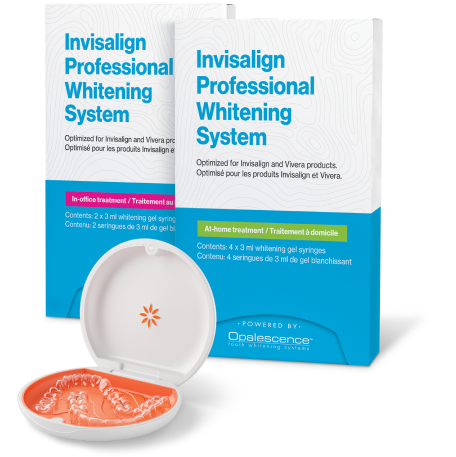
The Invisalign Professional Whitening System powered by Opalescence combines clear aligner therapy with professional-grade whitening in a single workflow. Developed through a...
Reviewed by Agnes Markovic
Pros
- All-in-one system with gel, syringes, tips, and trays for stand-alone orders, requiring no ancillary equipment
- Optimized viscosity specifically designed for Invisalign aligners and Vivera retainers, reducing gel migration and soft tissue irritation
- Proven Opalescence PF formula with potassium nitrate and sodium fluoride for reduced sensitivity and enamel protection
- Compatible with active treatment, even with attachments bonded in place, enabling simultaneous whitening and alignment
- Low wholesale cost of $50 to $75 per kit with strong patient-facing margin potential
- Streamlined ordering through the Invisalign Doctor Site, minimizing inventory management burden
- Dual product options (at-home and in-office) offer flexibility for different patient needs and practice workflows
- Customized whitening trays included at no additional cost for stand-alone patients not in treatment
- ISO 13485 certified manufacturing from Ultradent ensures consistent quality and regulatory compliance
Cons
- Exclusively available to Invisalign-trained doctors, limiting access for non-Invisalign providers
- 10% carbamide peroxide at-home concentration is relatively low, and patients with severe intrinsic discoloration may require supplemental in-office treatment
- Restorative materials (crowns, veneers, composites) will not respond to the whitening agent, potentially creating shade mismatches
- Standard Opalescence PF products with similar active formulas are available at potentially lower cost outside the Invisalign ecosystem
- Results are not permanent, and re-staining will occur over time, requiring periodic touch-up treatments
- Tray-based delivery only, so practices seeking light-activated or laser whitening options will need separate systems
The Invisalign Professional Whitening System powered by Opalescence combines clear aligner therapy with professional-grade whitening in a single workflow. Developed through a multi-year partnership between Align Technology and Ultradent Products, this system allows dental professionals to offer patients simultaneous teeth whitening and straightening without adding chair time, specialized equipment, or a separate appointment sequence.
For practices already providing Invisalign clear aligner treatment, the whitening system represents a natural revenue extension and patient experience upgrade. This review covers everything dental professionals need to evaluate the product, from formulation and Invisalign Professional Whitening System cost to step-by-step Invisalign Professional Whitening System instructions, clinical considerations, and measurable pros and cons.
What Is the Invisalign Professional Whitening System?
The Invisalign Professional Whitening System is the first and only professional whitening product officially approved by Align for combined use with Invisalign clear aligners and Vivera retainers (Align Technology, 2022). It carries the co-branded name "Invisalign Professional Whitening System – powered by Opalescence" and is manufactured by Ultradent in an ISO 13485 certified facility.
The system uses the established Opalescence PF whitening formula, which contains carbamide peroxide as the active ingredient along with potassium nitrate for desensitization and sodium fluoride for enamel protection. What distinguishes it from the standard Opalescence PF product is its optimized gel viscosity, specifically reformulated to maintain contact with tooth surfaces when delivered through Invisalign’s SmartTrack aligner material. This is a meaningful technical difference, as standard whitening gels designed for traditional custom trays often migrate out of thinner, more flexible aligner shells.
An important clarification for clinicians: Ultradent’s standard Opalescence PF product is not approved by Align for use with Invisalign aligners or Vivera retainers (Align Technology FAQs). The Invisalign Professional Whitening System is a distinct product available exclusively to Invisalign-trained doctors through the Invisalign Doctor Site and WebStore.
How the Invisalign Professional Whitening System Works
Understanding the science and delivery mechanism behind this system helps clinicians set accurate patient expectations, troubleshoot sensitivity issues, and compare the product against competing whitening options in the market.
Formulation and Active Ingredients
The system is available in two configurations. The at-home product uses a 10% carbamide peroxide gel, which is equivalent to approximately 3.6% Invisalign hydrogen peroxide. The in-office product uses a 45% carbamide peroxide formulation (marketed as "Quick PF"), designed for shorter, supervised applications. Both include the PF complex of potassium nitrate and sodium fluoride.
According to the product safety data sheet, the gel composition includes glycerin, carbamide peroxide, hydrogen peroxide (as a breakdown product), polyacrylic acid, polyethylene glycol, sodium hydroxide, potassium nitrate, and sodium fluoride. The formulation contains at least 20% water, a deliberate design choice that reduces dehydration-related sensitivity common with anhydrous whitening gels.
Mechanism of Action
Carbamide peroxide decomposes into hydrogen peroxide and urea when exposed to oral fluids. The hydrogen peroxide then breaks down further into water, oxygen, and reactive oxygen species that penetrate both enamel and dentin, oxidizing chromophore bonds within discolored stain molecules (Li & Greenwall, 2013, Journal of Dentistry). As these bonds are disrupted, the tooth color becomes progressively lighter.
A key clinical advantage is that these reactive oxygen molecules permeate the entire tooth structure. The whitening gel does not need to contact every square millimeter of the tooth surface to produce results. For patients with bonded attachments, this is particularly relevant, as the system effectively whitens under and around attachment sites without the need to debond and rebond.
Optimized Viscosity for Aligner Delivery
One of the most significant differentiators of this system is its viscosity profile. Generic whitening gels may not adhere properly to the interior surfaces of clear aligners, leading to gel migration, uneven whitening, and soft tissue irritation. The reformulated gel in this system is designed to stay in place within the unique geometry of Invisalign’s SmartTrack material (Align Technology provider page), reducing wastage and improving coverage predictability.
How To Use the Invisalign Professional Whitening System
Proper application technique is essential for consistent whitening outcomes and minimal adverse effects. The following Invisalign Professional Whitening System instructions are based on official guidance from Align Technology and Ultradent (Invisalign at-home whitening instructions).
At-Home Protocol (10% Carbamide Peroxide)
The at-home variant is the more commonly dispensed product and follows a straightforward application process.
Brush and floss teeth thoroughly before application. Clean, dry teeth allow for optimal gel adhesion.
Attach the dispensing tip securely to the syringe. Express a small, continuous bead of gel approximately halfway up the facial (front) side of the aligner or retainer, running from molar to molar. Use approximately one-half to one-third of a syringe per arch.
Insert the aligner or retainer and lightly tap it to adapt the tray to the teeth, distributing the gel evenly across facial surfaces.
Wipe away any excess gel that extrudes beyond the tray margins, particularly along the gumline.
Wear the tray for 8 to 10 hours. Overnight wear is ideal for the 10% concentration. Do not eat, drink, or use tobacco products during the whitening period.
Remove the tray after the recommended wear time, rinse the mouth thoroughly, and clean the aligner or retainer with cool water and a soft toothbrush.
Repeat daily or as directed. Treatment duration is typically 10 to 14 days, though this may vary depending on initial shade and desired outcome.
In-Office Protocol (45% Carbamide Peroxide)
The in-office variant (Quick PF) delivers higher peroxide levels in a shorter application window of 30 to 60 minutes per session. The gel is applied to the aligner, retainer, or whitening tray in the same manner, but the patient remains in the office for the duration of treatment. No gingival barriers, specialized lights, cheek retractors, or other ancillary equipment are required.
Important Precautions
Dental professionals should communicate the following to patients before dispensing the whitening system.
Use only with Invisalign clear aligners, Vivera retainers, or Invisalign whitening trays
Pregnant or nursing women should not use the product
Restorative materials (crowns, veneers, composites) will not change shade
Amalgam fillings may leave a temporary dark purple discoloration in the tray, which is a normal reaction
If significant sensitivity occurs, reduce frequency or discontinue use
Avoid contact with eyes, and rinse immediately if contact occurs
Teeth may re-stain over time, and touch-up treatments can be administered as needed
In-Office vs. At-Home: Which Product To Recommend
The Invisalign Professional Whitening System is available in two distinct product configurations in the United States, each serving a different clinical scenario. The following comparison helps practices match the right product to each patient.
Feature | At-home product | In-office product |
Active ingredient | 10% carbamide peroxide | 45% carbamide peroxide (Quick PF) |
Hydrogen peroxide equivalent | ~3.6% | ~16% |
Recommended wear time | 8–10 hours (overnight) | 30–60 minutes (in-chair) |
Setting | Patient’s home | Dental office |
Supervision level | Doctor-supervised, patient-administered | Direct clinical supervision |
Equipment required | None | None |
Doctor cost (USD) | $50 | $75 |
The at-home product provides more flexibility for patients and is typically the better choice for maintenance whitening or mild-to-moderate discoloration. The in-office product works well for patients who want rapid shade improvement, have limited compliance with take-home protocols, or are preparing for a same-day cosmetic event.
Invisalign Professional Whitening System Cost and Price
Pricing is one of the most frequently searched topics around this system. Understanding both the wholesale cost to the practice and the recommended patient-facing pricing is essential for building a profitable whitening program within the practice.
Wholesale Cost to the Practice
The Invisalign Professional Whitening System price at wholesale is approximately $50 per kit for the at-home product (whether ordered as an add-on to an existing Invisalign or Vivera case or as a stand-alone whitening order). The in-office Quick PF product costs approximately $75 per kit (Align Technology product FAQs). Stand-alone orders for non-Invisalign patients include customized Invisalign whitening trays at no additional charge.
Promotional pricing is occasionally available through the Invisalign Doctor Site, such as buy-five-get-one-free offers. These promotions vary by region and timing.
Patient-Facing Pricing and Margins
Professional teeth whitening treatments typically range from $200 to $600 at retail, depending on the market and modality. Given the $50 to $75 wholesale cost, this system offers substantial margins. Many practices bundle the whitening into the overall Invisalign treatment fee as a value-add, while others offer it as a paid upgrade. The all-inclusive nature of the kit (gel, syringes, tips, and trays for stand-alone orders) means there are no hidden consumable costs that erode profitability.
From a practice growth perspective, offering whitening at the initial Invisalign consultation creates an immediate upsell opportunity. Whitening-only patients may also convert to full orthodontic treatment once they are introduced to the Invisalign ecosystem within the practice.
Best Whitening Gel for Invisalign: Why Opalescence PF Leads
When evaluating the best whitening gel for Invisalign, clinicians should weigh formulation chemistry, viscosity compatibility, sensitivity profile, and clinical evidence. The Opalescence PF formula scores well across all these criteria.
Opalescence has been a market leader in professional whitening for over 30 years. The PF complex addresses the two most common patient complaints: transient sensitivity and enamel integrity concerns. Potassium nitrate desensitizes nerve endings in the dental pulp, while sodium fluoride promotes remineralization during and after the whitening process. A study published in the Journal of Prosthetic Dentistry confirmed that bleaching with carbamide peroxide does not increase enamel susceptibility to staining or alter surface topography (Alencar et al., 2019). Separate research found that 10% carbamide peroxide applied for up to 7 hours daily over 21 days does not significantly affect enamel microhardness (Basting et al., 2003).
The water-based formulation (at least 20% water) also mitigates dehydration effects on enamel. Anhydrous or low-water gels can cause transient enamel dehydration that creates a temporary "bounce-back" effect as the enamel rehydrates. The water-rich formula provides more stable, sustainable shade improvement. For practices comparing professional whitening systems, the Philips Zoom whitening review provides useful context for evaluating the alternatives.
Can You Whiten Your Teeth With Invisalign?
The question "Can I whiten my teeth with Invisalign?" is one of the most common patient inquiries in practices that offer clear aligner therapy. The short answer is yes, and the Invisalign Professional Whitening System is specifically engineered for this purpose. However, there are several clinical nuances that matter.
Timing Options for Whitening During Aligner Treatment
Whitening can be performed at multiple points during the Invisalign treatment journey, including before treatment begins, during active tooth movement, during retention with Vivera retainers, or as a stand-alone service for patients not in treatment.
Whitening during active treatment is one of the system’s primary selling points. Patients apply the whitening gel to their current set of aligners and wear them as usual, achieving alignment and shade improvement simultaneously. Because aligners are changed every one to two weeks, minor gel discoloration of the aligner material is temporary and self-correcting. This approach supports the growing patient demand for combined teeth whitening and straightening protocols.
Whitening during retention is an excellent long-term patient engagement strategy. Many patients experience mild re-staining after completing orthodontic treatment, particularly those with dietary habits that promote discoloration, such as coffee, tea, and red wine. Offering whitening touch-ups through Vivera retainers gives patients a compelling reason to maintain retainer compliance and stay connected to the practice.
Whitening With Attachments in Place
A common clinician concern is whether the whitening gel produces even results when composite attachments are bonded to the teeth. Because reactive oxygen molecules permeate the entire tooth structure, the gel does not need to contact every surface directly. Clinical guidance from Align confirms that the system can be administered after attachments have been bonded and that whitening effectively occurs under and around attachment sites.
The composite attachment material itself will not change shade. When attachments are removed, there may be a very slight mismatch at the attachment site, which typically equalizes after a short period of continued whitening or natural enamel rehydration. Setting this expectation with patients before treatment prevents dissatisfaction.
Can You Use Teeth Whitening Strips With Invisalign?
Another frequent patient question is whether they can use teeth whitening strips with Invisalign. While over-the-counter whitening strips are widely available and can produce noticeable results, their use during active Invisalign treatment requires careful consideration.
Whitening strips must be applied directly to the teeth, meaning aligners need to be removed for the 30- to 60-minute application period. Given that Invisalign treatment requires 20 to 22 hours of daily wear, removing aligners for additional whitening strip sessions can reduce overall compliance and potentially affect treatment outcomes. Additionally, whitening strips do not conform to teeth as precisely as a custom aligner, which can lead to uneven whitening in areas of crowding or irregular tooth anatomy.
The Invisalign Professional Whitening System is a clinically superior alternative for patients already in aligner treatment. It eliminates the compliance trade-off, uses a higher-grade professional formulation, and includes the desensitizing and fluoride components absent from most over-the-counter whitening products. If patients are determined to use strips regardless, advise them to do so only during the windows when aligners are already removed for eating and oral hygiene, and to ensure total out-of-aligner time does not exceed the recommended daily maximum.
Understanding Invisalign Hydrogen Peroxide and Carbamide Peroxide
Dental professionals sometimes encounter confusion about the relationship between Invisalign hydrogen peroxide levels and carbamide peroxide concentrations. Clarifying this chemistry supports accurate patient education and fair product comparisons.
Carbamide peroxide is a stable complex of urea and hydrogen peroxide. When dissolved in an aqueous environment, it decomposes to release hydrogen peroxide and urea. The standard conversion ratio is approximately 3:1, meaning that 10% carbamide peroxide yields roughly 3.3% to 3.6% hydrogen peroxide, and 45% carbamide peroxide yields approximately 15% to 16% hydrogen peroxide (Haywood, 1992, Quintessence International).
The choice of carbamide peroxide over direct hydrogen peroxide formulations offers practical advantages for tray-based delivery. Carbamide peroxide gels release active peroxide more gradually, providing sustained whitening over the wear period rather than a rapid spike followed by depletion. This controlled release profile aligns well with the extended wear times recommended for the at-home product and contributes to fewer acute sensitivity episodes. A systematic review published in Clinical Oral Investigations concluded that carbamide peroxide can achieve comparable efficacy to hydrogen peroxide while producing less sensitivity during in-office application (Braga et al., 2024).
Teeth Whitening and Straightening: The Combined Treatment Approach
The concept of simultaneous teeth whitening and straightening represents a meaningful shift in patient-centered aesthetic dentistry. Historically, patients were advised to complete orthodontic treatment first and pursue whitening separately. This sequential approach added time, cost, and scheduling complexity.
The Invisalign Professional Whitening System enables a parallel workflow. Patients can begin whitening at any point during active aligner treatment, continue through retention, and perform touch-ups indefinitely. For the patient, this reduces total treatment time, eliminates dedicated whitening appointments, and delivers a more dramatic overall aesthetic transformation. For the practice, bundling whitening with aligner treatment creates an upsell opportunity that requires minimal additional chair time, differentiates the practice from competitors, and generates high-margin revenue.
Practices that integrate whitening into their initial consultation workflow, presenting it as a natural extension of the Invisalign treatment journey rather than an afterthought, consistently report higher patient uptake rates.
The combined approach also addresses a common patient frustration: the feeling of incomplete transformation after orthodontic treatment. Patients who invest months in aligner therapy expect their final result to look dramatically different from their starting point. Whiter teeth amplify the visual impact of newly aligned teeth, making the overall transformation feel more significant and justifying the patient’s investment in their smile. When practices frame whitening as part of the complete treatment package rather than a separate cosmetic add-on, patient acceptance rates tend to increase measurably.
The retention phase deserves particular attention. Vivera retainers are already part of the recommended post-treatment protocol, and adding a whitening component transforms what many patients see as a passive maintenance step into an active improvement step. This shift in perception can improve retainer compliance, which is one of the most persistent challenges in orthodontic follow-up care. Patients who associate their retainer with visible cosmetic benefits are more likely to wear it consistently, which protects the orthodontic result and keeps the patient engaged with the practice long-term.
Bottom Line
The Invisalign Professional Whitening System, powered by Opalescence, fills a genuine gap in the aesthetic dental workflow. At $50 to $75 per kit wholesale, with no ancillary equipment required, it offers one of the most streamlined and cost-effective professional whitening solutions currently available to Invisalign-trained providers. The ability to whiten during active treatment, during retention, or as a stand-alone service makes the system versatile enough to serve a wide range of patient profiles. For dental professionals already offering clear aligner therapy, this system is a low-risk, high-reward addition to the service portfolio.
The product’s limitations are worth acknowledging. The exclusivity to Invisalign-trained providers narrows the user base, the at-home concentration is conservative for severe discoloration cases, and results are not permanent. However, these limitations are predictable and manageable within a well-structured treatment plan. The system does exactly what it promises: it delivers reliable, professional-grade whitening through a platform that millions of patients are already wearing daily. That level of integration is difficult to replicate with any competing product currently on the market.
For practices evaluating whether to add this system to their offering, the key question is straightforward. If the practice is already Invisalign-trained and serving patients who ask about whiter teeth, the Invisalign Professional Whitening System eliminates the gap between patient demand and available treatment. It enhances the patient experience, differentiates the practice from competitors, and generates meaningful incremental revenue with minimal operational overhead. Choosing the right dental equipment and products for the practice is always a balancing act between clinical value and business viability, and this system performs well on both fronts.
Verdict
<p>The Invisalign Professional Whitening System powered by Opalescence is a well-engineered, clinically sound addition to the clear aligner workflow. Its greatest strength lies in the seamless integration with the Invisalign ecosystem, allowing practices to offer patients simultaneous whitening and alignment without extra equipment, appointments, or complicated protocols.</p><p>The Opalescence PF formula is time-tested, and the addition of potassium nitrate and fluoride addresses the sensitivity concerns that affect many whitening systems. The optimized viscosity is a genuine differentiator that improves gel retention compared to standard products used in thin aligner shells. For practices looking to increase per-patient revenue with minimal incremental cost and chair time, the system delivers attractive returns. Review our analysis of the <a target="_blank" rel="noopener noreferrer nofollow" class="text-primary underline hover:text-primary/80" href="https://dentalreviewed.com/reviews/philips-zoom-professional-teeth-whitening-clinical-review-for-dental-practitioners/"><u>Philips Zoom professional whitening system</u></a> for a comparison with another leading in-office option.</p><p>That said, this is not a universal solution. Patients with severe intrinsic staining may require higher-concentration or light-activated treatments. The exclusivity to Invisalign-trained providers limits access. Results require maintenance. Overall, for Invisalign-trained general dentists and orthodontists, this is a high-quality, practice-friendly system recommended for integration into the whitening service menu.</p>
Frequently Asked Questions
What is the difference between the Ultradent Opalescence product and the Invisalign Professional Whitening System?
The Invisalign Professional Whitening System was uniquely developed for use with Invisalign clear aligners, Vivera retainers, and Invisalign whitening trays. It features an optimized gel viscosity for these specific tray types. Ultradent’s standard Opalescence PF product is not approved by Align for use with Invisalign aligners or Vivera retainers, even though both products share the same active ingredients.
Can you whiten teeth with Invisalign aligners that have attachments?
Yes. The reactive oxygen molecules generated by the carbamide peroxide penetrate the entire tooth, including areas under and around bonded attachments. The composite attachment material itself will not whiten, but once attachments are removed, any minor shade difference typically equalizes quickly through continued whitening or natural enamel rehydration.
How long does it take to see results?
Most patients notice visible shade improvement within the first few days of consistent use. The typical at-home treatment course is 10 to 14 days of overnight wear. In-office treatments with the 45% Quick PF product can produce noticeable results in a single session of 30 to 60 minutes.
Is the Invisalign Professional Whitening System safe for enamel?
Yes. The formulation includes sodium fluoride to promote enamel remineralization and contains at least 20% water to minimize dehydration effects. The carbamide peroxide concentrations used (10% at-home, 45% in-office) fall within well-established safety parameters for professional whitening products. Research confirms that 10% carbamide peroxide does not significantly affect enamel microhardness (Basting et al., 2003).
Can patients who are not in Invisalign treatment use this system?
Yes. The system is available as a stand-alone order for whitening-only patients. Stand-alone orders include customized Invisalign whitening trays fabricated from thermoplastic material at no additional cost. These trays are similar in design and fit to standard Invisalign aligners.
How does the Invisalign Professional Whitening System cost compare to other professional whitening options?
At $50 to $75 per kit wholesale, the system is competitively priced against other professional-grade whitening products. Considering that it includes all necessary components, the cost-per-treatment is often lower than systems requiring separate tray fabrication, gingival barriers, or activating lights. For a broader view of whitening product pricing, see the over-the-counter whitening product comparison.
Can you use teeth whitening strips with Invisalign at the same time?
Using whitening strips while wearing Invisalign aligners is not recommended. Strips require aligner removal, which reduces daily wear time and may compromise treatment outcomes. The Invisalign Professional Whitening System is a better alternative because it works with the aligners in place, eliminating the compliance trade-off.
What concentration of hydrogen peroxide is in the Invisalign whitening gel?
The at-home product contains 10% carbamide peroxide, equivalent to approximately 3.6% hydrogen peroxide. The in-office Quick PF product contains 45% carbamide peroxide, equivalent to approximately 15% to 16% hydrogen peroxide.
How should a practice order the Invisalign Professional Whitening System?
The system is ordered through the Invisalign Doctor Site. For new Invisalign or Vivera patients, it can be added to the prescription form at the time of case submission. For current patients, orders are placed through the WebStore. Align Technology is the sole distributor.
What should a clinician recommend if a patient experiences sensitivity?
Advise the patient to reduce application frequency (for example, every other night instead of nightly) or shorten the wear time. If sensitivity persists, discontinue use and evaluate for underlying causes. The potassium nitrate in the PF formula is designed to mitigate sensitivity, but individual responses vary. Lower-concentration formulations or a temporary pause in treatment may also be appropriate.
Does this system require any specialized equipment?
No. The system is entirely tray-based and requires no lights, gingival barriers, cheek retractors, or any other specialized dental equipment. This simplicity makes it one of the easiest professional whitening systems to implement in any practice setting.
How long do whitening results last?
Whitening results are generally stable over time, but duration varies based on individual factors including diet (coffee, tea, red wine), tobacco use, oral hygiene habits, tooth anatomy, and age. Periodic touch-up treatments are recommended to maintain optimal shade.