Pearl Launches Pearl RCM, AI-Powered Revenue Cycle Management Platform
The new platform brings insurance verification, claim validation, and clinical documentation together in a single workflow built specifically for dental practices – areas that...
Written by Maren Solvik
Read time: 5 min read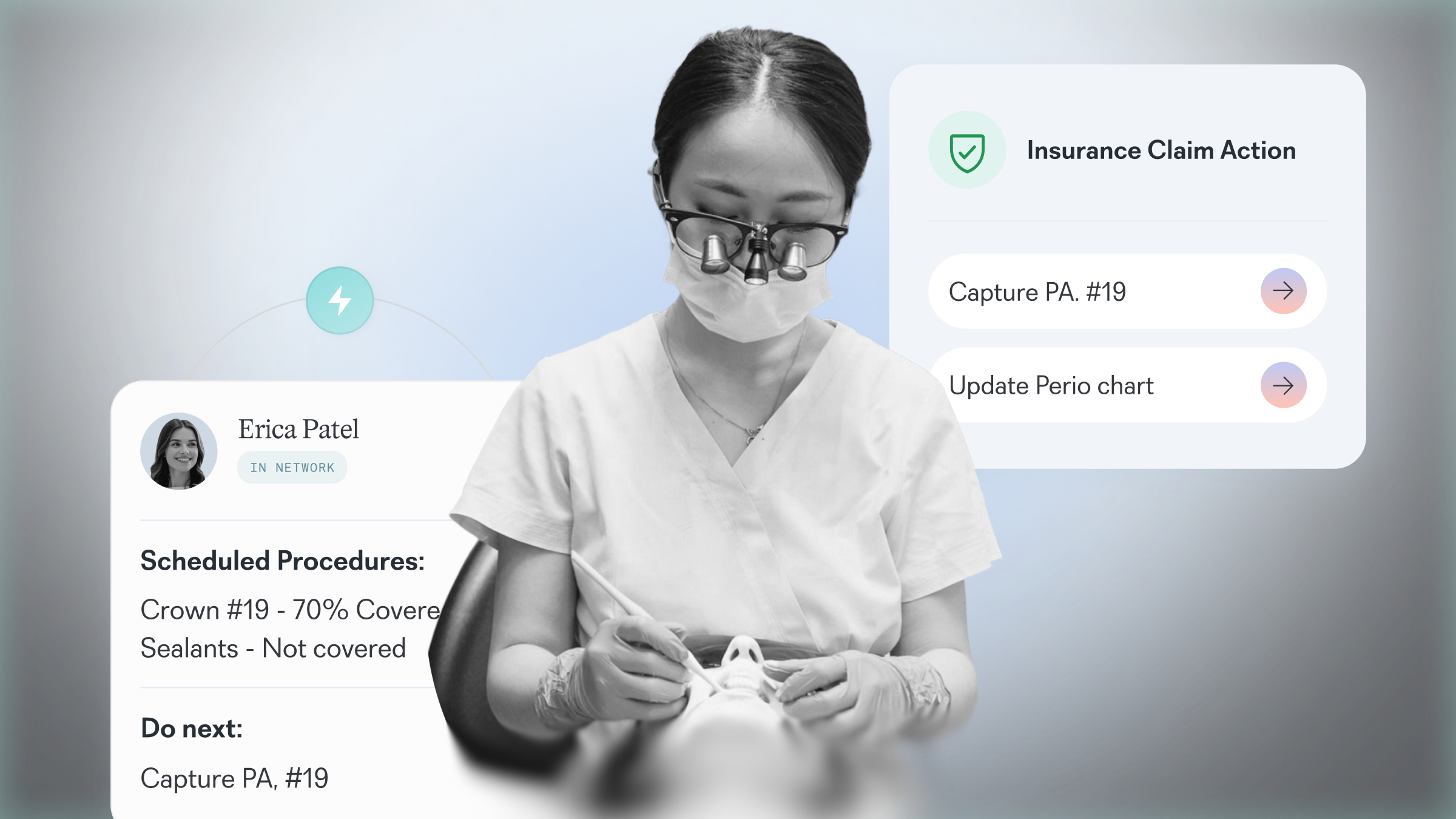
The new platform brings insurance verification, claim validation, and clinical documentation together in a single workflow built specifically for dental practices – areas that have traditionally required separate tools and manual handoffs. Pearl RCM went live on May 27, 2026.
TL;DR
Pearl RCM combines Precheck (insurance verification), Claimcheck (claim validation and optimization), and Pearl’s FDA-cleared imaging AI into one connected platform.
The platform flags missing documentation, coding errors, and eligibility issues before claims are submitted, not after they’re denied.
Early deployments show up to 35 hours of staff time saved per week and up to 80% fewer downcodes and denials tied to documentation gaps.
Pearl RCM completes a full end-to-end AI stack: diagnosis (Second Opinion), documentation (Pearl Voice), and now billing.
What’s Inside Pearl RCM
Pearl RCM is not a single new tool. It’s a unified platform that brings together several Pearl products, most notably Precheck and Claimcheck, under a single connected workflow, anchored to the company’s FDA-cleared radiologic AI. The result is a claims pipeline where insurance verification, clinical documentation, and claim submission all reference the same data, reducing the manual handoffs that typically introduce errors.
The platform is designed around one central idea: insurance intelligence should be embedded upstream, at the point of care, rather than applied retroactively after a claim has already been rejected. For dental teams accustomed to toggling between insurance portals, practice management software, and separate billing tools, that consolidation addresses a well-known operational pain point.
Key Features And Capabilities
Pearl RCM spans the revenue cycle from pre-visit verification through post-submission tracking. Here are the core capabilities the platform brings together.
Precheck: AI-Powered Insurance Verification
Precheck handles eligibility and benefits verification before the patient sits in the chair. The tool uses natural language processing to compile data from multiple clearinghouses, payers, and patient EOBs, delivering more complete coverage information than single-source verification methods. Pearl claims Precheck identifies coverage for 30% more patients compared to other verification platforms.
What it does in practice:
Confirms eligibility, copays, deductibles, and plan-level details in real time
Flags frequency limits and coverage exclusions before treatment begins
Identifies procedures that require prior authorization and tracks payer-specific rules
Provides code-level feedback on what specific procedures are covered under each patient’s plan
For offices that still verify insurance benefits manually, this is where Pearl RCM starts delivering immediate time savings. The Zentist 2026 Dental RCM Trends & Insights Report found that 71% of dental practices cited real-time insurance verification as a primary operational challenge, making this a high-impact starting point.
Claimcheck: Claim Validation And Optimization
Claimcheck is the submission-side engine. It integrates with existing practice management systems to validate claims in real time before they go to the payer. The tool merges radiologic AI findings, PMS data, eligibility information, and payer-specific rules to catch issues that would otherwise result in rejections, downcodes, or appeals.
Core capabilities include:
Automated claim review that validates submission data, highlights risk factors, and corrects errors before submission
Comprehensive coverage of claim types across diagnostic, preventive, restorative, and major procedure categories
AI-enriched X-ray evidence that automatically enhances radiographic images with annotations to support claims
AI-reviewed narrative assistance that generates summaries tailored to specific claim codes and payer requirements
Undercoding detection that flags missed billable treatments to ensure practices capture full revenue
The X-ray annotation feature is particularly notable. Because Claimcheck sits on top of Pearl’s Second Opinion imaging AI, it can automatically attach AI-annotated radiographic evidence to claims, strengthening the documentation without adding work for the clinical team. That direct link between diagnostic findings and claim evidence is something most standalone RCM tools cannot replicate.
Clinical Documentation Integration Via Pearl Voice
Pearl RCM also connects to Pearl Voice, the ambient documentation assistant Pearl launched in April 2026. Pearl Voice transcribes doctor–patient conversations into structured clinical records – SOAP notes, periodontal charts, and procedure-specific templates – in real time. Within the RCM workflow, those records become the documentation foundation that supports each claim.
This integration matters because documentation gaps are one of the most common triggers for claim denials. When the dental chart and clinical notes are generated automatically from the encounter itself, the risk of missing or incomplete documentation drops significantly. The same records that support a dental treatment plan feed directly into the claims pipeline.
Early Deployment Results
Pearl has released initial performance data from practices that deployed the platform early. These are limited, pre-scale figures, but they offer a first look at operational impact.
Up to 35 hours of staff time saved per week
Up to 80% fewer downcodes and denials related to missing or incomplete documentation
For context, industry data suggests that 15–20% of dental claims are denied on first submission, and reworking a denied claim costs 3–5 times more than getting it right the first time. If Pearl RCM’s early numbers hold at scale, the time and revenue implications for a busy practice would be substantial. That said, independent validation and larger sample sizes are still needed before drawing firm conclusions.
How Pearl RCM Fits Into The Broader Platform
Pearl RCM completes what the company describes as an end-to-end AI in dentistry platform. Here’s how the pieces connect:
Second Opinion (FDA-cleared imaging AI). Detects pathologies in bitewing, periapical, panoramic, and CBCT images. Feeds annotated diagnostic evidence into the claims workflow.
Pearl Voice (clinical documentation). Transcribes chairside conversations into structured notes and perio charts. Generates the documentation that supports each claim.
Pearl RCM (revenue cycle). Verifies insurance, validates claims, attaches evidence, and optimizes submissions before they reach the payer.
The platform also includes Practice Intelligence (clinical performance analytics) and Calibrate (scan quality scoring). Pearl was founded in 2019 and holds FDA clearance across four imaging modalities, with regulatory approval in 120 countries. Practices like Coast Dental (88 locations) and DECA Dental Group have deployed Pearl’s imaging tools across their networks.
What Practices Should Consider Before Adopting
Pearl RCM is a new product, and dental professionals evaluating it should ask the right questions before committing.
PMS integration. Confirm compatibility with your specific practice management software. Claimcheck integrates with existing systems, but the depth of that integration matters for daily usability.
Pricing structure. Pearl has not publicly disclosed Pearl RCM pricing. Request a detailed breakdown that accounts for Precheck, Claimcheck, and any bundled imaging or documentation tools.
Onboarding timeline. Ask about deployment timelines, staff training requirements, and what the transition looks like for a practice currently running manual verification and claims workflows.
Performance benchmarks. The early deployment numbers (35 hours saved, 80% fewer downcodes) are promising but limited. Request case studies with practice profiles similar to yours, and track your own billing KPIs for a pre/post comparison.
Overjet, Pearl’s most direct competitor, holds nine FDA-cleared modules and offers its own RCM and enterprise analytics capabilities. Dental-specific RCM platforms like Zentist and AirPay are also competing in this space. Practices should evaluate Pearl RCM alongside these alternatives to determine which dental technology stack fits their workflow and scale.
Bottom Line
Pearl RCM brings insurance verification, claim validation, AI-annotated radiographic evidence, and clinical documentation into one connected workflow. It’s the company’s clearest move yet from chairside diagnostic imaging into the financial operations of a dental practice.
The platform’s strongest differentiator is the integration with Pearl’s imaging AI. Most standalone RCM tools can scrub claims and verify eligibility, but they can’t automatically attach AI-annotated X-ray evidence or pull structured documentation from a real-time clinical transcript. That end-to-end connection between diagnosis, documentation, and billing is what sets Pearl RCM apart in a crowded market. For any dental assistant or office manager spending hours each week on denied claims, this is worth a closer look.
Frequently Asked Questions
What is Pearl RCM?
Pearl RCM is an AI-powered revenue cycle management platform for dental practices. It unifies Precheck (insurance verification), Claimcheck (claim validation and optimization), and Pearl’s FDA-cleared imaging AI into one workflow, allowing practices to verify coverage, validate claims, and attach radiographic evidence before submission.
What tools are included in Pearl RCM?
Pearl RCM includes Precheck for real-time insurance eligibility and benefits verification, Claimcheck for pre-submission claim validation and optimization, and integration with Pearl’s Second Opinion imaging AI for automated radiographic evidence. It also connects to Pearl Voice for structured clinical documentation.
How does Pearl RCM reduce dental claim denials?
The platform flags missing documentation, coding errors, eligibility gaps, and payer-specific rule violations before claims are submitted. Claimcheck also auto-corrects common errors and attaches AI-annotated X-ray evidence to strengthen claim documentation, reducing the likelihood of downcodes and rejections.
What results has Pearl RCM shown in early deployments?
Practices in early deployments reported saving up to 35 hours of staff time per week and experiencing up to 80% fewer downcodes and denials related to missing or incomplete documentation. These are preliminary figures from limited rollouts.
How does Pearl RCM compare to other dental RCM platforms?
Pearl RCM’s key differentiator is its integration with FDA-cleared imaging AI and ambient clinical documentation. Most dental RCM tools handle verification and claims independently, while Pearl RCM connects diagnostic findings, clinical notes, and billing in a single pipeline. Overjet, Zentist, and AirPay are the primary alternatives in this space.