Rating: 4.2/5
Onset EZ™ Pen Review for Dental Professionals
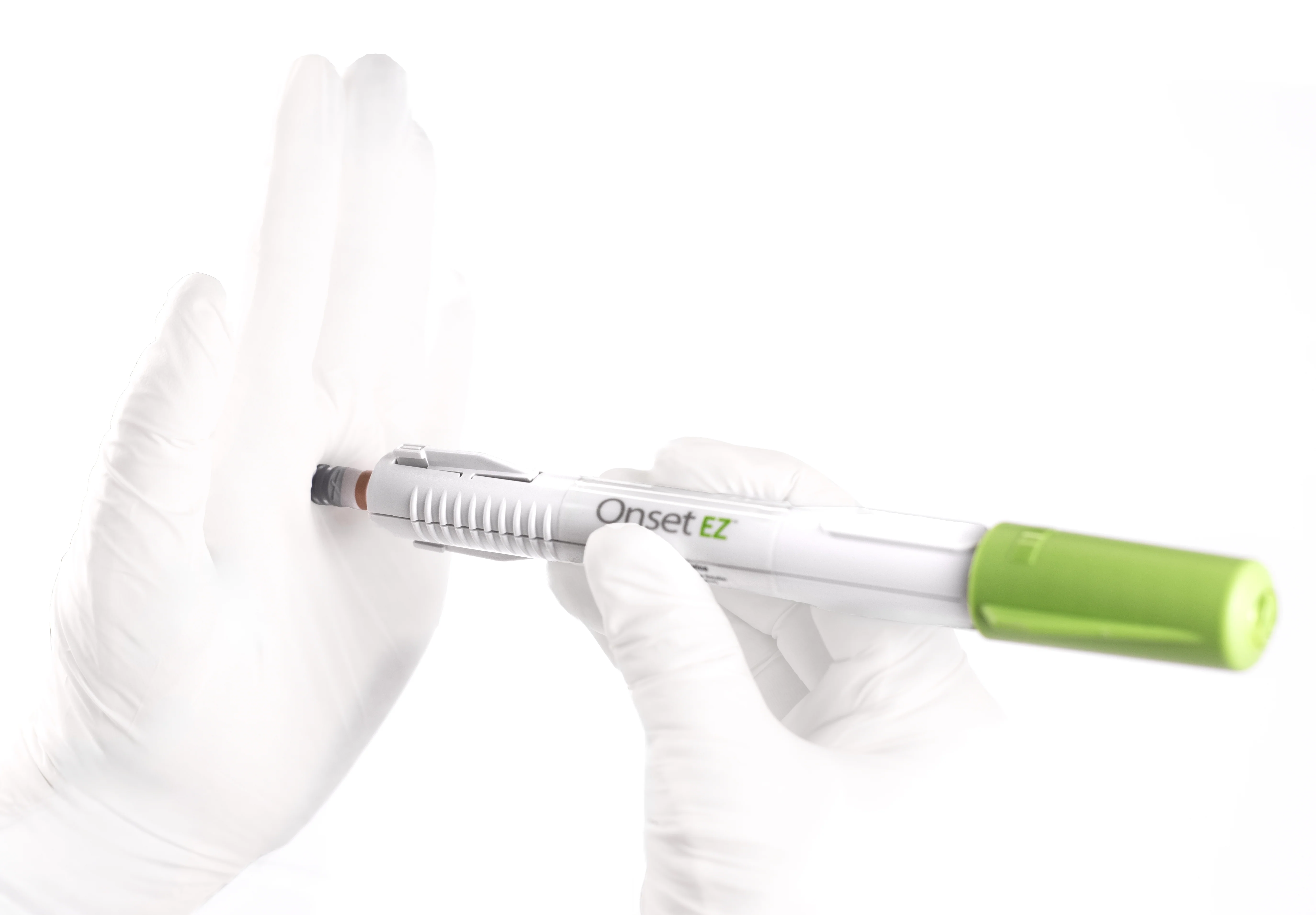
The Onset EZ Pen is a self-contained local anesthetic buffering device manufactured by Onpharma Company, based in Carson City, Nevada. Launched in September 2025 as the company’s...
Reviewed by Agnes Markovic
Pros
- Rapid anesthesia onset in under 2 minutes
- Significantly reduced injection pain for patients
- 30 buffering doses per pen with no extra packaging
- No training required, intuitive click-and-buffer design
- Compatible with lidocaine, articaine, prilocaine, and mepivacaine
- 30-day usable shelf life after opening
- Eliminates sharps waste from the buffering process
- Preferred by dental assistants for ease of use
- Over 10 million doses delivered across the Onset platform
- Saves approximately 10 minutes per restorative procedure
Cons
- Adds a per-injection cost on top of anesthetic cartridge expense
- Must be used within 30 days of opening, potential waste in low-volume practices
- Buffered anesthetic should be administered promptly after mixing
- Does not eliminate the need for topical anesthetic in all cases
- May require refrigeration of sodium bicarbonate in some climates
- Learning curve for practices unfamiliar with buffering science
- Not universally covered by dental insurance reimbursements
- Limited independent long-term outcome studies on the EZ Pen specifically
- Single-source product, dependent on Onpharma supply chain
- Pen must be disposed of entirely once 30 doses are used
The Onset EZ Pen is a self-contained local anesthetic buffering device manufactured by Onpharma Company, based in Carson City, Nevada. Launched in September 2025 as the company’s second-generation buffering pen, the device is designed to adjust the pH of standard dental anesthetic cartridges to a more physiologically neutral level before injection.
Each Onset EZ Pen contains a sterile solution of 8.4% sodium bicarbonate and water for injection, sufficient to buffer 30 individual local anesthetic cartridges. The pen may be used for up to 30 days after opening, and Onpharma recommends placing one pen per operatory so that buffering is always within arm’s reach for every injection.
Onpharma introduced dental anesthetic buffering technology over 15 years ago and has established itself as the category leader, with more than 10 million anesthetic cartridges buffered across the United States through its Onset platform. The EZ Pen represents the company’s effort to make buffering practical for every dental injection, not just selected cases. For dental professionals exploring the full range of dental equipment options available today, the Onset EZ Pen addresses a category that has historically been underserved: chairside anesthesia optimization.
How Anesthetic Buffering Works: The Science Behind the Onset EZ Pen
Understanding the pharmacology behind anesthetic buffering helps clinicians explain the value of the Onset EZ Pen to colleagues, staff, and patients. The science is well-established and supported by peer-reviewed research.
The pH Problem With Standard Local Anesthetics
Dental local anesthetics such as lidocaine, articaine, mepivacaine, and prilocaine are weak bases that exist in two chemical forms in solution: an ionized (charged) form and an un-ionized (uncharged) form. Only the un-ionized form is lipid-soluble enough to cross nerve cell membranes and block pain signal transmission.
Standard anesthetic cartridges are manufactured at a highly acidic pH, typically between 3.5 and 4.5. This low pH is necessary for shelf stability, but it creates a clinical problem. At acidic pH levels, the vast majority of anesthetic molecules are trapped in their ionized, membrane-impermeable form. After injection, the patient’s own tissue buffers must gradually raise the pH of the deposited solution toward physiological pH (7.4) before a clinically significant fraction of the anesthetic becomes active.
This biological buffering process is inherently slow and variable. It depends on the individual patient’s tissue buffering capacity, local blood flow, and the presence or absence of inflammation. That variability is the reason why some patients achieve numbness quickly while others take six or more minutes, and why inflamed or infected tissues are notoriously difficult to anesthetize.
How the Onset EZ Pen Solves the Problem
The Onset EZ Pen delivers a precise amount of 8.4% sodium bicarbonate into the anesthetic cartridge before injection. This raises the solution’s pH from its acidic manufacturing level to approximately 7.4, matching the body’s physiological pH. At this neutral pH, a dramatically higher percentage of anesthetic molecules shift into their un-ionized, lipid-soluble form.
When this buffered solution is injected, the anesthetic can immediately cross nerve membranes without waiting for the body to perform its own slow buffering process. The clinical result is a faster onset of profound anesthesia, a more comfortable injection, and a more predictable outcome.
Clinical Evidence for Anesthetic Buffering
The evidence base for local anesthetic buffering in dentistry has grown substantially over the past decade. Multiple peer-reviewed studies and systematic reviews support the clinical benefits that practitioners observe in everyday use.
Faster Onset of Anesthesia
Clinical trials have consistently demonstrated that buffered local anesthetics achieve profound pulpal anesthesia in under two minutes, compared to an average of more than six minutes for unbuffered solutions. Dr. Stanley Malamed, one of the foremost authorities on dental anesthesia, has noted that buffered anesthetics reach clinical effect roughly three times faster than their unbuffered counterparts (source).
Reduced Injection Pain
A systematic review published in the Journal of Dental Anesthesia and Pain Medicine found that children receiving buffered local anesthesia for inferior alveolar nerve blocks reported significantly lower pain scores compared to those receiving unbuffered solutions (source). The primary mechanism is straightforward: the acidic pH of the injected solution is the main cause of the stinging sensation patients feel, and raising the pH to 7.4 eliminates most or all of that discomfort.
Greater Anesthetic Success in Difficult Cases
A systematic review published in the Journal of the American Dental Association (JADA) concluded that buffered local anesthetics were 2.29 times more likely to achieve successful anesthesia in pulpally involved teeth compared to unbuffered solutions (source). This finding is particularly relevant for endodontists and general dentists treating patients with symptomatic irreversible pulpitis, where achieving adequate anesthesia has traditionally been challenging.
Reduced Post-Injection Soreness
Patients receiving buffered anesthetics consistently report less tenderness at the injection site in the hours and days following treatment. This improvement in post-operative comfort contributes to a more positive overall perception of the dental visit and can reduce follow-up calls from concerned patients.
Key Features and Specifications of the Onset EZ Pen
The Onset EZ Pen was engineered to remove the workflow barriers that prevented some practices from adopting the original Onset Mixing Pen system. The following specifications highlight what makes the device practical for routine clinical use.
Specification | Detail |
Product name | Onset EZ™ Pen |
Manufacturer | Onpharma Company (Carson City, NV) |
Category | Local anesthetic buffering device |
Active agent | 8.4% sodium bicarbonate and water for injection |
Doses per pen | 30 |
Shelf life after opening | Up to 30 days |
Compatible anesthetics | Lidocaine, articaine, prilocaine, mepivacaine |
Target pH | Approximately 7.4 |
Sharps waste | None during buffering |
Training required | None |
Recommended placement | One pen per operatory |
Disposal | Fully disposable once depleted |
Availability | Patterson Dental, Benco Dental, Onpharma.com |
Generation | Second-generation (successor to Onset Mixing Pen) |
How To Use the Onset EZ Pen: Step-by-Step
One of the primary advantages of the Onset EZ Pen is how little it adds to existing anesthesia preparation workflows. The entire buffering process takes only a few seconds, and Onpharma designed it so that no formal training is required. Dental assistants can incorporate it into their setup routine from day one.
Select the local anesthetic cartridge (lidocaine, articaine, prilocaine, or mepivacaine) as usual for the planned procedure
Insert the cartridge into the open end of the Onset EZ Pen and push until you hear a distinct audible click, confirming the cartridge is seated correctly
Press the dispensing mechanism to deliver the precise dose of 8.4% sodium bicarbonate into the anesthetic cartridge
Remove the buffered cartridge from the EZ Pen and load it into your anesthetic syringe as usual
Administer the injection promptly, as buffered anesthetic should be used as soon as possible after mixing for optimal results
Onpharma provides a Quick Start Guide with every pen, and instructional videos are available on the company’s website at onpharma.com.
Onset EZ Pen vs. Original Onset Mixing Pen: What Changed?
The Onset EZ Pen is Onpharma’s direct response to practitioner feedback about the original Onset Mixing Pen. While the first-generation system was clinically effective, its multi-step assembly process and reliance on separate components created friction for routine use. Understanding the key differences helps practitioners evaluate whether the EZ Pen addresses the concerns that may have kept them from adopting buffering previously.
Self-contained design: the EZ Pen comes with sodium bicarbonate pre-loaded inside the pen body, eliminating the need for separate cartridges and cartridge connectors
No assembly required: the original Mixing Pen had to be disassembled and reassembled for each cartridge loading, while the EZ Pen is ready to use out of the box
No sharps waste from buffering: the cartridge connectors used with the original system generated extra sharps waste that the EZ Pen completely eliminates
No training needed: the EZ Pen’s click-and-buffer mechanism is intuitive from the first use, whereas the original pen’s dial-and-dispense mechanism required some familiarization
Lower cost per injection: the EZ Pen is designed to bring the per-injection cost down to a level that makes buffering every injection practical
Clinical Workflow Integration and Time Savings
How a product fits into everyday clinical routines matters as much as its clinical performance. The Onset EZ Pen was specifically designed to add minimal time and zero complexity to anesthesia preparation. Onpharma recommends storing one pen per operatory alongside the practice’s dental equipment and anesthetic cartridges, ensuring that buffering is always immediately available without requiring staff to leave the room.
Practitioners who have adopted anesthetic buffering consistently report saving approximately 10 minutes per restorative procedure because they no longer wait for slow, unpredictable anesthesia onset (source). Over the course of a full clinical day, this can translate to an additional hour or more of productive chair time. That recovered time can be used to see additional patients, reduce schedule overruns, or simply end the day on time.
Predictable anesthesia also reduces stress for both the clinician and the patient. When profound numbness is reliably achieved within two minutes of injection, the entire appointment flows more smoothly. There is no second-guessing about whether the patient is adequately anesthetized, no awkward waiting periods, and fewer instances of needing to re-inject because the first attempt was inadequate.
Patient Experience: Why Injection Comfort Matters
Patient comfort during dental injections is one of the primary drivers of dental anxiety and avoidance. Research consistently shows that fear of injection pain is among the top reasons patients delay or skip dental treatment altogether. For practices focused on attracting and retaining patients, meaningfully reducing injection pain addresses one of the most significant barriers to patient compliance and practice growth.
Practitioners who routinely buffer their local anesthetics report that patients frequently comment on how different and how much more comfortable the injection experience is compared to previous dental visits. Many patients describe being unable to feel the needle at all. That kind of feedback is powerful for patient satisfaction and for word-of-mouth marketing.
For pediatric patients and those with severe dental phobia, the impact of buffered anesthetics can be particularly significant. Children are more sensitive to injection pain and more likely to develop lasting dental anxiety from negative early experiences. Achieving numbness almost immediately while eliminating the sting of injection helps create a calmer, more cooperative clinical environment.
The reduction in post-injection soreness is another patient experience advantage that should not be overlooked. Patients who receive buffered anesthetics consistently report less tenderness at the injection site in the hours following treatment, contributing to a more positive overall perception of the visit.
Cost Analysis and Return on Investment
The economics of anesthetic buffering are an important consideration for practice owners and managers. The Onset EZ Pen is listed at approximately $105 per pen on Onpharma’s website, with each pen providing 30 buffering doses. This translates to roughly $3.50 per injection for the buffering component alone, on top of the existing cost of the anesthetic cartridge.
Promotional offers, such as Onpharma’s periodic buy-four-get-two-free bundles, can bring the effective per-injection cost down further. Practices that order through major distributors like Patterson Dental or Benco Dental may also have access to volume pricing or subscription arrangements. For guidance on optimizing procurement decisions, see Dental Reviewed’s guide to dental procurement and inventory management.
When evaluating the return on investment, practitioners should consider factors beyond the direct per-injection cost:
Time savings: if buffering saves ten minutes per restorative procedure, and a practice performs ten or more procedures per day, that represents nearly two hours of recovered chair time daily, with revenue potential that far exceeds the buffering cost
Patient retention and referrals: practices that offer dramatically more comfortable injections build stronger patient loyalty and generate more word-of-mouth referrals, a critical growth driver in competitive markets
Reduced failed anesthesia: fewer instances of inadequate anesthesia mean fewer re-injections, less anesthetic consumption, and fewer disruptions to the clinical schedule
Staff efficiency: the EZ Pen’s simplicity means dental assistants spend less time on anesthesia preparation and troubleshooting, freeing them for other clinical support tasks
Who Should Consider the Onset EZ Pen?
The Onset EZ Pen is relevant to a broad range of dental professionals and practice types. The following specialties and clinical scenarios stand to benefit the most from routine anesthetic buffering.
General dentists performing routine restorative and operative procedures will benefit from the time savings and improved patient comfort
Pediatric dentists will find the reduced injection pain particularly valuable for managing young patients who are sensitive to discomfort and prone to developing lasting dental anxiety
Endodontists dealing with pulpally involved teeth, where anesthetic success rates are traditionally lower, can leverage the improved efficacy of buffered anesthetics
Oral surgeons performing multiple injections per procedure will appreciate the cumulative comfort and efficiency gains
Periodontists and prosthodontists who perform lengthy procedures requiring reliable, long-lasting anesthesia will benefit from the predictability of buffered anesthetics
Practices in competitive markets where patient experience is a key differentiator should give the Onset EZ Pen particularly serious consideration. For practices developing a broader growth strategy, Dental Reviewed’s guide on how to attract new dental patients offers additional perspective on how clinical investments like buffering technology can support practice development.
Clinical Tips for Getting the Most Out of Anesthetic Buffering
Practitioners who have used the Onset Buffering System for years offer several practical recommendations for maximizing the clinical benefits of the Onset EZ Pen.
Buffer every injection: the greatest benefits come from consistent, routine use, and the EZ Pen’s low per-injection cost makes this practical
Administer promptly after buffering: once sodium bicarbonate has been added, the pH begins to drift back toward acidity over time, so load and deliver the injection as soon as practical
Educate patients about the technology: letting patients know that you use advanced buffering to maximize their comfort sets a positive expectation and reinforces the value of the practice’s investment
Track results in the first few weeks: informally monitor time to onset and patient comfort feedback to build internal confidence and generate concrete talking points for staff
Prioritize pediatric patients: the impact on cooperation and long-term anxiety reduction can be especially significant for younger patients
Comparing Buffering Approaches in Dentistry
The Onset EZ Pen is not the only option available for dental professionals interested in anesthetic buffering. Understanding the landscape of buffering methods helps practitioners make informed decisions about which approach best fits their clinical needs and practice workflow.
Manual (DIY) Buffering
Some practitioners have experimented with manually drawing sodium bicarbonate from a vial and injecting it into anesthetic cartridges using a syringe and needle. While this approach is technically feasible and has been described in the peer-reviewed literature, it introduces significant drawbacks. Manual buffering requires precise volume measurement, creates additional sharps waste, increases the risk of contamination, and adds inconsistency to the process. The pH achieved through manual mixing can vary significantly from one attempt to the next, making clinical outcomes less predictable. Most buffering advocates discourage manual techniques in favor of validated, purpose-built systems that deliver consistent results every time.
The Original Onset Mixing Pen System
As discussed earlier in this review, the original Onset Mixing Pen is a precision dispensing device that requires multi-step assembly, separate sodium bicarbonate cartridges, and cartridge connectors. It remains available through Onpharma and continues to perform well in practices that have already integrated it into their daily routines. The Mixing Pen offers a higher degree of dose customization through its volume dial, which some practitioners prefer for specific clinical scenarios. However, the additional steps, sharps waste, and training requirements make it less practical for practices that want to buffer every injection without adding workflow friction to the clinical day.
Competitive Buffering Products
Other companies have entered the dental buffering market in recent years. Septodont and Premier Dental Products, for example, have partnered to distribute BufferPro, another buffering system designed for chairside use. Competition in this space benefits dental professionals because it drives innovation, reduces pricing, and expands the range of available clinical options. When evaluating any buffering device, clinicians should focus on published clinical evidence, ease of use, cost per injection, supply chain reliability, and compatibility with their preferred anesthetic agents. Dental Reviewed’s equipment reviews can help practitioners compare products across these criteria.
Infection Control and Safety Considerations
Any device introduced into the clinical workflow must be evaluated for its infection control implications. The Onset EZ Pen is designed as a fully disposable, single-use unit (once its 30 doses are depleted), which simplifies compliance with standard infection control protocols. The pen does not come into direct contact with patient tissue or fluids during the buffering process, as the sodium bicarbonate is dispensed into the sealed anesthetic cartridge, which is then loaded into a standard syringe for injection.
Practices should store the EZ Pen in a clean, dry area within the operatory, away from potential sources of contamination. Because the pen is used over the course of up to 30 days, it should be handled with clean gloves and wiped down according to the practice’s surface disinfection protocols between uses. For a comprehensive overview of dental sterilization equipment and infection control best practices, Dental Reviewed’s sterilization guide provides detailed recommendations that apply to all devices stored in the operatory.
From a pharmacological safety standpoint, 8.4% sodium bicarbonate is a well-established pharmaceutical agent used across multiple medical specialties. The buffering process does not alter the fundamental chemical identity of the local anesthetic, it simply adjusts the pH to match the body’s physiological environment. Clinical studies have not identified significant adverse effects associated with properly buffered dental anesthetics when administered according to manufacturer instructions.
Marketing Your Practice’s Buffering Technology
Investing in anesthetic buffering technology creates a tangible opportunity to differentiate your practice in a competitive market. Many dental consumers actively seek out practices that prioritize comfort and use advanced technology. Communicating that your practice uses buffered anesthetics can be a compelling element of your dental marketing strategy and patient acquisition efforts.
Practical ways to communicate the benefits of buffered anesthesia to patients and prospective patients include the following:
Mention buffering technology on the practice website’s technology or comfort page
Incorporate it into new patient welcome materials and pre-appointment communications
Train front desk and clinical staff to explain the technology in simple, patient-friendly terms during appointments
Feature buffering technology in social media content that highlights the practice’s commitment to patient comfort
Collect and share patient testimonials from individuals who have experienced the difference firsthand
For practices looking to build a broader patient acquisition and retention strategy, Dental Reviewed’s guide on proven strategies to attract new dental patients covers additional approaches that complement clinical investments like the Onset EZ Pen.
Considerations for New Dental Practices
For dentists in the process of opening a new practice, integrating anesthetic buffering from day one can establish a strong patient experience foundation. Including the Onset EZ Pen as part of the initial dental equipment procurement plan is a relatively low-cost investment that can set the tone for how patients perceive the practice from their very first appointment.
New practice owners should factor the ongoing cost of buffering supplies into their operating budget alongside other consumables. The new dental practice checklist published by Dental Reviewed provides a comprehensive framework for planning equipment procurement, clinical workflows, and budgeting for a startup dental office. Practices that explore dental clinic financing options can typically include minor consumable costs like buffering supplies in their overall startup budget without difficulty. Establishing buffering as a standard part of the practice’s anesthesia protocol from the start ensures consistency across all providers and eliminates the friction that comes with changing established habits later.
Bottom Line
The Onset EZ Pen takes the clinically proven benefits of anesthetic buffering, faster onset, reduced injection pain, more predictable anesthesia, and less post-injection soreness, and packages them in a device that is genuinely practical for routine clinical use. The peer-reviewed evidence is robust. The workflow integration is seamless. The patient experience improvement is immediate and noticeable.
For dental professionals committed to evidence-based care, clinical efficiency, and a differentiated patient experience, the Onset EZ Pen is one of the most straightforward equipment decisions a modern practice can make. Its combination of clinical effectiveness, operational simplicity, and affordable per-injection cost makes it a compelling addition to any operatory.
Verdict
<p>The Onset EZ Pen delivers on its core promise. It makes anesthetic buffering fast enough, simple enough, and affordable enough that routine use on every injection becomes realistic. The clinical evidence behind buffering is strong: faster onset, less injection pain, more predictable depth of anesthesia, and reduced post-injection soreness. With the EZ Pen, Onpharma has removed the workflow friction that kept many practices from adopting the original Mixing Pen system.</p><p>From a productivity standpoint, saving approximately ten minutes per restorative procedure adds up to meaningful gains across a full day of appointments. From a patient experience standpoint, the difference in injection comfort is immediate and noticeable. Patients comment on it, and that kind of feedback drives retention and referrals.</p><p>The per-injection cost is the main consideration for budget-conscious practices, but most clinicians who have adopted buffering find that the time savings and patient loyalty gains more than offset the expense. For any practice looking to modernize its anesthesia protocol and elevate the patient experience, the Onset EZ Pen earns a strong recommendation.</p>
Frequently Asked Questions
What is the Onset EZ Pen and how does it work?
The Onset EZ Pen is a self-contained local anesthetic buffering device from Onpharma. It contains a sterile 8.4% sodium bicarbonate solution that is dispensed directly into a standard dental anesthetic cartridge, raising the solution’s pH from its acidic manufacturing level to approximately 7.4. This increases the proportion of active, un-ionized anesthetic molecules, resulting in faster onset, less injection pain, and more predictable anesthesia.
How many doses does each Onset EZ Pen provide?
Each Onset EZ Pen delivers 30 buffering doses. Once all doses are dispensed, the pen is fully disposable.
How long can the Onset EZ Pen be used after opening?
An Onset EZ Pen may be used for up to 30 days after it has been opened, giving practices a full month to utilize the 30 available doses.
Which local anesthetics are compatible with the Onset EZ Pen?
The Onset EZ Pen is compatible with all four major dental local anesthetics: lidocaine, articaine, prilocaine, and mepivacaine.
Does buffering with the Onset EZ Pen really reduce injection pain?
Yes. Multiple clinical studies and systematic reviews have confirmed that buffered local anesthetics produce significantly less injection pain compared to unbuffered solutions. The acidic pH of standard anesthetic is the primary cause of the stinging sensation, and raising the pH to physiological levels eliminates most of that discomfort.
How fast does anesthesia take effect with a buffered local anesthetic?
Profound pulpal anesthesia is typically achieved in under two minutes with buffered anesthetics, compared to an average of six or more minutes with traditional unbuffered solutions.
Is special training required to use the Onset EZ Pen?
No. The Onset EZ Pen was designed to require no formal training. Its click-and-buffer mechanism is intuitive, and a Quick Start Guide is included with every pen.
What is the difference between the Onset EZ Pen and the original Onset Mixing Pen?
The original Mixing Pen required separate sodium bicarbonate cartridges, cartridge connectors, multi-step assembly, and a dial-and-dispense mechanism. The EZ Pen is self-contained with the buffering solution pre-loaded, requires no assembly, generates no sharps waste from the buffering process, and uses a simple click-and-buffer mechanism that requires no training.
Where can dental professionals purchase the Onset EZ Pen?
The Onset EZ Pen is available through major dental supply distributors including Patterson Dental and Benco Dental, as well as directly from Onpharma at onpharma.com.
Is anesthetic buffering considered the standard of care in dentistry?
Buffering is increasingly viewed as an evidence-based best practice. Multiple systematic reviews confirm its benefits, and prominent educators, including Dr. Stanley Malamed, have advocated for routine buffering of all dental anesthetic injections. While not yet universally mandated, the practice is moving toward standard-of-care status in many clinical settings.
Can the Onset EZ Pen be used in pediatric dentistry?
Yes. Buffering is particularly valuable in pediatric dentistry, where minimizing pain and reducing the waiting period for onset are critical for patient cooperation. Systematic reviews have shown significantly lower pain scores and faster onset times with buffered solutions in children.
Does the Onset EZ Pen generate sharps waste?
No. Unlike the original Onset Buffering System, which used separate cartridge connectors that required sharps disposal, the EZ Pen is a self-contained unit that eliminates extra sharps waste from the buffering process.