Rating: 3.9/5
Dandy Vision Scanner Review
What Is The Dandy Vision Scanner?The Dandy Vision Scanner is a wired intraoral scanner developed and branded by Dandy, a company that describes itself as a fully digital dental...
Reviewed by Marcus Hale
Pros
- No upfront hardware cost, since the scanner and DandyCart arrive without a purchase, which lowers the barrier to digital dramatically.
- Genuinely useful AI, with real time crown prep analysis and instant issue detection that can reduce remakes and adjustments.
- Fast, fluid scanning, with full arch capture reportedly under 45 seconds and a smooth capture experience.
- Outstanding onboarding and support, including step by step software, live scan review in under a minute, and around the clock help.
- Free mirror tips for life and no separate software fee, which removes recurring consumable and license costs.
- Integrated, connected workflow from scan to design preview to seated restoration, with real time case tracking.
- Strong lab product warranties and free remakes on the restorations Dandy manufactures.
Cons
- The scanner is not truly free, because a 1,000 dollar monthly lab minimum finances it, and the practice never owns the hardware.
- Scanner independence is reduced, since the capture device is tied to Dandy's lab and leaving can mean losing the scanner.
- The minimum must be met, so slow months can mean paying the difference for work the practice did not need.
- Limited published hardware specs, with no prominent trueness figure, weight, or standalone hardware warranty term.
- Single lab dependency, which ties restorative outcomes to one centralized lab that may not match a trusted local technician on complex cases.
- Terms could evolve, because today's aggressive pricing reflects a customer acquisition phase for a fast growing company.
What Is The Dandy Vision Scanner?
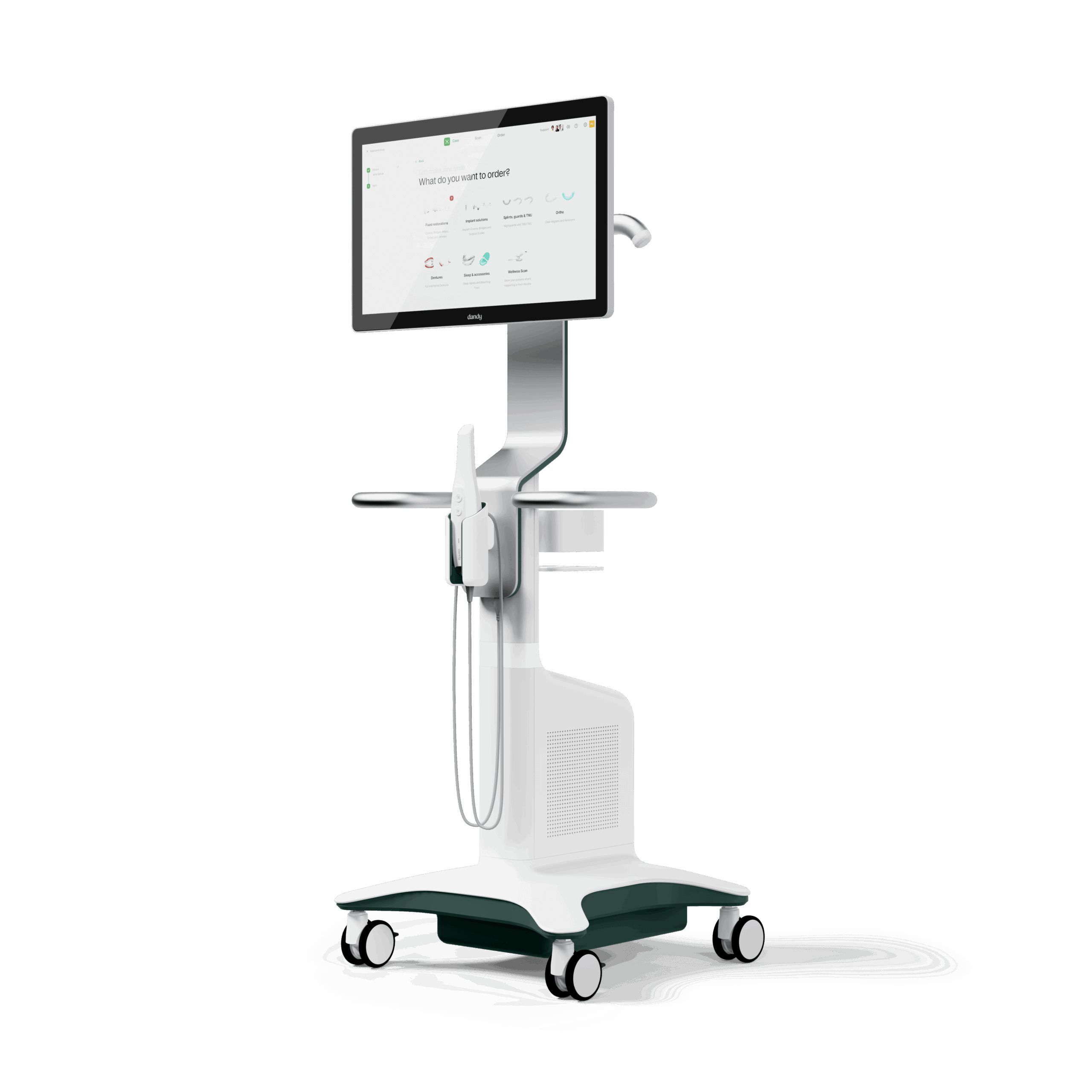
The Dandy Vision Scanner is a wired intraoral scanner developed and branded by Dandy, a company that describes itself as a fully digital dental lab building a modern operating system for dentistry. Dandy launched the Vision on October 27, 2025, alongside a companion touchscreen workstation called the DandyCart, according to the company's official announcement. The scanner reached general availability first, with the cart following in early 2026.
Unlike a traditional standalone scanner sold by a hardware manufacturer, the Dandy Vision sits at the front of an end to end restorative ecosystem. It captures the digital impression, then connects tightly to Dandy's Chairside software, its case management portal, its live lab technician support, and ultimately its manufacturing lab that produces the crowns, bridges, dentures, and other restorations. For a reader new to the category, a plain language explainer of what an intraoral scanner is gives useful background, because the Vision differs from a conventional scanner mostly in how it is packaged and sold rather than in the underlying capture technology.
One point deserves emphasis early. Dandy is primarily a lab company, and the Vision is the distribution channel that brings practices into that lab. That framing explains almost every design and commercial decision around the product, and this review returns to it throughout.
Who Makes The Dandy Vision Scanner?
Understanding the company behind the hardware helps a buyer judge both the product and the durability of the offer. Dandy is a venture backed technology company rather than a legacy dental manufacturer, and that background shapes the entire proposition.
Dandy was founded around 2020 by Toni Oloko and Daniel Hanover, both of whom studied at the University of Pennsylvania. Neither founder comes from a clinical dentistry or dental technician background, so Dandy was built from the outset as a technology company operating in the dental space. For some observers that outsider status is a weakness, while for others it explains Dandy's willingness to rethink the traditional lab and practice relationship and to invest heavily in software and support.
The company is heavily capitalized, having raised a large Series C round led by General Catalyst in September 2025, and it acquired a dental practice management software company in December 2025. A well funded, fast growing company can afford to subsidize hardware aggressively to win market share, which benefits early adopters but also means today's commercial terms reflect a growth stage strategy that could evolve over time.
According to independent digital dentistry educator Dr. Ahmad Al Hassiny of the Institute of Digital Dentistry, the Dandy Vision hardware is manufactured by the OEM Alliedstar and rebranded by Dandy, as noted in his independent review of the Dandy model. White labeling is common in this market, and Alliedstar has a solid reputation, which suggests the underlying capture engine is proven rather than experimental.
Dandy Vision Scanner Features And Specifications
Dandy makes several performance claims for the Vision. As with any manufacturer's marketing, these read best as claims to verify during a hands on trial rather than as independently validated benchmarks, though they map closely to the feature set clinicians actually experience. The sections below break down each capability that matters at the chairside.
Scanning Speed
Speed compounds across every case, every day, so it remains one of the most meaningful real world differentiators in an intraoral scanner. Dandy states that the Vision scans roughly 24.9 percent faster than leading competitor scanners and captures a full arch in under 45 seconds, per its product page and coverage in Dentistry Today. Clinicians who have used it describe a smooth, continuous capture rather than a choppy one, and independent reviewers place it firmly in the tier of fast, capable modern scanners.
Optics And Field Of View
Capture quality in difficult intraoral geometry depends heavily on optics, so this specification carries real clinical weight. The Vision uses next generation optics with a wide field of view and a deep depth of field. A wide field of view lets the operator capture more surface area per pass, which reduces the number of sweeps needed, while a deep depth of field improves tolerance to varying distances from the tissue and helps in deep sulci, distal molars, and other awkward areas.
Soft Tissue And Color Capture
Soft tissue clarity and color fidelity matter for margin identification, shade communication, and patient facing visuals. The Vision is designed to render tissue cleanly enough to support confident treatment planning and to keep the on screen model legible for patient education, which ties directly into case acceptance during a consultation.
AI Powered Scan Analysis
This capability most clearly distinguishes the Vision from a generic modern scanner. The system runs AI driven instant issue detection and real time crown prep analysis while the operator scans, and Dandy reports that the model draws on data from more than 11.5 million scans, according to Inside Dentistry. The next section examines the AI in more depth, because it is the basis for Dandy's claim that the Vision is the smartest scanner on the market.
Tips, Software, And Consumables
Recurring consumable costs add up in every digital practice, so bundled inclusions carry more value than they first appear. Dandy provides mirror tips free for life with the Vision, subject to fair use limits scaled to scanning volume, and the scanner runs on Dandy's Chairside software with no separate monthly software fee. Removing tip inventory tracking and license costs lowers both the ongoing spend and the administrative friction of a digital workflow.
Specifications Dandy Does Not Publish
A professional evaluation should note what is absent as well as what is present. Dandy does not prominently publish a stated accuracy or trueness figure in microns, handpiece weight and dimensions, tip sterilization cycle counts, or a formal hardware warranty term for the scanner itself, in the way traditional manufacturers typically do on a spec sheet. Because the scanner is a hardware placement rather than a purchase, the usual own it warranty framing does not apply in the same way, so any reader for whom those metrics are decision critical should request them directly from a Dandy representative and confirm them in writing.
The AI Engine Behind The Dandy Vision
Dandy calls the Vision the smartest intraoral scanner, and the AI is the foundation of that claim. Two capabilities stand out for restorative clinicians, and both aim to move quality control upstream to the moment of capture.
Instant issue detection. As the operator scans, the system analyzes the capture in real time and surfaces potential problems, the kinds of issues that lead to remakes, seat appointment adjustments, and extended chair time when missed. Catching a scanning gap, a hard to read margin, or a data problem while the patient is still in the chair costs far less than discovering it days later when the case returns from the lab.
Real time crown prep analysis. The AI evaluates the preparation itself, for example highlighting areas of insufficient occlusal reduction or flagging undercuts relative to the path of insertion, visualized directly on the model. In effect, the scanner offers a second, algorithmic set of eyes on the prep before the clinician commits the case. For newer clinicians, or for practices standardizing quality across multiple providers, that real time coaching can meaningfully reduce variability and remakes.
How much a practice values this depends on experience level and current remake rate. A seasoned restorative dentist with a low remake rate may treat the AI as a helpful confirmation, while a practice newer to digital, or one with associates of varying experience, stands to gain the most. One honest caveat applies throughout, because AI prep analysis remains decision support rather than a replacement for clinical judgment, and it can only flag what it has been trained to flag.
The DandyCart Workstation
Launched shortly after the scanner, the DandyCart completes the system and addresses a hidden cost of going digital. It removes the need to buy and maintain a capable computer for every scanning location, and it standardizes the hardware environment, which simplifies support.
The DandyCart is a 21.5 inch HD touchscreen workstation on wheels that pairs with the Vision. It provides the computing power to render high resolution scans instantly and gives clinicians a large, responsive display to zoom, rotate, and review scans chairside. The large screen also doubles as a patient communication tool, turning an abstract scan into a visual story that supports case discussions and helps the team walk a patient through a dental treatment plan they can actually see, which supports case acceptance. Dandy describes the cart as roughly a 40,000 dollar value included with the partnership at no additional hardware cost.
The Software And Support Ecosystem
Dandy has arguably invested most in software and support, and for many practices this is the real reason to consider the platform. The company sells a supported workflow rather than a bare scanner, which matters most for practices whose previous barrier to digital was uncertainty rather than hardware cost.
Chairside software guides scanning and ordering step by step, which lowers the learning curve for teams new to digital workflows and reduces operator error.
Live scan review lets a lab technician check a scan in real time, reportedly in under 60 seconds, while the patient is still in the chair, which sharply reduces the risk of sending an inadequate scan.
Case management portal provides real time case tracking with delivery estimates and the ability to make modifications through the software.
Digital design previews arrive within roughly 24 hours, so clinicians can review the proposed restoration design before manufacturing.
Around the clock support is available through phone, text, email, and live chat, which is a genuine differentiator for a solo or small practice adopting digital dentistry without an in house technology champion.
The Business Model, Understanding The Free Scanner
Every dental professional needs to understand this section clearly, because the commercial model defines the Dandy Vision more than any specification. The details below come from Dandy's own pricing page and from independent reporting on the arrangement.
What You Get And What It Costs
The value on offer is substantial, and so is the commitment attached to it. The Dandy Vision carries a stated MSRP of around 30,000 dollars, and the DandyCart is described as roughly a 40,000 dollar value. Dandy provides both, plus the Chairside software and updates, at no upfront hardware cost, with a one time shipping and activation fee reported at around 800 dollars. In exchange, the practice commits to a monthly lab minimum spend, which Dandy's pricing materials put at 1,000 dollars per month. If lab orders meet or exceed the minimum, the practice pays only for the work ordered, and if orders fall short, the practice pays the difference. Dandy describes the arrangement as month to month with no long term contract, allows the minimum to be paused for planned absences, and retains legal title to the hardware.
Is The Scanner Actually Free?
The honest answer is that the scanner is free in the same way a phone is free on a carrier contract. The practice is not paying for the hardware directly, yet it commits to routing a minimum volume of lab work to Dandy every month, and the cost of the hardware is effectively amortized into that arrangement. At a 1,000 dollar monthly minimum, the commitment reaches at least 12,000 dollars per year and roughly 24,000 dollars over two years, which is comparable to purchasing a typical intraoral scanner outright, and the practice still does not own the hardware. The decision therefore hinges on a single question, namely whether the practice was going to send that volume of lab work somewhere anyway.
A practice already sending 1,000 dollars or more per month in crown and bridge, denture, or implant work, and satisfied with Dandy's quality, turnaround, and pricing, effectively receives the scanner, cart, software, and support as a bundled bonus on top of existing lab spend. A practice with lower lab volume, or one that values the freedom to shop cases across multiple labs, may end up paying the difference in slow months and funneling work to a single lab to justify the free hardware.
The Scanner Independence Trade Off
Scanner independence is the most important strategic consideration in the whole evaluation. A scanner purchased outright from a hardware vendor belongs to the practice, which can send digital impressions to any lab, switch labs freely, and control its own digital workflow. Under the Dandy model, the scanner is tied to Dandy's lab, so a practice that later becomes dissatisfied with lab quality, turnaround, or pricing, or that faces changed terms in the future, could lose the scanner once it stops sending work. Independent experts specifically flag this loss of flexibility as the core trade off. Dandy does offer a bring your own device program for practices that already own scanners such as a 3Shape TRIOS, and in some cases has provided a TRIOS 5 to new customers instead of the Vision, which preserves some flexibility for practices that want to keep an independent scanner.
Warranties And Remakes
Dandy backs its lab products, rather than the scanner hardware, with strong warranties, including lifetime coverage against manufacturing defects on many fixed restorations and multi year coverage on removables, along with free remakes. This coverage applies to the restorations Dandy manufactures and forms a meaningful part of the overall value for a practice routing its lab work to the company. A reader should not confuse lab product warranties with hardware warranty on the scanner itself, which the placement agreement governs.
Where The Dandy Vision Fits In The Market
The intraoral scanner market in 2026 is crowded and mature, so raw scanning performance is no longer where most scanners win or lose. Differentiation has shifted toward software, AI, ecosystem, and total cost of ownership, and the Dandy Vision competes precisely on those newer axes.
Established platforms such as the iTero Lumina, the Medit i700, and the Primescan 2 offer excellent, fast, and accurate scanning, and many have converged on similar core performance. On pure hardware, independent reviewers place the Vision in the tier of any strong modern scanner, built on proven OEM hardware. Its genuine differentiators are the real time AI prep and issue analysis, the approachable interface and onboarding, the integrated live lab support, and the commercial model that removes the upfront hardware cost. The counterpoint is that competitors let a practice own the scanner and keep full lab flexibility, and that scanner prices have fallen substantially in recent years, which softens the advantage of free hardware.
Who Should Consider The Dandy Vision
The right answer depends far more on how a practice runs its lab relationships than on the hardware itself. The two lists below summarize the strongest and weakest fits.
Strong fit
Practices going digital for the first time that want maximum hand holding, live scan review, and a gentle learning curve.
Practices already sending 1,000 dollars or more per month in lab work that are open to consolidating with a single, technology forward lab.
Multi provider practices or groups that want to standardize prep quality and reduce remakes through AI coaching.
Cost sensitive practices that prefer to avoid a large upfront capital purchase for scanning hardware.
Weaker fit
Practices that highly value lab independence and want to send cases to multiple labs or a specific trusted local lab.
High volume restorative practices with established lab relationships and their own quality systems.
Practices whose monthly lab volume sits well below the minimum, where paying the difference means paying for work they do not need.
Clinicians who simply want to own their equipment outright and retain full control of their digital workflow.
Bottom Line
The Dandy Vision Scanner is a capable, AI forward intraoral scanner with an exceptional software and support ecosystem, delivered through a bold free with lab minimum model that removes the upfront cost barrier to digital dentistry. Its strengths in speed, real time AI prep analysis, live lab support, and easy onboarding are real, and so are its trade offs in ownership, lab independence, and monthly commitment. A practice that already sends steady lab work and values a connected, supported workflow may find the Vision an outstanding deal, while a practice that prizes independence and equipment ownership may prefer a purchased scanner. The wise move is to evaluate the lab, read the terms, and trial the system before signing.
Verdict
<p>The Dandy Vision Scanner is a well executed, modern intraoral scanner wrapped in one of the smartest commercial strategies dentistry has seen. On the hardware itself, it earns a solid recommendation, because capture is fast and fluid, the optics are capable, and the real time AI prep analysis is a legitimately useful clinical tool, especially for reducing remakes and standardizing quality across providers. The onboarding, live scan review, and around the clock support rank among the best available and make this one of the easiest ways for a hesitant practice to finally go digital.</p><p>The important caveat is that a practice is not choosing a scanner in isolation, it is choosing a lab relationship with a scanner attached. The free hardware is financed through a 1,000 dollar monthly lab minimum, and the scanner remains Dandy's property, which makes the arrangement smart for a practice that already sends that volume of work and values a connected, well supported workflow, and a poorer fit for a practice that prizes lab independence or has lower volume. The sensible path is to run a hands on trial, request accuracy specs, exact fees, and exit terms in writing, and pilot Dandy's lab work on several real cases before committing, judging the lab as carefully as the scanner, because the lab is what the practice is really buying.</p>
Frequently Asked Questions
Is the Dandy Vision Scanner really free?
Not exactly. There is no upfront hardware purchase, but the practice commits to a monthly lab minimum of about 1,000 dollars plus a one time shipping and activation fee reported around 800 dollars. Dandy retains ownership of the scanner, so the practice pays for it indirectly through lab work over time.
Do I own the Dandy Vision Scanner?
No. The scanner is provided as a hardware placement, and Dandy retains legal title. It is intended for use within Dandy's digital workflow, and ending the partnership or failing to meet the lab commitment can require returning the equipment.
What is the monthly cost?
Dandy's stated lab minimum is 1,000 dollars per month. If lab orders meet or exceed that figure, the practice pays only for the work, and if orders come in lower, the practice pays the difference. Dandy says the minimum can be paused for planned absences such as vacation.
Is there a long term contract?
Dandy describes the partnership as month to month with no long term contract and says the equipment can be returned if it does not meet expectations. Any practice should confirm the exact exit terms, notice periods, and conditions in writing before signing.
How fast is the Dandy Vision Scanner?
Dandy claims the Vision scans about 24.9 percent faster than leading competitors, with full arch capture reportedly in under 45 seconds. In independent hands on impressions, it performs like other strong modern scanners, meaning fast and fluid.
What makes the AI different from other scanners?
The Vision runs real time AI issue detection and crown prep analysis while the operator scans, flagging problems such as insufficient occlusal reduction or undercuts before the patient leaves the chair. It functions as decision support that helps reduce remakes, not as a replacement for clinical judgment.
Who manufactures the Dandy Vision hardware?
According to independent educator Dr. Ahmad Al Hassiny, the Vision is a rebranded scanner built by the OEM Alliedstar, a reputable manufacturer. White labeling is common across the intraoral scanner market.
Can I use my existing scanner with Dandy instead?
Yes. Dandy offers a bring your own device program for practices that already own scanners such as a 3Shape TRIOS, and in some cases has provided a TRIOS 5 to new customers, which lets a practice keep an independent scanner while using Dandy as its lab.
What is the DandyCart?
The DandyCart is a 21.5 inch HD touchscreen workstation on wheels that pairs with the Vision. It renders scans instantly and doubles as a patient communication and case acceptance tool, and it is included with the partnership at no additional hardware cost, described as roughly a 40,000 dollar value.
What about warranties and remakes?
Dandy provides free remakes and strong warranties on its lab products, including lifetime coverage against manufacturing defects on many fixed restorations and multi year coverage on removables. These warranties cover the restorations Dandy manufactures, not the scanner hardware itself.
Is the scanner tied to Dandy's lab?
Yes, and that is the core trade off. Scanning is coupled to Dandy's lab and workflow, which reduces the freedom to switch labs or route cases elsewhere, so a practice should weigh how much lab flexibility matters before committing.
What should I do before signing up?
Run a hands on trial, request accuracy specs and the full fee schedule in writing, clarify exit terms, and pilot Dandy's lab quality on several real cases. Because the practice is effectively choosing a lab, it should evaluate turnaround, quality, and consistency as carefully as the scanner itself.