Peg Lateral Teeth: Causes, Bonding, Veneers, and Treatment
Peg lateral teeth are upper front teeth that grow in narrow and pointed, like small fangs. Patients often hide them for years with a closed-lip smile. The good news is that...
Written by Mantas Petraitis
Read time: 6 min read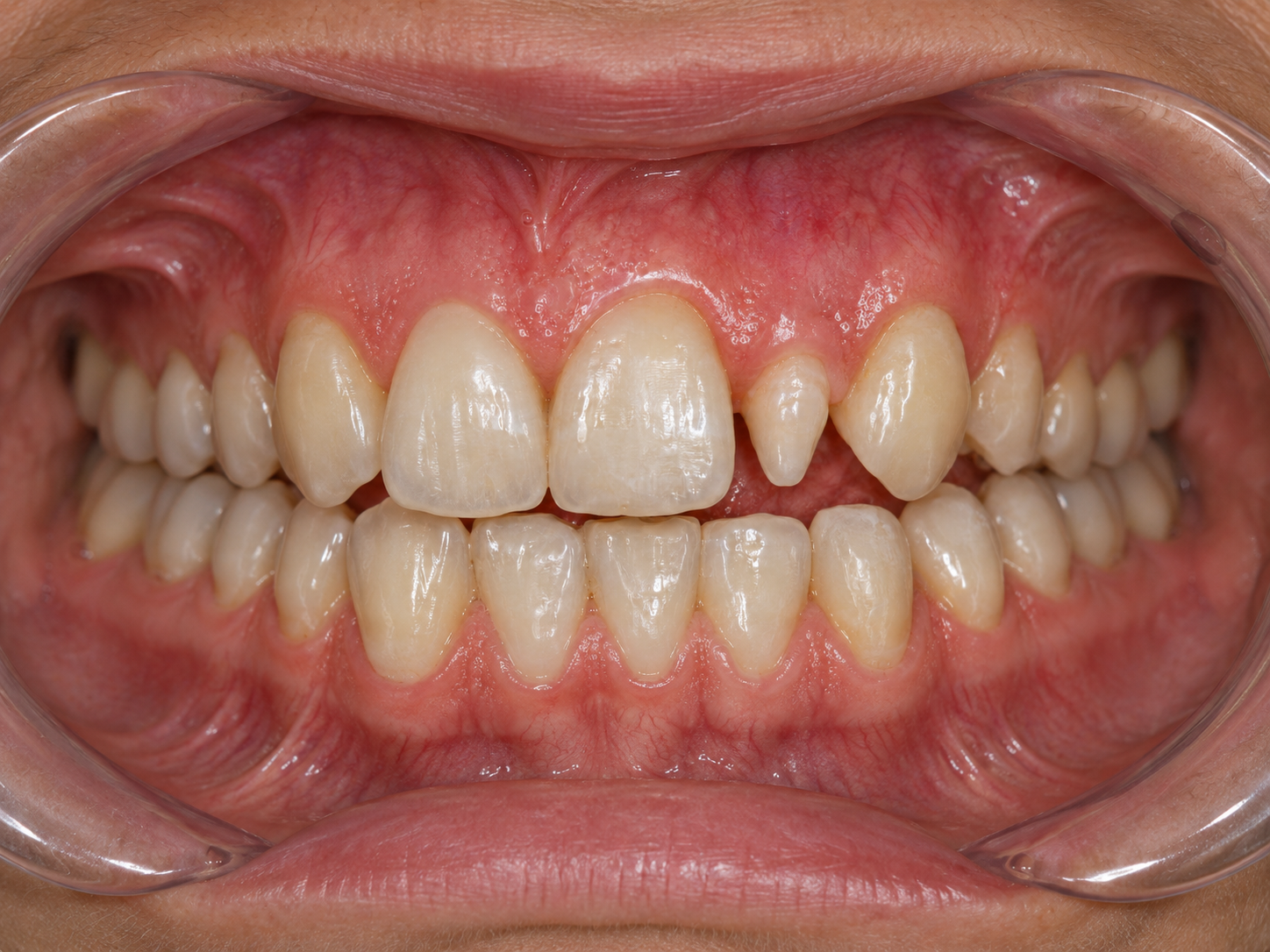
Peg lateral teeth are upper front teeth that grow in narrow and pointed, like small fangs. Patients often hide them for years with a closed-lip smile. The good news is that they're usually healthy teeth. Most can be rebuilt without drilling away any enamel.
TL;DR
Peg lateral teeth form small and cone-shaped before they erupt, and they affect about 1.8% of people.
A child with a peg lateral needs a canine check, since nearby teeth often erupt off course.
Composite bonding adds volume with little or no drilling and suits most cases, including teenagers.
Orthodontics sets the space first, and a mock-up previews the final shape before any permanent work.
What Are Peg Lateral Teeth?
Peg lateral teeth are permanent upper lateral incisors that develop with an undersized, tapered crown. Dentists call this localized microdontia. One tooth type forms small while the rest develop normally.
A typical upper lateral crown measures about 6.5 mm across. A peg lateral may be 4 or 5 mm wide, with sides that slope toward a narrow tip. That missing width has to go somewhere. It shows up as spaces next to the tooth, which patients often notice first.
Lateral incisors are one of the four types of teeth. They soften the step between the wide central incisors and the pointed canines. A peg lateral removes that step, so the smile can look sharp or childlike.
Peg Lateral Teeth vs. Naturally Small Teeth
Some people have lateral incisors that are small but normally shaped. Their sides run fairly parallel, and the edge is flat, like a scaled-down standard incisor.
A true peg lateral is wider at the gumline than at the biting edge. That reversed taper changes the treatment. A small, normally shaped lateral may only need a little added length. A peg lateral needs volume built onto both sides. The Hua meta-analysis found one-sided and two-sided cases at similar rates. In one-sided cases, the left side was affected twice as often.
What Causes Peg Lateral Teeth?
Peg lateral teeth form while the tooth is still developing inside the jaw. The crown shape is locked in years before the tooth appears in the mouth.
Genetics and Tooth Development
Tooth size and shape are strongly inherited. A parent who brings in a child with a peg lateral often has one too. Sometimes the parent is missing a lateral instead.
Alvesalo's family research linked peg-shaped and missing laterals as two expressions of the same inherited trait. That explains a puzzling pattern seen in families. One sibling has peg laterals, another is missing both laterals, and a third has normal teeth. No single gene or inheritance pattern covers every case.
Association With Missing or Undersized Teeth
A peg lateral is often the visible part of a bigger developmental picture. Dentists treat it as a reason to look at every other tooth, including the ones still forming.
In the Hua meta-analysis, 55.5% of people with a one-sided peg lateral were missing the opposite lateral. That mix is one of the hardest cases to treat, since the two sides need opposite solutions. A 2022 study in Progress in Orthodontics also links missing laterals with peg laterals and impacted canines.
The canine link is easy to miss. The lateral incisor root acts as a guide rail for the erupting canine. A short, thin peg lateral root gives poor guidance. A study of patients with impacted upper canines found peg laterals in 11.2% of them. From about age 10, the dentist should feel for the canine bulge above a peg lateral. If it can’t be felt, an X-ray is the next step. Catching a stray canine early can turn a surgical problem into a simple one.
Can Peg Laterals Develop After the Teeth Erupt?
No, a peg lateral's shape is fixed before the tooth breaks through the gum. Adults sometimes ask whether their laterals "shrank," and the answer is almost always wear or old damage.
Grinding, acid erosion, and fractures change teeth later in life. Teeth worn by bruxism lose length along the biting edge, so they look short and flat. A peg lateral looks narrow and pointed. A worn tooth also needs its cause controlled before any rebuild.
What Do Peg Lateral Teeth Look Like?
Peg laterals are easy to spot in photos, even when patients can't name the problem. Common features include:
A narrow, pointed upper lateral incisor
Spaces beside the central incisors or canines
Uneven proportions when only one side is affected
A gumline that sits higher or lower than expected
Crowding, rotation, or a displaced canine in some cases
The spaces around peg laterals are often confused with black triangles between teeth. Black triangles appear near the gumline when gum tissue between teeth shrinks. Peg lateral spaces run from the gum to the biting edge because the crown itself is too small. The fixes overlap, though the planning is quite different.
Do Peg Lateral Teeth Need Treatment?
No, a peg lateral is a sound tooth, and leaving it alone is a valid choice. Some people like the look, and some see it as part of their face.
The more common situation is a teenager who stops smiling in photos. That concern is real and worth treating. The key question is what the treatment costs the tooth. A peg lateral is short on volume, so the logical fix adds material. Any plan that starts by grinding down a healthy peg lateral deserves a second opinion.
Timing also counts. A peg lateral can be bonded at almost any age once it has fully erupted. Treatment that removes enamel is best left until the patient is an adult and the gums have matured.
Peg Lateral Teeth Treatment Options
Peg lateral teeth treatment depends on whether the problem is tooth size, tooth position, or both. In most mouths it's both, which is why orthodontics and bonding so often go together.
Treatment | Most relevant clinical situation | Main consideration |
|---|---|---|
Composite bonding | Healthy enamel and even spacing | Conservative, repairable, needs upkeep |
Porcelain veneers | Adults with stable gums and ceramic goals | May need some enamel preparation |
Orthodontics | Tooth position or spacing needs correction | Usually followed by bonding or veneers |
Dental crowns | Uncommon cases with major damage | Removes the most tooth structure |
No treatment | Healthy tooth and a satisfied patient | Avoids unneeded procedures |
Composite Bonding for Peg Lateral Teeth
Composite bonding adds tooth-colored resin to the outside of the peg lateral. For this tooth, bonding is the default starting point, and veneers need a reason to beat it.
Peg laterals are one of the few cases where “no drilling” is literally true. The dentist cleans and etches the enamel, applies adhesive, and builds resin onto the sides and tip. Most patients need no numbing. Two laterals typically take one to two hours. The patient leaves with new teeth the same day.
Modern technique has made results far more predictable. In the injectable method, a wax model of the planned tooth is copied into a clear silicone guide. Flowable resin is then injected through the guide onto the tooth. A clinical report found this workflow transferred the approved design accurately in one visit.
Composite picks up coffee and tea stains at the edges and loses its gloss over a few years. Small chips happen, usually from biting something hard. Each of those can be fixed in a short visit, since new resin bonds to old resin. That repairability is the main reason bonding fits minimally invasive dentistry so well.
Porcelain Veneers for Peg Lateral Teeth
A porcelain veneer is a thin ceramic shell made in a lab and bonded to the tooth. On a peg lateral, the veneer wraps around the sides to add the missing width.
Veneers make sense for some adults. They hold their shine and color for longer than composite. They also suit patients treating several front teeth at once. Because a peg lateral is so small, many cases need little or no enamel removal. The lab simply builds the bulk into the ceramic.
That bulk has a catch. A veneer that flares out at the gumline traps plaque and leaves the gum red and puffy. Good veneer work on a peg lateral depends on the gum shape as much as the tooth shape. Teenagers are usually better off waiting. A 2024 report in Dentistry Journal used composite on two 12-year-olds as an interim step before ceramic. Prices vary widely, and our veneers cost guide covers them by material and state.
One trend is hard to defend. Some patients with two peg laterals are offered eight or ten veneers as a "smile makeover." When the other teeth are healthy, two bonded laterals usually solve the real problem.
Orthodontic Treatment Before Restorations
Orthodontic treatment fixes where the teeth sit. Bonding and veneers fix how big the teeth are. Most peg lateral patients need some of each.
The classic mistake is letting braces finish first and planning the lateral afterward. The orthodontist closes spaces evenly. The dentist then has too little room for a normal-sized lateral. Most dentists will recommend planning orthodontics first, with the final lateral shape already decided. Peg laterals often create a tooth size mismatch between the arches, and the bite suffers without a plan.
The best results start with a wax-up of the final teeth. The orthodontist then moves teeth to fit that design, leaving equal space on both sides of each lateral. Some orthodontists bond a temporary composite shell onto the peg lateral during treatment. It gives the brackets a proper target and the patient a better smile in the meantime. A case report described this combined approach in a teenager.
Clear aligners can do the same job, and Invisalign cost depends on case length. Once braces come off, a retainer such as an Essix retainer holds the space. Spaces reopen fast, so final bonding should follow within a few weeks, once the gums have settled.
When Are Crowns or Other Treatments Considered?
Full crowns are rarely right for a healthy peg lateral. A crown requires trimming the tooth on every side, and a peg lateral has very little to trim.
Crowns may suit a lateral that already has a large filling, a root canal, or a fracture. Our dental crown cost guide explains the materials. The British Dental Journal review describes the core decision as restoring or replacing a peg lateral. Replacement is reserved for teeth with very short roots or poor gum support.
Extracting a healthy peg lateral for an implant is a poor trade-off in most cases. Front implants in young adults can appear to sink over time as the face keeps changing. The natural tooth moves with the face, and the implant doesn’t.
Composite Bonding vs. Veneers for Peg Lateral Teeth
Both options can give a peg lateral natural proportions. The real choice depends on age, gum stability, enamel, bite, and how much width the tooth needs.
Factor | Composite bonding | Porcelain veneers |
|---|---|---|
Tooth preparation | Often none | Minimal to light enamel reduction |
Treatment workflow | One chairside visit | Two or more visits with a lab |
Repairability | Quick and simple | Usually needs a new veneer |
Staining | Edges stain over time | Stays stain-resistant |
Cost | Usually lower | Usually higher |
Best fit | Teens and most adults | Adults treating several teeth |
Bonding keeps every door open. A patient who bonds at 15 can switch to veneers at 30 with the enamel still intact. Going the other way isn't possible once enamel is gone.
Long-term studies comparing the two on peg laterals are limited, so neither has proven itself superior. A reasonable rule is to bond first and upgrade only for a clear reason. For a broader view of options, see our guide to cosmetic dentistry treatments.
How Do Dentists Plan Peg Lateral Teeth Correction?
Good peg lateral work is decided before the first drop of resin. Planning covers the teeth, the gums, the bite, and the face. A typical workup includes:
Measuring each front tooth and the space beside each lateral
Checking whether the canines are present and on course
Evaluating gum heights and smile symmetry
Assessing how the lower teeth contact the laterals
Building a diagnostic wax-up and an in-mouth mock-up
Coordinating orthodontic and restorative steps when needed
Common Planning Mistakes
The most frequent problem in peg lateral cases is an oversized lateral. Patients often ask for “bigger” teeth, and a lateral built too wide looks like a second central incisor. It flattens the smile.
Textbook formulas such as the golden proportion give a starting point. Real faces vary, and the golden proportion often makes laterals look too narrow in a broad smile. The final width should come from the mock-up and the patient's face. It should also look right from across the room.
Gum height is the second trap. The lateral gumline naturally sits slightly lower than the central and canine gumlines. If a peg lateral's gum sits too high or uneven, longer resin can't hide it. A small gum contouring procedure may come first.
A mock-up solves most of these issues. It's a temporary resin copy of the plan placed over the patient's own teeth. The patient can smile, talk, and take photos before anything is permanent. Many clinics use dental treatment plan software to share each phase with the orthodontist and patient. The bite gets a final check too. Our entry on occlusion explains why lower teeth striking a new edge too hard can chip it.
How Much Does Peg Lateral Teeth Treatment Cost?
Peg lateral teeth cost depends on the number of teeth, the material, and whether orthodontics comes first. Location and the dentist's experience also shape the fee.
Bonding two laterals usually costs far less than two veneers, and much less than a full makeover. When braces are involved, the orthodontic phase is often the largest part of the bill. Our veneers cost guide lists US prices by material. Insurance often treats reshaping as cosmetic. Some plans review congenital conditions differently, so request a pre-treatment estimate.
How Long Do Peg Lateral Teeth Restorations Last?
Peg lateral restorations can last many years, though none are permanent. Treatment is best seen as an ongoing relationship with the tooth.
Composite needs a polish every year or two to keep its shine and remove edge stains. Ceramic needs less upkeep but can debond or crack, usually from heavy biting. Night grinding is the biggest threat to both, and a night guard protects the investment. If you plan teeth whitening, do it before bonding, since resin and ceramic won't lighten later. No firm lifespan applies to every patient, because long-term data on peg laterals specifically is limited.
Bottom Line
Peg lateral teeth are healthy teeth with an unusual shape, and they rarely need anything taken away. Composite bonding solves most cases with no drilling. Orthodontics should be planned around the final tooth shape, and a mock-up should come before permanent work. Children with peg laterals also deserve an early canine check. Veneers, crowns, and implants have a place, though usually later and less often than offered.
Frequently Asked Questions
Are peg lateral teeth genetic?
Yes, peg lateral teeth are strongly inherited. They often run in families, sometimes alongside missing lateral incisors in parents or siblings. One sibling may have peg laterals while another is missing a lateral. Siblings of an affected child are worth checking early.
Can peg lateral teeth be fixed with bonding?
Yes, bonding fixes most peg lateral teeth. The dentist adds tooth-colored resin to build width and shape, usually with no drilling or numbing. It works best when orthodontics has left even space on both sides. Bonding follows minimally invasive dentistry principles and is simple to repair.
Are veneers better than bonding for peg laterals?
Veneers aren't better for every patient. They resist staining and suit adults treating several teeth. Bonding costs less, keeps the enamel intact, and leaves the veneer option open for later. Our veneers cost guide explains the price difference by material and state.
Can braces fix peg lateral teeth?
Braces fix the position and spacing of peg lateral teeth. The crown stays the same size, so bonding or veneers usually follow. The best results come when the orthodontist works toward a planned final tooth width. Clear aligners can do the same job, and Invisalign cost varies by case.
Do peg lateral teeth need to be removed?
Peg lateral teeth rarely need to be removed. Keeping a healthy peg lateral preserves the bone and gum around it, which an implant can't fully replicate. Extraction is considered only for very short roots or serious damage. In those cases, a dental bridge or implant may be discussed.
Can one peg lateral tooth be corrected?
Yes, a single peg lateral can be corrected to match its partner. Shade matching is the hard part because the two teeth sit close together and are compared constantly. A mock-up confirms symmetry first. Plan any teeth whitening beforehand, since resin and ceramic won't change color later.