How Often Should You Replace Your Toothbrush?
The American Dental Association recommends that you replace your toothbrush every three to four months, or sooner if the bristles look frayed. A Delta Dental survey released on...
Written by Maren Solvik
Read time: 6 min read
The American Dental Association recommends that you replace your toothbrush every three to four months, or sooner if the bristles look frayed. A Delta Dental survey released on October 8, 2026, found that only 55% of US adults stick to a three-month schedule. Research on bristle wear suggests the condition of your brush matters as much as the date.
TL;DR
Replace your toothbrush every three to four months, or sooner if bristles fray.
Check bristle splay weekly, since wear predicts cleaning loss better than age.
Swap electric toothbrush heads on the same schedule as manual brushes.
Rinse, store upright, and air-dry your brush after every use.
How Often Should You Replace Your Toothbrush?
The ADA's guidance is simple: replace a toothbrush every three to four months, and sooner if the bristles become matted or frayed. The ADA ties this advice to cleaning performance, since a brush removes less plaque as its bristles wear down.
In practice, that recommendation works as an upper limit with a built-in exception. Four months is roughly the longest a brush should stay in service, while visible wear can justify replacing it much earlier.
How long a toothbrush lasts depends largely on the person using it. Someone who brushes gently with a soft brush may keep straight bristles for the full three months, while a heavy-handed brusher can flatten a new one within weeks. That same pressure also wears down the gums, which our guide to the best electric toothbrush for receding gums covers in more detail.
Gentle brushers often wonder whether a brush that still looks tidy can stay in use past four months. The ADA interval still applies, because filaments gradually lose stiffness in ways that are hard to see. A brush can look acceptable yet flex too easily to clear plaque along the gumline, so treat four months as the outer limit and let visible wear shorten it.
Why Are Nearly Half Of Americans Not Replacing Their Toothbrushes On Time?
The new figures come from Delta Dental's 2026 State of America's Oral Health and Wellness Report, which the company highlighted on October 8 for National Dental Hygiene Month. Researchers surveyed 1,000 US adults and 1,000 parents of children 12 and under between January 5 and 15, 2026, with a margin of error of plus or minus 3%.
Only 55% of adults said they replace their toothbrush every three months. Among those who fall behind, three reasons stood out:
Forgetting, cited by 46%
Waiting until the bristles look worn, cited by 42%
Skipping a replacement during routine shopping, cited by 30%
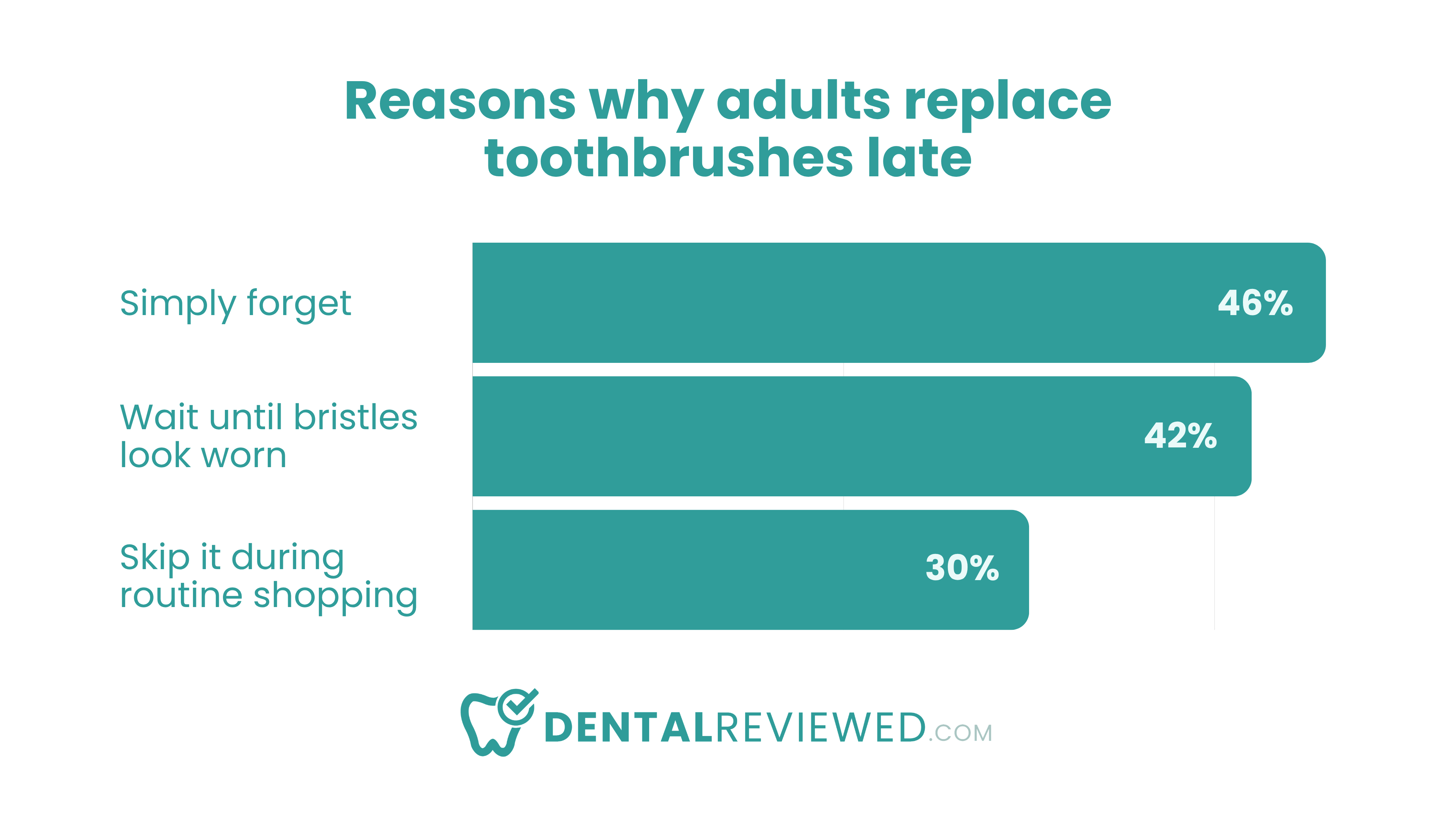
These answers point to two very different groups. Forgetting is simply a habit problem, while waiting for visible wear is a deliberate choice that lines up with some of the research covered below. People who check their bristles regularly may end up replacing a brush at the right time, even without a calendar reminder.
The report also found that 72% of adults brush twice a day and 73% floss daily. Keep in mind that these figures are self-reported, since the survey did not measure plaque, gum health, or brush condition. They show what Americans say they do and offer no direct insight into clinical outcomes.
Does An Old Toothbrush Clean Your Teeth Less Effectively?
Worn bristles do clean less effectively, although the effect depends on how far the wear has progressed. A new brush has straight, springy filaments packed into tight tufts that reach along the gumline and into the grooves between teeth. With use, the outer tufts splay outward, the filaments mat together, and the material gradually softens.
Each of these changes reduces how much contact the bristle tips make with the tooth surface. Splayed tufts sweep the space beside the tooth, and soft, bent filaments tend to skid over plaque rather than lift it. Plaque left behind at the gumline is what triggers gingivitis.
A 2019 study in the International Journal of Dental Hygiene put numbers on this effect. After scoring three-month-old brushes from 172 adults, researchers found significantly higher plaque scores among people whose brushes showed extreme wear. Wear varied widely between people but stayed consistent for each individual, so the authors concluded that splaying is a better replacement signal than brush age.
A 2020 randomized trial at Hiroshima University reached a similar conclusion with soft and medium brushes made from PBT, a polyester filament common in manual toothbrushes. The authors reported that these brushes may lose cleaning efficacy after about two months, and a follow-up from the same group showed bristle stiffness dropping significantly at that point.
These results apply to the specific brushes and participants studied, so they do not mean every toothbrush fails on day 60 or day 90. They do show that wear can be measured and that it affects plaque removal.
What Are The Signs You Need A New Toothbrush?
A quick visual check tells you more than the purchase date. Hold the brush at eye level with the bristles facing up and look at the outline of the head. The 2019 researchers used a simple cutoff: once the outer tufts splay past the edge of the head, it is time for a new brush.
Signs you need a new toothbrush include:
Bristles that bend, flatten, or fan outward
Tufts that clump together and stay matted after rinsing
Loose or missing tufts
A cracked handle or a head that wobbles
A sour smell that lingers after rinsing and drying
Visible mold or debris packed at the base of the tufts
Discoloration on its own is a weaker signal, since toothpaste dyes, coffee, and water minerals can tint bristles without creating a hygiene risk. The ADA acknowledges that toothbrushes harbor bacteria but reports no evidence that these bacteria cause adverse health effects. A stained brush is worth replacing when it also shows wear, smells sour, or holds visible residue.
Is The Three-Month Toothbrush Rule Backed By Science?
The three-month rule is a practical guideline built on limited direct evidence. It works well as a default for most people, although trials have never pinned down an exact interval.
Dental organizations broadly agree on the range. One published review compiled advice from 18 dental associations and found recommended intervals running from two to five months, noting that the ADA's three-to-four-month figure rests on expert opinion.
A 2024 scoping review in the Journal of Dentistry examined 26 randomized trials published between 2018 and 2023. Only four of them tracked physical changes in the bristles over time, and the authors called for more research linking bristle properties to plaque and gum scores before an ideal interval can be set.
Several factors change how fast a brush deteriorates:
Brushing pressure, since heavy force splays tufts quickly
Brushing frequency and duration, which add up to total minutes of use
Technique, as hard scrubbing bends filaments more than short, gentle strokes
Bristle material, diameter, and end-rounding
Tuft layout, including angled or multilevel designs
That is why the calendar and the condition of the brush both matter. The calendar catches people who never look at their brush, while a regular condition check catches those who wear one out early, and together they give a more reliable answer than either rule alone.
How Often Should You Replace An Electric Toothbrush Head?
Electric toothbrush heads follow the same basic rule. Philips recommends replacing a Sonicare head every three months of twice-daily use, or when its blue indicator bristles wear out, and Oral-B gives the same three-month guidance for its heads.
Indicator bristles are dyed filaments that fade as you use them, and on many Oral-B heads the color fades halfway as replacement time approaches. Some handles go a step further and flash an alert, including select Sonicare models and the Oral-B iO series.
These signals are useful prompts, but a worn head still needs replacing even when the color looks fine. Splayed tufts reduce contact on a powered brush just as they do on a manual one, and heavy pressure is a common culprit, which is where a pressure sensor helps.
Replacing the head is different from replacing the whole toothbrush. The handle houses the motor and battery and stays in service far longer, and our Sonicare toothbrush review and roundup of the best electric toothbrushes compare current models.
Factor | Manual toothbrush | Electric toothbrush |
|---|---|---|
What you replace | The whole brush | The brush head only |
Standard interval | Every 3–4 months (ADA) | About every 3 months (Philips, Oral-B) |
Built-in reminder | Indicator bristles on some models | Indicator bristles, plus handle alerts on some models |
Replace sooner if | Bristles splay, mat, or fray | Bristles splay, mat, or fray |
Should You Replace Your Toothbrush After Being Sick?
Many people replace their toothbrush after every cold, yet the evidence behind the habit is thin. An ADA News summary explains that pathogens can remain on a brush used during illness, though reuse rarely leads to reinfection because the antibodies your body produced protect against the same germ.
Toothbrush replacement after illness still makes sense in a few situations:
Several brushes share one holder during a household illness, so replace them all
The person has a severely weakened immune system
The person recently had a cold sore outbreak
The illness was bacterial, and a fresh brush is a low-cost precaution
The ADA News summary lists the first three situations directly. Cold sores come from the herpes simplex virus and are different from canker sores, and our guide to canker sore vs cold sore vs mouth ulcer explains how to tell them apart.
For a healthy adult with a cold and a separate toothbrush holder, the regular replacement schedule is usually enough, as long as the brush is rinsed, stored upright, and allowed to dry.
How Often Should Children Replace Their Toothbrushes?
Children should follow the same three-to-four-month rule, although their brushes often wear out sooner. Young kids tend to chew the head, bite the bristles, or scrub with a tight fist, and any of these habits can splay a new brush within a few weeks.
A simple routine helps parents stay on top of it:
Check the bristles every week, ideally during the evening brush
Replace any brush with chewed, flattened, or splayed bristles right away
Choose a child-sized brush with soft bristles and a small head
Keep a spare brush at home, so replacement happens the same day
The ADA advises adults to supervise brushing until a child can spit out excess toothpaste, and that supervision also makes it easier to spot chewing habits early. Parents in the Delta Dental survey reported that 75% of children now brush twice daily, up from 67% in 2025, which also means brushes wear out faster. Families considering a powered option can compare our picks for the best electric toothbrushes for kids.
How Should You Store Your Toothbrush Between Replacements?
Good toothbrush hygiene keeps a brush cleaner and drier between replacements, and the ADA's toothbrush care advice covers the basics:
Rinse the brush well after each use to remove paste and debris
Store it upright and let it air-dry
Space brushes in a shared holder so the heads don't touch
Never share a toothbrush, even with family members
Avoid closed, damp containers, which promote microbial growth
Travel caps are fine for short trips, as long as the brush dries before you cap it and comes out of the cap when you arrive.
Some people prefer to disinfect their brushes, although the ADA notes that data on sanitizing is limited. In one study, soaking a brush in 3% hydrogen peroxide or Listerine reduced its bacterial load by about 85%. The microwave and dishwasher are best avoided, since the ADA warns that high heat can damage the brush, and anyone buying a sanitizer device should look for one cleared by the FDA.
How Can You Remember To Replace Your Toothbrush?
Forgetting was the most common reason late replacers gave in the Delta Dental survey, and a few small systems solve most of the problem:
Set a recurring phone reminder every three months
Write the start date on the handle with a permanent marker
Buy multipacks or spare heads, so a new brush is always on hand
Tie replacement to the change of seasons in March, June, September, and December
Use each dental checkup as a backup prompt
The seasonal approach works especially well for households, since everyone swaps brushes on the same weekend and the next spare pack goes straight onto the shopping list. It also helps the 30% of late replacers who don't pick up a new brush during routine shopping.
For daily brushing time, our free brushing timer runs a full two-minute session.
Bottom Line
So how often should you replace your toothbrush? The ADA's answer of every three to four months, or sooner if the bristles splay, mat, or fray, remains the best default for most people.
Research adds useful detail to that rule. Worn bristles remove less plaque, and wear rates differ widely from one person to the next, so the three-month mark works best as a reminder while the brush itself gives the final answer.
Delta Dental's survey shows that many Americans simply forget, which a recurring reminder and a weekly look at the bristles can fix. A brush in good condition, used twice a day, also supports cavity prevention and healthy gums.
Frequently Asked Questions
How often should you replace your toothbrush?
The ADA recommends replacing your toothbrush every three to four months, or sooner if the bristles look matted, splayed, or frayed.
Is it okay to use a toothbrush for six months?
Six months is beyond the ADA's upper limit. Filaments gradually lose stiffness even when a brush looks tidy, and a softer, splayed brush removes less plaque, so it's best to replace it well before then.
What happens if you don't change your toothbrush?
Over time, the bristles splay, mat, and soften, so a worn brush leaves more plaque behind, especially along the gumline. Over several months, that leftover plaque can raise the risk of gum inflammation.
How often should you replace an electric toothbrush head?
Philips and Oral-B both recommend a new head about every three months, or sooner if the indicator bristles fade or the tufts splay. The handle itself does not need replacing on that schedule.
Should you change your toothbrush after a cold?
A healthy adult usually doesn't need to, because the antibodies from the illness protect against the same virus. Replacing it makes more sense if the brush shares a holder with others or if your immune system is weakened.