What Is TMJ Disorder? A Dentist Explains Types And Self-Checks
What is TMJ disorder, and could it explain jaw pain that flares when chewing, yawning, or clenching under stress? This article covers the three TMD types, a six-question...
Written by Marcus Hale
Read time: 7 min read
What is TMJ disorder, and could it explain jaw pain that flares when chewing, yawning, or clenching under stress? This article covers the three TMD types, a six-question self-check, five jaw exercises, and a priced treatment ladder.
TL;DR
TMJ disorder groups more than 30 jaw joint and chewing muscle conditions into three types.
A score of 3 or more on the six-question self-check signals likely painful TMD.
Home care, jaw exercises, massage, and splints settle most cases without surgery.
Surgery costs $5,000 to $70,000, and suits only damaged joints that resist other care.
What Is TMJ Disorder?
The temporomandibular joint, or TMJ, connects the lower jaw to the skull just in front of each ear. A TMJ disorder, or TMD, is pain or dysfunction in these joints or in the chewing muscles that move them. TMJ technically names the joint and TMD names the problem, and most patients use the two terms interchangeably.
TMD covers more than 30 separate joint and muscle conditions and affects about 5% of US adults, with women developing it roughly twice as often as men, most often between ages 35 and 44.
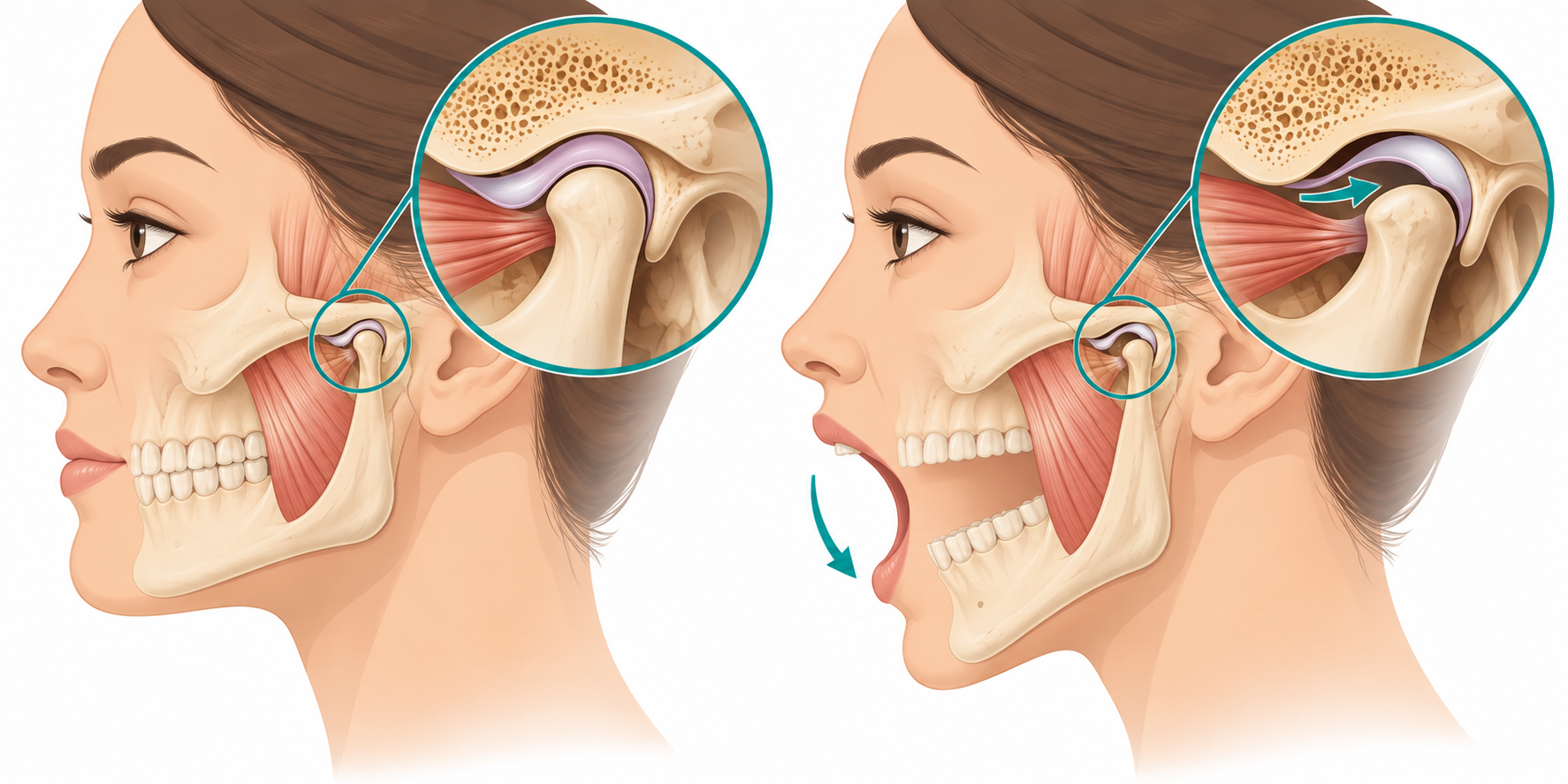
The joint hinges for small movements and slides forward for wide ones, carrying the condyle, the rounded top of the jawbone, onto a bony ridge in front of the socket. A small fibrous disc rides between the condyle and the skull as a cushion, and when that disc slips out of place, the joint clicks, catches, or locks.
What Are The Three TMJ Disorder Types?
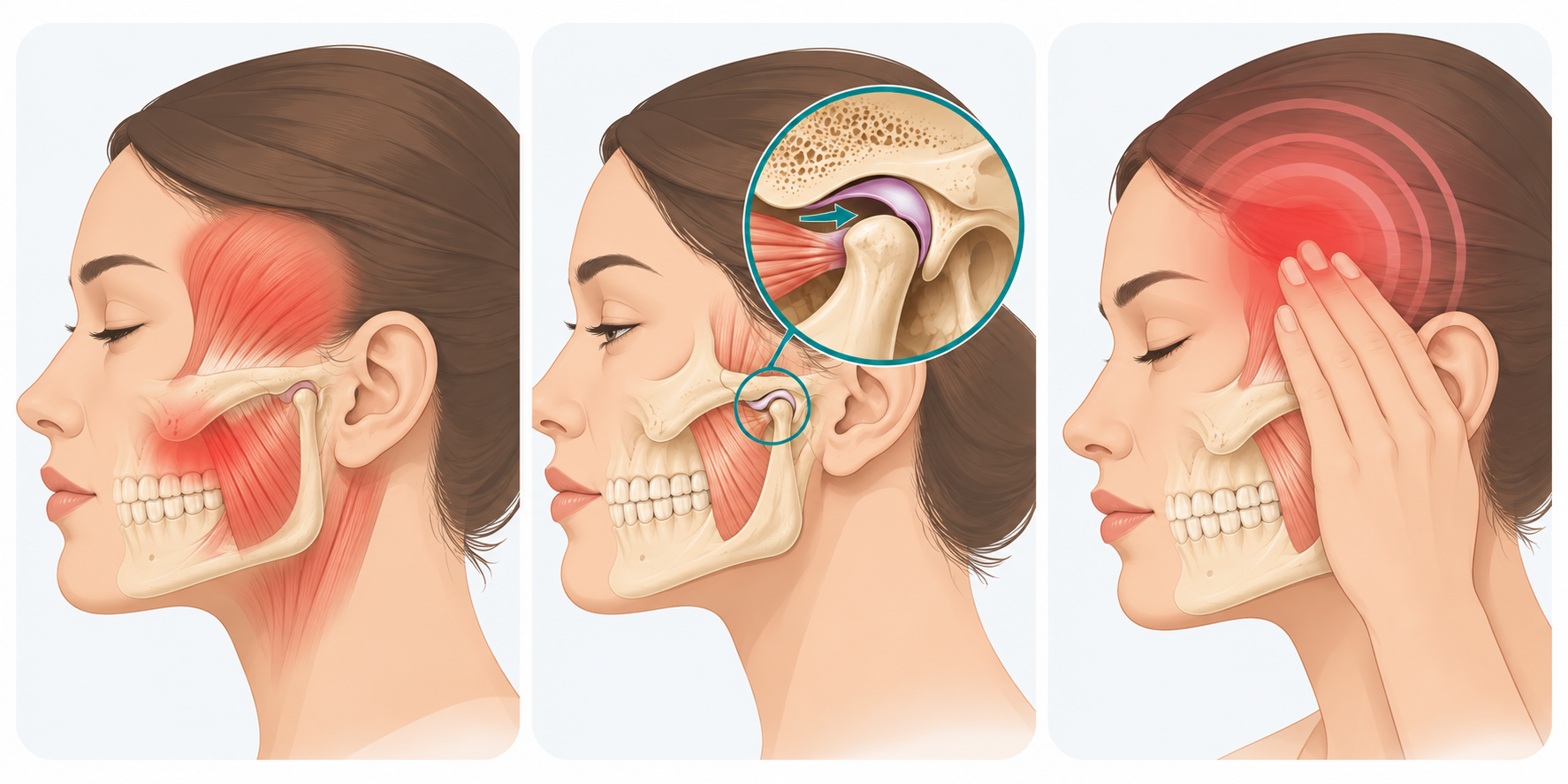
TMJ disorder types fall into three groups: muscle disorders, joint and disc disorders, and headaches caused by TMD. One person can have more than one type at once, and each type responds to different treatment.
What Are TMJ Muscle Disorders?
Muscle pain, called myalgia, is the most common TMD diagnosis and involves the masseter at the cheek and the temporalis at the temple. It feels like a dull, tired ache, and pressing on the sore muscle reproduces it.
Pain that is worst on waking suggests clenching during sleep, while pain that builds through the afternoon suggests clenching at a desk or behind the wheel. Trigger points in the masseter can also refer pain into the molars, which leads some patients to chase a toothache that no filling will fix. Many of these patients show wear facets from teeth grinding on their back teeth.
What Are Joint And Disc Disorders?
Joint disorders start inside the TMJ itself, and the most common is disc displacement with reduction. The disc slips forward and pops back over the condyle during opening, which produces a click on opening and often a softer click on closing.
In disc displacement without reduction, the disc stays forward and blocks the condyle's slide, so opening stops short, usually under 40 millimeters, often after a sudden lock. Arthralgia is an inflamed, painful joint, and a gravel-like grating sound called crepitus suggests degenerative joint disease with cartilage wear.
Can TMD Cause Headaches?
This type causes temple headaches that get worse with chewing, clenching, or wide opening and usually ease once the jaw muscles settle. Many patients carry a tension headache diagnosis before anyone examines their jaw.
What Are The Symptoms Of TMJ Disorder?
TMJ disorder symptoms cluster around the jaw, ear, and temple and change with jaw use, which helps separate them from ear and sinus problems.
Aching in the cheek or temple that worsens with chewing
Jaw stiffness on waking
Clicking, popping, or grating that comes with pain
A jaw that catches or locks open or closed
Ear fullness, ringing, or ear pain with a normal ear exam
Temple headaches
A bite that suddenly feels different
Painless clicking is common and needs no treatment. A bite that suddenly feels different deserves a prompt dental visit, because joint inflammation or bone changes can shift how the back teeth meet.
What Causes TMJ Disorder?
Most cases grow from a combination of the following risk factors.
Genetic differences in how the body processes pain
Stress, anxiety, and poor sleep
Clenching or grinding, awake or asleep
Jaw injury, including long appointments with the mouth held wide open
Osteoarthritis or rheumatoid arthritis
Heavy gum chewing and nail biting
Repeated oral habits such as pen chewing keep the chewing muscles loaded all day.
Bite discrepancies and past braces do not cause TMD, so treatments that permanently change the teeth or bite, such as grinding teeth down or crowning healthy teeth, have no place in TMD care.
Can A TMJ Disorder Self-Check Tell If You Have It?
This six-question self-check screens for painful TMD in about two minutes. Answer each question based on the last 30 days.
What Questions Does The Self-Check Ask?
Score each answer, then add up the points. The questions cover how long the pain lasts, whether it appears on waking, and whether everyday jaw activities such as chewing, yawning, or clenching change it. Pain that responds to jaw use is the hallmark of TMD, which is why most of the points come from the movement questions. Answer based on a typical day over the last month, and count a symptom even if it felt mild.
Question (last 30 days) | Points |
|---|---|
How long did any jaw or temple pain last? | No pain = 0, comes and goes = 1, constant = 2 |
Was the jaw painful or stiff on waking? | No = 0, yes = 1 |
Did chewing hard or tough food change the pain? | No = 0, yes = 1 |
Did opening wide or moving the jaw sideways change the pain? | No = 0, yes = 1 |
Did clenching, grinding, or chewing gum change the pain? | No = 0, yes = 1 |
Did talking, kissing, or yawning change the pain? | No = 0, yes = 1 |
Add the points from all six rows to get a total between 0 and 7, then use the table below to see what that total means.
Total score | What it means |
|---|---|
0 to 2 | Painful TMD is unlikely |
3 to 7 | Painful TMD is likely, so book a dental exam to confirm the diagnosis |
A high score points to painful TMD without showing which of the three types is involved or ruling out a dental cause such as a cracked tooth. Bring the score to a dental exam, where muscle and joint palpation, opening measurements, and imaging when needed confirm the diagnosis. A low score with ongoing jaw pain still deserves an exam, since the pain may come from a tooth, a sinus, or the ear.
How Does The Three-Finger Opening Test Work?
This quick test checks how far and how straight the jaw opens.
Stand in front of a mirror with your face relaxed.
Open the mouth as wide as is comfortable.
Stack three fingers vertically between the upper and lower front teeth.
Remove the fingers, then open and close slowly while watching the chin.
Most adults fit three fingers without pain, while two fingers or fewer means restricted opening that needs an exam. A chin that swings to one side during opening suggests a joint problem on that side.
Which Signs Point To Something Other Than TMD?
The following signs point away from TMD and need prompt medical or dental care.
Fever, facial swelling, or pus
Numbness in the lip, chin, or cheek
Jaw pain with exertion that eases at rest
Scalp tenderness, jaw fatigue on chewing, or vision changes after age 50
Throbbing tooth pain that wakes the person at night
Unexplained weight loss or a firm facial lump
What Is The Best TMJ Disorder Home Treatment?
Start with simple, reversible steps that rest the jaw and cut daily overload, and give TMJ disorder home treatment two to four weeks before judging results.
Soft foods for two weeks, cut into small pieces
Moist heat for 15 minutes on sore muscles, twice a day
Ice wrapped in cloth for a hot, swollen joint
A short course of ibuprofen or naproxen, if safe for the person
No gum, no ice chewing, and no chin resting on a hand
A fist under the chin to limit wide yawns
What Is The Correct Jaw Rest Position?
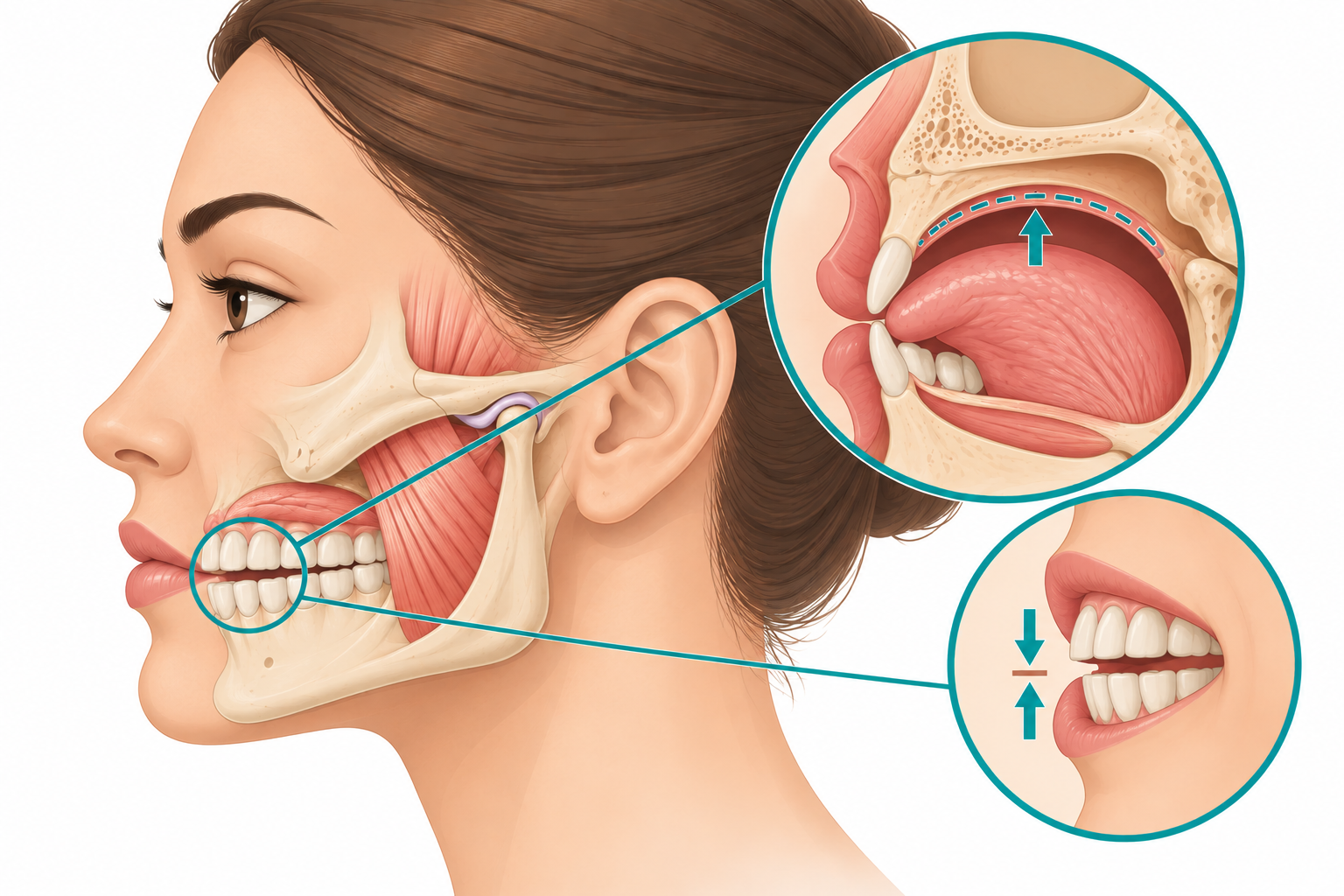
The rest position is the habit that helps most – lips together, teeth apart, and the tongue resting lightly on the palate behind the front teeth. Teeth should touch only during chewing and swallowing, and hourly phone reminders help catch daytime clenching. People who grind at night should ask a dentist about a night guard.
Which Jaw Exercises Help TMJ Disorder?
Guided exercise and manual therapy reduce TMD pain and improve opening, and each movement should stay pain-free or only mildly uncomfortable.
Stop any exercise that sharpens pain or triggers a lock, and skip the resisted exercises during an acute flare or closed lock.
1. Controlled Opening With Tongue Up
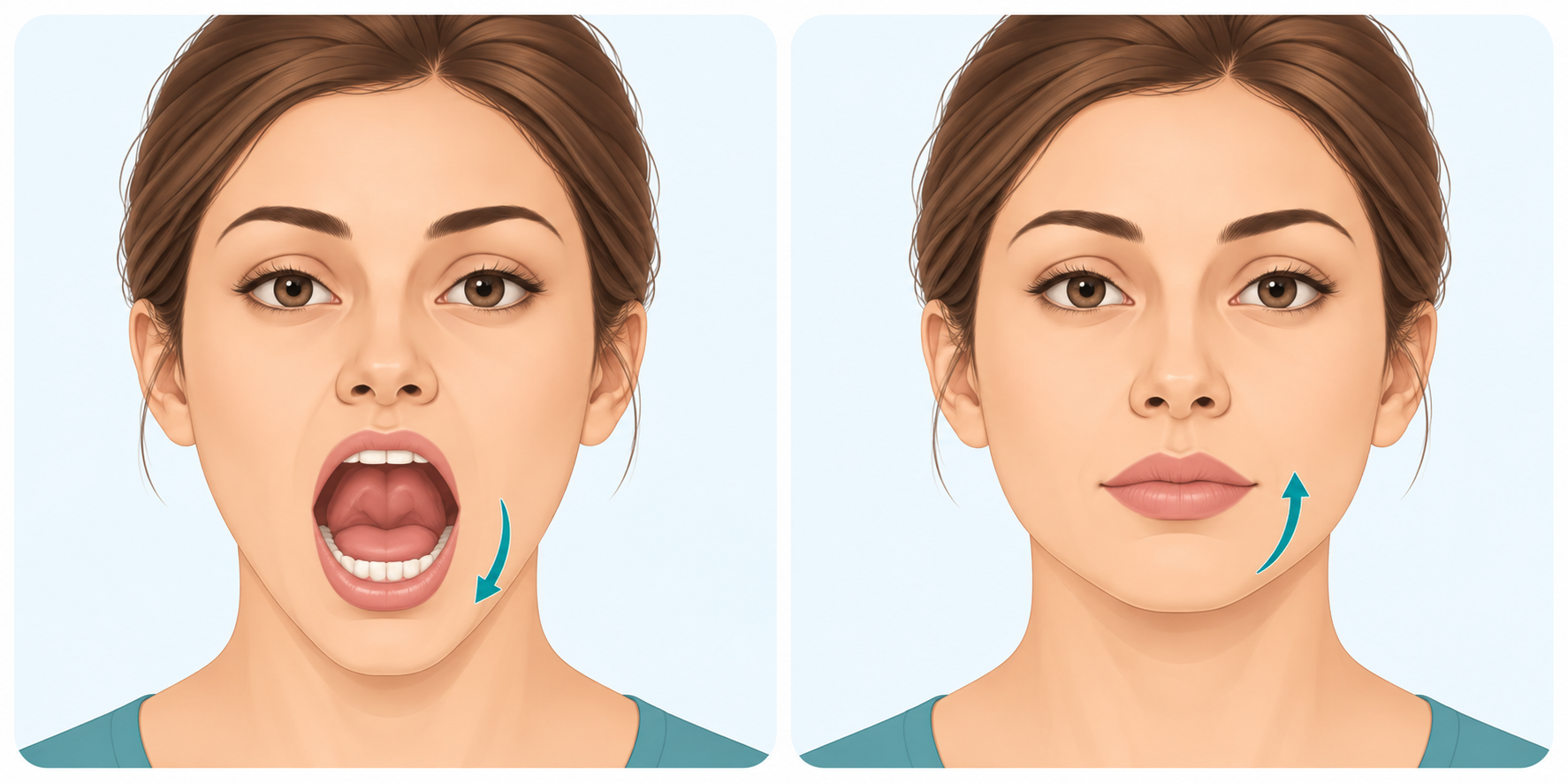
This exercise trains the jaw to open along a smooth, straight path and keeps the condyle from sliding forward too early.
Sit or stand in front of a mirror with the shoulders relaxed.
Rest the tip of the tongue on the palate just behind the upper front teeth.
Open the mouth slowly, only as far as the tongue can stay in place.
Keep the chin centered in the mirror throughout the movement.
Close slowly until the teeth are just apart.
Do 6 repetitions, 6 times a day.
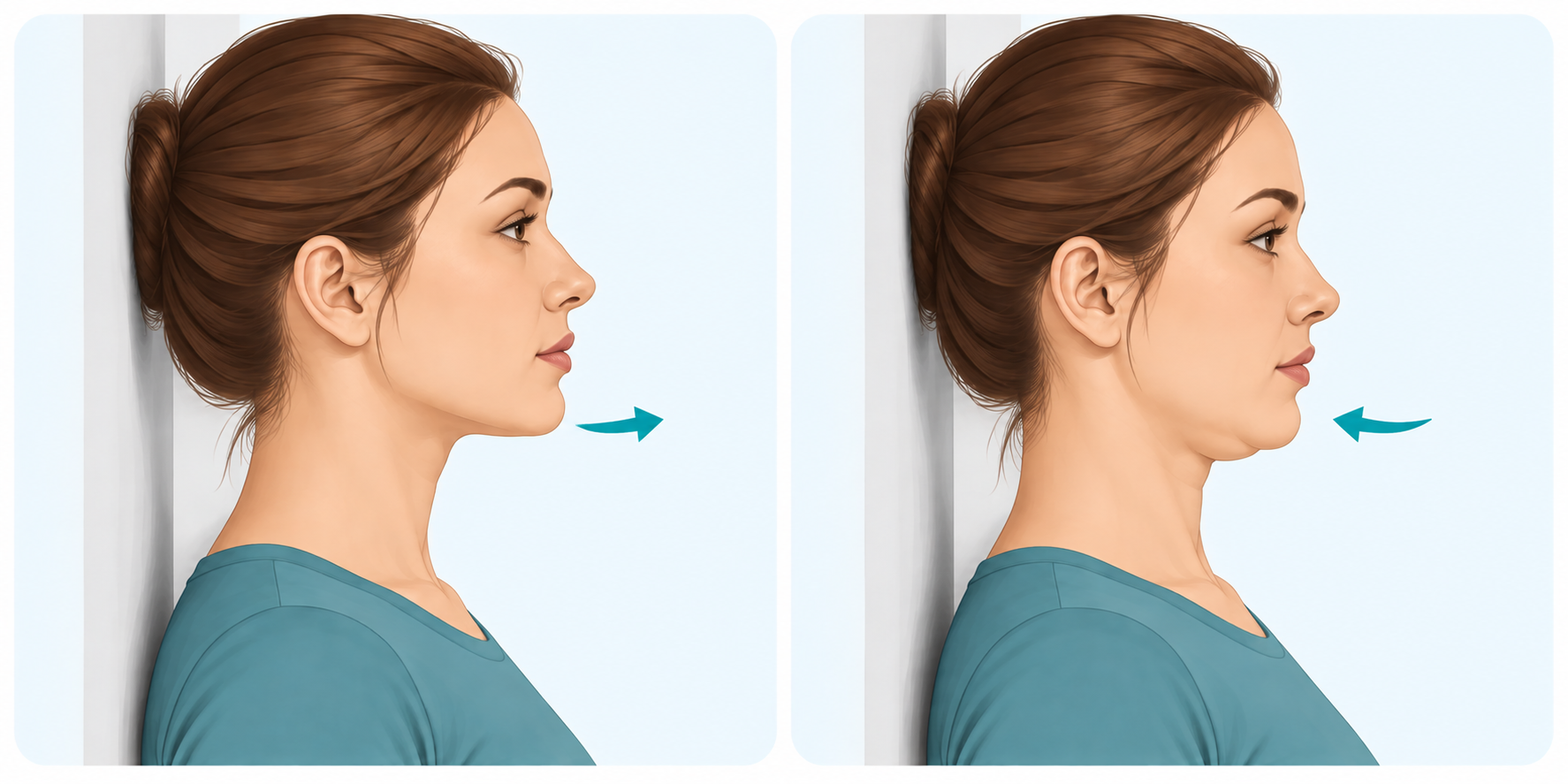
2. Chin Tucks
Chin tucks correct the forward head posture that strains the jaw and neck muscles, and they fit easily into a workday.
Stand tall with the shoulders back and the chest open.
Keep the eyes level and the jaw relaxed, with the teeth apart.
Pull the chin straight back, as if making a double chin.
Hold for 3 seconds, then release.
Repeat 10 times, several times a day.
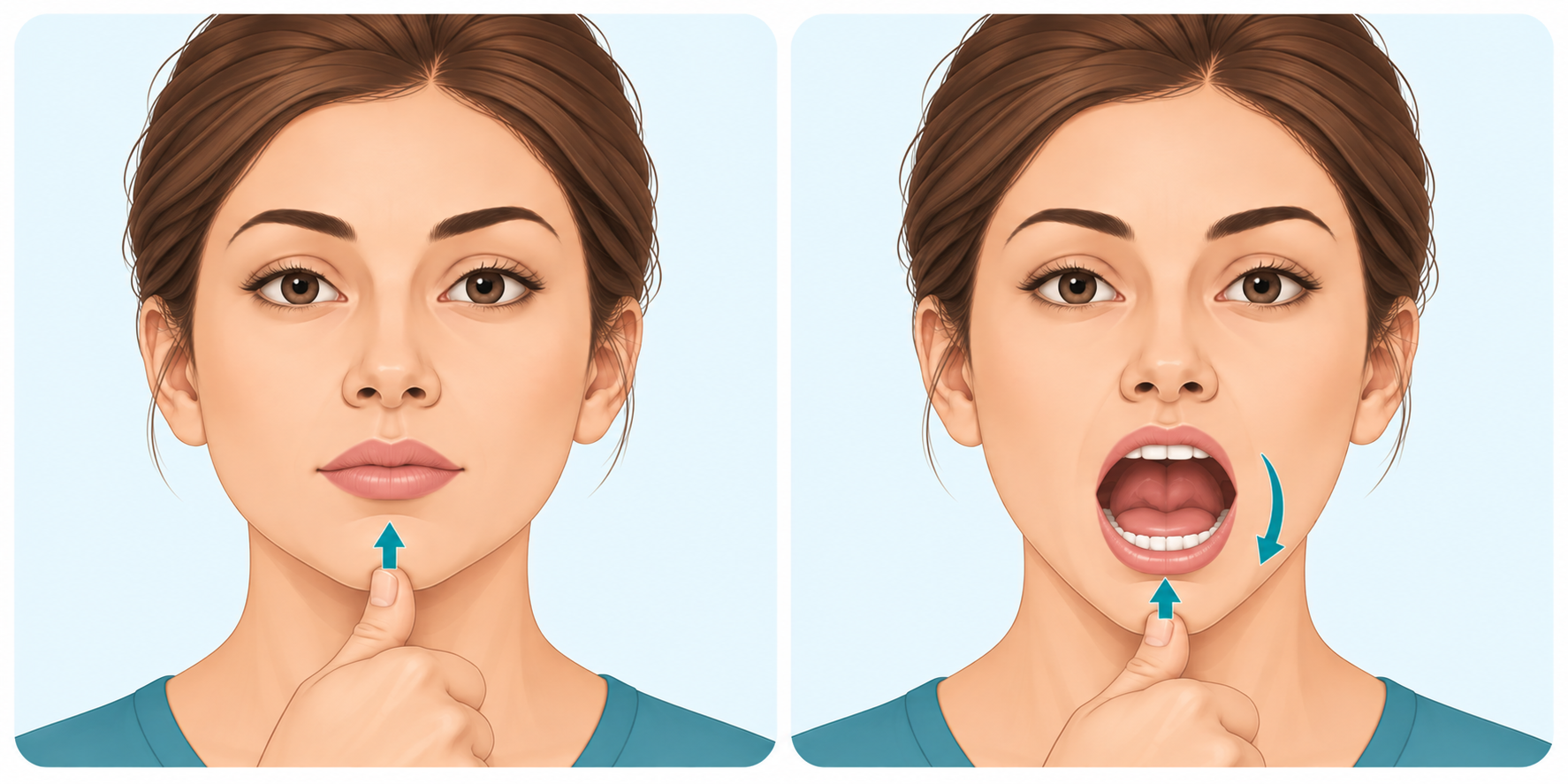
3. Resisted Opening
This exercise strengthens the muscles that open the jaw and improves control of the opening movement.
Sit upright with the jaw relaxed and the teeth apart.
Place a thumb under the chin.
Open the mouth slowly while the thumb pushes gently upward.
Hold the open position for 3 to 6 seconds.
Close the mouth slowly.
Repeat 5 times.
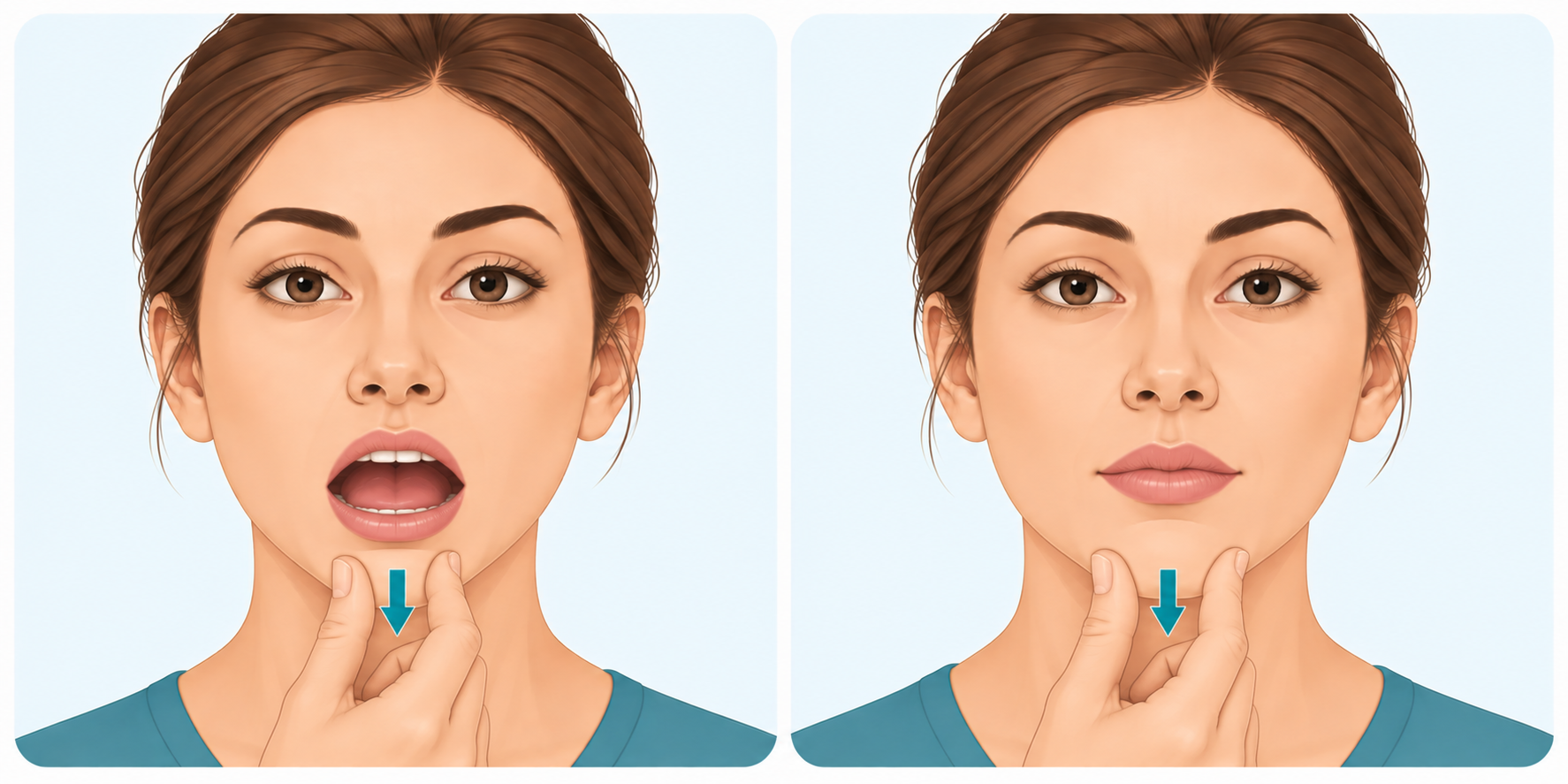
4. Resisted Closing
Resisted closing trains the closing muscles to work under light, steady control.
Open the mouth partway, about one finger width.
Pinch the front of the chin gently between the thumb and index finger.
Close the mouth slowly while the fingers press gently downward.
Stop just before the teeth touch.
Repeat 5 times.
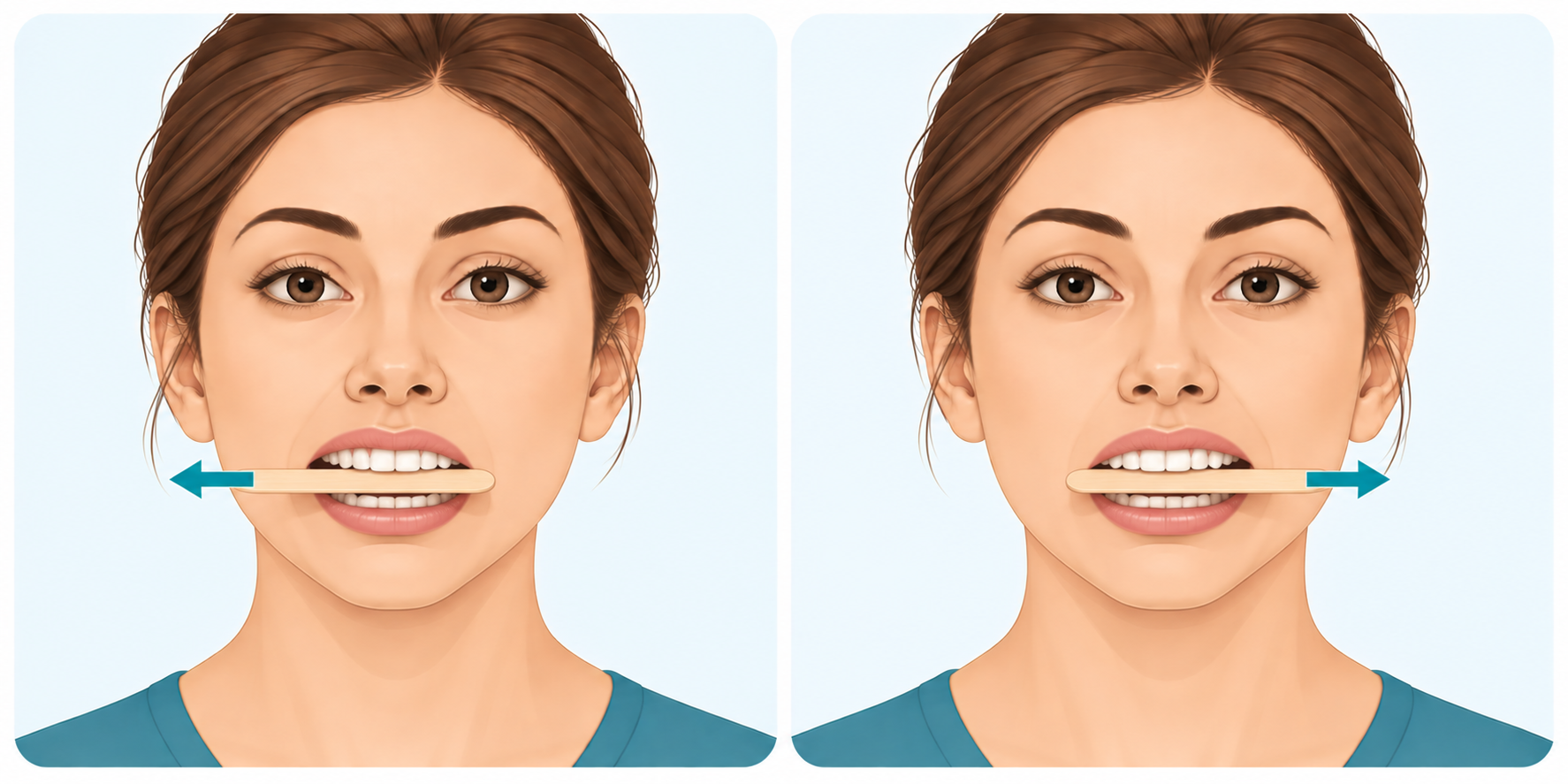
5. Side-To-Side Glide
This glide restores the sideways movement the jaw needs for chewing.
Hold a thin object, about a quarter inch thick, lightly between the front teeth. Two stacked tongue depressors work well.
Slide the lower jaw slowly to the left, then back to center.
Slide it slowly to the right, then back to center.
Repeat 5 times on each side.
Switch to a thicker object as the movement gets easier.
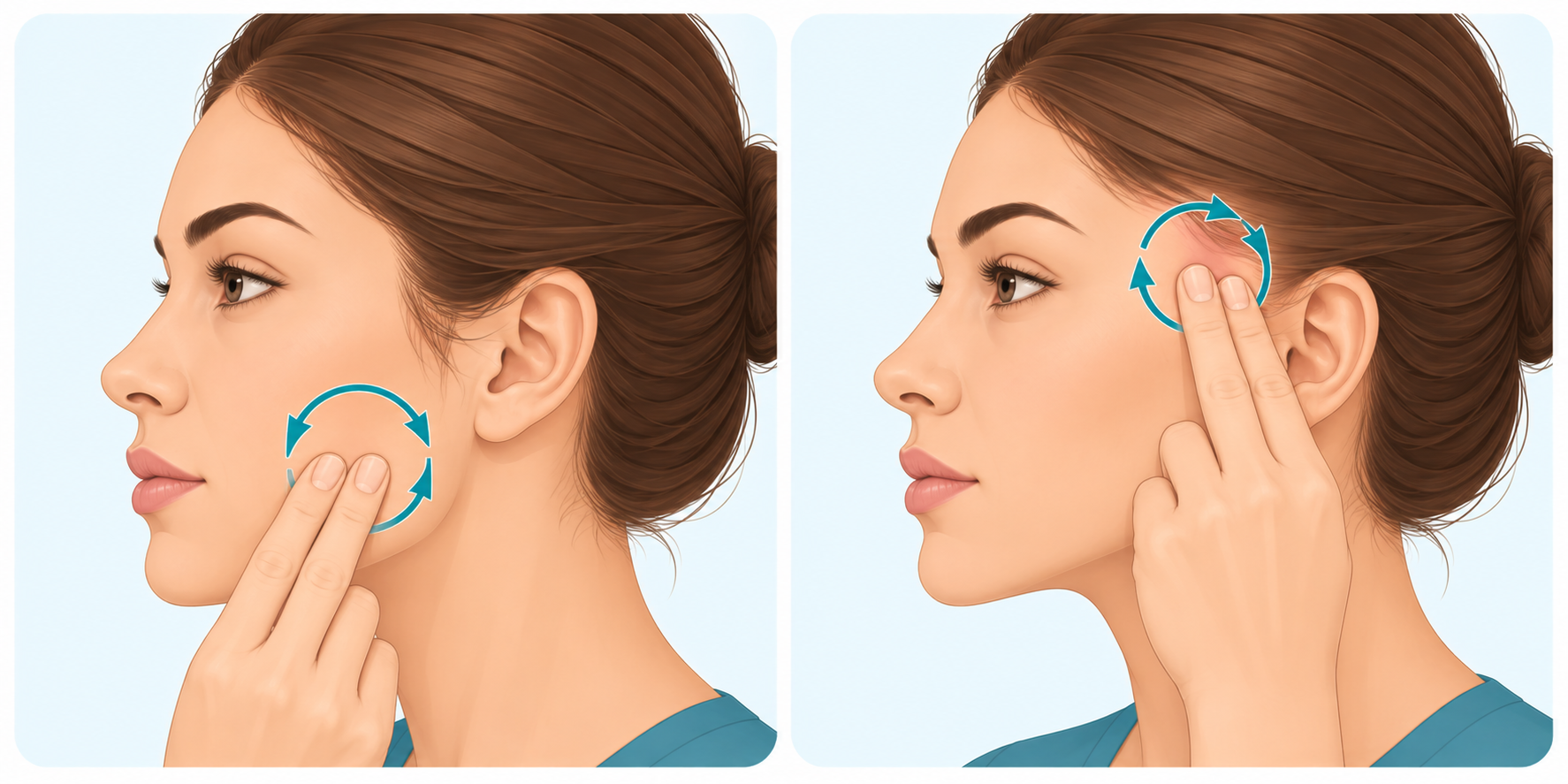
How To Do a TMJ Disorder Massage At Home?
TMJ disorder massage targets the masseter and temporalis, the two strongest closing muscles. Warm the area with moist heat, then clench briefly to find each muscle and relax the jaw fully before starting.
Press two fingertips into the masseter with firm, comfortable pressure.
Make slow circles for 60 seconds, working from cheekbone to jaw angle.
Repeat over the temporalis, just above and in front of the ear.
Finish with slow downward strokes from cheekbone to jawline, teeth apart.
Repeat the routine twice a day. Tender knots that send pain into the teeth are trigger points, and steady pressure for 30 to 60 seconds helps them release. Avoid pressing directly on a swollen, hot joint, and ask a physical therapist about intraoral massage for the deeper muscles.
How Is TMJ Disorder Treated, And What Does Each Step Cost?
TMD care should climb from reversible steps to irreversible ones, one rung at a time. Each rung gets a fair trial, usually several weeks, before moving up, and most patients improve on the lower rungs without ever needing a procedure.
The prices below are typical US self-pay ranges and vary by region and provider. TMD care falls between dental and medical coverage, so check both policies before starting treatment.
Treatment | Best suited for | US price (self-pay) |
|---|---|---|
Home care and exercises | All new cases | Under $500 |
Custom occlusal splint | Clenching, grinding, muscle pain | $200 to $600 for the device, $800 to $5,000+ with specialist care |
Physical therapy | Muscle pain, limited opening, posture strain | $50 to $300 per session |
Botox injections | Muscle pain that resists rungs 1 to 3 | $300 to $600 per session, up to $1,500 in large cities |
Arthrocentesis | Closed lock, inflamed joint | $300 to $3,000 |
Arthroscopy | Adhesions, disc problems | $5,000 to $10,000 per joint |
Open surgery or joint replacement | Destroyed or fused joints | $20,000 to $70,000+ |
Do Oral Splints Help TMJ Disorder?
A custom occlusal splint is a hard acrylic guard made from a scan or impressions of the teeth, and most patients wear it at night, when clenching goes unnoticed. It gives the teeth a smooth, even surface to meet on, which spreads the clenching force and lets the jaw muscles relax.
Splints work best for muscle pain driven by night clenching, and relief usually shows within a few weeks of regular wear. The dentist adjusts the surface at follow-up visits as the muscles settle.
A well-made splint never moves teeth or changes the bite, so any guard that increases pain or makes the bite feel different should come out until the dentist checks it. Some dental insurance plans cover splints under night guard codes.
How Does Physical Therapy Help?
Physical therapy suits patients whose pain comes with tight muscles, limited opening, or neck and shoulder tension. A therapist trained in jaw disorders works on the masseter, temporalis, and neck, and gently mobilizes a stiff joint to restore its glide.
Posture correction is part of the program, since a forward head position keeps the closing muscles tense. The therapist also teaches home exercises, so progress continues between visits. Sessions cost $50 to $300 each, and most programs run over several weeks.
Is Botox An Option For TMJ Pain?
When heavy clenching keeps driving the pain after splints and therapy, Botox becomes an option. Small doses injected into the masseter and temporalis weaken these muscles and lower clenching force for about three months.
The FDA has not approved Botox for TMD, so its use is off-label, and it does nothing for disc or joint problems. Sessions cost $300 to $600, insurance rarely pays, and relief lasts only as long as the patient keeps up repeat injections.
When Is TMJ Surgery Needed?
Procedures enter the picture only when the problem sits inside the joint and conservative care has failed, as with a locked disc, adhesions, or advanced joint damage. Each step up adds cost, recovery time, and risk.
The least invasive is arthrocentesis, which flushes the joint through two thin needles and can free a closed lock for $300 to $3,000. Arthroscopy goes a step further, using a tiny camera to release adhesions or reposition the disc, at $5,000 to $10,000 per joint.
Open surgery and total joint replacement cost $20,000 to $70,000 or more and involve weeks of recovery. They are associated with destroyed or fused joints, and a second opinion from an orofacial pain specialist should come first.
When Should You See A Dentist For TMJ Pain?
Book an exam if pain lasts more than two weeks or the jaw locks. The exam measures opening, checks the muscles and joints for tenderness, and rules out cracked teeth, abscesses, and sinus problems. Most cases need no imaging, although a CBCT scan shows bone changes and an MRI shows the disc when the diagnosis is unclear. Ask for a written dental treatment plan that puts reversible steps first, and learn how to read a treatment plan before comparing second opinions.
Bottom Line
TMJ disorder is common, usually muscle-driven, and often settles without treatment. Start with the self-check, home care, jaw exercises, and massage, then add a splint or physical therapy if pain lasts past a month. Be wary of any offer to grind teeth or rebuild the bite, and keep surgery for damaged joints that fail every lower rung.
This article is for informational purposes only and does not constitute medical advice. Always consult with qualified healthcare professionals for diagnosis and treatment recommendations specific to your situation.
Frequently Asked Questions
Can TMJ disorder go away on its own?
Yes, symptoms fade without treatment for many people within weeks to months, and pain lasting past three months needs structured care.
Is TMJ disorder permanent?
Rarely. Joint wear seen on imaging can remain, and pain and function still improve for most patients with conservative care.
What is the fastest way to relieve TMJ pain at home?
Combine moist heat, soft foods, and a short NSAID course, and practice the rest position every hour. Most flares ease within a few days.
Does TMJ disorder cause ear pain?
Yes. The joint sits just in front of the ear canal, so joint or muscle pain often feels like an earache, and jaw tenderness with a normal ear exam points to TMD.
Which specialist treats TMJ disorder?
Start with a general dentist, who can refer complex cases to an orofacial pain specialist or an oral and maxillofacial surgeon. Physical therapists and psychologists often join the care team.
Does insurance cover TMJ treatment?
Coverage varies by plan. Splints often fall under dental benefits, while joint procedures usually bill to medical insurance, so check both policies before treatment starts.