Orthodontist Salary In 2026: Pay By State, Career Stage, And Setting
The average orthodontist salary in the US is $259,400 a year, per the latest BLS data. The median sits higher, near $289,000. This guide covers pay by state, career stage, and...
Written by Mantas Petraitis
Read time: 6 min read
The average orthodontist salary in the US is $259,400 a year, per the latest BLS data. The median sits higher, near $289,000. This guide covers pay by state, career stage, and practice setting. It also weighs residency debt against lifetime earnings.
TL;DR
BLS puts the orthodontist mean wage at $259,400 and the median near $289,000.
State averages run from $167,240 in Georgia to $412,100 in Connecticut.
Practice owners out-earn associates, and top earners clear $500,000 by midcareer.
Residents now finish training with about $567,000 in debt on average.
What Is The National Orthodontist Salary?
How much do orthodontists make? Two BLS figures answer that, and they tell slightly different stories.
The BLS May 2025 wage survey puts the mean orthodontist salary at $259,400 a year. That equals $124.71 an hour. The median hourly wage is $139.01, which works out to about $289,140 a year. BLS counted 6,210 employed orthodontists.
A median above the mean is unusual. It means a smaller group of low earners pulls the average down. Part-time associates, faculty, and hospital orthodontists sit in that group. The typical full-time clinician earns closer to the median.
Both figures also miss a large share of the profession. BLS wage estimates exclude self-employed workers. Many practice owners pay themselves through their business, so they drop out of the survey. The ADA's practice survey covers that group. Private-practice orthodontists averaged $333,250 in net income in 2023. The median was $286,670, per ADA Health Policy Institute data.
How Has Orthodontist Pay Changed Since 2021?
The BLS mean has swung more than most healthcare wages. A small survey base explains most of the movement.
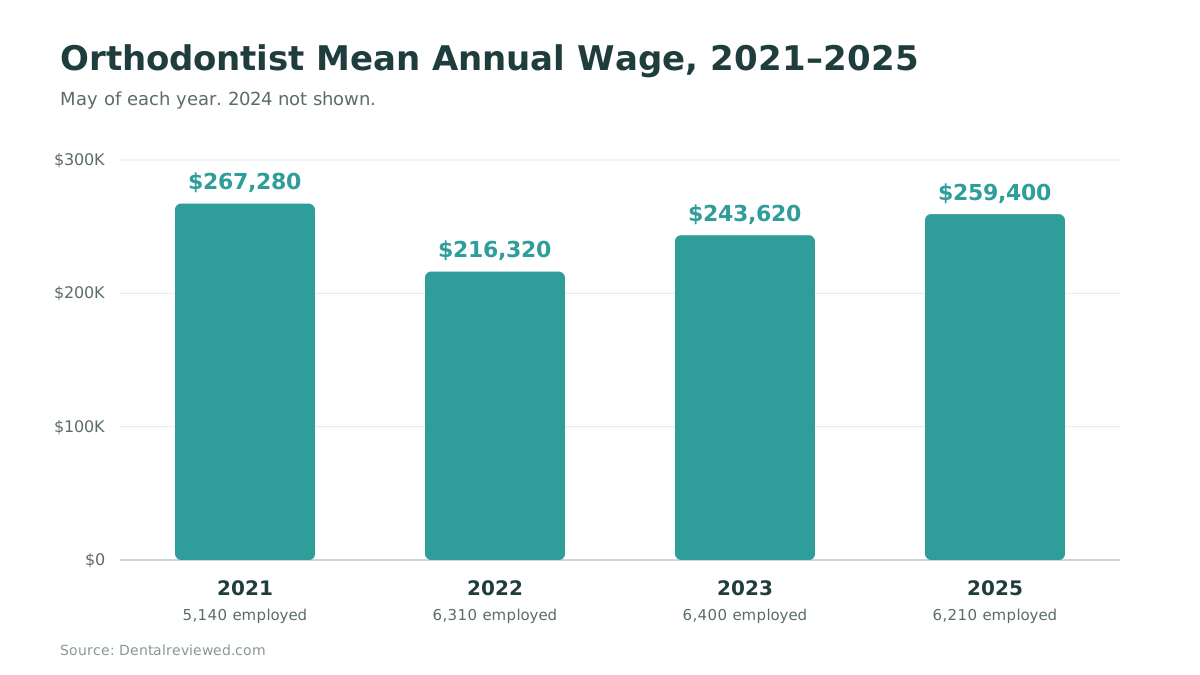
BLS estimates cover only about 6,000 employed orthodontists. Each release carries a wide margin of error. The 2022 dip and 2023 rebound reflect sampling more than a real pay cut. The chart uses the four BLS releases with full orthodontist pages. The AAO's own member survey shows steadier growth. Its average reported salary rose 16% between the 2022 and 2025 surveys.
Orthodontist Salary By State
State pay spreads wider for orthodontists than for almost any dental role. The table lists every state.
The cost-of-living index compares each state's living costs with the national average of 100. The COL-adjusted salary divides pay by that index. It restates each salary in national-average dollars.
State | Mean salary | Cost-of-living index | COL-adjusted salary |
|---|---|---|---|
Connecticut | $412,100 | 112.7 | $365,660 |
Colorado | $404,120 | 102.7 | $393,500 |
Illinois | $335,910 | 94.7 | $354,710 |
Pennsylvania | $327,330 | 97.2 | $336,760 |
Michigan | $327,310 | 90.1 | $363,270 |
Maryland | $315,180 | 115.4 | $273,120 |
Tennessee | $302,050 | 90.3 | $334,500 |
Missouri | $295,460 | 89.0 | $331,980 |
South Carolina | $292,350 | 94.7 | $308,710 |
North Carolina | $277,320 | 97.8 | $283,560 |
Washington | $276,250 | 114.1 | $242,110 |
Maine | $263,020 | 113.0 | $232,760 |
Montana | $257,230 | 95.5 | $269,350 |
Alabama | $246,170 | 88.6 | $277,840 |
Arizona | $242,650 | 110.7 | $219,200 |
Wisconsin | $225,580 | 97.7 | $230,890 |
Ohio | $206,430 | 94.3 | $218,910 |
New York | $188,400 | 125.1 | $150,600 |
Georgia | $167,240 | 92.5 | $180,800 |
Alaska | $295,060 | 124.9 | $236,240 |
Arkansas | $266,720 | 89.6 | $297,680 |
California | $295,060 | 142.3 | $207,350 |
Delaware | $266,720 | 101.9 | $261,750 |
District of Columbia | $266,720 | 138.8 | $192,160 |
Florida | $266,720 | 102.2 | $260,980 |
Hawaii | $295,060 | 185.0 | $159,490 |
Idaho | $295,060 | 99.9 | $295,360 |
Indiana | $278,140 | 91.0 | $305,650 |
Iowa | $278,140 | 89.7 | $310,080 |
Kansas | $278,140 | 88.8 | $313,220 |
Kentucky | $266,720 | 92.5 | $288,350 |
Louisiana | $266,720 | 92.3 | $288,970 |
Massachusetts | $297,710 | 141.2 | $210,840 |
Minnesota | $278,140 | 94.6 | $294,020 |
Mississippi | $266,720 | 87.3 | $305,520 |
Nebraska | $278,140 | 92.6 | $300,370 |
Nevada | $295,060 | 100.2 | $294,470 |
New Hampshire | $297,710 | 111.4 | $267,240 |
New Jersey | $297,710 | 115.1 | $258,650 |
New Mexico | $295,060 | 93.7 | $314,900 |
North Dakota | $278,140 | 91.4 | $304,310 |
Oklahoma | $266,720 | 86.0 | $310,140 |
Oregon | $295,060 | 111.8 | $263,920 |
Rhode Island | $297,710 | 110.6 | $269,180 |
South Dakota | $278,140 | 91.9 | $302,660 |
Texas | $266,720 | 92.1 | $289,600 |
Utah | $295,060 | 102.2 | $288,710 |
Vermont | $297,710 | 113.6 | $262,070 |
Virginia | $266,720 | 100.8 | $264,600 |
West Virginia | $266,720 | 88.3 | $302,060 |
Wyoming | $295,060 | 93.7 | $314,900 |
Read both columns together. Connecticut leads in nominal pay, and Colorado leads once prices are accounted for. Michigan and Illinois climb near the top after the adjustment. New York drops near the bottom, with an adjusted figure near $150,600. The regional averages behind the estimates are $297,710 for the Northeast and $295,060 for the West. They are $278,140 for the Midwest and $266,720 for the South.
Why Does Orthodontist Pay Vary So Much By State?
Cost of living explains only part of the spread. Supply, business models, fees, and survey size explain the rest.
Supply comes first. Orthodontists cluster in metro areas, and many rural counties have none. A state with few orthodontists per resident gives each one more new starts and more pricing power.
Business models come next. Markets with heavy DSO and OSO presence tend to pay orthodontists a salary or per diem. Practice profit stays with the organization, which can pull state averages down.
Fees also differ. Comprehensive treatment fees track local income and insurance mix. The guides to braces pricing and Invisalign cost show how wide that range runs.
Small samples add noise on top. A state with a few dozen responses can swing $50,000 in a single year. Treat any one state figure as a rough range.
How Much Does An Orthodontist Earn By Career Stage?
How much does an orthodontist earn over a full career? Pay climbs steeply in the first decade, then depends heavily on ownership.
Career stage | Typical setup | Typical pay pattern |
|---|---|---|
Residency | Tuition-paying student, a few stipend programs | Little or no income, debt keeps growing |
Years 1–3 | Associate, often per diem across several offices | About $1,250 to $1,500 a day |
Years 4–10 | Partner track, buy-in, or DSO lead role | Rising toward the BLS median near $289,000 |
Ages 45–54 | Owner or partner | 37% earn over $500,000 a year |
Late career | Selling to a partner, buyer, or DSO | Sale proceeds add a one-time payout |
The AAO's 2025 survey shows the curve clearly. Among members under 35, 60% work as employees. No older age group tops 31%. Ownership drives the midcareer jump. At ages 45 to 54, 37% of respondents earned over $500,000. Another 36% in that group earned under $300,000, which shows how wide outcomes run.
The late-career payout depends on practice value. Owners nearing retirement can see how buyers price a practice in the practice valuation guide.
What Is An Orthodontist Starting Salary?
Most new orthodontists start on a daily rate. That makes the orthodontist starting salary a function of days worked.
The AAO found 59% of members under 35 are paid per diem. Daily quotes of $1,250 to $1,500 are common. At four days a week for 46 weeks, that lands between $230,000 and $276,000. Many new graduates combine two or three offices to fill a week. Some offices add production or new-start bonuses on top.
On an hourly basis, the BLS mean orthodontist pay rate is $124.71. The median hourly rate is $139.01. Associates should convert any offer into both a daily and an annual figure before comparing.
Orthodontist Earnings: Owner Vs Associate Vs DSO
Setting shapes orthodontist earnings as much as location does. The table compares the three main paths.
Path | How pay works | Typical earnings | Trade-offs |
|---|---|---|---|
Practice owner | Keeps practice profit after overhead | Often above the ADA private-practice average of $333,250 | Startup or buy-in debt, staff, marketing, management |
Private associate | Per diem or salary, sometimes a share of production | About $230,000 to $276,000 at common daily rates | Little equity unless a partner track is in writing |
DSO or OSO | Salary or per diem plus bonuses and benefits | Close to private associate pay, with benefits added | Production targets, less control, restrictive covenants |
Ownership remains the norm in orthodontics. According to the AAO, 68% of survey respondents own a practice, alone or with partners. Younger orthodontists increasingly start elsewhere. Women were more than twice as likely as men to join a DSO or OSO first, at 47% versus 20%.
The DSO model trades upside for stability and support. Clinic owners benchmarking an associate offer should weigh the daily rate against expected production. Anyone planning to open a practice should start with a practice business plan. A review of practice financing options comes next.
Does Residency Debt Pay Off Over A Career?
Orthodontic training is expensive, and the bill now arrives under tighter federal loan rules. The lifetime math still favors the specialty for most graduates.
Indebted dental graduates in the class of 2025 owed $297,800 on average, per ADEA. Residency adds more on top. Based on various surveys, orthodontic residents now graduate with about $567,000 in debt. Federal rules also changed on July 1, 2026. Grad PLUS loans ended, and new borrowing caps took effect. More residents will now need private loans. The guide to the cost of dental school breaks down the first half of that bill.
Item | General dentist | Orthodontist |
|---|---|---|
BLS mean annual wage, May 2025 | $191,350 | $259,400 |
Training after dental school | None | About 2.5 years |
Average debt at finish | $297,800 | $567,000 |
Earnings over 30 years after dental school | About $5.74 million | About $7.13 million |
Net advantage after extra debt | — | About $1.1 million |
Break-even point | — | About 11 years into practice |
The table uses simple pre-tax math at BLS mean pay. The orthodontist works 27.5 of the 30 years and carries $269,200 more debt. Interest and taxes shrink the lead. A practice sale can widen it. An owner in a strong market recovers far faster. An associate in a crowded metro may take much longer.
How Does Orthodontist Pay Compare With A General Dentist?
Orthodontists earn about 36% more than general dentists at the BLS mean. Oral surgeons still sit at the top of dental pay.
Role | BLS mean annual wage, May 2025 | Training after college |
|---|---|---|
Oral and maxillofacial surgeon | $346,490 | DDS or DMD, plus 4 to 6 years |
Prosthodontist | $268,630 | DDS or DMD, plus about 3 years |
Orthodontist | $259,400 | DDS or DMD, plus 2 to 3 years |
General dentist | $191,350 | DDS or DMD, 4 years |
Dental hygienist | $98,990 | Associate degree, 2 to 3 years |
Dental assistant | $50,200 | Certificate, under 1 year |
The ADA's practice survey tells a similar story. Specialists averaged $346,520 in net income in 2025. General dentists averaged $215,320, per ADA Health Policy Institute data. The full breakdown for general dentists sits in the guide to how much a dentist earns in the US. The dental hygienist salary and dental assistant salary guides cover the rest of the team.
What Education Does An Orthodontist Need?
The path runs 10 to 11 years after high school, per the AAO. Each step adds cost before the first paycheck.
It starts with a bachelor's degree, then four years of dental school for a DDS or DMD. The guide to the best dental schools in the US compares programs. Next comes an orthodontic residency of 2 to 3 years. Board certification through the American Board of Orthodontics is voluntary. It adds a credential that patients and referring dentists recognize.
Bottom Line
Orthodontics remains one of the best-paid paths in dentistry. The BLS mean is $259,400, and the median is near $289,000. Across states, pay runs from $167,240 in Georgia to $412,100 in Connecticut.
Ownership drives the top incomes, and most associates build toward it over a decade. Residency debt is heavy. At average pay, the specialty premium recovers it about 11 years into practice. Associates and owners should model real days worked and production when pricing an offer. Tracking case value in each patient's dental treatment plan shows what an associate day produces.
Frequently Asked Questions
How much do orthodontists make a year?
According to multiple surveys, the average pay per year is $259,400. The median is higher, near $289,000.
What is an orthodontist starting salary?
Most new orthodontists start on a daily rate of about $1,250 to $1,500. At four days a week, that equals roughly $230,000 to $276,000.
Which state pays orthodontists the most?
Connecticut and Colorado lead all states, both above $400,000. After cost of living, Colorado ranks first.
Do orthodontists make more than dentists?
Yes. Orthodontists' salaries are about 36% higher than those of general dentists.
How much does an orthodontist make an hour?
The hourly wage is around $124.71, and the median is $139.01.
Do practice owners earn more than associates?
Usually, yes. Owners keep practice profits, and 37% of orthodontists aged 45 to 54 earn over $500,000.