The Real Materials Behind George Washington's Teeth
George Washington's teeth were never made of wood. His real dentures were made of ivory, metal, and human teeth. This article explains what those dentures actually contained. It...
Written by Maren Solvik
Read time: 3 min read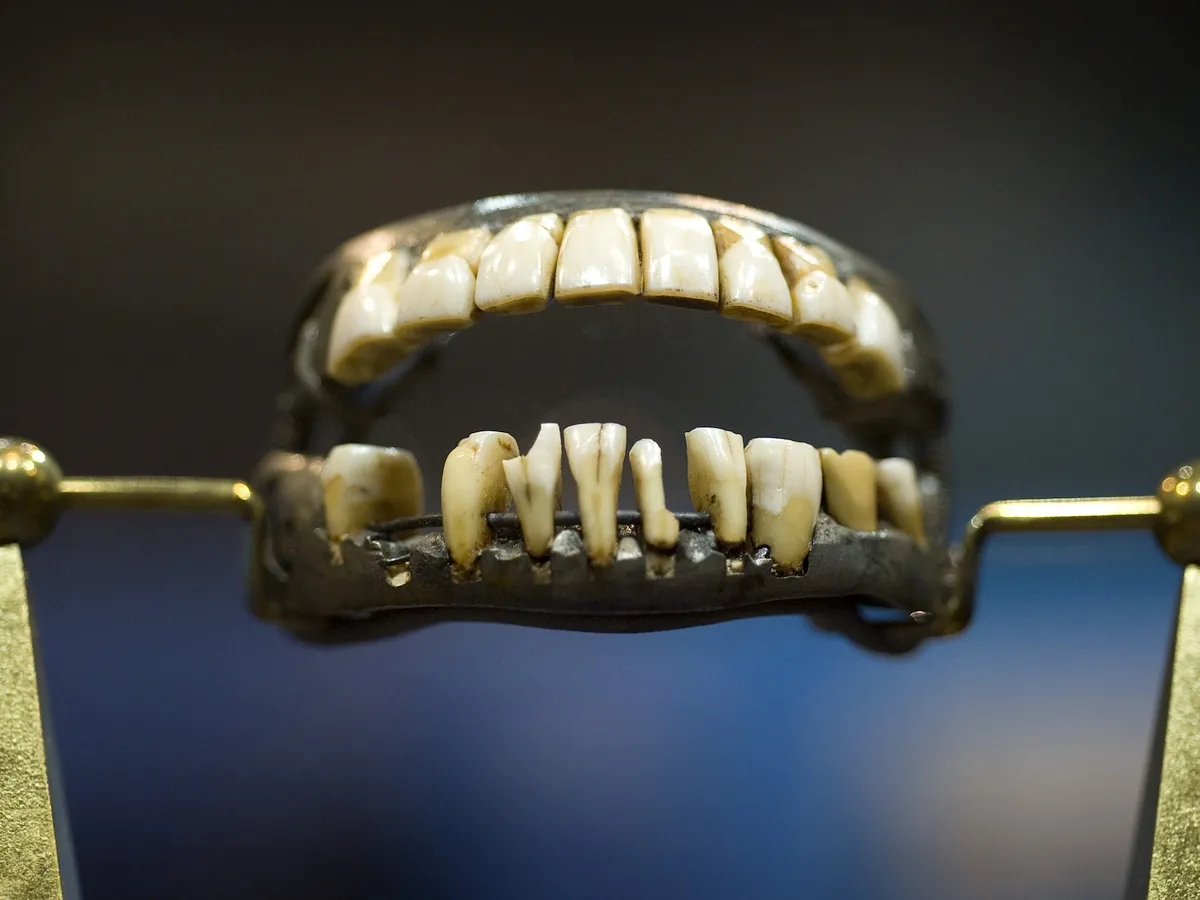
George Washington's teeth were never made of wood. His real dentures were made of ivory, metal, and human teeth. This article explains what those dentures actually contained. It also covers who built them and why the wooden teeth myth still gets repeated.
TL;DR
Washington's dentures contained ivory, human teeth, and metal, never wood.
Wine-stained ivory cracks likely started the wooden teeth myth.
Dr. John Greenwood built and adjusted most of his later dentures.
Some human teeth came from enslaved people at Mount Vernon.
How Bad Were George Washington's Teeth
Washington's dental problems started early and never really stopped. His own records tell most of the story.
At age 24, Washington paid five shillings to have a tooth pulled. He had lost most of his natural teeth by his fifties. Letters and diary entries describe aching teeth and swollen gums. Ill-fitting dentures caused him pain for the rest of his life.
Only one natural tooth remained in his mouth by his 1789 inauguration. Dr. Greenwood finally pulled that last tooth in 1796. Washington let Greenwood keep it as a memento. Greenwood later sealed the tooth inside a small locket.
John Adams claimed Washington blamed the tooth loss on cracking walnuts with his teeth. Modern historians point instead to calomel. This mercury compound treated smallpox and other illnesses at the time. Untreated tooth decay and gum disease likely played a role as well.
Washington's financial records include regular purchases tied to his teeth. He bought toothbrushes, tooth scrapers, denture files, and cleaning powders throughout his adult life. He also paid multiple dentists for extractions and repairs over several decades.
What George Washington's False Teeth Were Actually Made Of
This is the heart of the myth. The real materials were more unusual than wood, not less.
None of Washington's dentures ever contained wood. His real sets combined ivory, human teeth, animal teeth, and metal.
Hippopotamus and walrus ivory, carved to resemble natural teeth
Human teeth, some purchased from other people
Cow, horse, and donkey teeth
Lead, gold, silver, brass, and tin, used for bases, wires, and springs
Dentists at the time favored hippopotamus ivory over other options. It resisted staining and decay better than most substitutes available in the 1700s. This made it a premium, expensive choice for wealthy patients like Washington.
The wooden teeth myth likely started with the ivory itself. Ivory develops fine cracks over time, and Washington's fondness for Madeira wine stained those cracks dark. The discoloration gave his dentures a grained look that resembled wood.
Mount Vernon's own inventory of all four sets also lists tiny wood pegs among the materials. These pegs served as small structural fasteners, not as visible teeth. So they do not support the popular wooden teeth story as usually told.
Dr. John Greenwood, a New York dentist, built and maintained most of Washington's later dentures. The two corresponded regularly by mail about fit and repairs.
Washington actually used two dentists during his life. Le Mayeur treated him during the 1780s. Greenwood became his primary dentist by the 1790s and remained so until Washington's death in 1799.
George Washington's Lead Teeth And The Surviving Denture Set
One complete denture set survives today. It shows exactly what these materials looked like combined.
The surviving set is held by Mount Vernon. It combines ivory, horse teeth, and human teeth, all set into a lead base. Brass wire and steel springs hold the pieces together and force the plates open.
The springs meant Washington had to actively hold his jaw shut. If he relaxed his mouth, the dentures would pop open on their own.
This set represents the closest look historians have at the teeth in George Washington's mouth. He wore it during much of his presidency.
A modern dentist would capture that same fit with digital scanning technology in minutes. Greenwood had to carve and adjust it by hand over repeated fittings.
How Many Sets Of Dentures Did Washington Actually Have
Historians count four separate sets across Washington's adult life. Each one mixed different materials and survives, or doesn't, in different ways.
The earliest known set was a partial denture worn starting around 1781
One full set, built by Greenwood, survives today at Mount Vernon
A second set was reportedly buried with Washington after his death
A separate set went to the University of Maryland Dental School in 1854
Two of the four sets contain human teeth. The other two rely only on animal materials and ivory.
A separate partial denture made by Greenwood is held by the New York Academy of Medicine. The same institution also holds the small locket containing Washington's last natural tooth.
Where The Teeth Came From
Some human teeth in Washington's dentures came from other people. This part of the story deserves a direct explanation, not a footnote.
Washington's financial records document a payment for nine teeth. The teeth came from enslaved people at Mount Vernon in 1784. Historians do not know the full circumstances of that transaction. Given the power imbalance, genuine consent is impossible to confirm.
Washington enslaved more than 300 people at Mount Vernon during his lifetime. The nine teeth purchased in 1784 came from an unknown number of them.
In 1781, French dentist Jean-Pierre Le Mayeur began treating Washington after leaving British-occupied New York. Le Mayeur publicly advertised paying two guineas per tooth to free individuals willing to sell them.
Washington's own payment records show a far smaller sum for nine teeth. That sum was about six pounds, paid to enslaved people. That gap reflects the coercive power an enslaver held over enslaved people. The price on paper does not erase that power.
Why The Wooden Teeth Myth Never Died
A false story like this does not survive by accident. It had real help along the way.
In a 1798 letter, Greenwood warned Washington that his dentures had turned very dark. Greenwood blamed port wine, which he said stripped away their polish. That single letter captures exactly how the myth likely got started.
The wooden teeth story appeared in American schoolbooks well into the 20th century. Repetition in classrooms turned a visual misunderstanding into settled fact. The story was also simple and memorable, which helped it outlast the more complicated truth.
Washington's biographer, Mason Locke Weems, published an exaggerated life story in 1800, shortly after Washington died. That book is the source of the equally false cherry tree legend. The wooden teeth myth grew separately from a real physical detail. It fit the same appetite for tidy, memorable stories about Washington.
How The Dentures Affected Washington's Life And Image
The dentures shaped more than his diet. They likely shaped how the public saw his face.
Ill-fitting dentures made eating and speaking difficult for Washington. The bulk of the dentures also pushed his lips and jaw outward. Historians point to this distortion as one reason for his tight-lipped expression in later portraits. This includes the image on the one-dollar bill.
The portrait used for the one-dollar bill was painted late in Washington's life. He was wearing these uncomfortable dentures at the time.
Painter Gilbert Stuart noticed the effect firsthand. Stuart said Washington had just received new false teeth for a famous portrait sitting. That explained the tight, strained look around his mouth.
Witnesses at Washington's first inaugural address said he spoke very quietly. Much of the crowd reportedly could not hear him, likely because of his dentures.
Greenwood's letters describe Washington's ongoing complaints about pain, fit, and appearance. Washington asked for adjustments so the dentures would look less bulky. Even with regular repairs, he never found lasting comfort.
How Modern Dentistry Compares
Tooth replacement has changed enormously since Washington's era. A quick comparison shows how far the field has come.
Dentists today have imaging, sterile materials, and precise fabrication methods Washington's dentists never had. A missing tooth no longer means carving ivory or paying for teeth from another person.
Missing teeth today are more often replaced with titanium dental implants. Implants fuse directly with the jawbone, unlike carved ivory or purchased human teeth.
Planning has also changed just as much as materials. Modern providers typically map out each phase digitally before any work begins. Dental treatment plan software sequences that plan and attaches pricing. This replaces the guesswork Greenwood relied on with hand tools and letters.
None of this erases what Washington went through. It does explain why his dentures now look like artifacts rather than ordinary equipment.
Bottom Line
George Washington's teeth were never made of wood. His real dentures combined ivory, metal, and human teeth. Some of those teeth came from enslaved people at Mount Vernon. The wooden teeth myth likely grew from stained, cracked ivory, not an actual wooden set. The real story is stranger and more revealing than the legend.
Frequently Asked Questions
Did George Washington really have wooden teeth?
No. None of his four denture sets ever contained wood. Stained, cracked ivory likely started the myth.
What were George Washington's false teeth actually made of?
His dentures combined ivory, human teeth, animal teeth, and metals like lead, gold, and brass.
Did George Washington's dentures have human teeth in them?
Yes. Two of his surviving denture sets contain human teeth. Some of those teeth came from enslaved people at Mount Vernon.
Why does George Washington look like he is frowning in portraits?
His ill-fitting dentures pushed his lips and jaw outward. Holding his mouth closed likely produced his tight, stern expression.
Who was George Washington's dentist?
His main dentist was Dr. John Greenwood of New York. Greenwood built and repaired most of Washington's later dentures.