Impacted Wisdom Tooth: Symptoms, Types, and Healing Time
Wisdom teeth often run out of room by the time they try to erupt. An impacted wisdom tooth stays trapped under the gum or jawbone instead of erupting normally. This guide breaks...
Written by Mantas Petraitis
Read time: 5 min read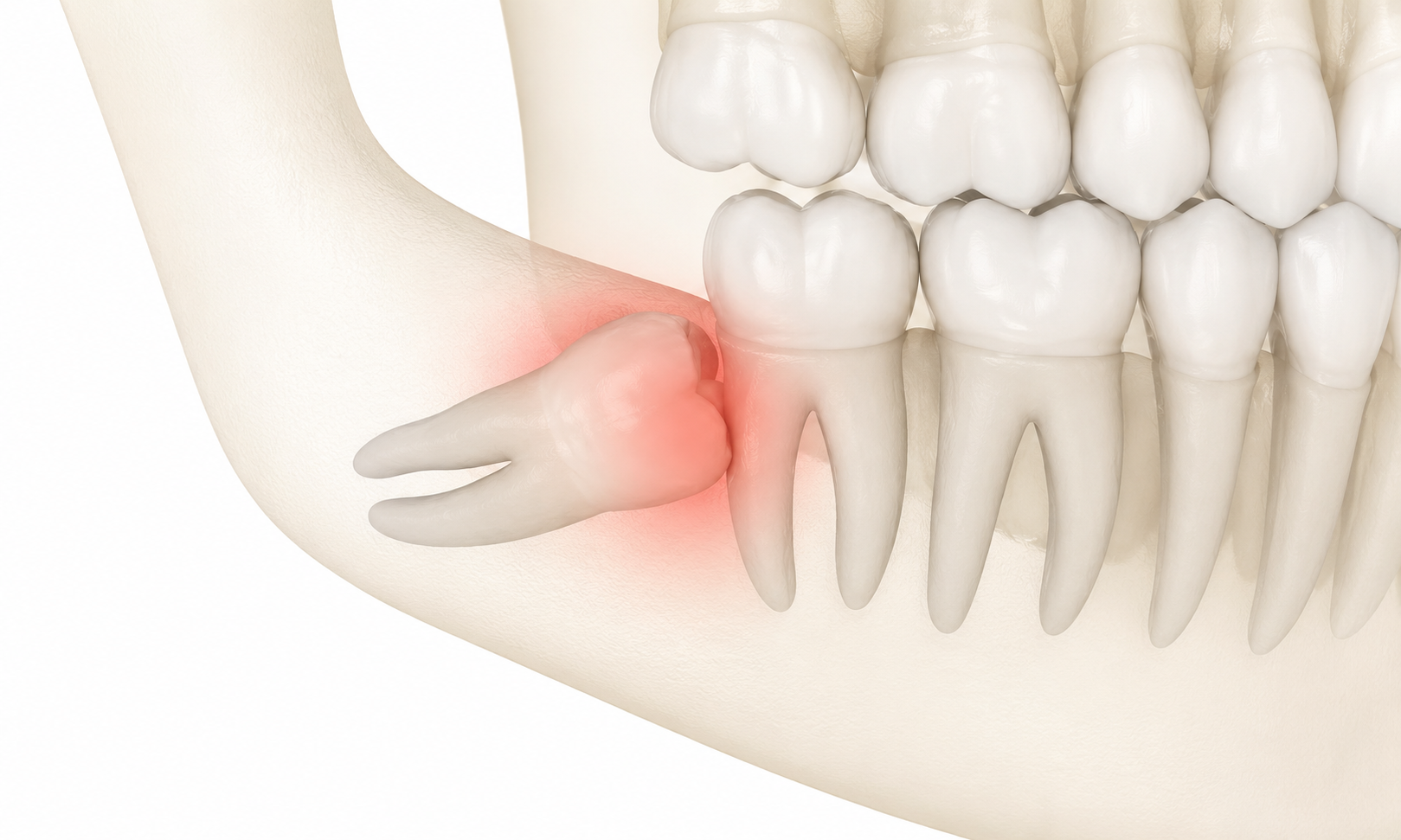
Wisdom teeth often run out of room by the time they try to erupt. An impacted wisdom tooth stays trapped under the gum or jawbone instead of erupting normally. This guide breaks down the types dentists diagnose, the symptoms worth tracking, and what recovery looks like after treatment.
An impacted wisdom tooth angles or lodges under the gum or bone instead of erupting fully.
Symptoms range from none at all to jaw pain, headaches, and swollen lymph nodes.
A dental exam and X-ray confirm impaction, often years before symptoms appear.
Treatment ranges from monitoring to extraction, with healing typically spanning one to several weeks.
What Is An Impacted Wisdom Tooth?
An impacted wisdom tooth is a third molar that cannot fully erupt. Dentists confirm this on a panoramic X-ray. The image shows the crown's angle and root position. It also shows how close the roots sit to the nerve canal.
Wisdom teeth, also called third molars, are the last adult teeth to erupt. They typically appear between ages 17 and 25.
A partly erupted tooth is often covered by a flap of gum tissue called an operculum. Food and bacteria can collect underneath this flap.
The jaw usually lacks room for a fourth molar to fit properly. As a result, the tooth may tilt, angle sideways, or stay fully buried in bone. Impaction reflects jaw anatomy, not oral hygiene habits.
Types Of Impacted Wisdom Teeth
Impacted wisdom tooth types describe the angle and depth of the blockage. Oral surgeons use this classification to judge how difficult removal will be.
Mesial impaction: The tooth angles toward the front of the mouth, this is the most common type and usually the most straightforward to remove
Distal impaction: The tooth angles toward the back of the mouth, root curvature here can make extraction more involved
Vertical impaction: The tooth grows straight up but stays trapped under the gum or bone
Horizontal impaction: The tooth grows sideways and presses into the neighboring molar's root, often the hardest pattern to treat
Dentists also weigh two other factors. One is how much of the tooth sits below the neighboring molar's biting surface. The other is how much space exists in front of the jawbone's vertical ramus.
Less space and greater depth both point toward a more involved extraction. Some dentists also classify impaction by tissue coverage.
A soft tissue impaction means gum still covers part of the crown. A bony impaction means the jawbone covers some or all of the tooth. Bony impactions generally take longer to remove and involve more swelling afterward.
Impacted Wisdom Teeth Upper Vs Lower Jaw
Impacted wisdom teeth upper and lower cases share the same root cause. Jaw anatomy in each arch changes how the tooth behaves and how a dentist approaches treatment.
Upper impacted wisdom teeth sit in softer, more porous bone. They tend to drift toward the cheek or tip toward the maxillary sinus. Sinus proximity can cause pressure or congestion that mimics a sinus infection.
Upper impaction causes fewer infections than lower impaction overall. Lower impacted wisdom teeth sit in denser cortical bone.
They are more often horizontally impacted. This makes them more likely to trap food and bacteria under the gum. This raises the risk of pericoronitis, a gum infection around a partially erupted tooth.
The lower jaw also carries the inferior alveolar nerve close to the roots. This proximity factors directly into surgical planning. Both upper and lower impactions are diagnosed the same way, through a clinical exam and imaging.
What Causes Wisdom Tooth Impaction?
Several factors combine to cause wisdom tooth impaction, most tied to jaw size and eruption timing.
Modern jaws tend to be smaller than earlier human jaws. Softer, processed diets during childhood reduce early chewing forces. Those forces once helped jaws grow to full size.
Smaller jaws leave little room for a third set of molars. Jaw size and shape are often inherited, so family history plays a role.
Wisdom teeth also erupt later than other teeth. This happens after the jaw has finished most of its growth. That timing leaves less flexibility for the jaw to adjust and make room.
These factors are anatomical, unrelated to adult brushing habits or diet choices. Genetics and jaw growth, not daily habits, determine whether a tooth becomes impacted.
Some people inherit a narrower jaw from one or both parents. Others simply lack space for a full set of 32 teeth. Neither situation is preventable through daily oral care.
Signs And Symptoms To Watch For
Impacted wisdom teeth cause a wide range of symptoms, and sometimes none at all. The sections below cover the signs dentists watch for, including some less obvious ones.
Impacted Wisdom Tooth But No Pain, Is That Normal?
A painless impacted wisdom tooth is common in clinical practice. Many patients only learn about the condition during a routine dental X-ray.
A tooth fully covered by bone and gum often avoids pressing on nerves. It may also avoid pressing on the neighboring tooth. Without that pressure, it can sit quietly for years without any noticeable change.
A lack of pain does not always mean a lack of risk. Silent impactions can still shift position, form a cyst, or trigger infection over time. Periodic X-rays, spaced every few years, catch these changes before symptoms start.
Can An Impacted Wisdom Tooth Cause Headaches?
An impacted wisdom tooth headache is a real, if indirect, symptom. The connection usually runs through jaw muscle tension rather than the tooth itself.
Pressure from an impacted tooth can trigger clenching or grinding, a habit known as bruxism. Sustained tension in the jaw muscles can radiate pain toward the temple.
The trigeminal nerve, which supplies sensation to the jaw and face, can also refer pain upward. Headaches from wisdom teeth rarely appear alone.
They usually accompany jaw soreness, ear discomfort, or a limited ability to open the mouth. A headache paired with jaw pain is worth raising at a dental visit.
Impacted Wisdom Tooth And Lymph Node Swelling
An impacted wisdom tooth lymph node reaction signals infection nearby. Swollen glands reflect the immune system responding to bacteria.
Lymph nodes under the jaw or in the neck can swell during pericoronitis. Pericoronitis is inflammation of the gum and alveolar bone around a partially erupted tooth. This is most common on lower wisdom teeth.
The nodes most often affected sit just below the jawline. They may feel tender and mobile when touched.
Swollen lymph nodes paired with fever, a bad taste, or trouble swallowing are a warning sign. This combination points to a spreading abscess and needs prompt dental care.
Jaw pain or stiffness near the back of the mouth
Swollen, tender, or bleeding gums around the tooth
Bad breath or an unpleasant taste that does not go away
Trismus, a reduced ability to open the mouth fully
Cheek or tongue irritation from biting against a partially erupted tooth
How Is An Impacted Wisdom Tooth Diagnosed?
Diagnosis relies on a clinical exam and imaging rather than symptoms alone. Many impacted teeth are found before a patient notices anything.
A dentist checks the back of the mouth for swelling, an operculum, or crowding. This crowding often shows up against the second molar. A panoramic X-ray usually confirms the angle and depth of the tooth.
When roots sit close to the nerve canal, a 3D cone beam scan helps. It gives a clearer picture before surgery.
This extra imaging helps plan around the inferior alveolar nerve. It also lowers the risk of injury to that nerve during surgery.
Routine checkups, once or twice a year, remain the most reliable way to catch impactions early. This includes cases with no pain at all.
What To Do About An Impacted Wisdom Tooth
Treatment depends on symptoms, tooth position, and risk to nearby structures like the nerve canal. Options range from monitoring to surgical removal.
Watchful waiting, when there are no symptoms and no damage to nearby teeth, some dentists monitor the tooth with periodic X-rays instead of removing it right away
Extraction, the most common treatment when there is pain, infection, crowding, or a cyst risk, typically done by an oral surgeon under local anesthesia, IV sedation, or general anesthesia
Coronectomy, an alternative when the roots sit very close to the nerve canal, the crown is removed, but the roots are left in place to protect the nerve
At-home comfort measures, while waiting for an appointment, a warm salt water rinse, over-the-counter pain relief, and a cold compress can ease discomfort
Urgent care, severe swelling, fever, or trouble swallowing or breathing calls for same-day dental or medical attention
A dentist reviews the imaging and symptoms first. From there, they build a dental treatment plan around the tooth's position and health history.
This plan sets the timeline for monitoring, referral to an oral surgeon, or scheduling removal. It also flags any medications or health conditions that could affect anesthesia or recovery.
Impacted Wisdom Tooth Healing: What To Expect
Impacted wisdom tooth healing follows a fairly predictable timeline after extraction. Recovery speed depends on impaction depth and how closely aftercare instructions are followed.
Soft tissue healing over the extraction site usually takes one to two weeks. Deeper bone healing continues for three to six months.
Younger patients tend to heal faster than older ones. The type and depth of the original impaction also affect the pace. For a day-by-day breakdown, see this guide to tooth extraction healing stages.
Two complications are worth knowing about in advance. Dry socket is a loss of the protective blood clot. It affects an estimated 0.5 to 5 percent of routine extractions, according to the Cleveland Clinic.
That rate climbs toward 20 to 30 percent for impacted lower wisdom teeth specifically. Temporary numbness in the lip or chin can also follow lower wisdom tooth removal.
This happens in a small share of cases, usually resolving within weeks. Both risks factor into the treatment plan an oral surgeon builds before surgery.
Avoid using straws or smoking for several days to lower the risk of dry socket
Stick to soft foods for the first few days
Rinse gently with warm salt water starting 24 hours after surgery
Rest and avoid strenuous activity for 24 to 48 hours
Take prescribed or over-the-counter pain medication on schedule rather than waiting for pain to build
Most healing goes smoothly with these steps. Increasing pain after day three or four is a warning sign. A foul odor or fever also calls for a same-day check with a dentist.
Bottom Line
Impacted wisdom teeth are common, and most cases are manageable with the right approach. Some teeth need no treatment beyond periodic monitoring. Others need extraction to prevent infection, crowding, or cyst formation.
Jaw pain, headaches, or swelling near the jaw are signs to schedule a dental evaluation. A dental exam and X-ray confirm whether a tooth is impacted, even before symptoms start.
Routine checkups remain the most reliable way to catch impaction early. They also give a dentist time to plan the safest treatment approach.
Frequently Asked Questions
Do all impacted wisdom teeth need to be removed?
No. Teeth causing no pain or nearby damage can simply be monitored with regular X-rays.
How long can an impacted wisdom tooth go untreated?
Some stay untreated for years without issue, while others develop an infection or cyst risk within months. A dentist evaluates each case individually.
Can an impacted wisdom tooth fix itself?
An impacted tooth cannot correct its own position or angle. Once growth stops, the tooth stays where it is unless a dentist treats it.
Is swelling weeks after wisdom tooth removal normal?
Mild swelling for a few days is expected. Swelling that appears or worsens weeks later should be checked promptly.
Can an impacted wisdom tooth affect nearby teeth?
Yes. Pressure from an impacted tooth can crowd or tilt the neighboring molar. It can also damage that tooth's root over time.