New 2026 Research Tests Pulpotomy Vs. Root Canal
The pulpotomy vs. root canal question moved forward in September 2026. A new adult trial reported high two-year success for partial pulpotomy in mature molars. Days later, the NIH...
Written by Maren Solvik
Read time: 6 min read
The pulpotomy vs. root canal question moved forward in September 2026. A new adult trial reported high two-year success for partial pulpotomy in mature molars. Days later, the NIH funded a national center to study pulpotomy as a root canal alternative. The evidence supports wider use in selected teeth, and root canal treatment keeps its place.
TL;DR
A 2026 trial in adults reported high two-year success for partial pulpotomy in 139 mature molars
Hemostasis time predicted outcome, while the preoperative pulpitis grade did not
The NIH put nearly $2 million into a national center studying pulpotomy in everyday practice
Pulpotomy suits selected teeth, and root canal treatment stays the reference standard
Why Are Dentists Rethinking Irreversible Pulpitis?
The traditional pathway is short. Deep caries reaches the pulp and the tooth aches. The diagnosis reads irreversible pulpitis, and the whole pulp comes out.
That diagnosis rests mostly on symptoms, such as lingering pain to cold or spontaneous pain at night. Symptoms describe how the patient feels. They do not show how far inflammation has spread through the pulp. Histological studies have found healthy tissue below an inflamed coronal pulp, even in painful teeth.
In 2017, Wolters and colleagues proposed grading pulpitis as initial, mild, moderate, or severe. Each grade links to a different level of treatment. A retrospective study of elective full pulpotomy credits this classification with changing treatment attitudes. It moved thinking away from a single "irreversible" label.
Pulpotomy Vs Root Canal Treatment: What Is The Difference?
Both procedures start with access to an inflamed pulp. They differ in how much pulp leaves the tooth and what replaces it.
Feature | Pulpotomy | Root canal treatment |
|---|---|---|
Pulp removed | Part or all of the coronal pulp | The entire pulp |
Radicular pulp | Kept alive | Removed |
Goal | Preserve healthy pulp | Disinfect, shape, and fill the canals |
Main material | Calcium silicate cement, such as MTA or Biodentine | Gutta-percha and sealer |
Evidence base | Growing, mostly one to five years | Decades of long-term data |
Two types of pulpotomy appear in the research. A partial pulpotomy removes about 2 to 3 mm of pulp beneath the exposure. A full pulpotomy removes the coronal pulp down to the canal orifices. Both rely on a calcium silicate cement and a well-sealed final restoration.
A conventional root canal treatment removes all pulp tissue and fills the canal space. The tooth then depends on the filling and the coronal seal to stay infection-free.
What Did The New Adult Trial Find?
The headline study is a randomized clinical trial in adults. It appeared online in the International Endodontic Journal on September 18, 2026.
Serrano and colleagues treated 139 mature permanent mandibular molars. Patients had a median age of 36. Each tooth had deep caries within 1.5 mm of the pulp on the radiograph. Diagnoses covered all four Wolters grades, from initial to severe pulpitis.
Every tooth received a partial pulpotomy. Sixty-four were capped with White MTA Angelus and 75 with NeoPutty, a premixed calcium silicate putty. Both groups reached high clinical and radiographic success at 24 months.
Why Did Hemostasis Time Stand Out?
The most useful finding concerns prediction. Hemostasis time was significantly linked to outcome. The preoperative Wolters grade was not.
That result fits pulp biology. Bleeding that stops quickly after tissue removal suggests the remaining pulp is healthy. Bleeding that persists suggests inflammation extends deeper. The clinician sees this at the chair, after the tooth is open. Symptoms recorded beforehand gave a weaker signal in this trial.
The field is already debating the details. An October 2026 letter in the same journal questioned whether complete hemostasis is required. Exact time cut-offs remain unsettled.
What Else Did 2026 Research Show?
The adult trial joins a growing body of 2026 evidence. Each study answers a slightly different question.
An August 2026 meta-analysis in Cureus pooled five randomized trials with 832 participants. Full pulpotomy and root canal treatment showed similar healing and similar pain at seven days. Pain at one day was lower after pulpotomy. That result weakened when some studies were removed. The authors still call root canal treatment the established reference.
A separate systematic review compared full and partial pulpotomy in posterior teeth with irreversible pulpitis. Full pulpotomy showed higher success and fewer pain-related failures. The authors rated the certainty of evidence as low to very low.
Age matters when reading these studies. An August 2026 trial compared NeoPUTTY and MTA for full pulpotomy in mature molars. Its patients were children aged 9 to 14. "Mature permanent tooth" describes root development, and many of these studies did not include adults.
What Will The NIH-Funded Center Study?
On September 23, UT San Antonio announced a new NIH-funded national center worth nearly $2 million. Its first project asks whether pulpotomy can work as a root canal alternative in everyday practice.
Funding comes through two NIH institutes. They are NCATS and the National Institute of Dental and Craniofacial Research. Rahma Mungia of UT San Antonio is a principal investigator. Partners include the University of Alabama at Birmingham and the University of Rochester. The National Dental Practice-Based Research Network also takes part.
The center focuses on moving research findings into routine care. The announcement states plainly that a root canal is sometimes unavoidable. Pulpotomy is framed as an option for appropriately selected patients.
How Can Pulpotomy Work In Irreversible Pulpitis?
The name suggests a contradiction. If pulpitis is irreversible, leaving pulp inside the tooth sounds like a mistake.
The answer lies in where the inflammation sits. Bacteria from deep caries reach the coronal pulp first, and inflammation spreads from the exposure downward. In many teeth, the coronal tissue is badly inflamed. The radicular pulp below can keep its blood supply and healing capacity. A pulpotomy removes the damaged layer and leaves the healthier tissue in place.
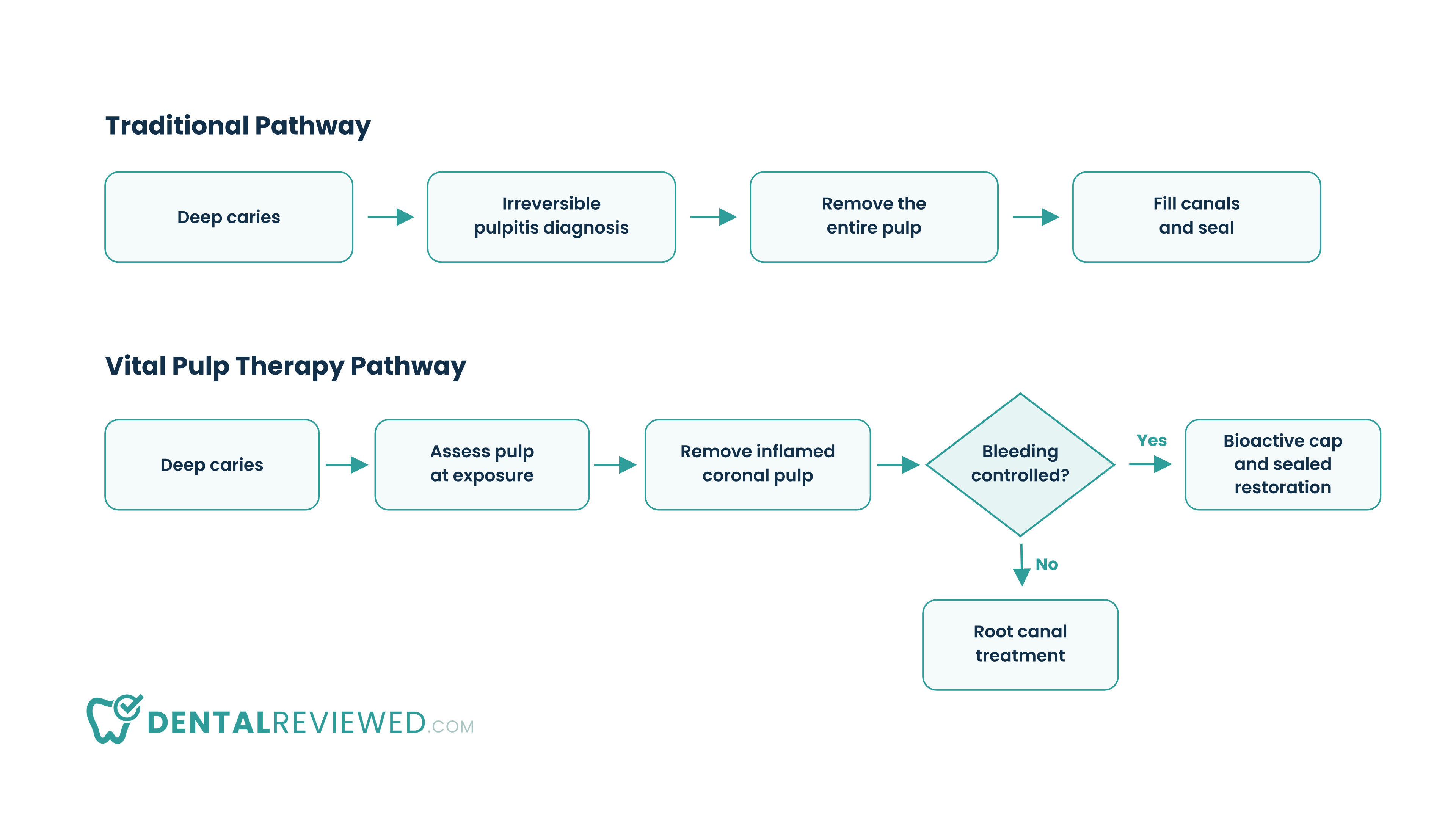
The decision point sits in the middle of the procedure. Clean, controllable bleeding suggests healthy tissue below. Bleeding that will not stop points toward deeper inflammation. Root canal treatment then becomes the safer path.
Why Did Calcium Silicate Cements Change The Outcome?
Older pulpotomy results relied on calcium hydroxide. A 2017 trial in mature molars showed how much the material affects outcome.
In that randomized trial, partial pulpotomy succeeded in 85% of MTA cases at two years. Calcium hydroxide reached 43%. Calcium silicate cements set in a moist field and release calcium ions. They seal the wound and support the formation of a hard tissue barrier over the pulp.
Why Is Biodentine Studied For Pulpotomy?
Biodentine is a tricalcium silicate cement made by Septodont. It sets faster than traditional MTA and handles more like a restorative material.
A 2022 meta-analysis in Scientific Reports reported 83% pulpotomy success in mature teeth with irreversible pulpitis. In that analysis, Biodentine outperformed MTA, calcium-enriched mixture, and calcium hydroxide. Premixed putties such as NeoPutty aim to simplify placement further. Direct head-to-head data in adults remain limited.
Who Might Be A Candidate For Pulpotomy?
Case selection decides most outcomes. The factors below come from the trial protocols and clinical reasoning, and none works alone. A patient cannot use them as a self-diagnosis checklist.
A mature permanent tooth with a carious pulp exposure
A vital pulp with no signs of necrosis
A restorable tooth that can hold a durable coronal seal
Rubber dam isolation that keeps the field clean
Bleeding that comes under control after tissue removal
Remaining pulp tissue that looks healthy
A patient able to return for follow-up and radiographs
A necrotic pulp, a sinus tract, or uncontrollable bleeding still calls for root canal treatment. The same applies when a sound restoration cannot be placed.
What Are The Potential Advantages Of Keeping The Pulp?
A living pulp keeps functions that a filled canal loses. These benefits are plausible and partly supported, and some remain unproven.
The pulp keeps its sensory response, which warns the patient of new decay or cracks. It also retains some capacity to lay down dentin. Less tooth structure is removed, since canals are not shaped. Early pain relief may be faster, as the 2026 meta-analysis suggested for day one.
Cost and time are often mentioned. A 2024 trial of full pulpotomy versus root canal treatment reported lower time and cost for pulpotomy. That is one trial in one setting. Fees vary widely, as the root canal cost breakdown by tooth and state shows.
Why Isn't Pulpotomy Replacing Root Canals Yet?
The evidence is promising and still young. Several open questions keep root canal treatment as the reference standard.
Case Selection Remains Imperfect
No chairside test shows how far inflammation has spread. Clinicians infer it from symptoms, pulp tests, and bleeding at the time of treatment.
The adult trial suggests bleeding is a better guide than preoperative grading. Even so, no agreed time limit for hemostasis exists.
Long-Term Data Are Thin
Most pulpotomy trials follow teeth for one to two years. A few report five-year results.
Root canal treatment has decades of outcome data across millions of teeth. Pulpotomy needs comparable long-term follow-up before it can claim equal footing.
Technique And Restoration Drive Results
Outcomes depend on steps that vary between operators. Isolation, caries removal, pulp assessment, material placement, and the final restoration all count.
A leaking restoration lets bacteria reach the pulp wound again. The coronal seal carries as much weight in pulpotomy as in root canal treatment.
Results Do Not Transfer Automatically
Many studies enrolled adolescents or a single molar type. Their results cannot be applied to every adult tooth.
The 2026 adult trial studied mandibular molars only. Maxillary molars, premolars, and older patients need their own data.
Is Irreversible Pulpitis Still Irreversible?
In part, the debate is about language. The term is a symptom-based judgment that the pulp will not recover on its own.
That judgment can still hold for the coronal pulp. The new evidence questions whether it applies to the whole pulp in every tooth. A tooth with classic nerve pain can keep healthy radicular tissue. The label may survive while its treatment implications narrow.
What Does The Research Mean For General Dentists?
The practical message is narrower than the headlines. Vital pulp therapy is becoming a studied option for selected mature teeth.
General dentists already see most deep carious exposures first. Offering pulpotomy requires a calcium silicate material and rubber dam for every case. It also takes time to judge bleeding carefully. A firm rule should trigger conversion to root canal treatment when the pulp looks unhealthy.
Documentation carries extra weight with a newer procedure. The chart should record the pulpal diagnosis, bleeding time, material, and restoration. A clear dental treatment plan should also list follow-up dates and the root canal fallback. Patients deserve to hear both options and the strength of evidence behind each.
The approach fits a wider shift toward minimally invasive dentistry. Referral to an endodontist remains sensible for complex anatomy, unclear diagnoses, or a failing pulpotomy. Follow-up radiographs, and CBCT when 2D images are unclear, help detect apical changes early.
What Happens Next?
The next few years should answer the open questions. Several research streams are worth watching.
First results from the NIH-funded national center
Longer follow-up from the 2026 adult trial
Head-to-head trials of pulpotomy and root canal treatment in adults
Agreed hemostasis time limits for case selection
Patient-reported outcomes and cost analyses
Biomarkers that measure pulp inflammation at the chair
Updated guidance from endodontic organizations
We will continue to update this article as new trial results and guidance are published.
Bottom Line
The pulpotomy vs root canal debate has new data and new funding behind it. A 2026 adult trial showed high two-year success for partial pulpotomy in mature molars. Bleeding control at the chair predicted outcome better than the pulpitis grade. The NIH is now funding research on everyday use. Root canal treatment remains the reference standard. For selected teeth, preserving the healthy root pulp is a credible option worth discussing with patients.
Frequently Asked Questions
Can adults get a pulpotomy instead of a root canal?
Some can. A 2026 randomized trial treated 139 mature molars in adults with a median age of 36. Suitability depends on pulp status, bleeding control, and restorability.
Is pulpotomy successful in permanent teeth?
Short-term results are encouraging. Trials and meta-analyses report high one- to two-year success in carefully selected mature teeth. Long-term data remain limited.
Can pulpotomy treat irreversible pulpitis?
In selected cases, yes. Several trials treated teeth with symptoms of irreversible pulpitis. Success depends on removing the inflamed tissue and leaving healthy pulp below.
What is the difference between pulpotomy and root canal treatment?
A pulpotomy removes part or all of the coronal pulp and keeps the root pulp alive. Root canal treatment removes all pulp and fills the canals.
Is Biodentine used for adult pulpotomy?
Yes. Biodentine has been studied in adults, including a trial of patients aged 19 to 69. Many Biodentine studies have enrolled children or adolescents, so the patient's age should be checked.
How long does a pulpotomy last in a permanent tooth?
Most studies follow teeth for one to two years, and a few report five-year results. Longevity depends heavily on the final restoration.