Nano-Hydroxyapatite 101: Particle Size, Remineralization, and What to Tell Patients
Hydroxyapatite needs little introduction to anyone who has looked at a histology slide: it is the calcium phosphate mineral that makes up roughly 96–97% of enamel and about 70% of...
Written by Agnes Markovic
Read time: 4 min read
Hydroxyapatite needs little introduction to anyone who has looked at a histology slide: it is the calcium phosphate mineral that makes up roughly 96–97% of enamel and about 70% of dentin by weight. What is newer is its arrival as an active ingredient in oral care, nano-hydroxyapatite in particular, and the growing number of patients who walk into the practice asking whether "HAp toothpaste" is a gimmick or a genuine alternative to fluoride.
TL;DR
Nanoparticles infiltrate lesions and occlude tubules. Micron particles polish the surface.
Fluoride catalyzes remineralization from saliva. Hydroxyapatite supplies the mineral directly.
Trials show nHAp matches fluoride for caries prevention and helps with sensitivity.
It's safe to swallow, so it suits kids and pregnant patients. High-risk patients should still stay on fluoride.
Nano vs. Micron: Why Particle Size Matters
Not all hydroxyapatite in oral care is the same material in any practical sense. The two sizes you will encounter are nano-hydroxyapatite (typically 20–100 nm particles) and micron-scale hydroxyapatite (tens of micrometers).
Nano-hydroxyapatite (nHAp) is the form most of the clinical literature examines. At 20–100 nm, particles are small enough to infiltrate demineralized subsurface lesions and adhere to the enamel surface, where they act as a reservoir of calcium and phosphate. The same size range lets nHAp particles occlude exposed dentinal tubules, which is the basis for its use in sensitivity management. Occlusion by deposited apatite is mechanically and chemically similar to the tissue it is protecting – one reason nHAp performs well in dentin hypersensitivity studies.
Micron-scale hydroxyapatite behaves differently. Particles this size do not enter subsurface lesions; they work at the surface, contributing to gentle cleaning and surface remineralization and serving as a slower-dissolving mineral depot. Some formulations combine both sizes for that reason: nano for infiltration and tubule occlusion, micron for surface effects.
When a patient asks "does the nano part matter?", the honest answer is yes – the particle size determines where the mineral can physically go.
Hydroxyapatite vs. Fluoride: How Remineralization Differs
Fluoride does not rebuild enamel with new mineral from the toothpaste. It works catalytically. It promotes redeposition of calcium and phosphate already present in saliva and converts the outer crystal layer to fluorapatite, which has a lower critical pH and therefore better acid resistance.
Hydroxyapatite works by a different, more literal route: it supplies the mineral itself. Deposited particles buffer the local calcium and phosphate concentration at the tooth surface, drive supersaturation in plaque fluid, and integrate into demineralized enamel as a biomimetic apatite layer. The result is chemically the same mineral the tooth is made of, rather than a modified surface layer.
There is also evidence beyond remineralization: hydroxyapatite particles bind oral bacteria in saliva and reduce their initial adhesion to the enamel surface, which may slow early biofilm formation – a secondary benefit fluoride does not share.
The clinical evidence base for nHAp has grown considerably in the past decade. Randomized controlled trials, including head-to-head caries trials in children and adults, have repeatedly found nHAp toothpastes non-inferior to fluoride toothpastes for caries prevention, as do meta-analyses.
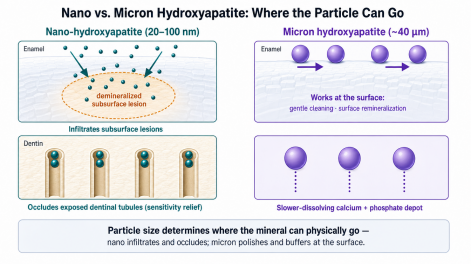
Diagram comparing nano-hydroxyapatite and micron hydroxyapatite particle size: nano particles infiltrate subsurface enamel lesions and occlude dentinal tubules. Micron particles work at the enamel surface as a mineral depot.
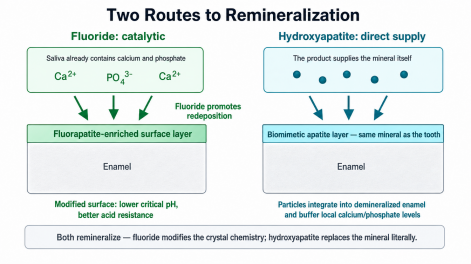
Diagram of hydroxyapatite vs fluoride remineralization – fluoride works catalytically on calcium and phosphate from saliva to form a fluorapatite surface layer. Hydroxyapatite supplies the mineral directly and forms a biomimetic apatite layer on enamel, with reported consistent benefits for remineralization of early lesions and reduction of dentin hypersensitivity. That does not mean hydroxyapatite replaces fluoride in every case; it means it has earned a place as a serious, evidence-supported option, particularly for patients who cannot or will not use fluoride.
Two practical points are worth passing on:
Safety on ingestion. Hydroxyapatite is a biocompatible calcium phosphate; swallowing it carries no fluorosis risk. This is why it is often the first recommendation for young children who cannot reliably spit, and for pregnant patients who want to avoid systemic fluoride exposure.
Don't rinse. As with high-fluoride pastes, the benefit depends on contact time. Patients should spit, not rinse, after brushing.
Formats: Pastes and Pure Powders
Most patients will use hydroxyapatite as a conventional paste, and formulation matters: concentration is rarely disclosed on the front of the tube, and the surrounding formula (abrasives, surfactants, thickeners) varies widely between brands.
A newer format worth knowing about is pure hydroxyapatite powder: 100% hydroxyapatite with no carrier formula at all. It is sold as nano-hydroxyapatite powder in a 60 nm grade for remineralization and sensitivity, and in a 40 µm micron grade for gentler surface polishing. Patients use it by dipping a wet brush, mixing it into their existing toothpaste, or applying it directly to sensitive areas. The appeal for a certain kind of patient is transparency and control: there is exactly one ingredient, and they decide how much of it they use and which particle size fits their goal (nano for remineralization and sensitivity, micron for surface polishing).
For clinicians, powders are also a useful adjunct recommendation: a patient can keep their preferred fluoride paste and add a hydroxyapatite step, rather than switching products entirely.
What to Tell Patients
When patients ask about hydroxyapatite, a five-point summary covers it:
It is legitimate. nHAp is one of the best-studied fluoride alternatives, with RCT support for caries prevention, remineralization, and sensitivity relief.
Particle size matters. Nano-scale particles infiltrate lesions and occlude tubules; micron-scale particles work at the surface. Check which one a product actually contains.
It is not an excuse to skip fluoride where fluoride is indicated. High caries-risk patients on prescription fluoride should stay on it; hydroxyapatite can be layered on top, not swapped in.
Technique still decides outcomes. Twice daily, adequate contact time, spit, don't rinse, and the mineral needs a clean surface to bind to — brushing technique and interdental cleaning still do the heavy lifting.
Safe to swallow. For children and pregnant patients, that is often the deciding factor.
Bottom Line
Hydroxyapatite is not a trend that will pass. It is the tooth's own mineral finally being used deliberately. Understanding the particle-size distinction and being able to explain it in one sentence at the chair is the fastest way to turn a patient's internet question into a good clinical conversation.
This article is for informational purposes only and does not constitute medical advice. Always consult with qualified healthcare professionals for diagnosis and treatment recommendations specific to your situation.
Frequently Asked Questions
Is nano-hydroxyapatite as effective as fluoride?
For caries prevention, randomized controlled trials have found nano-hydroxyapatite toothpastes to be non-inferior to fluoride toothpastes, and they perform well in remineralization and sensitivity studies. High caries-risk patients on prescription fluoride should stay on it; for everyone else, nHAp is a legitimate primary option.
What is the difference between nano and micro hydroxyapatite?
Size, and therefore reach. Nanoparticles (20–100 nm) infiltrate demineralized subsurface lesions and occlude dentinal tubules; micron particles (tens of micrometers) stay at the surface, where they polish gently and act as a slower-dissolving mineral depot. Neither is "better" – they do different jobs.
How much hydroxyapatite does a toothpaste need?
Most clinical trials used pastes with around 10% hydroxyapatite, but commercial products rarely disclose their concentration, and formulas vary widely. This is one argument for the pure-powder format: with a single-ingredient powder, there is nothing undisclosed, and the user controls the dose.
Is hydroxyapatite safe to swallow?
Yes. It is a biocompatible calcium phosphate, the same mineral family as teeth and bones, and carries no risk of fluorosis. That makes it the usual first recommendation for young children who cannot reliably spit and for patients who want to avoid systemic fluoride exposure.